
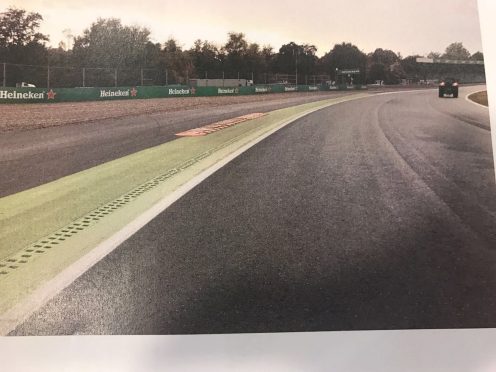
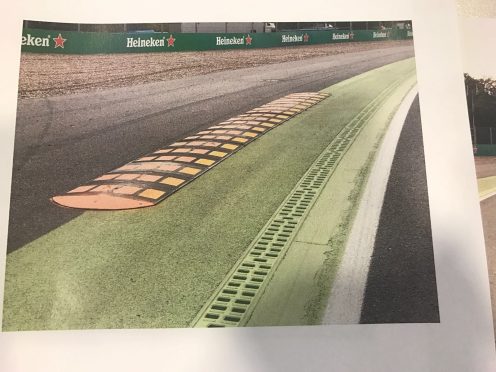
Following a lengthy drivers meeting yesterday, an additional kerb has been added to the exit of Parabolica for this weekend’s Italian Grand Prix.
With drivers using the excess run-off at Parabolica to obtain a better drive onto the start-finish straight, it was agreed to add an additional kerb to dissuade competitors from going too far off track during sessions.
© FIA.
© FIA.

© FIA.
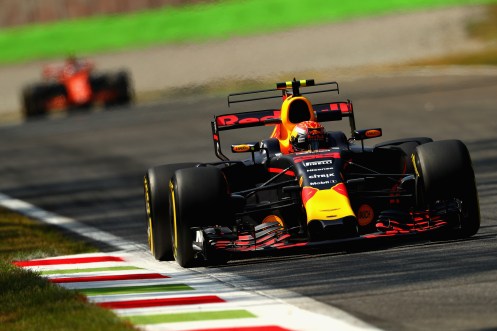
MONZA, ITALY – SEPTEMBER 01: Max Verstappen of the Netherlands driving the (33) Red Bull Racing Red Bull-TAG Heuer RB13 TAG Heuer on track during practice for the Formula One Grand Prix of Italy at Autodromo di Monza on September 1, 2017 in Monza, Italy. (Photo by Clive Rose/Getty Images)
On paper, Red Bull’s pace in yesterday’s free practice sessions at Monza looks set to cast the Milton Keynes team into a lonely battle for 5th and 6th.
But a range of penalties – due to mechanical maladies – means Daniel Ricciardo and Max Verstappen may have far more interesting races than originally expected.
Come tomorrow’s Italian Grand Prix, it is likely that Ricciardo and Verstappen will take up positions on the final two rows of the grid.
The habit of penalising drivers who utilise more than four elements of their power unit struck Red Bull, rendering Ricciardo’s and Verstappen’s efforts rather mute – although for pairing, there is still something to look forward to, as the Australian Ricciardo relates. ‘Even though I’ve got the penalty I’m actually excited for tomorrow and the race on Sunday, knowing we’ll start at the back we have a chance to have a fun race. Of course it’s disappointing knowing that the chance of a Monza podium is unlikely, but the chance of a fun race is there.’
Alas there is an issue for the duo – and that is an oft-ineffectual Renault power unit, that is down on power (compared to Mercedes and Ferrari at least) and unreasonably frail should your name be ‘Verstappen’. Red Bull’s Class A chassis design – a given for the most part – is clearly an effective machine on circuits where medium-to-high speed cornering is a premium, but there is little of that at Monza. ‘It is hard for us on this track with the long straights, which we have to combine with a very low-downforce setting,’ Verstappen explains. ‘We just try to make the best of it. We will start the race a bit further back with the penalties but hopefully I can enjoy overtaking a good number of cars on Sunday.’
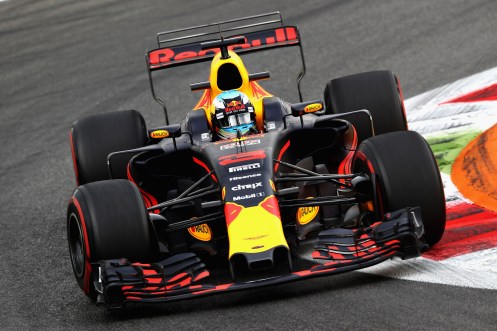
MONZA, ITALY – SEPTEMBER 01: Daniel Ricciardo of Australia driving the (3) Red Bull Racing Red Bull-TAG Heuer RB13 TAG Heuer on track during practice for the Formula One Grand Prix of Italy at Autodromo di Monza on September 1, 2017 in Monza, Italy. (Photo by Mark Thompson/Getty Images)
But they knew that long beforehand and while the collective penalties for Red Bull comes to 35 places (20 for Ricciardo and 15 for Verstappen), it makes sense to sacrifice grid position for a race where potential and expectation is already at a minimum. ‘It makes sense to take the penalties here as this track is already not that good for us, Singapore is better for our car so we don’t want to risk anything there,’ continues the young Dutchman.
Ricciardo adds. ‘I expected this a few races ago so at least I was prepared, however I’m excited for the chance to pass a few people on Sunday.’
Ricciardo was keen to emphasise that the RB13 is relatively competitive and only requires minor adjustments, but with a dry race expected, Red Bull will do well to collect take points home from Monza.
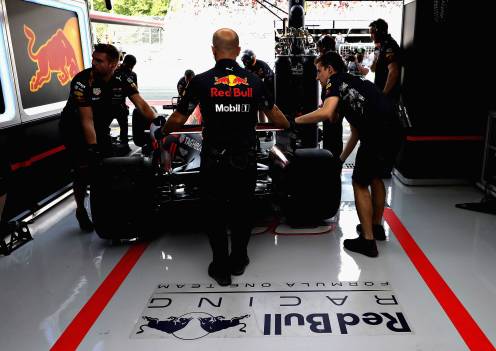
© Red Bull Content Pool.
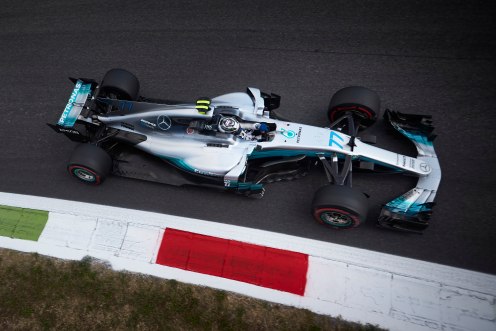
Großer Preis von Italien 2017, Freitag – Steve Etherington. © Daimler AG
Mercedes dominated the free practice time sheets at Monza on Friday, but on hot and fiercely humid day, it was easy to see Ferrari prowl.
Instability seemed to be the word of the day for many drivers. For some, it was an issue cured as the day aged; for those with more sensitive machinery, there was little hope for sympathetic drivability.
Of course, those toward the front of the order enjoyed the best of things – that is not a shock – inherent stability and performance is often what gets a good team to the front whatever the whether.
And “whatever the weather” was a saying latched to the tongues of many in the paddock all through Friday. Through the build-up, the weather forecast looked – and felt – truly wretched.
Yet beyond a light sprinkling in the latter stages of FP1, the day remained very dry, as Mercedes’ Valtteri Bottas explained. ‘It was nice that it stayed dry today. All the forecasts said that the rain could affect the running and we could have limited running before qualifying and the race in the dry. But we got our full plan done. In FP1 we were actually ahead of the plan because we were still worried about the weather.’
This was a story that was repeated up and down the paddock. Eventually it wasn’t until just after the final support series action of the day that the rain came, and it is only then that one is reminded that Monza rain can be ferocious.
The kind of downpour that belatedly arrived would have brought out red flags – especially in modern motorsport, where risk and peril is measured on a scale against court-ruled damages.
Meanwhile, back to Valtteri. Having set the fastest time of the day in FP2, the Finn was delighted that his weekend was back on track following a stumble in the opening session. ‘Initially in FP1 we went slightly in the wrong direction with the set-up, but we managed to change it around for FP2 and the car felt a lot better.’ Although this is only practice and that the real meat comes on Saturday and Sunday, Bottas is keen to avoid a repeat of Spa, where anonymity cast him adrift of teammate Lewis Hamilton and championship leader Sebastian Vettel (Ferrari).
Hamilton, meanwhile, was one of the few that enjoyed clean Friday running, so while he may have dropped to 2nd in FP2, Hamilton has been around long enough to know that this is only the small game. ‘It’s been a good day, a clean day,’ he said. ‘We got the running done, we got through our programme with no problems. The car seems nicely balanced here. We just have some work to do to eke out a little bit more performance.’ Like at Spa, the Briton knows rivals Ferrari are close, as the demons of Silverstone was washed away.

GP ITALIA F1/2017
© FOTO STUDIO COLOMBO PER FERRARI MEDIA (© COPYRIGHT FREE)
But Monza is not Spa or Silverstone. It’s ‘lonnnnnng straight; tight chicane; lonnnnnnng curving right-hander; tight chicane; short chute-fast right-short chute-fast right; lonnnnnnnng straight; fast chicane; lonnnnnnnng straight; lonnnnnnng curving right-hander; lonnnnnng straight’ format renders it a very different prospect to almost anything on the calendar today.
This will be, as is common in modern Formula One, the fastest race of the year.
Yet despite closing up on the Mercedes in FP2, Vettel was… unconvinced about Ferrari’s potential, with the German complaining of a lack of stability and balance in the low downforce SF70H machine. ‘Today has been a mixed day and I hope tomorrow is going to be better,’ Vettel said. ‘This afternoon for the first part of the session we mostly used Soft tires, but I am not entirely happy because we had a mixed run with a lot of traffic and the Virtual Safety Car period. Overall, we should have enough data to go through now. If we can improve a couple of things tomorrow, then it should be better.’
And Ferrari do need to be better. Whereas it is generally accepted that Ferrari have shown more muscle at medium-to-slower layouts, Mercedes have been the strongest on faster layouts like Monza, as Vettel admits. ‘Mercedes has been strong here during the last couple of years but we focus on ourselves. We try to improve the car because there’s still a little bit missing and then we’ll start from there.’
While it will be necessary to score high where one is strongest, this championship will likely be decided by a team’s performance at their weakest tracks.
A victory on merit for Vettel and Ferrari at Monza would not only extend his championship lead, but also strike a blow against Mercedes on a layout where they are perceived strongest.
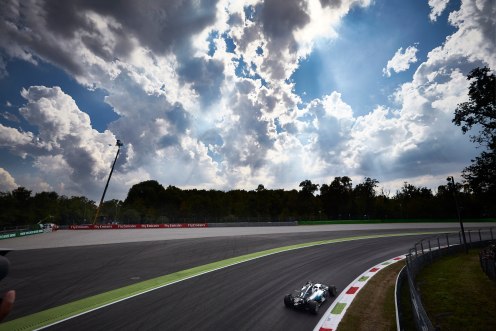
Großer Preis von Italien 2017, Freitag – Steve Etherington. © Daimler AG
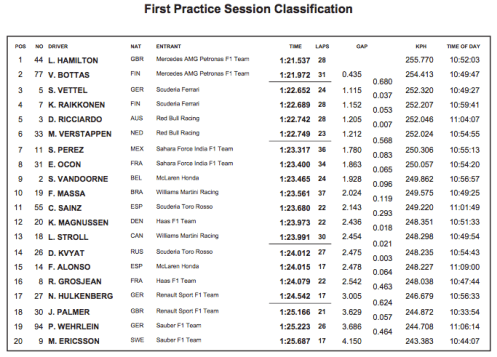
FP1 Classification. © FOM
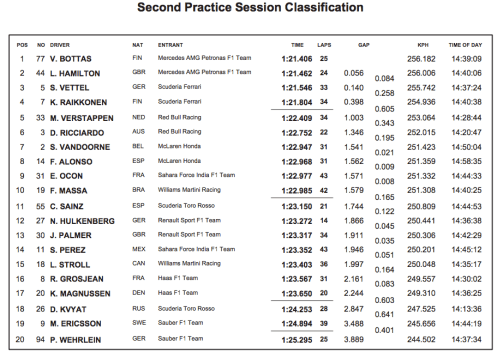
FP2 Classification. © FOM
This weekend’s Formula One Grand Prix in the Royal Park of Monza will no doubt be an interesting one for followers of the sport.
With Mercedes racer Lewis Hamilton chasing down Sebastian Vettel and his Ferrari, this is the race upon which the 2017 world championship may well spin.
There will be much talk about Mercedes’ decision to introduce their final engine specification of the year, just as the FIA tighten the rules regarding oil burning in the combustion chamber, but that is a discussion for a different time. All that can be said is that the silver-and-turquoise team have played a canny hand, which may deliver the crown.
This Grand Prix will also mark the first time since the 2014 Abu Dhabi Grand Prix that I have covered Formula One on site. There was no intention for this gap to go for such a long time – indeed, I fully expected to be in Sepang in 2015, but for various reasons, that fell through. It has taken thirty-three months, and I am looking forward to seeing what has changed.
When last in F1, Bernie Ecclestone was still running the show and while materially, very little has changed under the stewardship of Liberty Media – they are very limited in what can be done until various contracts come up for renegotiation – I will be keen to find out if the atmosphere has changed.
Following a rather trying situation with a publisher of very questionable repute come the end of 2014, if it had not been for the help of the wonderful Sam Collins and Andrew Cotton at Racecar Engineering Magazine, it is quite likely that I may have had no choice, but to throw in the towel two years ago.
In the meantime, there has been support from and work with the likes of Kate Walker, Kevin Turner at Autosport and a later foray into televised motorsport commentary with Dave Richardson and Chris Hartley on ITR’s DTM and Formula 3 package. In another turn, I will be making my Super GT commentary debut in October for the series’ penultimate round – alas not from Thailand; that would be too much to ask.
For this, I can only thank all of the above.
Paid work in motorsport can be pretty hard to find and it has pleased me no end that those that have worked with me in the past two-and-a-half years have been fair and I hope that the work supplied has been well received by readers.
This weekend, I will be working with Crash.net to bring coverage of the Italian Grand Prix; hopefully it will an interesting and exciting event – although not too exciting, as a plane home needs to be caught on Sunday night.
These events allow me to earn a reasonable extra amount of extra income – just enough to put money aside for a house deposit in London (!) and make reporting my tax return irritating, but very necessary. Still work needs to be done and I will be back in the office for the daily job at 8am Monday morning.
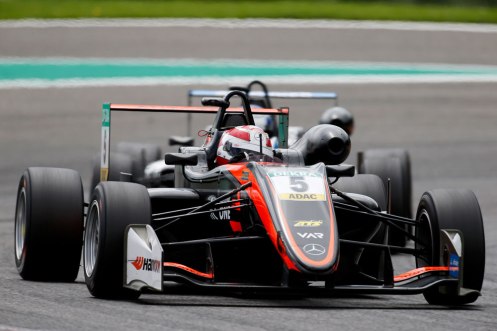
© Thomas Suer / FIA European F3 Championship
This piece was initially written in May for a run in a print magazine; however unfortunately was not published at the time. While things have moved on slightly as teams have gathered greater understanding of the aero updates, much of it is still relevant and worthwhile.
Without wishing to get too far ahead, I may soon be able to tell you more about the new-for-2018 Formula 2 car and engine package.
FIA EUROPEAN FORMULA 3 TECH UPDATE (May 2017)
Since our last Formula 3 technical update, there have been numerous sweeping changes to the F3 regulations. As budgets have risen to approximately €700,000-750,000 per season for a top drive (not including the Macau Grand Prix), teams have either struggled to find drivers or have simply resigned altogether.
With the aim of cutting costs, the FIA have outlawed individual windtunnel testing by teams, with the chassis manufacturer completing aero development work and delivering performance updates to the teams. The first result of this update came earlier this year in testing, when Dallara delivered a new package, which included a front wing with new endplates and outer front wing flaps; a new rear wing with an adjusted profile endplates and a new floor and diffuser designed to increase downforce and reduce drag. This has also increased the weight of the car by 15kg.
According to front-running one team principal, ‘the new floor has eased the instability at the rear of the car that the previous version had, making it easier to accelerate out of corners.’ The team boss also felt that this should help the field close up, as the new stability allows “lesser able” competitors find to get on the throttle much quicker on corner exit, with reduced risk of the back end stepping out.
There have also been safety modifications to the Dallara F317. The nose box has been pushed slightly back and the nose itself lowered to prevent cars getting airborne, while the front impact structure has been updated, resulting in an increase of the impact energy absorption by about 25 per cent. In line with Formula One safety regulations, additional secondary U-shaped intrusion panels have been added to the sides and bottom area on the front of the car.
The survival cell of the monocoque has been fitted with additional padding to protect drivers’ legs and wheel tethers have been upgraded to sustain forces of up to 6kJ instead of 4kJ, to further minimise the risk of wheels getting detached from the chassis in case of a crash. There will also now be data sharing between the teams, as the series aims to equalise opportunities for drivers in a category that has been won by a Prema Powerteam pilot every year since 2011.
According to Prema Powerteam racer Callum Ilott, the car which already had a reasonable amount of downforce now has even more. Ilott added, ‘the front wing is more efficient – this is noticeable – particularly this is coming from the end plates, while the new diffuser has improved the car.’
The teenager also noted that the weight increase of the car exaggerates the handling, amplifying the feel of oversteer. Ilott concluded by saying, ‘these are very small changes though – it doesn’t feel like a step change in handling. The effect overall on the car in the feeling is small but it has had the effect of closing the gap between all the teams at this point in the season.’
While the modifications are impressive, there have been some quiet criticisms regarding the cost of the complete update package, with comments that any savings made by windtunnel ban have been largely negated by the additional spend on the performance and safety update kit. The aforementioned team boss told me of a round figure of €45,000 or higher for the new kits, depending on how much a given F3 car needed to be updated. Personnel limits have also been placed on the teams, although it is believed that this likely mostly affected the likes of Hitech GP and to a lesser extent van Amersfoort Racing.
The European Championship has been reduced to five teams running nineteen drivers (as of the season opener at Silverstone) and while there have been rumours that British teams Fortec and T-Sport would re-enter should the right driver with the right budget appear, it is still the smallest field since the European Championship’s rebirth earlier this decade. Alas as it stands, both teams are currently stuck with cars in 2016 chassis configuration in their factory’s.
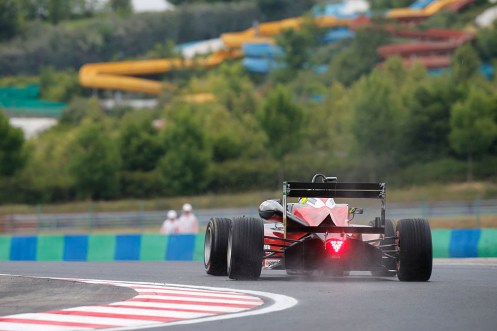
© Thomas Suer / FIA European F3 Championship
‘What are your expectations for the season ahead?’ (or variations thereof).
It is a question that I despise and there are certainly better ways of asking it, but no matter what, it is a very clumsy query that make me curl up inside.
Season preview guides are often vacuous efforts, that recall past results and testing form mixed in with polite, but empty quotes from drivers keen to stick to directionless soundbites.
Rather than trying to get the driver to say s/he will win the title – they all want to do that and secretly believe that they can – the question should be more or less designed to try to get a driver to measure and discuss the competition and whom they think their rivals may be.
As an aside, these questions also open the window slightly to understanding the depth of the talent pool in any given championship.
For example, one might argue that despite the lower driver count this year, the European Formula 3 Championship possesses a nice pocket of talent, with Joel Eriksson, Maxi Günther and Lando Norris swapping race victories and podiums as they fight for the title.
Each one of those drivers is backed by a manufacturer – BMW, Mercedes and McLaren respectively – and they are delivering on that promise in a tight and aggressive campaign. On the outside of that Callum Ilott, who may need some luck to bring him back into the hunt, but he has performed well.
On the other hand, one could also examine the newly re-instated Formula Two Championship, currently led by the Ferrari-supported Charles Leclerc by a very healthy margin.
Beyond that, it thins out quickly. While RUSSIAN TIME’s Artem Markelov and DAMS duo Oliver Rowland and Nicholas Latifi – the latter also both Renault backed – are reasonably quick, they also have a habit of inconsistency.
Across from Leclerc, his Prema Powerteam stablemate, Antonio Fuoco, has been roundly beaten by the Monegasque driver, but that is of little surprise.
Underneath it all, Leclerc has the potential to be a very special driver, all the while much of the rest of top ten is filled out drivers who have been around for too long and achieving very little.
So if I were to ask Leclerc to measure the Formula Two field, I would (firstly) expect a very diplomatic non-answer, but it would not surprise me if the list of true challengers was very small. This is by no means a slight on Rowland, et al., but rather underlining that Leclerc has been in a different league.
Whereas Leclerc will almost certainly be in Formula One next year, I am not convinced anyone else in the Formula Two field possesses that quality. Lots of good quality drivers with professional careers ahead of them, but just not F1 talents…
Conversely, it is unlikely that anyone will care or notice who takes this year’s World Series Formula V8 3.5 crown, because the field is both poor and small.
On paper, the FV8 3.5 presents a thrilling battle with six title protagonists covered by less than one race win with only three rounds to go, but it is difficult to get excited when we are talking of Rene Binder, Alfonso Celis Jr., Pietro Fittioaldi, Matevos Isaakyan, Roy Nissany and Egor Orudzhev.
If one were to ask any of these drivers who their potential competitors were, the list may well be longer in order to compensate for the closer gauge of talent. The only surprise about FV8 3.5 is that Yu Kanamaru has not been more potent.
In the end, I suppose it is the concept of value that is in question. Is a hard fought Formula 3 title, in which the victor fends off numerous competitors more valuable than a Formula 2 crown where the winner pisses all over the field?
When initially I examined Formula 2 and Formula 3 this year, my expectations were thus: Leclerc would win the F2 Championship, the only question being by how much; I couldn’t decide the European F3 Championship victor between Günther, Eriksson and Ilott.
Admittedly, I expected Norris to win numerous races, but am very impressed with his performance – against tough opposition, he has at this stage delivered beyond what I thought he would.
GP3 is turning out almost as I thought, with Russell being chased by Jack Aitken, but it would not surprise me if Russell took the eventual honours. He may be just a little better in the long run. As an aside, it does surprise me somewhat that Anthoine Hubert and Nirei Fukuzumi are running them as close as they are.
The annoying aspect of both Formula Two and GP3 is the mere existence of partially reverse grid races, which should never exist at this level of motorsport. Designed to aid midfield drivers not necessarily good enough to do the job in the first instance, these gimmicks do have a habit of artificially boosting a competitor’s position in the standings {note 1}.
There is a skill to getting the feel and set-up of the car just right through practice and registering a best grid slot as possible in qualifying, before securing the best possible result in the race – only to be artificially ‘given’ 8th on the grid for Sunday morning’s points paying race. It brings to mind Stefano Coletti who over a period of several years won seven GP2 races – all of them from reverse grid situations.
And it matters because these elements affect championship positions, upon which superlicence points are collected and a possible Formula One race licence is awarded.
It is doubtful that when a driver is asked who his potential challengers are, s/he will be thinking of the racer who drove to 8th place on a Saturday afternoon…
{Note 1}
The closest example to my head in which a driver was propelled into a championship contention is when Felix Serralles found his way in the hunt for the 2012 British F3 title thanks to big scores in reverse grid races at Monza, Brands Hatch, Norisring, Silverstone and Donington.
Jolyon Palmer has been on the receiving end of plenty of criticism in 2017, but would replacing him for the remainder of 2017 be in Renault’s best interests?
It wasn’t meant to be quite like this for Jolyon Palmer. Now in his 2nd season in Formula One with the works Renault team, the Englishman is rooted to the bottom of the standings, having not registered a point yet in 2017.
Meanwhile Palmer’s teammate, Nico Hülkenberg, has clocked up 26 scores amidst several impressive runs in the top ten. On the surface, Palmer has been wiped off the table this year and although Renault management have assured the Englishman that his seat is safe for the rest of 2017 – beyond that, Palmer’s future is weak. Palmer needed that reassurance to help bolster confidence, but with each non-score, the threat still lingers.
In the opening half of the year, there was so much comment regarding Palmer’s place in the Renault team, that it is likely to have provided a distraction. With potential suiters lining up to replace him at every Grand Prix, Palmer has been living close to the axe – a situation not helped by the re-emergence of Grand Prix winner Robert Kubica in recent months.
At the beginning of this season, team principal Cyril Abiteboul set a target for 5th in the Constructor’s Championship and following a disastrous season last year – Renault effectively inherited an under-developed 2015 Lotus – the French marque are slowly climbing up the order and currently sit 8th in the standings.
There is little doubt that Palmer – and to a lesser degree Hülkenberg – have been blighted by poor reliability this year, thanks mostly to an evolution of the Renault hybrid engine, which has been quicker but more likely to choke on itself. The nadir came at Silverstone, where for Palmer’s home Grand Prix, a car failure ensure he did not even take the start. Whatever one thinks of his performances, the continued loss of running in a number of practice sessions this year has hampered Palmer’s development.
Yet when he has run, the 2014 GP2 champion has still fallen short of expectations. In Hungary, Palmer qualified a reasonable 11th, but was eight-tenth shy of his teammate. It was a similar gap to Hülkenberg in Silverstone and Montreal, which extended to nine-tenths in Monaco. In Barcelona, Melbourne, Red Bull Ring, Shanghai and Sochi, Palmer never even made it out of Q1, while in Baku he never had an opportunity to run, thanks to a technical issue.
The highlight has been a visit to the top-ten shoot-out in Bahrain, but for both Renault’s, the French marque has struggled to maintain that pace during Grands Prix. That Hülkenberg has still managed to score 26 points is a testament to his heightened level of performance this year.
Yet while Palmer has not delivered close to Hülkenberg’s level, it would have been a mistake to replace the Briton mid-season. Renault’s late return to Formula One for the 2016 means the Enstone-based team is very much in rebuild-mode and at this time, stability – even if it is short-term – is a desirable commodity. But Palmer still needs to score and by providing some stability and putting rumours to bed, the Briton may return after the summer break more at ease.
Kubica’s recent evaluation at the Hungaroring was with 2018 in mind and in their reserve and young driver’s – Oliver Rowland, Nicholas Latifi and Sergei Sirotkin – Renault do not immediately possess an abundance of extraordinary talent that could leapfrog the team further up the table. Earlier this year, there were rumours that Carlos Sainz or Esteban Ocon could move over from Toro Rosso or Force India, but neither of those moves was ever truly on the cards.
At this stage Haas are only three points ahead in 7th, with Toro Rosso and Williams a further ten and thirteen in front respectively. With the (Renault-powered) Toro Rosso hitting something of a development wall and the Ferrari-partnered Haas’ inconsistency, it is not inconceivable that Renault may still snatch 6th as the season winds down and development funds continue to trickle in. Williams, with their Mercedes power unit package, may be more difficult to catch, and good results at fast circuits such as Spa-Francorchamps and Monza (amongst others) may take them beyond Renault’s still frail unit.
Would dropping Palmer for another competitor be enough to make up the deficit? It seems unlikely when one considers the most likely replacements on offer.
As Abiteboul stated at Silverstone, Palmer’s seat is safe for the rest of 2017, but beyond that it is difficult to see where he could end up. Realistically, Palmer is going to have a difficult time finding a race seat in Formula One come the end of this season and he could very well join the lost list of drivers who were good enough to drive Formula One cars, but not good enough to take them to the next level.
By favouring stability in the short term, Renault have made a smart decision for this year, but Palmer may not be starring in their future plans.
Just like at an FIA GT World Championship qualifying race at Silverstone in 2011, Sebastian Vettel showed why hot-headedness, a racing car and hand gestures are not common or advised behaviour in top-level motorsport.
In the Silverstone situation, an angry Stefan Mücke (Young Driver Aston Martin) – recovering after a clash with JRM Nissan’s Richard Westbrook – drew alongside Westbrook on the Hangar Straight and was giving it all with his hands, when he lost control and smashed into the side of Westbrook.
Mücke was lucky. He was kicked out of the event and was reported to the DMSB (German motorsport governing body) for a possible ban on his licence; however this was not followed through. It was incident that captured eyeballs in the world of motorsport, but given GT racing’s small audience, it barely stretched beyond the specialised motor racing press.
But it was not a deliberate action, unlike Dan Ticktum’s ramming Ricky Collard at an MSA Formula round at Silverstone in 2015 or Pastor Maldonado’s swipe at Lewis Hamilton at Spa-Francorchamps some year’s earlier. This was more an act of utter stupidity by a very good and accomplished driver who should have known better and while it did not kill Mücke’s career, it certainly damaged his reputation in the eyes of many in the sport. Westbrook, for his part, emerged from his car, wagged his forefinger at Mücke and returned to the paddock…
Vettel’s action against then race-leader Hamilton during lap 19 of yesterday’s Azerbaijan Grand Prix seemed to fall under a similar umbrella. Feeling aggrieved by Hamilton’s actions behind the safety car, Vettel decision to draw up alongside Hamilton and gesticulate with the Briton, resulting in a loss of control and a clash with the Mercedes was a stupid, misguided, indefensible, moronic, arse-about-ways error.
What Hamilton may or may not have done to provoke Vettel is completely irrelevant – Vettel’s act was inexcusable and comes at a time when he once again let his emotions get the better of his extraordinary talent and ability.
That the Ferrari man got away with just a ten-second stop/go penalty also reflected poorly upon the stewarding of this meeting – a penalty awarded for “dangerous driving”, yet the penalty itself was so soft as to be a cushion on a brick chair. There are protocols available that allow for drivers to receive a black and white flag and even a black flag if necessary and Vettel’s conduct fell in the latter category.
It seems inexplicable that Vettel was not excluded from the event and placed under referral, but that would potentially have harmed the championship show and we cannot allow that to happen, can we?
The incident and the resultant penalty blurred the line between acceptable behaviour and dangerous driving and in this, Vettel has been very fortunate.
Pascal Wehrlein is a reasonably tall chap.
Maybe not overly so in the grand scheme of the human race, but in the realm of racing drivers, he is quite tall.
Upon meeting, he would stand not too far shy of my 6’1” frame, whereas a great many racers fall somewhere in the 5’6”-5’8” region. And this was before his hair got ‘bigger’, as is now the case at Sauber.
Associates of Pascal told me at the time that he was a huge Lewis Hamilton fan and had adopted Lewis-esque diamond-ish stud earrings that the then-McLaren driver had debuted around that time. All apparently though, because getting Pascal to talk about this – or anything else for that matter was bloody difficult; something that became abundantly clear at a very hot Norisring in 2012.
For the most part, I was still mainly covering British F3 that year, but the future of the series was looking very bleak and indeed, the original British F3 would finally collapse in 2014 with a paltry five drivers participating. In an effort to broaden my potential and build relationships, it seemed best to take on a couple of rounds of the Euro Series (the predecessor to the European Championship), which partnered with British F3 for a few rounds during the 2012 season.
As noted, Norisring was hot. Very hot. Very bloody hot, but upon leaving my London flat at 3.30am to make way to the Stansted Airport, the late-June weather was rather cool and so it seemed appropriate to throw on a jumper and pair of heavy black jeans to get me through the first leg of the weekend. It probably would have been a good idea to check the weather forecast ahead of me, as by the time I had arrived at Nuremberg, it was be 39°C and insides were beginning to melt and smell like cheap cheese.
The heat is made somewhat worse as the Norisring and the old structures around it were seemingly built from several tonnes of smooth and shiny concrete, the kind that loves to absorb here on a warm day and fry those who stand upon it.
Having just climbed out of their cars following Friday practice, Formula 3 Fortec racers Pipo Derani and Félix Serrallés looked me up and looked me down, with Derani first to comment: “what the hell are you doing in those clothes, man?” The red-and black striped jumped having this stage clung to skin was not budging for anything… Serrallés, meanwhile, gave me a pitying look and sniggered a little.
That year’s Norisring round is best remembered for a pair of collisions that saw Daniel Juncadella collide first with Wehrlein and then later with Raffaele Marciello, dropping Wehrlein to 7th, while ultimately ending Marciello’s race. In the aftermath, Juncadella was disqualified from the race for his actions.
However as Juncadella was disqualified for breaching sporting regulations, the race director had the option to merely scratch the Spaniard from the result, but actually promote anyone else in his place – something that would have been required had a technical infringement been spotted. This meant that the having come home as runner-up, Will Buller became the highest-placed finisher, yet was not promoted to the winning spot despite Juncadella’s exclusion. And so, the race had no winner [note 1]
Rounding the far side of the makeshift media centre in the large indoor hockey court a short while later, I received an eyes-to-the-sky look from photographer Stella-Maria Thomas, before Wehrlein emerged from a temporary race control cabin. “Oh, this will be load of fun”, I thought to myself, but attempts to speak to him didn’t really get me anywhere. For a moment, one would bumble through a question or two, like an injured athlete limply trying to hop a hurdle, but it was impossible to shake. The major problem being, at this point in his life, Pascal could not really speak much English. At all.
And as I tripped through a query relating to an incident that happened during the race, I could only see Pascal’s brow stress, as his eyes widened into a large open glare and I know that in his head, he was probably thinking, “Ich habe keine verdammte Idee, wovon du redest…“
Pascal is still very young of course – already a DTM champion and now in his 2nd season in Formula One – and it hurts my brain that he is still only 22-years-old. Although I have not seen Pascal since last year since a brief meeting at a press conference last year, the young man does seem to be maturing a touch, although it has been said that he does carry something of an arrogant touch from time-to-time.
A racing driver? Arrogant occasionally..? Nawwwwww……..
Note 1
The exclusion of a driver without promoting from below is not a new regulation by any stretch of the imagination, and in fact, goes back to the 1983 Brazilian Grand Prix. Following a botched pitstop, which included a fire, Williams’ Keke Rosberg finished 2nd in that year’s race at Rio, but was later excluded due to receiving a push-start in the pits – a decision that proved very controversial at the time.
While this rule large been forgotten, it still goes get dragged out on occasion by the DMSB (Germany’s moto racing governing body), but I have seen it used a few times at the Norisring, but nowhere else. A few years ago, DTM race winner Mathias Ekström was excluded when it was deemed his father had interfered with Ekström’s race suit in Parc Fermé by pouring water down his leg, while his son celebrated with mechanics.
A few years earlier, in a another Formula 3 round (this time the Euro Series), Stefano Coletti was excluded from the entire Norisring weekend after he punched race winner Jules Bianchi in the face, after Bianchi apparently insulted Coletti in the cool down area behind the podium.
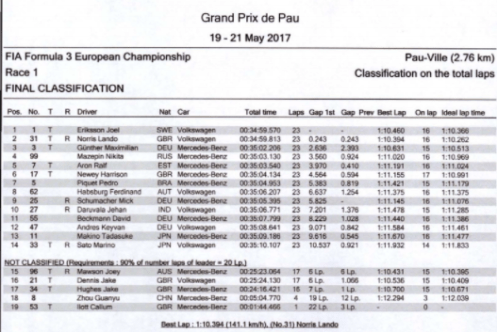
Maxi Günther claimed the 76th Grand Prix de Pau this afternoon, but only after early leader Lando Norris crashed out.
Prema Powerteam’s Callum Ilott trailed home in 2nd place, challenged by Hitech GP Ralf Aron to the flag.
For the first eighteen of the twenty-eight laps, the race was all about Norris. Having suffered from repeated poor starts this season, the Briton cut across the front of Günther as the lights went out, and eased into a dominant lead.
Indeed Ilott’s first lap was such; he pulled a 1.2s gap on the opening tour, which had then extended to 4.2s by the end of the eighth lap. The race was neutralised by the safety car a lap later when David Beckmann crashed on the Allée Alfred de Musset, while pressuring Guan Yu Zhou for 14th place.
The safety car brought Günther back into play when the race restarted on lap 11, but only for a moment, as once again Norris sprinted away, building a gap of nearly 3.0s by the turn of lap 18.
It was not to be for Norris, who crashed out at Foch on the nineteenth tour after his suspension gave way, causing him to lock up on entry, hitting the barrier front on.
From there, Günther drew a gap to the chasing Ilott, holding at approximately 2.0s until the flag, where he secured his 2nd win of the day and the season. It is a result that propels him to 3rd in the championship – just two points behind the tied Norris and Joel Eriksson – and gives him the prize of the 76th Grand Prix de Pau.
Ilott kept a feisty Aron at bay for much of the race. Initially the Prema Powerteam man had Harrison Newey (van Amersfoort Racing) and Eriksson on his tail, only for Aron to push his way passed both when Eriksson attempted a move on Newey on lap 11.
From there, Aron kept the pressure on Ilott, but his challenge began to fade in the final few laps, as the Estonian solidified his first podium of the weekend.
Newey and Eriksson followed home in 4th and 5th respectively, while Ferdinand Habsburg recorded a respectable 6th place. Tadasuke Makino scored his first points of the year by coming home 7th – he led a small train that contained Pedro Piquet (8th, van Amersfoort) and Jake Dennis (9th, Carlin).
Zhou eventually closed out the points for Prema Powerteam by coming home 10th ahead of the only other three finishers – Jehan Daruvala (11th, Carlin), Mick Schumacher (12th, Prema Powerteam) and Marino Sato (13th, Motopark).
Jake Hughes and Joey Mawson both pitted to retire on lap nine, capping a horrific weekend for both, while Andreas Kayvan binned his Motopark machine on lap 15. Nikita Mazepin pitted with mechanical issues on lap 17, ending his race immediately.
The series reconvenes in Budapest in three weeks time for its first round with the DTM. It will be interesting to see if Günther can continue this run of form on a far more “regular” circuit.

Maxi Günther finally got his 2017 FIA European F3 Championship campaign going with victory in Race 2 at Pau.
The Prema Powerteam man kept a feisty Lando Norris at bay in the early laps, while Prema Powerteam stablemate Callum Ilott completed the podium.
Günther won out following a tense and exciting opening three laps at the French street circuit. Once again, Norris made a sluggish getaway, allowing Günther to slip down the inside on the run down through Tribunes, before the German made sure of the position into Virage de la Gare.
It did not end there however, as Norris fought hard over the next three laps, particularly on lap two, when the Briton got a good run on Günther as the leading duo made their way to Pont Oscar.
Incredibly, Norris pulled himself alongside Günther on the outside of Oscar and held that as it switched to the inside of Lycée. Despite being only centimetres apart, the pair played it hard and fair and did not touch, as Norris stayed halfway up the inside of Günther along the Allée Alfred de Musset and around the Courbe du Parc Beaumont, before Günther finally made sure of his lead.
Norris tried again on the following lap – and was clearly taking aggressive lines through Poeymirau, Virage du Buisson and the Descente – but the Carlin man could not make it count as Günther solidified his advantage.
From there Günther slammed his authority home and drew a lead of over 3.1s by lap 22, before easing off slightly in the final seven tours, eventually winning by 1.9s come the chequered flag. It was a marvelous performance by both drivers, showcasing the very best that Formula 3 has to offer on one of the toughest circuits on the calendar. Bravo.
Ilott was 3rd having fought off the intentions of Joel Eriksson for the first half of the race. Indeed while Günther and Norris were dicing, Ilott had to work hard to keep his Swedish rival at bay, as he too attempted overtakes at any place possible.
As the race aged, Ilott pulled away from Eriksson and had built more than a 1s gap by the 13th tour; however the position was solidified further when Eriksson crashed in Foch on the 23rd lap, leaving Ilott unchallenged for the remainder of the race,
Eriksson’s incident promoted Harrison Newey to 4th place – his best ever finish in European F3. The van Amersfoort racer had to work hard to keep Ralf Aron behind, with the duo less than 1s apart for the majority of the race. In the later laps, Jake Hughes closed in on the Newey / Aron fight, but was unable to break into the top five.
Nikita Mazepin (Hitech GP) continued to his showcase his progress by holding Carlin duo Ferdinand Habsburg and Jehan Daruvala off for 7th, 8th and 9th places. On his way to 9th, Daruvala committed the sole overtake in the race, as he took Jake Dennis on lap 12.
There were few other incidents. Marino Sato clumsily clattered into the back of Andres Kayvan on lap 17, after which Sato retired. Two laps later, Guan Yu Zhou pitted to retire with front-end damage, following a battle with David Beckmann over 16th and 17th places. Joey Mawson again retired, this time on lap 25 when he pitted with damage after a battle for position with Dennis.
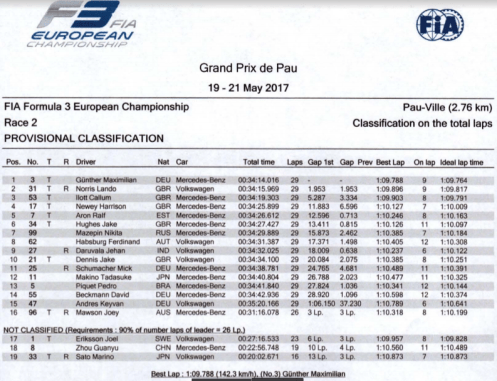
Joel Eriksson took his third win of the FIA European Formula 3 Championship season at Pau this morning.
The Motopark racer pipped Carlin’s Lando Norris to the flag by just two-tenths of-a-second. Maxi Günther filled out the podium for Prema Powerteam.
From the second row, the super-fast Swede jumped Norris and briefly trailed initial leader and polesitter Callum Ilott. However Ilott lost control of his Prema Powerteam machine on the exit of Pont Oscar and pitched the left-front of his Mercedes-powered entry into the barrier, gifting Eriksson the lead.
Thereafter Eriksson drew a lead of just over 1s, when a charging Norris began to reel the Motopark man in. Just as Norris closed to with four-tenths, a full-course yellow was called when Guan Yu Zhou crashed out on lap six.
Moving Zhou’s stricken car proved more difficult than originally though and the safety car was eventually called, neutralizing the race until the eleventh tour.
Once again Eriksson made a quick getaway to build a lead to over 1.0s, but again Norris closed in to around half-a-second, when a second safety car was called.
At first, the Hitech GP racer of Jake Hughes crashed out at the exit of the Foch Chicane, but when it looked like that might be handled by the marshals, 3rd and 4th place runners Joey Mawson and Jake Dennis ran wide through the Descente and hit the barrier in independent incidents.
The safety car stayed out for just three laps and upon the restart, Eriksson gained four-tenths over Norris to ease into a comfortable lead on the final lap. It was almost too comfortable for Eriksson, as he slowed to take the chequered flag, Norris closed to within two-tenths, creating something of a scare for the winner.
Following the Mawson/Dennis exits, Günther took the final podium spot. The German had started 4th, but fell behind the quick starting Dennis into the first few corners. Günther came close to regaining 4th on the lap 11 restart, when Dennis attempted to go around the outside of Mawson into the Virage de la Gare – the pair touched slightly, causing Dennis to slow and Günther to close right in; however the Prema racer could not complete the pass.
Nikita Mazepin took an excellent 4th, having started 9th. The Force India junior took two places at the start and gained three more when Dennis, Mawson and Hughes ruled themselves out. Often criticised, Mazepin made few mistakes and kept a solid pace to keep close to Günther through the race.
Ralf Aron secured 5th in his Hitech. He took enjoyed a good start, jumping Zhou, Pedro Piquet and the crashed Ilott. Thereafter the Estonian benefitted from later retirements to take his first top-five finish of the year.
Harry Newey was the highest van Amersfoort runner in 6th spot, following teammate Mawson’s crash. Newey headed home teammate Piquet (7th) and the battling Mick Schumacher (8th, Prema Powerteam) and Ferdinand Habsburg (9th, Carlin), although both Schumacher and Habsburg are currently under investigation for overtaking each other under yellow flags at the beginning of the race.
Jehan Daruvala took the final points score in 10th, although he is under investigation for overtaking under safety car conditions just as the Mawson/Dennis incident was called.
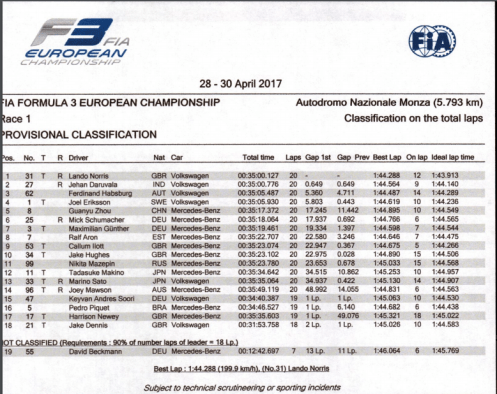
Callum Ilott took a stellar victory at Monza this afternoon, keeping a feisty Lando Norris at bay.
Maxi Günther secured is first podium of the weekend, after he escaped the clutches of Joel Eriksson during the 20-lap race.
Ilott made a stunning start from 3rd on the grid to slot between Eriksson and Norris, while Guan Yu Zhou came through from 4th to temporarily slot in behind Ilott. Zhou held 2nd spot for the first four laps, as Eriksson, Norris and Günther passed and repassed each other for 3rd, 4th and 5th.
Norris was the first to break Zhou, when he took 2nd from the Chinese driver on the entry into Lesmo 1 on lap five. It would take another five laps for Eriksson and Günther to take the Prema man, when the Swede passed Zhou after Curve Grande and Günther did the deed after Ascari.
Meanwhile out front Ilott’s lead over Norris continued to fluctuate between 1.0s and 1.6s, as the Carlin man closed in on Ilott, only for the leader to draw away again. But the margins were mere tenths.
For a time the pair swapped personal best laps, before settling into a consistent run in the mid-to-late 1’44s. Where Norris closed up in sector one, a change of brake pads prior to the race gave Ilott more confidence in the second sector, allowing him to rebuild the gap.
Norris did close in on the lead in the final four laps, with the Carlin man sitting just 1.0s adrift of Ilott in the last miles; however he could not close on Ilott, who was simply imperious.
Günther’s slow start to the season took a slight upward turn, as he took the flag just 1.9s after Norris to complete the podium. Once past Zhou, the German racer pressured Eriksson, while Zhou, Hitech’s Ralf Aron and Carlin’s Ferdinand Habsburg latched onto their tails. Eriksson could only fend Günther off for two laps and the Prema Powerteam racer stole 3rd place on lap twelve and built a significant gap thereafter.
Although he leaves Monza with a championship lead of one point, this was a disappointing end to Eriksson’s weekend considering he started on pole with two fresh left tyres.
After he was passed by Günther, he dropped 6.3s behind the Prema racer, but did manage to keep a fighting Habsburg at bay until the end.
After spending much of the race at the tail end of the points, Mick Schumacher scored a solid 6th place for Prema Powerteam. The German made the most of the tussle between Zhou, Pedro Piquet and Nikita Mazepin to jump from 9th to 7th on lap 15, before deposing Aron of 6th on lap 17.
Piquet followed through a lap later and claimed 7th, when Aron lost three places two tours from the end. Aron would at least take one spot back when he passed Zhou on the penultimate lap to finish 8th, while Jehan Daruvala also took Zhou to score a 9th place finish.
It was a lucky result for Daruvala, who was involved in a right front/left rear wheel locking clash with Keyvan Andres Soori on lap 7. Thereafter Daruvala passed Joey Mawson, Marino Sato and Mazepin to claim two points.
Zhou eventually crossed the line a disappointing 10th place – a disheartening result considering how high he ran early in the race.
Jake Dennis and Jake Hughes both retired at the end of the first lap, following an incident, while Harrison Newey blew a decent qualifying position when he ran off at Curve Grande on the opening lap. The weekend only got worse for van Amersfoort Racing at the end, when Mawson and Sato collected each other in the Retifilo chicane, ending Mawson’s race there and then.
The victory lifts Ilott to 3rd in the point standings, just 28 behind Eriksson as the series moves to the streets of Pau in three weeks time.
Joel Eriksson secured his 2nd FIA European F3 race win of the season at Monza this morning, heading Lando Norris following a tense battle between the duo.
After a good start, Mick Schumacher came home 3rd to score his first Formula 3 podium.
On paper, it must have seemed like an easy effort for Eriksson. The Swede initially got away well, only to lock up on the approach to the Retifilo chicane, but led from start-to-finish thereafter, while Norris and Schumacher fought over 2nd place. This allowed Eriksson to build a crucial 3.3s lead in the first eight laps.
In his mirrors, Schumacher jumped Norris off the line, as once again the Briton struggled was slow away. The Carlin man also briefly lost a place to Callum Ilott at the beginning of lap two, only for Ilott to miss the Retifilo chicane and drop back behind Norris.
From there, Norris chased Schumacher and ran him close until lap six, when he forced a way past the Prema Powerteam racer in Lesmo One.
Once in clear air, Norris asserted himself and began to take minor chunks out of Eriksson’s lead, bringing it down to 3.1s by lap ten and then 2.0s by the end of lap 15. Now in the slipstream, Norris made some inroads, even setting the (then) fastest lap just two tours from the end and was within one second of the lead when he eventually ran out of time.
Eriksson for his part drove a sublime race. Always maintaining a smart pace in the early-to-mid 1’44s, the Swede proved his ability to maintain tyre life, while setting a speedy enough pace to keep Norris at bay.
In the final two laps, Eriksson closed in on Joey Mawson – delayed by a mid-race pitstop – and gained enough of a tow to help steady the gap to Norris and win by just 0.7s after twenty tours.
The win gives Eriksson a seven-point advantage over Norris after five races, with the Motopark man starting from pole position for race 3 later today.
After falling to 3rd, Schumacher enjoyed a quiet race, with the German teen dropping over 9s down to the race winner, but still holding a 4.5s gap to 4th placed man Maxi Günther.
Günther started 7th which became 6th when Ferdinand Habsburg through his Carlin off the road exiting Curve Grande on lap one. That became 5th when Ilott went off the track on lap five and then 4th when he passed Jake Dennis a lap later.
For a time, a large train collected behind Günther and he momentarily dropped back a place when a charging Harrison Newey joined the fight for 4th, but the German retook the position on lap ten and held it to the flag.
The fight behind Günther was intense, with Newey, Dennis, Ilott and Guan Yu Zhou all joining the fight, followed closely by Jehan Daruvala and the recovering Habsburg. Dennis and Newey would take each other out of the reckoning with a collision on lap 13, while Habsburg passed Daruvala (lap 8), Zhou (lap 12) and Ilott (lap 13) to jump back up to 5th.
Amidst this Ilott lost out to Zhou and spent some of the final laps keeping Daruvala at bay and the trio would eventually take the chequered flag line-astern, with Zhou (6th) leading Ilott (7th) and Daruvala (8th).
Ralf Aron came home 9th in the Hitech GP machine, ahead of teammate Nikita Mazepin, who took 10th despite starting a lowly 15th due to penalties in qualifying.
David Beckmann pitted early, while Mawson (both van Amersfoort) pitted early leaving them a lap behind. Pedro Piquet made it another tough day for van Amersfoort when he spun out on lap six.
Lando Norris took his 2nd win of the FIA European Formula 3 Championship at Monza this morning, winning out following a frantic battle with Carlin teammate Jehan Daruvala.
Ferdinand Habsburg made it a Carlin 1-2-3 following his own tight fight with Joel Eriksson, Guan Yu Zhou, Mick Schumacher, Jake Dennis and Callum Ilott.
From the front row, Norris got a good start initially, but bogged down as he went through the gears, allowing poleman Daruvala to escape into an early lead. Norris fell to 4th, behind Dennis and Habsburg, with Ilott also pressing the Carlin man from behind.
From there, Norris scraped with Habsburg and pushed by the Austrian on lap 2, before Dennis missed the Retifilo chicane on the following tour, with Norris assuming 2nd place once Dennis rejoined the circuit.
Dennis continued to press Norris however and the pair swapped positions again on lap 5, with Habsburg also getting in ahead of Norris on the same lap. Habsburg himself then fell two positions on the sixth tour, bringing Norris to 3rd, and then 2nd when he took Dennis a lap later.
Norris then recorded three fastest laps in a row, shrinking Daruvala’s lead from 2.4s to 1.5 by the halfway point in the race. The gap continued to close in the laps afterward, with Norris closing to within half-a-second on lap 14.
Thereafter the Briton continued to push and pressure his Carlin stablemate, with Daruvala becoming more and more defensive, until Norris finally slipped through to the lead in the first chicane on lap 16.
Daruvala did not allow Norris to escape however and the Indian held close to the new leader, but was unable to get close enough, as he dropped vital time through Ascari in the remaining laps.
With Daruvala unable to close the gap, Norris took the win, but just by 0.6s, while the trailing Habsburg secured his first podium – and points – some four seconds further back.
The win gives Norris joint championship lead with Eriksson; both of whom have taken 67 points, some 22 ahead of Ilott and Maxi Günther.
For Habsburg, it seemed as if the race had gone away from him. Falling to 6th on lap six, the Austrian passed Ilott on lap seven and then did the same to Dennis two circulations later.
Thereafter Habsburg chased Eriksson close, but only lost the podium spot on lap 17, when he locked up at the Roggia chicane, allowing Habsburg through. Eriksson stayed close to the rookie, but was unable to force his way back through and trailed Habsburg by just 0.4s over the line.
There was a larger gap to Zhou, who claimed 5th after a long battle with Schumacher, Dennis, Ilott and – later – Günther. The group effectively circulated as a gap for much of the race and changed positions with each other on several occasions, but did so in a clean manner and without unnecessary contact.
As they crossed the line, Zhou headed Schumacher by just 0.6s, while Günther ended the day 7th, just 1.3s further behind. It marked a solid result for Günther, who had started the race back in 14th.
Dennis was amidst the group until a late tap from Günther forced the Carlin man to the pits and out of the race, while after a good early push and fight with Habsburg, Ilott’s pace faded, and he began to slip down the order, eventually finishing 9th.
In between Günther and Ilott, Ralf Aron sneaked up to take 8th place, while Jake Hughes climbed back to 10th, following a bad start that dropped him to the lower reaches of the pack.
David Beckmann pulled out after just seven laps with a technical issue, while Pedro Piquet also retired following a clash with Keyvan Andres Soori two laps from the end. Piquet was involved in an earlier incident with Joey Mawson, which resulted in a drive through penalty for the Australian.
© FIA.
Lewis Hamilton and Mercedes struck back at Sebastian Vettel and Ferrari to win the Chinese Grand Prix this morning.
Vettel did eventually take 2nd place after early-race strategy cast him adrift at the bottom of the top six early doors.
Max Vertsapen made it three manufacturers on the podium in a race partially dictated by cool and, initially, damp conditions; although the Dutch had a tough job to hold his teammate Daniel Riccairdo at bay in the closing laps.
In a race that started as damp and greasy, Hamilton led from the beginning, but the pack was close together in his mirrors, as Vettel edged out Valtteri Bottas (Mercedes) around the outside of the first turn and Ricciardo slotted into 4th ahead of Kimi Raikkoenen (Ferrari).
A second lap virtual safety period was triggered when Sergio Perez (Force India) pitched Lance Stroll into the gravel early on, ending Stroll’s race as his Williams became stuck in the gravel. This prompted Vettel to pit for soft Pirelli tyres, while the rest of the front runners stayed out, dropping the Ferrari to 6th.
This proved costly, as only moments after the lap four restart, Antonio Giovinazzi crashed hard on teh pit straight, bringing out a full safety car, allowing the remaining front runners to pits for fresh tyres.
Vettel gained one position under safety car when Bottas spun while warming his tyres, dropping the Finn to 12th position and picking up some damage in the process. Amidst all this, a great start and a cool headed strategy brought Verstappen to the Dutch teen to the top four, despite starting towards the rear.
Under the lap 13 restart, Hamilton pulled away from the now 2nd Ricciardo, while Verstappen passed Raikkonen for 3rd. Verstappen quickly made the 2nd place a short while later and began to chase Hamilton for the lead.
Now 3rd, Ricciardo began to struggle for pace, leaving the leading pair to stretch away. Thereafer Riccirdo, Raikkonen and Vettel closed in for a tight fight until the latter forced his way into 4th on lap 20 with an audacious move in turn six. Vettel made that a podium spot two laps later when he and Ricciardo went wheel-to-wheel through turn six, touching momentarily, as Vettel passed.
Out front, Hamilton stepped up the pace and pulled away from Verstappen, while the now free Vettel closed in on the Dutchman. Within six laps, the Ferrari was in range to attack; however this was nullified when Verstappen ran wide in the turn 13 hairpin, allowing Vettel to slot through into 2nd spot. Vettel closed in on the lead, as Hamilton began to struggle on ageing tyres, with gap reducing from 11s to 8s in a few short tours.
Anticipating stops, Vettel was called in for softs on lap 35, with Hamilton pitting two laps later; however this briefly split the pair as Hamilton continued to lead from the yet-to-stop Raikkonen and Vettel in 3rd.
Vettel took another second out of Hamilton and soon disposed of a struggling Raikkonen, but from there Hamilton stabilised the gap to the chasing man and even extended it slightly. The Mercedes man managed the race pace after that, rubber-stamping his authority on the Grand Prix and take the win.
The result leaves both Hamilton and Vettel on 43 points as they head to Bahrain next weekend and puts Mercedes in the lead of the Constructors Championship.
The fight for 3rd was more intense toward the end. Pitting on lap 30, Verstappen took another set of super-softs, falling to 6th momentarily. That became 5th when the Red Bull man passed the struggling Bottas , which became 4th when Riccairdo pitted for new softs on lap 34.
Eventually a frustrated Raikkonen was pitted on lap 40 – an inconceivable strategy, considering the Finn was losing over 2s per lap at that stage – bringing Vettel and Verstappen to 2nd and 3rd respectively, although the gap between the pair was significant enough for Vettel to only need to concentrate on the lead.
Ricciardo’s late race pace on super-softs brought him back into the game and he closed in on Verstappen as the race drew to a close. The Australian was helped somewhat by Verstappen’s inability to catch and pass the lapped Romain Grosjean (Haas), causing the Red Bull to suffer significant understeer.
Ricciardo spent the final laps under the rear wing of Verstappen, but despite constant pressure and a late lunge from Ricciardo, Verstappen did not budge. A good result for Red Bull on one hand; however the duo still ended the day half-a-minute adrift of the leading man.
Kimi Raikkonen’s tyre struggles rendered him a bit player, as he followed the Red Bull’s behind in 5th. His late stop gave him pace in the final laps, but it was too late to make a difference to those ahead. Bottas’ race never really recovered after his early race problems and the Mercedes man took a very disappointing 6th place.
Carlos Sainz finished 7th place following a topsy-turvy race that saw him battle with Bottas and McLaren’s Fernando Alonso on occasion. Sainz endured a torrid opening lap though. Starting on super-softs in damp conditions, the Spaniard drifted off the road in turn one, spun around in turn two and the clattered the barrier slightly as he recovered to the track, but battled his way back up the order, helped by starting tyre. As the rest of the field changed from intermediates to dry tyres during the safety car period, Sainz stayed out on his super-softs, and climbed up the order as others peeled away.
Kevin Magnussen (Haas) won a tight battle for 8th place, as he nabbed Perez in the closing tours. Perez pitted with only three laps to go, fearing losing chunks of time – it worked, keeping the Mexican ahead of his teammate come the chequered flag. They bested Esteban Ocon (Force India) who took another 10th place finish, after the Frenchman passed a struggling Felipe Massa (Williams) toward the end of the race.
Romain Grosjean recovered from a post-qualifying penalty and was the first non-points finisher in 11th, after a tough move on Nico Hulkenberg (Renault) in turn six gave him sight of the top ten. Hulkenberg endured a horrid race – after a poor start, the German illegally overtook cars under both virtual safety car and safety car to garner 15s of penalties in his first stop. Jolyon Palmer came home 13th from last following a post-qualifying penalty, while Massa fell to 14th on destroyed tyres by the chequered flag. Marcus Ericsson had a quiet drive to 15th and last.
Alonso retired just after halfway with mechanical issues in his McLaren. Once again, the Spaniard was running in the points at the time in a car that probably should not have been there. Daniil Kvyat’s day ended early when the power steering system failed on his Toro Rosso, while Stoffel Vandoorne made it an awful day for McLaren, when he parked with a fuel feed usage problem.
Although it is still early, the championship is beginning to hot up at this early stage, but with the cool, damp conditions for today’s Grand Prix, we may need to wait until Bahrain next week before we see a true reflection of the order in optimum conditions.
For now, Hamilton will take in the glory in Shanghai, but expect Ferrari to respond.


