
The second practice session of the Chinese Grand Prix elapsed with no running this morning, due to heavy fog.
The conditions were such that it was deemed too dangerous for the medical helicopter to land at the designated Shanghai hospital, based 38km from the circuit.
As such, FP2 ended with thirteen minutes still on the clock in a session that saw no cars enter the circuit. With the first session only seeing 27 minutes of action for similar reasons, this marked a barren Friday for the fans in the grandstands.
For the teams, this will put a premium on running in Saturday morning’s one-hour final practice session.
Max Verstappen topped this morning’s highly interrupted opening Chinese Grand Prix practice at Shanghai International Circuit.
The Dutch racer set a best of 1:50.491s in damp and foggy conditions – the latter of which forced two lengthy red flags.
Such was the thickness of the fog, the medical helicopter was unable to land at the designated hospital Shanghai, rendering the session null and void.
The practice was red flagged for approximately 64 minutes of the session, but while there was some running, Renault’s Nico Hulkenberg spun off in turn two and became beached in the gravel, while several other drivers endured light spins in the Pirelli intermediate tyres.
Sauber revealed last night that reserve driver Antonio Giovinazzi is to stay on in place of Pascal Wehrlein for this weekend’s Chinese Grand Prix.
Citing a lack of fitness following a truncated pre-season, Wehrlein withdrew from the Australian Grand Prix after Free Practice 2 – a situation born out of Race of Champions crash in January.
While disappointing for Wehrlein, his absence offers Giovinazzi another opportunity to impress the Formula One field, after the Italian quickly got up to speed and raced very well in Melbourne. Should Giovinazzi match that debut, he stock will rise again.
There were several theories floating around the web yesterday as to Wehrlein’s continued absence, with some believing there is more to the story than meets the eye. In the background, Wehrlein and Giovinazzi are backed by Mercedes and Ferrari respectively and while it is though in some circles that Sauber’s relationship with current power unit supplier Ferrari may be coming to an end, talk about linking up with Mercedes has quietened since February.
Over the weekend, rumours began to emerge that Sauber may be considering a possible relationship with Honda, as the struggling Japanese manufacturer search for a second team to work with, now that their exclusivity relationship with McLaren has passed. This is, of course, conjecture, and there is absolutely nothing to link political actions being played between teams and manufacturers, but it would not surprise if games were being actioned out in the background.
Beyond the immediate realms of Formula One, this potentially creates future problems for the Race of Champions. Following Wehrlein’s crash and eventual issues, the RoC could find it a little more difficult to attract top names in future events, especially as long as the event is held close to the beginning of pre-season testing.
This may promote a move back to an early December date, but considering the tight clauses that already bind the drivers, teams may be less likely to release their drivers for such an event.


It may not have been the most dramatic of Grand Prix, but the events in Melbourne offered a sign that Formula One as a championship battle has been rejuvenated.
All it needs to do now is turn on the races and keep it up. Easy, right..?
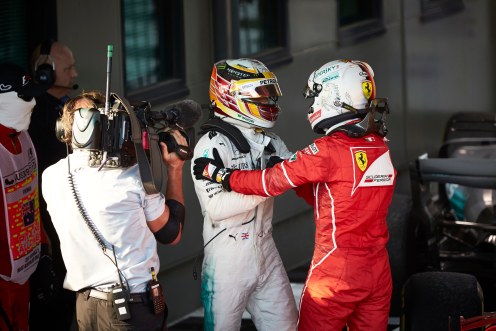
It would not be a surprise if I was not the only one to be both delighted and disappointed to see Sebastian Vettel pass Lewis Hamilton for what would eventually be the lead, as the Ferrari exited the pits on lap 25 of Sunday’s Australian Grand Prix.
That is not to say that I favour or am against Ferrari in any way – my role is unbiased one – but rather it was pleasant to see, for the first time in a very long time, a team other than Mercedes take victory that was not attributable to the retirements of the sport’s recent dominant team.
On a few occasions since the new power unit regulations came into play in 2014, Mercedes have managed to pull significant results together, such was their dominance on track.
This race gave Ferrari an opportunity to prove their pre-season pace in a competition setting, something that seemed a while away following Friday’s free practice running. Vettel was in buoyant mood. “The last months have been really intense, it’s been tough to get into the rhythm. It’s just the beginning and there’s still a lot of work going on. This is one of many steps and we have to enjoy what we do. It’s great to see people smiling.”
Ferrari’s success instantly invited the possibility of a multi-team championship battle – something that has been missing from Formula One for nearly five years, but while one suspects that the pass delivered some relief to the viewing public, the overtake to decide the race was reduced to action in the pits.
Watching just the laptimes, it is clear that it was a very tight contest between Vettel and Hamilton. Neither Mercedes nor Ferrari appear so absolutely strong as to drastically pull away from the other and dominate the other, but Hamilton’s early struggles on the ultrasoft did not help matters and although Hamilton performed better on the softs, traffic rendered his efforts null. Hamilton: “Towards the end of the first stint I caught some traffic and that overheated the tyres. I struggled for grip to the point where I needed to come in, plus the gap was closing up and I was sliding around a lot. We made the call to pit, because otherwise I think Sebastian would have come past me anyway. After my stop I got caught in some traffic, which was unfortunate but that’s motor racing.”
Mercedes’ new Technical Director, James Allison, called for caution from the Brackley team. “If it wasn’t already clear after qualifying, then it’s certainly clear now that this is going to be a season of very small margins. We got a good getaway from the flag, but credit to Ferrari today, they had a very quick car and we just weren’t quite good enough to stick with them.
“We won’t panic, though. It’s race one of a long season and we scored some very good points with both cars today.”
Vettel was close to Hamilton in the early stages, but not close enough to commit to an overtake, such was the force of the turbulent air pouring from the rear of the Mercedes. Later when Hamilton pitted on lap 19 to escape sluggish and damaged Marcus Ericsson, the Englishman would briefly emerge in clean air, only to soon find himself stuck helplessly behind the Red Bull of Max Verstappen, before the Dutch teenager stopped for fresh tyres on lap 26.
Between the three-tenths that Ferrari saved in the tyre stop and the (net) two seconds that Hamilton lost frozen behind Verstappen, Vettel overcame his British rival. But making the move stick on track proved too difficult a prospect for Vettel and if this is the impasse that Formula One is to face for the foreseeable future, it will make the sport an equally difficult sell for viewers. “The GP was all decided at the pit stops,” said Ferrari’s Chief Technical Officer Mattia Binotto. “At that moment, we probably had less tyre degradation than our rivals towards the end of the stint and that meant we were able to stay out on track for longer. From then on, it was a case of bringing home the car in terms of reliability.”
Going back to Hamilton, his predicament was probably more telling. Through testing, the Red Bull’s seemed well shy of Ferrari and Mercedes’ optimum pace, but when the Melbourne updates proved somewhat indecisive, Red Bull fell into the road of de facto third-quickest team – not close enough to the leaders to challenge, but still well clear of the Williams, Force India fight. Yet when Hamilton rejoined on fresh tyres just behind Verstappen, the Briton could do nothing to slice by the Red Bull, who was by now on twenty-something-lap-old ultrasofts.
If the rest of the season plays out like Melbourne, we could very well see Mercedes will do the business in the qualifying session on Saturday, while Ferrari’s strengths can be employed during the race itself. The challenge for Ferrari is whether they can consistently overcome Mercedes through strategy or improve their own qualifying performance in order to leapfrog the silver and turquoise cars. Mercedes, too, have little choice but to redouble their efforts to improve both their race pace and the treatment of their tyres.
Realistically the drawn out nature of the race was not unexpected, and Melbourne is far too small a sample upon which to judge a season, but while the cars are undoubtedly much faster, they did underline just how drastically the new technical regulations can hinder the art of overtaking.
—-
This piece was originally written last August, but has ben updated slightly and published here to coincide with the imminent start of the 2017 European Formula 3 Championship. Further updates will come later.
—-
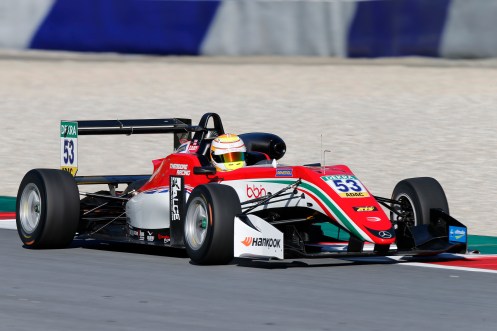
53 Callum Ilott (GBR, Prema Powerteam, Dallara F317 – Mercedes-Benz), FIA Formula 3 European Championship Test Spielberg (AUT) – 28. – 29. March 2017 *** Local Caption *** Copyright (c) FIA Formula 3 European Championship / Thomas Suer
Last July, at a small press conference at Spa-Francorchamps, the Director of Racing Activities for the FIA revealed several measures designed to tackle the increasingly thorny issue of rising costs and a perception of a lack of competitiveness in the European Formula 3 Championship.
Frederic Bertrand announced a ban on wind tunnel testing by teams, a restructuring of testing and a rewording of the engine regulations – alongside several sporting regulation changes – that aim to lower costs and increase competitiveness.
Since the introduction of the current engine package in 2014 (the current chassis technical regulations came into play in 2012), costs for a full season drive in the category have risen from approximately €600,000-650,000 to €700,000-750,000, depending on which team you ask (and how much success you may want to achieve).
Italian squad Prema Powerteam has also secured each of the drivers’ titles since 2011 (then known as the F3 Euro Series) and all of the teams’ titles since its introduction in 2013. Although each season is generally peppered with race wins from a number of outfits – including Van Amersfoort, Carlin, Mücke Motorsport and more recently, the re-launched Hitech GP – Prema Powerteam have taken the silverware over the course of seasons.
In recent years, however, Mücke Motorsport’s light has faded and the team has decided not to field entries for the 2017 season, while T-Sport are also unable to find a funded driver for this season, and have opted to run an entry in the fledgling LMP3 category in sportscars.
It follows the loss of Double R Racing, EuroInternational and Team West-Tec at the end of 2015. Hopefully some of these will eventually return to the category.
While wind tunnel work by teams will be outlawed, Bertrand revealed instead that aerodynamic work will be undertaken by existing chassis manufacturers – in this instance Dallara, the sole chassis manufacturer currently competing in European F3. The results from these tunnel sessions will take the form of an ‘aerokit’ and data package to be produced for each entrant.
All manufacturers who enter into FIA F3 will be required to produce a data package for a customer; however at the time of writing, it is believed these data packages will only be available to a team once a car has been purchased.
‘We wanted to give the feeling to the current teams, the ones this year [who are] not able to invest or to the ones who want to come into the championship to be incentivated and to think that they come with the same level,’ Bertrand said. He added that Dallara will deliver a full aero model, so that competitors get all the information necessary to do the job that needs to be done, allowing teams to focus on the development of driver. ‘This will put everybody back to zero or at least back to basics. All the teams have agreed on [this] element; this was validated in the last world council.’
According to FIA F3 Technical Delegate Robert Maas, the package will limit teams to work within the confines of the aerokit provided – placement of wing angles for example – effectively locking down a manufacturer’s aerodynamic profile for the period of homologation. Bertrand added that, ‘It is good to develop the engineers and it is still the DNA of F3, so we keep that open. We keep the possibility where the teams have areas to work on, but we limit it to where we think it is actually valuable for the drivers and the engineers.’
Expending further on what is and isn’t allowed, Maas explains, ‘On the current car, we still have some small areas where [teams] put small winglets, small gurneys. They started working on the brake ducts, which is quite a big area and this is all banned for next year, so you have the standard Dallara car.
‘The chassis manufacturer is delivering options for the rear wing – so for example high, medium and low downforce. You have certain options on the front wing to adjust the balance, you have the possibility to work with brake ducts to either put them on or leave them off, but you don’t develop something.
‘On the suspension side, you still have a lot more freedom – you can choose out of a lot of different dampers, adjust these dampers and still have the possibility to work with a third element in a very limited fashion, so the teams just work with a basic spring to keep the ride height during driving.’
It will be interesting to note whether these alterations will be enough to challenge engineers within the Formula 3 paddock, but it must be remembered that these updates came with the blessing on the teams, with Maas adding, ‘In the end, a driver can still feel what set-up or aerodynamic changes [are made], but without any development on the team’s side.’
Both Bertrand and Maas were keen to emphasise that this is not a step to Formula 3 becoming a spec category, with the former acknowledging that any additional manufacturer(s) will need to provide a similar data package to buyers.

16 Ralf Aron (EST, Prema Powerteam, Dallara F312 – Mercedes-Benz), FIA Formula 3 European Championship, round 2, race 1, Hungaroring (HUN), 22. – 24. April 2016
As I previously covered in the feature ‘Carbon Dating’ in Racecar Engineering Magazine (Vol. 26; No. 4), the current Formula 3 regulations have been extended to the end of 2019, meaning a high percentage of the chassis in use will be eight years old and will have experienced close to (and in some cases over) 100,000km of racing and testing.
While keeping costs at an optimum level was the key driver to these regulatory updates, questions were raised as to reasonable life expectancy of a carbon composite monocoque, especially when one takes into account that young and inexperienced drivers who pilot these machines have a tendency to crash from time-to-time. ‘To do this, we had to push the safety level, because we saw that we had some crashes last year and we had some inexperience and we wanted to upgrade the safety level, particularly in view of keeping the cars to 2020,’ Bertrand notes.
‘Some specific evolution will be done and Dallara will produce a kit that will be delivered by 2017 to all the teams so that they can upgrade the level of safety for the life of the car.’
Bertrand also revealed that engines will be budget capped to €65,000 for approximately 10,000km usage over the course of a season, with the current package remaining in place until the end of 2019 as well. The existing engine regulations quote a cap of €50,000; however that cap related only to the engine unit. ‘I think the main issue was there was a €50,000 budget in the regulations, but that was not the reality, because you had to add service, so we created a complete figure that everyone who reads the regulations will know what he is looking into,’ explains Maas.
The rewrite of the regulations will include servicing and it is believed this will save €20-40,000 per car. ‘The cost of the engines is still too high, so we have agreed with the manufacturer to have something where all is included. It will help the teams to be a little bit more effective on this cost management side.’
Comment
When Frederic Bertrand sat with the media and laid out the future direction for Formula 3, one could not help but feel a deep pang of disappointment.
These junior series’ exist not just to define champions, Super Licence points tallies and improve racecraft, but also to allow drivers to develop relationships with engineers and vice versa. Categories, such as Formula 3, are classes of learning. What these competitors learn here potentially shapes their outlook as they look to progress up the ladder toward Formula One.
One of the last bastions of open technical regulations in single-seater racing, the cost of competing in Formula 3 has admittedly risen to a level beyond many aspiring drivers. But a balance must be found. The slide toward regulations whereby teams no longer develop these machines and come up with intricate solutions to problems could damage our sport’s future as a battleground for engineers and drivers.
There appears to be precious little appetite in the current climate at the FIA for wind tunnel usage at Formula 3 level, with the governing body questioning the need for such testing in F3. ‘In the end, it made no big difference what they discovered there, because we don’t discover many things,’ says Bertrand. ‘In the end they go there and this puts in the system the idea that if you don’t go [wind tunnel testing], you don’t get [data]. The easy solution is to first of all say “you are not allowed to go anymore”, so this is one of the decisions validated for next season.’
Yet over the years, several drivers who had graduated from Formula 3 had often relayed to me that they had learned more in a short period of F3 than they had in season-long campaigns in the various spec categories that proliferate the single-seater ladder today due the nature of F3’s open engineering approach. Admittedly, the regulations have tightened significantly over the years, but they always provided teams the option to develop. One only needs to look at ArtLine Engineering’s efforts last season with the ArtTech P315 to understand the regulations still have plenty of scope.
On the other hand, the FIA also recognise that these teams are businesses and it can be easy to forget that plenty of jobs rely on the continued existence of these squads. By moving to ensure lower costs makes teams better equipped to survive, they could have gone some way to securing the future of these teams – whether the concept of F3 survives this to remain a significant engineering category is a different matter.
Should you have it, I would suggest a re-read of Danny Nowlan’s excellent feature from the August 2015 edition Racecar Engineering Magazine (‘Industrial Strife’; Vol 25, No. 8) to get a more nuanced view of the ‘open regs vs spec regs’ discussion.
© Mattias Persson / Motorsport Publication & Team Motopark.


If their performance at Australian Grand Prix is anything to go by, McLaren-Honda’s winter of discontent looks set to add Spring, Summer and Autumn to that mix, but it is not all doom and gloom at Woking.
While Fernando Alonso drove what he felt was one of the drives of his career and was happy to do so in car where he could push, the Spaniard was keen to emphasise the lack of pleasure that his efforts would have resulted in no points.
Such is the drop-off in performance from the Honda power unit and a seemingly uncooperative MCL32 chassis, McLaren looked all at sea, as one clung desperately to the edge of the points and the other battled off a debutante Sauber.
Upon this performance, the once-famed McLaren-Honda partnership looks set to repeat the dismal efforts of 2015. This must surely hurt even more considering the step forward made in 2016 and the lavish pre-season promises delivered from all corners of the project.
Alonso would eventually retire in the latter stages with brake duct issues and a damaged floor, while new teammate Stoffel Vandoorne ended the day 13th and last after putting up his own brave fight, following an early dashboard failure that resulted in an early long pitstop.
But it is not good enough and the team from Woking know it, as Eric Boullier – Racing Director at McLaren – describes. “The 2017 Australian Grand Prix won’t be remembered as one of McLaren-Honda’s finest hours, and indeed there are precious few reasons for us to be cheerful here in Melbourne this evening.”
Yet for all this, there is little point in rehashing the current failings of the project, as so many seem to want to do – that does little to move the project forward. The question that McLaren and Honda have been asking themselves for many weeks already is: “what next?”
Well, some minor improvements have already been made. Prior to the start of the season, there were questions as to whether the McLaren would be able to string more than a dozen laps in a row during the Grand Prix; however both comfortably surpassed this marker and were close to achieving a double-finish when Alonso pulled off.
Boullier, however, knows there is much more to do: “From here we’ll return to Woking and Sakura, where our development work will continue with relentless intensity, with regard to chassis and power unit alike, in an effort to improve MCL32 for the Shanghai-Bahrain double-header.”
Whether either driver was able to push the power unit as hard as they would have ideally liked is unknown. In a sense, one would hope no, as their pace was relatively weak compared to even some of the midfield squads. Should the pace shown in Melbourne be genuine, then McLaren-Honda are in real trouble, but if there is still a need to reign the drivers in, in order to secure a reliable run – even slightly – then a window of improvement becomes viable.
Over at Honda, Yusuke Hasegawa, Executive Engineer and Head of the Honda F1 Project, was somewhat upbeat considering the circumstances. “We knew coming into the weekend that this race wouldn’t be an easy one. But, despite a number of issues, I’m still happy with the progress we’ve made over the last weeks.” Hasegawa complimented his drivers for their efforts in what he described as “a challenging season-opening race, with retirements up and down the grid.”
And therein Hasegawa’s final comment could be the rung that measures McLaren’s season. Melbourne was this year (and generally is) a race of a high number of retirements.
The thirteen competitors who finally crossed the line on Sunday represented a very low threshold for finishers and, it is not unreasonable to assume that in a “regular” Grand Prix, the McLaren duo may struggle to pull their way as far up the order and as incredible a performer as Alonso is, the Spaniard’s patience is not endless.
All the same, do not underestimate McLaren-Honda. The removal of the token system will aid Honda in their development of the power unit and as the season progresses and updates arrive, it will be interesting to see if it can deliver enough to allow drivers to push full tilt, thereby pulling the team back into the midfield.
So many ifs, too many buts.


Following a difficult transition year in 2016, the factory Renault team look to have delivered some gains with the RS17, but midfield battles may be the peak for the French squad.
“Our race result highlights that we were not as well prepared as our opposition and our lack of mileage and preparation, both during pre-season testing and during this weekend, meant we suffered.” A reasonably fair assessment of Renault’s current standing in Formula One from Renault’s Managing Director, Cyril Abiteboul.
Where the likes of Mercedes and Ferrari surged ahead and the Renault-powered Reb Bull team took a top five finish with Max Verstappen, Renault’s optimum pace leaves them lingering very much in the midfield.
Although the newly signed Nico Hulkenberg qualified 12th (but started 11th due to Daniel Ricciardo’s grid penalty), the German drove a strong race to 11th, but it was all he could extract from RS17. “The conclusion from my first race with the team is that we are firmly in the midfield and we’re looking forward to continuing to improve,” said Hulkenberg.
The former Force India driver commented that he found it extremely difficult to follow opponents in dirty air, struggling with the front end of his RS17 as the race unfolded; however he join a battle with Fernando Alonso (McLaren) and Esteban Ocon (Force India) late-on, offering up a memorable image of the trio going side-by-side into the first turn late in the race. “My battle with Ocon and Alonso was a lot of fun, I had massive double tow from them, so I gave it all with overtake mode and DRS. It was quite spectacular and must have looked pretty good from the outside too.”
But the story of that move was that the fight was for 10th, 11th and 12th positions and while the French manufacturer say they are in Formula One for the long term, the progress of the Renault project will be under constant scrutiny from the bosses in France.
Renault will also be monitoring the performances of its driver’s and Jolyon Palmer will be hoping that his Melbourne weekend will not be repeated in the coming races. Or ever again. The former GP2 Series champion seemed flustered all weekend, losing time in Friday’s 2nd practice session thanks to a crash in the final corner, while a fuel flow surge in qualifying and a brake issue during the race left him a long way adrift of Hulkenberg.
Even when Palmer has run without problems, his pace did not match that of his teammate. “It’s not been the start I wanted to my season,” Palmer said. “I made places at the start despite being on the hardest tyre, my pace was pretty reasonable and I could see Nico and Esteban ahead of me. Unfortunately, my brakes stuck on at turn 14. We hoped it was just a glitch, but it happened again so we had no alternative other than to retire.”
When problems do strike his Renault, the Briton does need to keep a calmer head, as his comments about the car and team on television during the weekend will do little to endear him to the French squad.
Following a difficult two pre-season tests in Barcelona, Renault reverted to the their 2016-version of their MGU-K recovery system during the weekend, deciding that a finish with a heavily, but reliable unit was more profitable than retiring due to known issue.
Yet that is just one area that Abiteboul knows Renault need to improve. “We have learnt that in this new Formula 1 era everything needs to be perfectly executed, as it is very difficult to gain track position. We needed to be stronger at the start, in our execution of our strategy, in our pit stops and with our car set-up and balance.
“At every race, we should be in a position to fight for Q3 on Saturday and to fight for points on the Sunday. Looking forward, our first priority for Shanghai is to improve our reliability and from there we should be in a stronger position.”
Abiteboul’s comments point to an acknowledgement of the problems facing the Enstone-based team, but the sheer magnitude of the issues may mean it will be a long time before they genuinely threaten the leading three teams.

© Sauber F1 Team
Antonio Giovinazzi’s late call-up for Sauber for this weekend’s Australian Grand Prix was certainly a surprise, particularly given the reasons for which Pascal Wehrlein was withdrawn.
But had one told the Italian about his Formula One less than two years ago, it is doubtful whether he would have believed it.
During the early stages of the 2015 FIA European F3 Championship, I sat down with Giovinazzi and spoke to him about the future beyond F3. Knowing that season – his third in the category – was likely to be his final season before moving on, Giovinazzi was in several minds as to what to do next.
Recognising the paths taken by F3 and other single-seater drivers in previous years, Giovinazzi desires seemed more realistic than unnecessarily hopeful. “I would think, I like, maybe DTM. Testing first for a year and maybe trying for a race seat,” he said, continuing, “I would also like to try IndyCar. That looks like it could be fun.”
At this stage in their careers, most young drivers will tell you of their ambition to take over the world and that they will eventually be a multiple world champion, but occasionally there are those with enough sensibility to understand the situation facing them when faced with the brutal finances of motor sport.
When I asked him if there were any ambitions for Formula One, the then 21-year-old was frank in his assessment of the possibilities. “We have not enough money. It’s crazy. I would like to, but we do not have the sponsorship [for F1] and I am not with a big team. Formula One is not in my future.”
Of course, at this time, Giovinazzi was not part of any team programme in Formula One and his backing from Jagonya Ayam {note 1} was unlikely to carry him to F1, especially considering the funds required and the potential lack of brand carry-over outside of South East Asia.
That year Giovinazzi finished runner-up in the European Championship to Felix Rosenqvist and the relationship With Jagonya Ayam carried through that winter and into 2016, where the Italian competed in two Asian Le Mans Series races in the LMP2 class with Sean Gelael, taking victories in both with his Indonesian friend. A move to the GP2 Series with Prema Powerteam followed, with Giovinazzi pushing series favourite Pierre Gasly to the flag, eventually finishing runner-up there and getting drafted to the Ferrari Driver Academy.
There is little doubt that the link to Ferrari may have helped Giovinazzi make the jump – even if it is just for one race, but the growth shown in Formula 3 and GP2 and his performance in Melbourne should go some way to opening doors for the 23-year-old.
One can only hope teams were paying attention.
{note 1}
Jagonya Ayam is the KFC franchise for Indonesia and its President Director is a chap called Ricardo Gelael, Sean Gelael’s father. Ricardo has occasionally rallied as a hobby, particularly in the 90s, but looks to have stopped about a decade ago; however Sean has been committed to racing since his early teens.
When both were competing in the MRF challenge a few years ago, Giovinazzi stayed with the Gelael family and have been friends since. Giovinazzi returned the favour for Gelael when they were teammates at Double R Racing for the 2013 European Championship.

© Sauber F1 Team
Sebastian Vettel won the Australian Grand Prix this morning, claiming his first victory since Singapore 2015.
The Ferrari man headed a Mercedes 2-3, with poleman Lewis Hamilton securing the runner-up spot ahead of Valtteri Bottas.
Following a slightly sluggish start, Vettel ran 2nd in the first stint to early leader Hamilton, only to take the lead during the pit cycle. Thereafter the Ferrari man managed the gap to Hamilton to between eight-to-ten seconds, eventually taking the victory by 9.975s from the Mercedes.
Although his initial getaway was quite good, Vettel appeared to bog down slightly in the second phase of his start, allowing Hamilton an easy lead and almost gifting Bottas a shot at 2nd.
Vettel recovered to maintain 2nd into turn one and began to shadow Hamilton until the Briton stopped on lap 19, as they caught the first round of backmarkers. However Hamilton emerged behind Red Bull’s Max Verstappen, costing the Mercedes racer several seconds as Verstappen began to struggle on aging ultrasoft tyres.
Out front, Vettel cleared the backmarkers and set several quick laps in clear air and building a significant enough gap over the Verstappen/Hamilton pairing to pit safety on lap 24. It was another two laps before Verstappen pitted, in which time Vettel build a six second gap over Hamilton, effectively securing the win before halfway.
Such was the loss of time, Bottas had claimed four seconds on his teammate when he finally pitted on lap 26, bring the Finn to the rear of Hamilton. For a time Bottas fell away, before catching Hamilton again as the Briton’s tyres aged; however Hamilton managed the gap to keep Bottas behind.
Through this, Vettel drove undisturbed to victory, taking his and Ferrari’s first win since the final third of 2015. Bottas crossed the line 3rd, just 1.3s shy of Hamilton.
Kimi Raikkonen drove an anonymous race to 4th, only waking up when he needed to fend off Red Bull’s Max Verstappen in the final stages of the race. The Finn even set the fastest lap of the race in the closing laps, raising questions as to his motivation and competitive level to Vettel. Felipe Massa secured 6th for Williams, albeit almost a lap behind the eventual winner.
Sergio Perez secured 7th spot as the first lapped car, despite a section of his engine cover coming loose late on. The Mexican held off challenges from both Toro Rosso’s of Carlos Sainz and Daniil Kvyat in the final third of the race.
Sainz took 8th with a late stop dropping Kvyat to 9th; however Sainz and Kvyat had swapped places earlier in the event, pointing to a return strategy at Toro Rosso at the chequered flag approached.
Esteban Ocon took the final points place, with a daring late move on Fernando Alonso (McLaren), while Renault’s Nico Hulkenberg made it three-wide into the first corner. Having run in the points for quite a time, Alonso would soon retire with suspension issues.
Antonio Giovinazzi finished his Grand Prix debut in 12th place, a wonderful effort for the young Italian who was only called up on Friday evening when Pascal Wehrlein declared his lack of fitness. Stoffel Vandoorne came home 13th and last in his McLaren, after what was tricky race in an ill-handling MCL32.
Neither Haas driver finished with Kevin Magnussen retiring late on and Romain Grosjean parking his Ferrari-powered machine first. It could have ended much earlier for Magnussen, who clattered Sauber’s Marcus Ericsson on the first lap, the latter of whom would almost retire with a mechanical issue a short distance into the race.
Williams’ debutante Lance Stroll retired in the pits with a brake issue, although he needed finished much earlier when he outbroke himself to a large degree in turn one on the opening lap, very nearly careering into the pack. Finishing what had been an awful weekend, Renault’s Jolyon Palmer also pulled out with mechanical frailties.
It was a hard day for Red Bull’s Daniel Ricciardo, who initially suffered a gearbox issue on the lap to the grid and then retired with engine-related failure mid-way through the race, while already two laps down.
The field moves to China for the second Grand Prix of the year in two weeks time and while Mercedes may turn up the wick when the race at the first “proper” circuit of the year, for now the champagne will be flowing at Maranello.
Daniel Ricciardo’s Australian Grand Prix weekend went took another severe hit following his crash during yesterday’s qualifying session.
Spinning into the turn 14 barriers during his first Q3 run, the Red Bull driver damaged the rear of his RB13, necessitating a gearbox change. After initially qualifying 10th, Ricciardo will now start from 15th position.
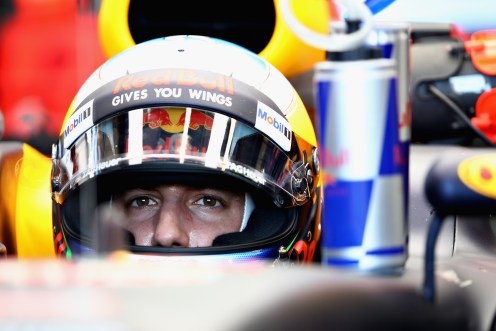
MELBOURNE, AUSTRALIA – MARCH 25: Daniel Ricciardo of Australia and Red Bull Racing sits in his car in the garage during final practice for the Australian Formula One Grand Prix at Albert Park on March 25, 2017 in Melbourne, Australia. (Photo by Clive Mason/Getty Images)
2017 Australian GP (Rd 01, Qualifying)
POS DRIVER (TEAM) TIME (GAP)
01. Lewis Hamilton (Mercedes) 1m22.188s
02. Sebastian Vettel (Ferrari) 1m22.456s (0.268s)
03. Valtteri Bottas (Mercedes) 1m22.481s (0.293s)
04. Kimi Raikkonen (Ferrari) 1m23.033s (0.845s)
05. Max Verstappen (Red Bull/Renault) 1m23.485s (1.297s)
06. Romain Grosjean (Haas/Ferrari) 1m24.074s (1.886s)
07. Felipe Massa (Williams/Mercedes) 1m24.443s (2.255s)
08. Carlos Sainz (Toro Rosso/Renault) 1m24.487s (2.299s)
09. Daniil Kvyat (Toro Rosso/Renault) 1m24.512s (2.324s)
10. Sergio PerezForce (India/Mercedes) 1m25.081s (2.893s)
11. Nico Hulkenberg (Renault) 1m25.091s (2.903s)
12. Fernando Alonso (McLaren/Honda) 1m25.425s (3.237s)
13. Esteban OconForce (India/Mercedes) 1m25.568s (3.380s)
14. Marcus Ericsson (Sauber/Ferrari) 1m26.465s (4.277s)
15. Daniel Ricciardo (Red Bull/Renault) {no time}
16. Antonio Giovinazzi (Sauber/Ferrari) 1m26.419s (4.231s)
17. Kevin Magnussen (Haas/Ferrari) 1m26.847s (4.659s)
18. Stoffel Vandoorne (McLaren/Honda) 1m26.858s (4.670s)
19. Jolyon Palmer (Renault) 1m28.244s (6.056s)
20. Lance Stroll (Williams/Mercedes) 1m27.143s (4.955s)
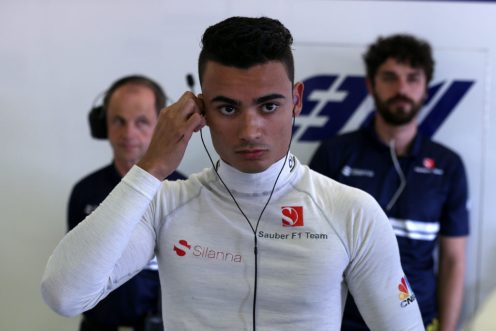
Wehrlein at practice at Melbourne on Friday. © Sauber F1
Sauber F1 team have decided to sit driver Pascal Wehrlein out for the rest of the Australian Grand Prix following the continued fitness after effects of his Race of Champions crash.
The German racer complained of a “fitness deficit” following the Friday practice sessions, leaving Sauber little choice but to bring in reserve driver Antonio Giovinazzi for his Grand Prix debut.
Wehrlein missed the first test in Barcelona in the aftermath of his ROC crash, allowing Giovinazzi two days of running in the Ferrari-powered C36, but it was believed that he had fully regained his fitness.
Of Wehrlein, Sauber Team Principal Monisha Kaltenborn said, “We have great respect of Pascal’s openness and professionalism. This decision was definitely not an easy one for him, it underlines his qualities as a team player. The focus is now on his fitness level, and in such a situation we do not take any unnecessary risks. Pascal will be in China as planned.”
Wehrlein added: “My fitness level is not as it should be for a full race distance because of my training deficit. I explained the situation to the team yesterday evening. Therefore, the Sauber F1 Team has decided not to take any risks. It is a pity, but the best decision for the team.”
Giovinazzi secured runner-up spots in both the FIA European Formula 3 Championship and last year’s GP2 Series.
For no reason, this little story about Nico Rosberg popped into my head today, so I thought it would be nice to share it with you.
—
Over the weekend of the 2015 DTM season finale at Hockenheim, then Mercedes racer (and future world champion) Nico Rosberg was brought in to take part in a round table with the press.
Mercedes were, and still are, very good at roping in some of their Mercedes drivers, as well as Mercedes-engined and Mercedes-partnered drivers in for the press over some of the DTM’s more significant weekends.
This has included conversations with Nico Hulkenberg (then Force India-Mercedes), Esteban Ocon, David Coulthard (formerly McLaren Mercedes), Pascal Wehrlein (then Manor-Mercedes) and others. It is a welcome practice that offers a touch of spectacle and opportunity to the DTM {note 1}.
On this particular occasion, I remember being surprised that Rosberg had been brought in. The German was, at the time, still in with a slim shot of winning the 2015 World Championship, although teammate Lewis Hamilton was rather far ahead in the points. So, one week prior to the key race of 2015 at COTA, Rosberg attended the press engagement at the Hockenheimring.
Most apparent throughout the conference was the rather strained impression drawn by Rosberg. In a year where he had seemingly fallen well behind Hamilton, the Mercedes man was sent in to fend off a barrage of questions from a 25-personed unfamiliar press corps, all of whom digging for a story to sit atop of their weekend motorsport contributions.
The presser was mostly uneventful in the end and there were few truly difficult questions, until toward the end of meeting, when one Spanish journalist (at his sole DTM event of the year) asked Nico ‘if he expected Hamilton to help him in his battle to finish 2nd in the World Championship.’
In a split moment, Rosberg’s brow creased noticeably and a deep “oooohh” emanated from the regular journalists, partnered by a series of grimacing faces that screamed “oh shit”. A few struggled to hold back laughter.
It was the most unexpected question. Rosberg’s reply, worded through the grittiest of gritted teeth, referred the journalist back to points standings and that he ‘still fully intended to fight Hamilton for the title.’
The conference ended shortly thereafter and Rosberg was gone, very quickly. A week later, Formula One descended upon the Circuit of the Americas where poor weather tore through the region, leaving a circuit doused as the race began. Rosberg was leading late on and was in a position to gain on Hamilton in the points standings, but a late spin from the German gave Hamilton the necessary points and the title.
Rosberg still took 2nd place in the standings, but he did so without Hamilton’s help – the Briton, now a three-time World Champion, having seemingly switched off for the rest of the season.
{note 1}
This is not to say that Audi and BMW do not do this either, they do, but as neither Audi nor BMW are currently in F1, they cannot realistically offer current F1 drivers for media purposes. However it must be added that both manufacturers have been very kind to produce stars from other forms of motorsport through the years for media engagements, such Tom Kristensen, Allan McNish and Alex Zanardi amongst many others.
Mercedes’ Lewis Hamilton topped the second free practice session at Albert Park in Melbourne this morning.
The three-time world champion was as equally dominant on the timesheets as he was in the opening session, with Hamilton setting a best time of 1:23.620 – a half-second clear of nearest rival Sebastian Vettel of Ferrari.
Not only was the Mercedes quick on its low fuel run, Hamilton also displayed fine longer run pace on the Pirelli ultrasoft tyres too, eventually losing some three seconds, raising ominous signs for the weekend ahead.
Vettel’s best also came on the ultrasofts, although he will be hoping more can etched from the Ferrari.
Hamilton’s Mercedes teammate Valtteri Bottas registered 3rd spot with a 1:24.176s; however the Finn may argue that he lost a chunk of time in the final sector of his fastest run. Kimi Raikkonen rounded out the top four with an effort nine-tenths shy of Hamilton’s best.
The Red Bull duo of Daniel Ricciardo and Max Verstappen were next up, with Ricciardo setting a best of 1:25.650s and Verstappen four-tenths slower, although the Dutch teen set his best on the super-softs as opposed to the ultrasofts. Verstappen’s session ended slightly earlier than he had wished however – he damaged the floor of his Red Bull machine during an off.
Carlos Sainz set 7th in the Red Bull-backed Toro Rosso, ahead of Romain Grosjean in the Haas, who took 8th spot, despite a number of lock-ups during the session. Niko Hulkenberg enjoyed a quiet session to 9th in the factory Renault; however it was less serene for teammate Jolyon Palmer who crashed out early in practice in the final corner, destroying the rear wing in the process.
Daniil Kvyat made it four Red Bull-backed drivers in the top ten with some confident long runs, although the Russian had a light scare in the opening minutes when he overshot the first corner.
Felipe Massa (Williams) had his session cut short thanks to gearbox issues around the 35 minute mark. Sauber’s Marcus Ericsson spun off at turn six, five minutes for the chequered flag enduing his day early, while Kevin Magnussen (Haas) endured disruptive running due to technical issues.
Lewis Hamilton topped the opening practice session of the 2017 Formula One season at Albert Park.
The Mercedes driver registered a best lap of 1:24.220s on the Pirelli ultrasoft tyres to gap teammate Valtteri Bottas by over half-a-second.
Daniel Ricciardo headed a Red Bull 3-4, albeit on the slower soft tyres, with the Australian falling just shy of Bottas’ best.
Max Verstappen was four-tenths off of Ricciardo’s time, just edging the Ferrari’s of Kimi Raikkonen and Sebastian Vettel. While only the opening practice, the gap to Hamilton marked a slightly disappointing result for the Ferrari duo, both of whom looked very speedy during pre-season testing.
Ferrari did, however, resist running through much of the session, leaving much of their rimed circulation to the final twenty minutes.
Felipe Massa took 7th in the session for Williams, while his new teenage teammate Lance Stroll recorded the 13th fastest time in his first practice. Romain Grosjean was the first driver on the track in these more aggressive 2017 cars and the French-Swiss racer secured 8th for the Haas.
Fernando Alonso was the fastest of the under pressure McLaren’s, with the former champion 14th on the sheets, while new teammate Stoffel Vandoorne was bottom of the times in what looked like an unhelpful Honda-powered machine.
Esteban Ocon (Force India) and Jolyon Palmer (Renault) missed chunks on the session due to work ongoing on their cars – the recorded 16th and 19th respectively.
Something came up during the week that at first I assumed would be pretty simple to throw together.
A conversation on Twitter between Sam Collins of Racecar Engineering Magazine and fellow user Davin Sturdivant was brought to my attention when it turned to costs and the nature of the regulations and how their framework affects engineers – or potential engineers.

The latter will be addressed in another post, but touch on the former. Admittedly the more I thought about it, the more I realised that I either did not have the answer or did not have up-to-date answers.
Speaking to an active F3 team principal on Thursday, who wished to remain unnamed, a few details were fleshed out.
It is important to remember that while the regulations remain tight, Formula 3 is not a spec series and as such incurs costs that are not strictly present in single-make categories, such as GP2, GP3 or Formula 3.5 V8.
On the other hand, when one considers the open nature of technical regulations in Formula One and in LMP1, one might consider the benefits of an open-reg formula such as Formula 3 to be pivotal in the development of both drivers and engineers.
We must not forget – and we so often do – that the likes of Formula 3 are learning categories. They exist to develop drivers (and to a lesser obvious extent engineers) in the practical world of motor racing.
Totting up superlicence points is all well and good, but is utterly irrelevant if the driver does not learn and this is why a category such as Formula 3 matters. But that is an argument for another day (and oh boy, is that an argument)!
Anyway, according to the unnamed team boss, “The minimum cost [for a full season of European F3] is about €600,000, but that is if you exclude a winter test programme, which for ten days can add up to €100,000. There are also twelve test days during the season – six private and six official.”
From an initial standpoint that does seem like a hugely expensive season; however the amount of track time available for drivers in F3 is significant compared to similar categories, where testing is heavily restricted and race weekend track time is poor.
For example, a race weekend in the European Formula 3 championship consists of ninety minutes of practice, two qualifying sessions and three races that run to approximately thirty-five minutes apiece. In some instances, drivers are clocking up close to 8,000 kilometres of track action per season (although this would most likely be in the higher spectrum of track testing, etc.)
Continuing, he notes, “You also have to consider covering hotels, food, travelling, accident costs, spares, etc., which can add another €40,000.”
The team manager acknowledges that (unsurprisingly) manual labour is the most expensive cost – your driver will be teamed with well-qualified engineers working to an extremely high level. “After that, it’s engines and tyres.”
It is key to note at this point that the FIA have acted to reduce costs for next season onward by banning wind tunnel testing by teams and ensuring that the cost of engines for the year is capped at €65,000 (for 10,000km of usage), which will also cover installation, ancillaries, maintenance.
Previously, the engine costs were €50,000, but the wording of the regulation meant that cost only covered the engine block and omitted elements such as maintenance. The rewrite of this regulation is believed could save teams approximately €20,000-40,000 per season, depending on who you talk to; however while admitting the savings, the manager was rather disparaging commenting that, “It’s a little bit like shutting the gate after the horse has bolted.”
One of the drawbacks of spec series’ or categories that utilise spec components, is that it closes the market and can allow to a manufacturer to set their own price range, which at times is not representative of the actual market value; however our unnamed team manager commented that Dallara – who provide chassis and spares – are fair when it comes to pricing, but he notes, “All suppliers do cheap deals when they enter, but then there is generally a leap in prices to make it work. You also work with ATS wheel rims, which come to around €25,000 for the season.”
The Formula 3 regulations are now locked in until the end of 2019, but as I reported in a feature for Racecar Engineering earlier, this will bring life of these regulations to eight years.
Given that there will unlikely be any new cars bought by current teams (unless warranted by excessive damage), many of the cars on the grid will be eight years old by the time 2019 finishes. To combat concerns regarding the structural integrity of chassis, the FIA are introducing a safety upgrade kit to bolster the life and strength of the cars, but as one might imagine, the teams will cover this cost. “Next years regulations help in some ways, but then again, there will be a €25,000 upgrade kit and then another €10,000 for spares with that.”
At a time when sponsorship can hard to come by, Formula 3 remains an expensive business. “All-in-all, you might need between €750,000-800,000. That doesn’t include Macau, which would, maybe, be another €50,000. Something like GP3 is cheaper, but then it has fewer events and they test far less.”
Formula 3 has a lot of positives and negatives. Open regulation cars and tonnes of test time in support of a popular series like DTM and – thankfully – no reverse grid nonsense to artificially boost the morale of otherwise mid-grid drivers; however it is still a hugely expensive category and it is the sheer scale of that cost that saw drivers numerous drivers turn to other championships in 2016.
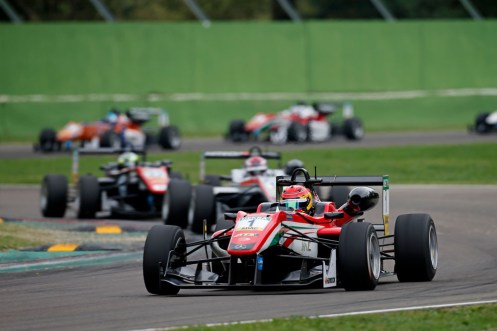
1 Lance Stroll (CAN, Prema Powerteam, Dallara F312 – Mercedes-Benz), 12 George Russell (GBR, HitechGP, Dallara F312 – Mercedes-Benz), 22 Joel Eriksson (SWE, Motopark, Dallara F312 – Volkswagen), FIA Formula 3 European Championship, round 9, race 2, Imola (ITA), 30. September – 2. October 2016
Newly crowned FIA European F3 Champion Lance Stroll secured his second race win of the weekend in stellar style, finishing nearly eight seconds ahead of George Russell and another two ahead of Callum Ilott.
The Prema Powerteam man led from the off, while Russell and Ilott fought over the runner-up prize into the opening corners.
In the only race this weekend not interrupted by the safety car, Stroll showcased his prowess, as he edged away from the chasing pack over almost all of the race’s twenty-two laps.
Such was the Canadian teenager’s confidence, he even registered the fastest lap of the weekend – a 1:35.876s – on the final tour. Having already secured the title in race two, Stroll appeared confident and happy within himself prior to the start and that really showed in this performance.
Russell had a trickier time as he kept Ilott at bay for the duration. Starting from the cleaner side of the grid, the Hitech GP man was able to slip by his van Amersfoort rival on the run down to Tamburello, securing the place under braking on the run into the chicane.
Thereafter Ilott held Russell close – often within one-and-a-half seconds – but he could not do enough to pressure Russell into an error. It was a good result for Russell, who now finds himself just 36 points shy of Maxi Günther in the standings.
Ralf Aron passed Joel Eriksson for 4th place on the opening lap and the pair remained relatively close as the race aged, but like the battles ahead, Eriksson could not close in of his Estonian rival to make a move.
Anthoine Hubert and Mikkel Jensen secured 6th and 7th respectively, having started in those positions; however Nick Cassidy proved the biggest mover as he climbed from 13th on the grid to 8th by the end.
David Beckmann led a gaggle of cars home across the line. The German headed a close battle with Guan Yu Zhou (10th), Sergio Sette Camara (11th) and Günther (12th) – the quartet were covered by 1.757s across the line.
Ben Barnicoat had a difficult race. Initially running 8th, the Hitech GP endured a tricky mid-section to the race, losing five places in the process, before his pace began to recover.
There were incidents at the start, when Niko Kari and Nikita Mazepin suffered offs, resulting in retirement for Kari and then Ukyo Sasahara destroyed his right rear suspension on lap three.
Harrison Newey also damaged his suspension with an off at the halfway mark, resulting in his retirement.
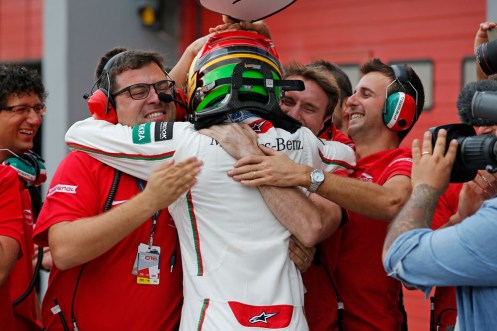
Rene Rosin (Team manager Prema Powerteam), 1 Lance Stroll (CAN, Prema Powerteam, Dallara F312 – Mercedes-Benz), FIA Formula 3 European Championship, round 9, race 2, Imola (ITA), 30. September – 2. October 2016
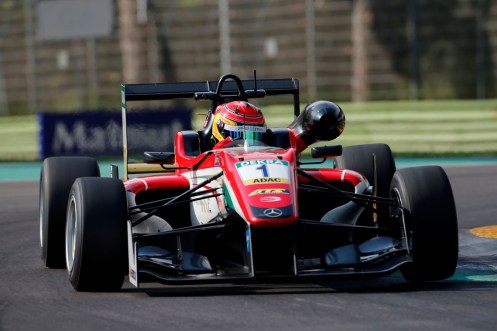
1 Lance Stroll (CAN, Prema Powerteam, Dallara F312 – Mercedes-Benz), FIA Formula 3 European Championship, round 9, Imola (ITA), 30. September – 2. October 2016
Prema Powerteam’s Lance Stroll claimed both race two and the FIA European Championship crown at Imola this afternoon.
Joel Eriksson continued his solid run to finish 2nd, while George Russell extended his lead over Nick Cassidy in the battle for 3rd in the standings.
Starting from pole, the Canadian teenager eased into a comfortable lead early lead from Russell, who had initially edged ahead of Eriksson.
Thereafter Stroll built a gap of approximately 2s, but as soon as Stroll got into a rhythm, the race was punctured by a safety car period, with three in total neutralizing the race.
The first came on lap three when Callum Ilott spun into the gravel at Rivazza and became beached in the sand. This came moments after another incident in which Ilott fell from 6th place, solidifying what has been a tricky weekend so far for the young Briton.
From the lap six restart, Stroll again build a lead of over 2s, only for that to be truncated when title rival Maxi Gunther binned his Prema Powerteam machine exiting the final bend, pitching him hard into the barrier from 12th spot.
Although Günther’s lowly position would have given Stroll the championship, this non-score confirmed Stroll’s crown.
On the lap 11 restart, Eriksson locked onto the rear of Russell, eventually retaking 2nd from the Hitech racer a tour later, but despite the charge, the Motopark man had nothing for Stroll and settled into a 2nd position a couple of seconds adrift of the lead but also comfortably ahead of Russell in 2rd.
There was one final stoppage when David Beckmann crashed at Tosa from 6th place, but come the lap 18 restart, Stroll continued to press his confidence and dominance on the race, again pulling away from the field and winning with sublime ease, as if he were in a different class.
Eriksson ran home a welcome 2nd ahead of Russell who doubtful have few complaints following that result.
Ralf Aron propped up what has been an inconsistent year with a drive to 4th, having taken both Harrison Newey and Ilott off the line. From there he stayed, although he fought hard to keep Guan Yu Zhou at bay in the latter tours.
Zhou enjoyed a good run up the order. From outside the top ten, he passed Günther, Anthoine Hubert, Cassidy and Newey, but also benefitted from offs by Sergio Sette Camara, Ben Barnicoat and Mikkel Jensen, all of whom fell from points playing positions.
Hubert came home 6th, thanks in part to a late race contretemps between Zhou, Newey and Cassidy. From 8th in the final few laps, Hubert took Cassidy and Newey, when Cassidy attempted an unlikely move down the inside of Zhou at Tamburello, inadvertently blocking Newey as he rejoined the track.
From there the Frenchman stayed ahead of Cassidy and Newey to maintain 6th, 7th and 8th across the line. Both Newey and Cassidy will be a touch disappointed with their final positions having run 5th and 6th at various points in the race.
Yesterday’s race winner Niko Kari came home 9th, despite starting 18th. The Finn calmly closed up the order, while also taking advantage of the misfortune of others.
Nikita Mazepin took the final points finish, when the resurgent Camara suffered another incident two laps from the end, which took him out of the race.
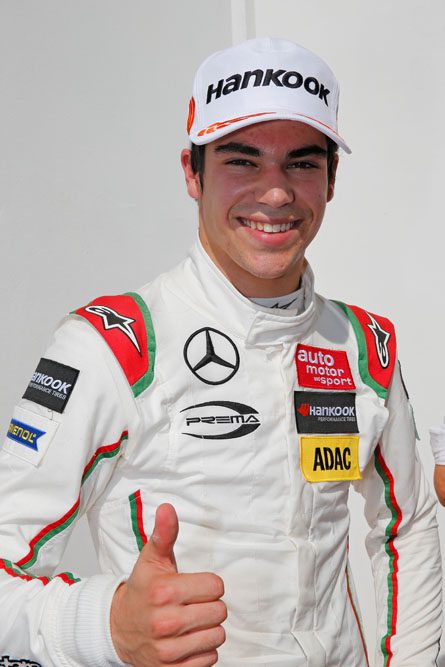
Lance Stroll; FIA European F3 Champion of 2016. © Thomas Suer / FIA.
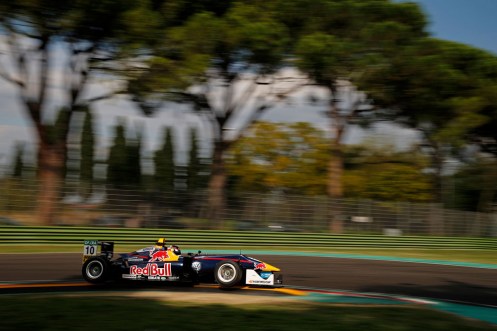
10 Niko Kari (FIN, Motopark, Dallara F312 – Volkswagen), FIA Formula 3 European Championship, round 9, Imola (ITA), 30. September – 2. October 2016
Red Bull Junior driver Niko Kari took his first FIA European F3 race victory at Imola today thanks to a wonderful move around Lance Stroll.
Stroll, who led for much of the race, took 2nd place, with Joel Eriksson not far behind in 3rd spot.
The Finn started from the front roll and initially chased Stroll, but took advantage of the draft after a second safety car restart to pull his way around the outside of the Prema Powerteam driver in Tamburello.
From there, Kari managed a narrow gap over Stroll, while the Canadian secured several fastest laps in his chase, but the teenager was unable to overhaul his Motopark rival.
It was a welcome result for Kari, who has endured an inconsistent year that has been peppered with some podiums, points results alongside several anonymous drives.
Stroll’s 2nd place finish may not be too disappointing. The Canadian came home ten positions ahead of his teammate and championship rival Maxi Günther to extend the points lead to eighty-six.
Eriksson fought an impressive battle to secure the final podium spot, with the Swede rising up the top eight taking Anthoine Hubert, George Russell and Nick Cassidy to eventually rise to the top three. Retirements and issues for David Beckmann, Sergio Sette Camara and Callum Ilott helped Eriksson’s position.
Cassidy initially started well, rising from 5th on the grid to 3rd off the line, but the Kiwi could not hold Eriksson at bay and had to do with 4th, while Russell secured 5th for Hitech following a sluggish start.
Hubert came home 6th for van Amersfoort, but it was a less fruitful result for the Dutch team’s other two drivers Callum Ilott and Harrison Newey. Ilott had been been running in the lower reaches of the points by halfway, but an off on lap 11 dropped him to 17th. After climbing back up the order, Ilott challenged Newey for 12th, only for the teammates to force each other off at Tamburello, with Ilott taking a long ride through the gravel travel trap. Both finished well outside the points.
Guan yu Zhou enjoyed a long battle with Ilott, before the latters off, but stayed on track to take 7th, ahead of Ralf Aron, whose mistake on lap nine left him battling for 8th. Ben Barnicoat secured 9th for Hitech, while Mikkel Jenson took the final point for Mücke with a 10th place finish/
The first safety came about when Pedro Piquet had a solo off at the Rivazza on lap five. The second safety car was released when Beckmann and Camara had an apparent coming together near Tamburello on lap 13.
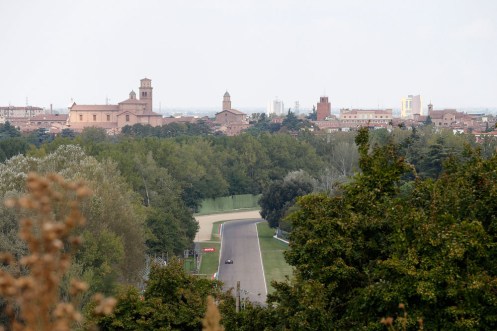
1 Lance Stroll (CAN, Prema Powerteam, Dallara F312 – Mercedes-Benz), FIA Formula 3 European Championship, round 9, Imola (ITA), 30. September – 2. October 2016

 TheMotorsportArchive.com