
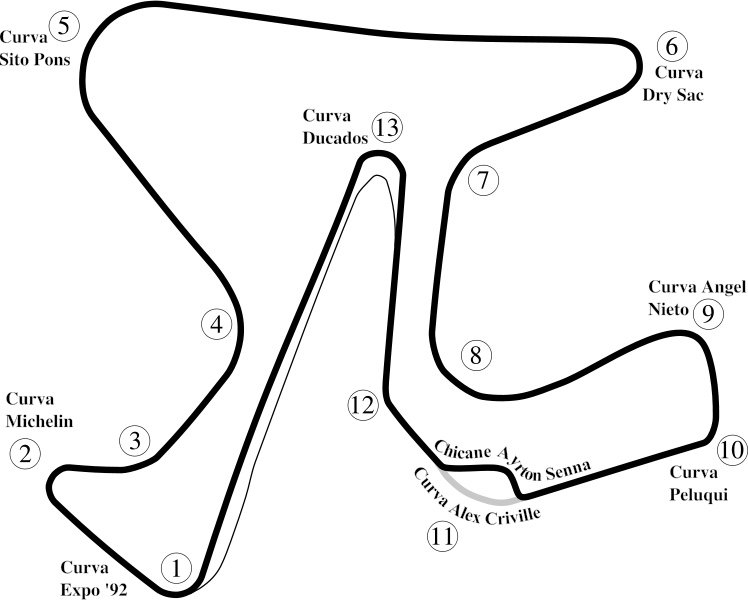
The last day of this week's test was at Jerez.
The final day of testing at Jerez saw a Rubens Barrichello take the lead of the timesheets.
At the wheel of his Cosworth-powered Williams, the Brazilian registered an unlikely time of 1:19.832 set in the morning, on a day when much of the running was around the 1:22 or 1:23 mark. Barrichello engaged in some long runs thereafter, eventually clocking up 103 laps.
Next up was the fiery Japanese driver, Kamui Kobayashi. The Sauber driver registered 86 laps on a day that was broken up by a spin and a drivetrain issue. Despite that, the Swiss squad have been making quiet, but confident noises about their 2011 prospects; although we well know at this stage that testing can be very deceptive.
Fernando Alonso was once again the day’s busiest pilot; the Spaniard took in 115 laps around Jerez in front of a respectable and enthusiastic Spanish crowd. His best lap of 1:21.074 was good enough for 3rd on the scoreboard, ahead of Sebastien Buemi’s Toro Rosso.
Entering his third season, Buemi has a critical year ahead of him, but if his STR6 shows as well in the races as it does in testing, he could be in for a solid year. A day of aerodynamic work and set-up evaluations gave the Swiss man a best of 1:21.213 after a 90 lap day.
Bruno Senna was unable to match Nick Heidfeld’s best time in the Renault today; however the former-Hispania racer took the day very much as a day of learning, especially as he had never used KERS or the movable rear wing before. It was also his début Pirelli run.
Heikki Kovalainen only managed 43 laps in his Lotus T128, but finished the day 1.8 seconds down on Barrichello; however numerous delays and niggling problems shortened the Finn’s running. Nico Rosberg only managed an extra two laps in the Mercedes as a late morning engine change meant Rosberg lost over three hours to the rest of the runners. His best lap of 1:22.102 put him one-tenth better than Sebastian Vettel, who spent his time investigating aerodynamic and suspension upgrades.
Jenson Button claimed 90 laps in the McLaren Mercedes, with a best lap some 2.44 seconds off the best. The 2009 World Champion complained later that it was difficult a good balance in the MP4-26, while an internal failure stopped running completely later on.
Both Jerome d’Ambrosio (10th, Virgin) and Paul di Resta (11th, Force India) had frustrating times again today. D’Ambrosio lost much of the session thanks to an engine problem late in the morning, meaning the Belgian could only produce 45 laps.
As for di Resta, a day doing long stints was cut short when a part failed on the front of the car. It was an unfortunate compromise for the Scot, who suffered balance problems in the morning.
For the final hour of the week, rain drew upon the Jerez circuit, giving the teams a short window to use wet Pirelli tyres for the first time.
Testing resumes on Friday at the Circuit de Catalunya, where a full field will take to the Barcelona track. As for Hispania, they begin a three day test and media session in Monza tomorrow, but are expected to have joined the pack come the green light on Friday morning.
Pos  Driver              Car                   Time       Gap       Laps
 1.  Rubens Barrichello  Williams-Cosworth     1m19.832s            103
 2.  Kamui Kobayashi     Sauber-Ferrari        1m20.601s  + 0.769s  86
 3.  Fernando Alonso     Ferrari               1m21.074s  + 1.242s  115
 4.  Sebastien Buemi     Toro Rosso-Ferrari    1m21.213s  + 1.381s  90
 5.  Bruno Senna         Renault               1m21.400s  + 1.568s  68
 6.  Heikki Kovalainen   Lotus-Renault         1m21.632s  + 1.800s  43
 7.  Nico Rosberg        Mercedes              1m22.103s  + 2.271s  45
 8.  Sebastian Vettel    Red Bull-Renault      1m22.222s  + 2.390s  90
 9.  Jenson Button       McLaren-Mercedes      1m22.278s  + 2.446s  70
10.  Jerome D'Ambrosio   Virgin-Cosworth       1m22.985s  + 3.153s  45
11.  Paul di Resta       Force India-Mercedes  1m23.111s  + 3.279s  99
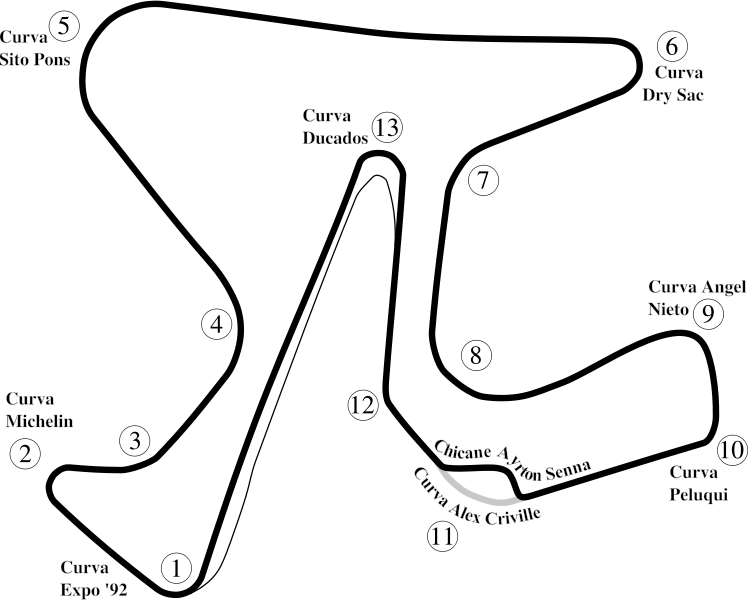
Jerez is based in southern Spain.
Nick Heidfeld’s chance of landing the Renault drive, in place of the injured Robert Kubica, received a bolster shot yesterday.
The veteran completed 86 laps around the Jerez circuit in southern Spain, clocking up a fastest lap of 1:20.361 in the process. During his runs, Heidfeld tested an upgraded floor while also carrying out further evaluations of the new Pirelli tyres.
Kubica wrestled his R31 to the top of the time sheets at last week’s test in Valencia, but questions remain about the true pace of Renault’s 2011 charger, compared to what Red Bull, Ferrari and McLaren may achieve.
The former Sauber driver claimed the top spot ahead of Ferrari’s Fernando Alonso, who managed several runs totalling 131 laps – easily the busiest any one driver has been on a day this week. Indeed the Spaniard ran a number of long runs during the afternoon as team begin to gather knowledge about potential race strategies.
Michael Schumacher continued his positive test week in the Mercedes. The seven-time World Champion registered the 3rd best time of the day, albeit seven-tenths down on Heidfeld; however the German was busy throughout the day, notching up 114 laps.
One driver who had plenty of time on his hands was Lewis Hamilton. The McLaren had very little running during Saturday due to a lack of spare parts (not arriving until Sunday), meaning Hamilton could only complete 36 laps before calling it a day. His best lap still put him for on the time sheets, one-tenth quicker than the next tester, Kamui Kobayashi.
This was the Sauber driver’s first test in the new C30 since the opening day at Valencia and he put it to good use, registering 84 laps throughout the day. It was a day of discovery for the Swiss squad as added some minor developments to the new machine, while also learning more about the Pirelli’s.
Further back were reigning champion, Sebastian Vettel (6th) in the Red Bull RB and Sebastien Buemi (7th) in the sister car, the Toro Rosso STR6. Both ran over 90 laps each, with Vettel bettering Buemi on the timesheets by just 0.1 of-a-second, although whether this is borne out come the first race weekend remains to be seen. Buemi’s session ended slightly earlier than everyone else’s as his Toro Rosso shut down with ten minutes to go.
Lotus continued to show good progress with their T128 design. Finnish driver Heikki Kovalainen completed a 61 lap day, with a fastest 1.35 seconds down on Heidfeld; something that could not be said for Rubens Barrichello. The Brazilian was only able to guide his Williams to 9th quickest, although he did garner 99 valuable laps of Jerez. There may well have been more running for the grove squad had there not been an issue with the KERS onboard cooling system.
Only Paul di Resta (10th, Force India) and Jerome d’Ambrosio (11th, Virgin) were slower than Barrichello, as both rookies continue to get used to both their new roles and their new cars. During the day, di Resta suffered from braking issues, while d’Ambrosio worked on getting used to the Nick Wirth designed MVR-02.
Pos  Driver              Car                   Time       Gap       Laps
 1.  Nick Heidfeld       Renault               1m20.361s            86
 2.  Fernando Alonso     Ferrari               1m20.493s  + 0.132s  131
 3.  Michael Schumacher  Mercedes              1m21.054s  + 0.693s  114
 4.  Lewis Hamilton      McLaren-Mercedes      1m21.099s  + 0.738s  36
 5.  Kamui Kobayashi     Sauber-Ferrari        1m21.242s  + 0.881s  84
 6.  Sebastian Vettel    Red Bull-Renault      1m21.574s  + 1.213s  98
 7.  Sebastien Buemi     Toro Rosso-Ferrari    1m21.681s  + 1.320s  92
 8.  Heikki Kovalainen   Lotus-Renault         1m21.711s  + 1.350s  61
 9.  Rubens Barrichello  Williams-Cosworth     1m22.227s  + 1.866s  99
10.  Paul di Resta       Force India-Mercedes  1m22.945s  + 2.584s  64
11.  Jerome D'Ambrosio   Virgin-Cosworth       1m25.471s  + 5.110s  72
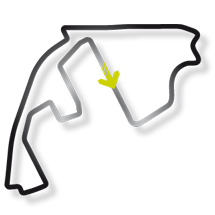
Yas Marina layout. © GP2 Media Service
Stefano Coletti garnered his first GP2 Series victory yesterday with a measured drive in Abu Dhabi.
The Monegasque racer picked up something of an advantage when fellow front row man, Sam Bird, got a poor start to be passed by the swift Giedo van der Garde.
Unfortunately for van der Garde, he would receive a drive through penalty early, thanks to mechanic retrieving tools from his sidepod, just as the lights went out for the warm up lap. The Dutchman took the penalty on the fifth lap, essentially dropping him to the rear of the field for the duration.
Van der Garde would soon be joined by Dani Clos, as the Spaniard stalled on the grid for the second consecutive race, completing a nightmare weekend for the Racing Engineering driver.
A decent weekend for Romain Grosjean turned somewhat sour on the opening lap too. The Renault reserve got off the line well, only to be passed by championship rival Jules Bianchi in the first few turns. That dropped Grosjean to 9th; however that became a retirement half-a-lap later, as the DAMS driver was tapped into a spin by Michael Herck.
Things wee going rather better for Marcus Ericsson. The young Swede made a good start and after a few laps attempted moves on Davide Valsecchi, finally drew himself into 4th spot to leave him trailing Coletti, Bird and Josef Kral after six laps
The race became rather static after the opening half-a-dozen laps as the field fell into a long line of machines, with only Nathanael Berthon making any progress. The Frenchman spent the initial stint in 11th place, but moves passed Rodolfo Gonzalez and Johnny Cecotto made that 9th.
A collective shuffle came on lap 23 as Sam Bird lost the rear of his iSport machine, planting the Dallara chassis into the barriers. It brought Kral up to 2nd position – his highest GP2 position to date. Sadly there was to be no such progress for Mikhail Aleshin – the Russian driver had been having a difficult time in Abu Dhabi and found himself out of the race with only three laps remaining.
Out front, Coletti continued home, taking the chequered flag in style. His gap to Kral – at 2.629 seconds – may not have been emphatic, but it did not need to be. The Trident racer has shown much improved pace during both the tests and the first weekend and now comes away with his first GP2 victory, while never once looking pressurised from behind.
For Josef Kral, runner-up spot is also a big improvement, especially as the Czech Republic native calmly held off a push by Marcus Ericsson in 3rd.
Feature Race winner, Jules Bianchi had originally come across the line in 4th spot, but was later given a 2-second penalty for passing under yellow flags, dropping the Frenchman down to 8th. It was a shame for Bianchi, who had run a good race up until that point having made last passes on Davide Valsecchi and Fabio Leimer.
It promoted Davide Valsecchi to 4th, followed by the bumper machine that is Michael Herck (5th). Herck has also forced his by Leimer in the dying laps, as Leimer’s tyres gave up. Leimer eventually took the final points place.
Nathanael Berthon and Charles Pic had originally come home 8th and 10th, but both received 20 second penalties for not respecting yellow flags – it would drop them down to 14th (Berthon) and 21st (Pic). Johnny Cecotto crossed the line 7th to be classified ahead of Bianchi, as Jolyon Palmer and Rodolfo Gonzalez rounded out the top ten.
Like the Feature Race, Saturday afternoon’s GP2 Asia adventure was a dour affair with not much overtaking, nor much of an opportunity to pass. Indeed, drivers more or less slipped down the order depending on the state of their tyres – worrying, should this set the scene for the rest of the season.
Race Rating: 2 out of 5
Pos  Driver               Team                  Time/Gap
 1.  Stefano Coletti      Trident             43m02.819s
 2.  Josef Kral           Arden                 + 2.629s
 3.  Marcus Ericsson      iSport                + 3.323s
 4.  Davide Valsecchi     AirAsia              + 11.531s
 5.  Michael Herck        Coloni               + 14.687s
 6.  Fabio Leimer         Rapax                + 17.175s
 7.  Johnny Cecotto       Super Nova           + 25.351s
 8.  Jules Bianchi        ART                   + 9.434s**
 9.  Rodolfo Gonzalez     Trident              + 30.947s
10.  Jolyon Palmer        Arden                + 32.897s
11.  Andrea Caldarelli    Ocean                + 33.396s
12.  Esteban Gutierrez    ART                  + 33.643s
13.  James Jakes          Coloni               + 34.526s
14.  Nathanael Berthon    Racing Engineering   + 17.426s**
15.  Fairuz Fauzy         Super Nova           + 38.094s
16.  Luiz Razia           AirAsia              + 38.830s
17.  Julian Leal          Rapax                + 39.280s
18.  Max Chilton          Carlin               + 42.205s
19.  Oliver Turvey        Ocean                + 42.677s
20.  Pal Varhaug          DAMS                 + 43.137s
21.  Charles Pic          Addax                + 25.493s**
22.  Dani Clos            Racing Engineering   + 47.035s
23.  Giedo van der Garde  Addax                + 49.926s

Retirements:

     Mikhail Aleshin      Carlin                 23 laps
     Sam Bird             iSport                 21 laps
     Romain Grosjean      DAMS                    0 laps
**20-second penalty
Pos  Driver                     Points
 1.  Jules Bianchi                  12
 2.  Romain Grosjean                10
 3.  Davide Valsecchi                9
 4.  Marcus Ericsson                 9
 5.  Josef Kral                      8
 6.  Stefano Coletti                 7
 7.  Giedo van der Garde             4
 8.  Michael Herck                   2
 9.  Sam Bird                        2
10.  Fabio Leimer                    1
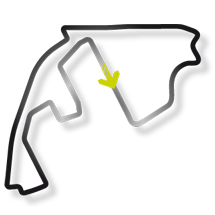
Yas Marina layout. © GP2 Media Service
Lotus-ART driver Jules Bianchi nailed the Feature Race victory at Abu Dhabi on Friday afternoon to assure stellar start to the 2011 GP2 Asia Series.
Although the Frenchman found himself somewhat adrift of poleman Romain Grosjean after the Thursday afternoon qualifying, Bianchi soared into the lead off the line to seize the initiative. It was short lived.
While much of the field pulled away from their respective grid slots, Dani Clos stalled from his second row position, only to be rammed by an unsighted Luiz Razia, who in turn collected Pal Verhaug (DAMS). Thankfully all three drivers emerged unharmed from their stricken machines.
Instantly, the safety car was instantly introduced; however this only led to confusion on the back straight as green lights turned to flashing yellow, with several drivers seemingly striking the brakes on the long stretch. Caught unawares, Trident racer Rodolfo Gonzalez, ran into the rear of Charles Pic, removing his own front wing and Pic’s rear end in the process.
With the circuit shrouded in debris, the red flag was thrown.
Bianchi was sure to maintain his command of the race when it eventually restarted, but with overtaking so difficult, Grosjean could not get by the Lotus-ART machine.
Davide Valsecchi shadowed the leading pair in the early laps, only to fall away as the race matured; however the reigning GP2 Asia Champion had his own position to ponder, as Giedo van der Garde, Marcus Ericsson and Max Chilton bore down on the Italian.
A repaired Rodolfo Gonzalez started the mandatory pit cycle on the seventh lap, but it would be a further six tours before the frontrunners opted for new Pirelli’s. Valsecchi was the first to make the jump (lap 12), followed by Grosjean a lap later and Bianchi on the 15th lap. Ericsson and van der Garde made for new tyres in this period, but were unable to overhaul Valsecchi, while a poor stop for Chilton dropped him out of contention.
Unperturbed by tyre wear, Fabio Leimer, Jolyon Palmer and Charles Pic stayed out for the long haul, easily holding the top three positions ahead of Bianchi and co.
In fact while Palmer and Pic eventually took to the pits (laps 19 and 26 respectively), Leimer stayed put on circuit, seemingly content with his Pirelli’s. The long runs by Leimer, Palmer and Pic pointing to potential long term stability with the new tyres – something that will be of importance later in the year as teams play with race strategies.
Leimer played for too long though. Having finally pitted on lap 29, Pic had reeled the Rapax driver in and passed him as Leimer exited the pit lane. Only two laps remained when Oliver Turvey pulled off track while stuck in gear, gifting a top-ten spot to Pic.
Pic was soon battling with Max Chilton (8th) and Stefano Coletti. Although Coletti beat Pic to 9th spot, Chilton was judged to have overtaken the pair on the run off area at the end of the second back straight, earning the Briton a 20 second post-race penalty.
Of course, none of this registered with Jules Bianchi. The Frenchman kept his head and his lead ahead of Grosjean, eventually crossing the finish line for a solid victory. Bianchi also picked up an extra point for the race’s fastest lap, which he secured on the second-last tour.
Grosjean came home an unchallenged 2nd and Davide Valsecchi made it to 3rd, giving Team AirAsia a podium on their GP2 début. Marcus Ericsson swiped 4th off of Giedo van der Garde on the final lap, as the Dutch driver’s tyres fell away; however van der Garde had more than enough of a gap over 6th place Josef Kral to maintain his top-five position.
Sam Bird took quiet 7th place in his iSport machine giving the Englishman a front-row starting position for the following Sprint Race. He was to be joined by Max Chilton, but his penalty dropped him down to 12th. It promoted Stefano Coletti to 8th ahead of Charles Pic (9th) and Fabio Leimer (10th).
Behind the top-ten, Julian Leal and Fairuz Fauzy took themselves out of contention as the pair clouted eachother while fighting over 19th place. Also Johnny Cecotto and Jolyon Palmer were spun around at the end of the first back straight by the somewhat clumsy Michael Herck.
Michael Aleshin, Esteban Gutierrez and Nathanael Berthon also joined the retirements list thanks to various mechanical failures.
It was a decent run from the field once the red flag was cleared, but it was obvious that passing is still very difficult at the Yas Marina circuit for formula cars.
This race win could be the start of big year for Jules Bianchi as he eyes up a Formula 1 seat.
Race Rating: 2 out of 5
Pos  Driver               Team                    Time/Gap
 1.  Jules Bianchi        ART                 1h22m04.643s
 2.  Romain Grosjean      DAMS                    + 6.681s
 3.  Davide Valsecchi     AirAsia                + 12.794s
 4.  Marcus Ericsson      iSport                 + 14.001s
 5.  Giedo van der Garde  Addax                  + 15.198s
 6.  Josef Kral           Arden                  + 20.601s
 7.  Sam Bird             iSport                 + 24.412s
 8.  Stefano Coletti      Trident                + 36.809s
 9.  Charles Pic          Addax                  + 37.411s
10.  Fabio Leimer         Rapax                  + 40.252s
11.  Max Chilton          Carlin                 + 31.866s**
12.  Rodolfo Gonzalez     Trident                + 48.587s
13.  Michael Herck        Coloni                 + 59.963s
14.  Jolyon Palmer        Arden                + 1m07.206s
15.  Johnny Cecotto       Super Nova           + 1m08.136s
16.  Andrea Caldarelli    Ocean                + 1m37.978s

Retirements:

     James Jakes          Coloni                  32 laps
     Oliver Turvey        Ocean                   32 laps
     Nathanael Berthon    Racing Engineering      24 laps
     Julian Leal          Rapax                   19 laps
     Fairuz Fauzy         Super Nova              19 laps
     Esteban Gutierrez    ART                     18 laps
     Mikhail Aleshin      Carlin                  10 laps
     Dani Clos            Racing Engineering       0 laps
     Luiz Razia           AirAsia                  0 laps
     Pal Varhaug          DAMS                     0 laps
**20-second penalty
Pos  Driver               Team                  Points
 1.  Jules Bianchi        ART                   11 points
 2.  Romain Grosjean      DAMS                  10
 3.  Davide Valsecchi     AirAsia                6
 4.  Marcus Ericsson      iSport                 5
 5.  Giedo van der Garde  Addax                  4
 6.  Josef Kral           Arden                  3
 7.  Sam Bird             iSport                 2
 8.  Stefano Coletti      Trident                1
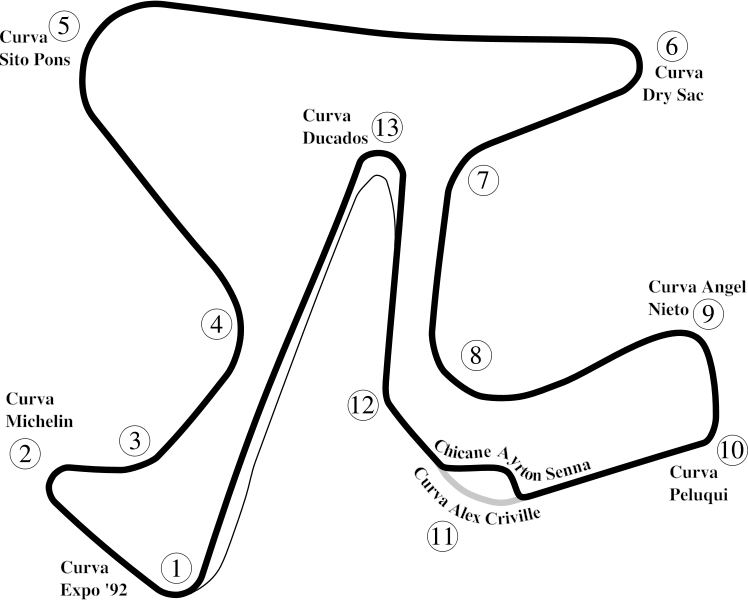
The layout for Jerez.
Seven-time World Champion Michael Schumacher topped today’s running at the Jerez.
The Mercedes driver registered a speedy run of 1:20.352 at the beginning of a 10-lap run, leaving the famous German 0.061 of-a-second quicker than Ferrari pilot, Felipe Massa. However, Schumacher’s fast laps appeared to be spikes rather than indications of consistent pace from his MGP-W02 machine.
Completing 112 laps, Schumacher may also take some satisfaction that he suffered none of the hydraulic problems that have blighted teammate Nico Rosberg in testing thus far. Massa, meanwhile, managed 116 laps throughout the day, clocking up steadier times in the 2011 Ferrari.
That left the Brazilian over six-tenths ahead of McLaren’s Jenson Button, although the British team spent part of the day completing systems checks on their new entry, before letting Button out on circuit. The 2009 World Champion held an advantage of 0.2 of-a-second over Jaime Alguersuari. Running in the STR6, Alguersuari logged 72 laps, managing to keep a rather steady pace throughout his stints.
In the big sister car, Mark Webber notched up the 5th best time in his Red Bull. The Australian secured a best lap of 1:21.613; however it was in the long runs that Webber impressed as he set decent times over 15-19 laps stints.
Next up was Adrian Sutil. The Force India driver racked up 73 laps with a quickest of 1:21.780, giving the German less than a one-tenth advantage over 7th best man, Sergio Perez. After showing up near the top of the pile yesterday, the Mexican could do no better than 1:21.857 – a time that may be more representative of the Sauber’s actual pace. Perez ended his session early by crashing in turn 7, destroying the left-front suspension of his Sauber C30.
Renault’s Vitaly Petrov had an unspectacular day, although his day was punctured somewhat by causing one the opening red flag of the day with a spin. The Russian finished 2.1 seconds off of Schumacher’s pace, although that was quick enough to pip the Williams of Pastor Maldonado by 0.098 of-a-second. Having lost a lot of time yesterday and today due to car problems, Maldonado caused further difficulties for his Williams team by stuffing his FW33 into the turn 4 barriers.
Lotus’ Jarno Trulli filled out the order, 2.86 seconds shy of Schumacher; however the day ended early for the Italian due to mechanical issues.
Pos  Driver              Car                   Time       Gap       Laps
 1.  Michael Schumacher  Mercedes              1m20.352s            112
 2.  Felipe Massa        Ferrari               1m20.413s  + 0.061s  116
 3.  Jenson Button       McLaren-Mercedes      1m21.009s  + 0.657s  69
 4.  Jaime Alguersuari   Toro Rosso-Ferrari    1m21.214s  + 0.862s  72
 5.  Mark Webber         Red Bull-Renault      1m21.613s  + 1.261s  113
 6.  Adrian Sutil        Force India-Mercedes  1m21.780s  + 1.428s  73
 7.  Sergio Perez        Sauber-Ferrari        1m21.857s  + 1.505s  56
 8.  Timo Glock          Virgin-Cosworth       1m22.208s  + 1.856s  57
 9.  Vitaly Petrov       Renault               1m22.493s  + 2.141s  65
10.  Pastor Maldonado    Williams-Cosworth     1m22.591s  + 2.239s  38
11.  Jarno Trulli        Lotus-Renault         1m23.216s  + 2.864s  40
Carnegie – famous for his deep rumbling voice and catchphrases signifying the start of a quick qualifying run and a new track record – was the track announcer at the Indianapolis Motor Speedway from 1946 until his retirement five years ago.
During the second World War, the Connecticut native played basketball; however an illness shortened his brief career. A keen speaker, Carnegie took debating to heart, where soon after he took a broadcasting job with the radio station, WOWO, in Indiana. As well as basketball games, Carnegie presented car shows, something that led to him being approached by Tony Hulman about being the announcer for the re-opened Indianapolis Motor Speedway.
Carnegie maintained that position until he left in 2006 at the age of 86.
Commentators and announcers come and go, but rarely do they feed into the public consciousness, becoming almost an integral part of the sport. Tom Carnegie was one of that rare breed.
Tom Carnegie (1919-2011)
© iSport are regular GP2 title challengers. © GP2 Series Media Service
With the first Feature Race of the 2011 GP2 Asia Series only a few of hours away, how timely would it be for a very quick season preview?
Of course, when writing “season”, I realise that this year’s Asia Championship only contains three rounds – once this weekend at the Yas Marina circuit in Abu Dhabi and twice at Sakhir in Bahrain.
It can therefore be rather difficult to validate the worth of the Championship, when it runs for such a short period; however for the first time in its run, GP2 Asia has garnered much attention and notice.
This year sees the introduction of the new spec chassis for the series – the GP2/11. The new car has been aimed to replicate the modern Formula 1 car to some degree and as such has followed a similar aerodynamic path of a wide front wing and a tall, but square-shaped rear end. Whether the attempt to mimic the top level remains to be seen.
Such is the demand for seat time in the new car, the entry list for this year’s Asia Series run represents many that will be high fliers in the Main Series, as opposed to the weakened fields that have taken part in recent years.
We will see soon as the Renault-Mechachrome engines burst into life – now the race to become the 2011 GP2 Asia Series Champion begins.
The Favourites
Romain Grosjean
DAMS driver Romain Grosjean probably has the most to lose in this brief championship. Having been dropped the Renault Formula 1 team at the end of 2009, the Swiss driver took time out to compete in Auto GP, winning that series, despite not attending every race. Grosjean won the GP2 Asia Series three years ago and may need to show race winning – if not Championship winning – form, if he is to keep his Formula 1 hopes alive.
Grosjean has gained an early boost with pole for today’s Feature Race.
Davide Valsecchi
The reigning GP2 Asia Champion, Davide Valsecchi, returns with the new Team AirAsia squad – an offshoot of Formula 1’s Team Lotus. While Valsecchi’s situation may not as perilous as Grosjean’s, the Italian still needs to pull some victories out of the bag – and I believe he may do just that. He showed some good speed in pre-season testing and appears to be building confidence; however this will be his fourth year in GP2 – if he’s going to make his case for Formula 1, he’s needs to do it now.
Valsecchi will be starting from 3rd on the grid in Abu Dhabi.
Jules Bianchi
The one driver who looked brilliant quick throughout testing was young Frenchman Jules Bianchi. While the Ferrari reserve did not have the best of GP2 Asia campaigns last year, Bianchi really began to show his hand in the Main Series, eventually finishing 3rd overall despite garnering no wins. Now entering his second year of GP2 competition, Bianchi may well be about to shine and has the potential to give ART GP another GP2 title.
Bianchi qualified an excellent 2nd for this afternoon’s race.
Outside Favourites
Sam Bird
New iSport International signing, Sam Bird, suffered much poor luck during his début GP2 run last year; however on occasion he displayed a fantastic turn of speed. While Bird is undoubtedly one of the best overtakers in the field, his skills have often had to come about following his own errors. Should he curb some of those mistakes and keep his head up front, then he may add to his Monza victory from last September.
Following an indifferent qualifying session today, Bird will start from 11th at Yas Marina.
Giedo van der Garde
Going into his second season with Barwa Addax, Dutchman Giedo van der Garde will be looking to make a splash in 2011 following a couple of so-so years. In 2009, van der Garde scored three Main Series victories, but was highly inconsistent during the rest of the year – last season, he found consistency, but was not victorious anywhere. If van der Garde can reconnect those winning ways to his new found consistency, results should come.
Van der Garde will get away from 5th on the grid in Abu Dhabi.
Dani Clos
Spain’s Dani Clos did not have a good 2009. An aborted Asia Series run, followed a year of of struggles in the Main Series left many scratching their heads as to how much talent Clos actually had. In fairness to the Racing Engineering driver, he really came alive in 2010, eventually taking one win and four podiums on his way to 4th in the Main Championship. Expect great things from the 22 year-old this year, but also watch for the odd moment when he goes completely off the boil.
Clos starts alongside Valsecchi in the Feature Race with a good qualifying effort in 4th.
Occasional Potential Surprises
As with every Championship, we will see the occasional surprise result from young contenders as they find their feet in the series. So don’t be shocked if the likes of Marcus Ericsson (iSport), Oliver Turvey (OCR), Charles Pic (Barwa Addax), Fabio Leimer (Rapax), Mikhail Aleshin and Max Chilton (both Carlin), Luiz Razia (Team AirAsia) and / or Esteban Gutierrez (Lotus ART) grab the odd podium or race win.
I’m going to stick my neck out and say the 2011 GP2 Asia Series Champion will be…
Jules Bianchi.
The opening Feature Race from the shortened version of Abu Dhabi’s Yas Marina circuit will be broadcast live from British Eurosport 2 at 1pm (GMT). Live timing will also be available from gp2series.com.
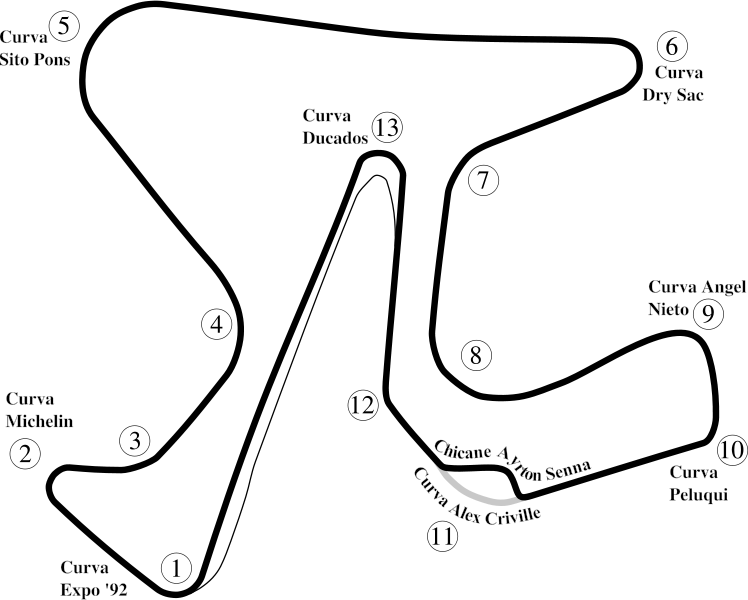
Layout of Jerez
Ferrari’s Felipe Massa made the best of the opening day’s test at Jerez in southern Spain.
The Brazilian clocked up 101 laps over the course of the morning and afternoon, with a best of 1:20.709 – nearly eight-tenths clear of the next quickest man, Sergio Perez. The Sauber pilot clocked up 94 laps in his C30 – both Massa and Perez will return tomorrow.
Mark Webber was next up in the RB7 with a quickest lap 1:21.522; only two-tenths up on Daniel Ricciardo, this years Toro Rosso reserve driver. Ricciardo only ran in the morning, before handing over to teammate Jaime Alguersuari. The Spaniard notched up the 6th best lap, some 1.98 seconds slower than Massa.
In between the Toro Rosso pair was McLaren’s Lewis Hamilton. The 2008 World Champion gave the MP4-26 its first run, placing 5th in the time sheets by the evening’s chequered flag.
Another team to début their 2011 charger was the Force India VJM04. It was left to Adrian Sutil to do the driving duties and the German ran for 28 laps, with a best of 1:23.472. That placed Sutil a few thousandths quicker than Renault’s Vitaly Petrov.
The Russian will also be running tomorrow, with Saturday and Sunday being split between Bruno Senna and Nick Heidfeld – the Renault squad will quickly need to decide who replaces the injured Robert Kubica when the season starts next month.
Mercedes’ Nico Rosberg was next up, finishing 3.25 seconds slower than Massa. Already there appear to be worries from the Mercedes camp that the car is a disappointment with talk of a Bahrain upgrade filtering down. Rosberg ran 67 laps, before hydraulics ended his day prematurely.
Jarno Trulli took 10th spot ahead of Virgin’s Timo Glock, giving the early impression that not much has changed in the ordering of the teams. Williams new boy Pastor Maldonado brought up the rear, although a difficult day filled with inactivity left the Venezuelan 14.26 seconds shy of Massa. By the evening, Maldonado had only completed 14 laps.
There were a few red flags throughout the day, mainly caused by spins from Petrov and Perez; however a number of other stoppages occurred that stuttered the session somewhat.
Only eleven teams will be running in Jerez this week. Hispania Racing have taken this week out to commit to taking a testing and media schedule at Monza from Monday to Wednesday of next week.
Pos  Driver             Car                   Time       Gap
 1.  Felipe Massa       Ferrari               1m20.709s
 2.  Sergio Perez       Sauber-Ferrari        1m21.483s  + 0.774s
 3.  Mark Webber        Red Bull-Renault      1m21.522s  + 0.813s
 4.  Daniel Ricciardo   Toro Rosso-Ferrari    1m21.755s  + 1.046s
 5.  Lewis Hamilton     McLaren-Mercedes      1m21.914s  + 1.205s
 6.  Jaime Alguersuari  Toro Rosso-Ferrari    1m22.689s  + 1.980s
 7.  Adrian Sutil       Force India-Mercedes  1m23.472s  + 2.763s
 8.  Vitaly Petrov      Renault               1m23.504s  + 2.795s
 9.  Nico Rosberg       Mercedes              1m23.963s  + 3.254s
10.  Jarno Trulli       Lotus-Renault         1m24.458s  + 3.749s
11.  Timo Glock         Virgin-Cosworth       1m25.086s  + 4.377s
12.  Pastor Maldonado   Williams-Cosworth     1m34.968s  + 14.259s
This evening Canadian race promoters, Octane Racing Group, released a picture of the new layout for the IZOD IndyCar race at Edmonton.
The original configuration for the city centre airport circuit has received much criticism since its inception in 2005 (then a Champ Car event). Multiple slow and medium speed corners broke up several all too-short straights, meaning many races at the track became processional affairs.
Having taken over the race in 2009, Octane determined that the circuit map needed to change in order to encourage better races; however difficulties regarding finances, as well as problems regarding runway closures put the future of event in doubt.
Now with the event secured, a thirteen-turn course has been unveiled, to be raced on for the first time later this year. Measuring in at 2.256 miles, the new Edmonton track will contain two long straights (out of turn 13 to turn 1 and from turn 12 to 13), while the section from the first corner to turn 5 will feature a shorter straight dominated by light kinks and quick switches. Turns 6 to 12 are dominated by slower speed corners, no doubt with a view to forcing driver errors.
Along with a simplified ticketing package that allows for greater general admission areas on race day and cheaper three-day sets, the course will be littered with six grandstands and TV towers that are to be placed much closer to the action.
So far, the Firestone Indy Lights Series is the only announced support for the IndyCar race; however it is thought that the weekend program may grow with a greater package to be announced for Friday and Saturday.
The Honda Indy Edmonton will take place from 22nd – 24th of July. Tickets go on sale on Friday.

© Octane Racing Group
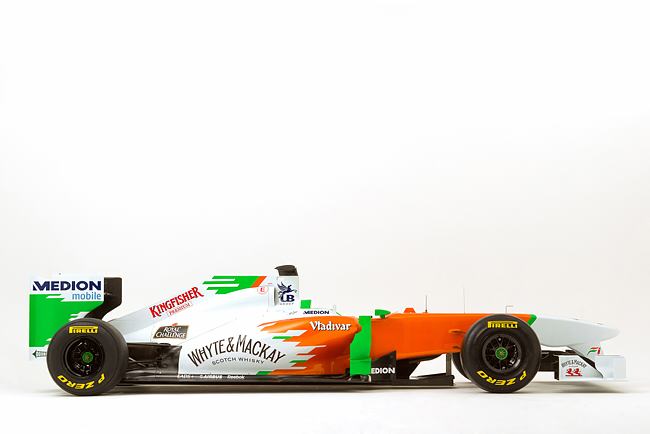
© Force India Formula 1
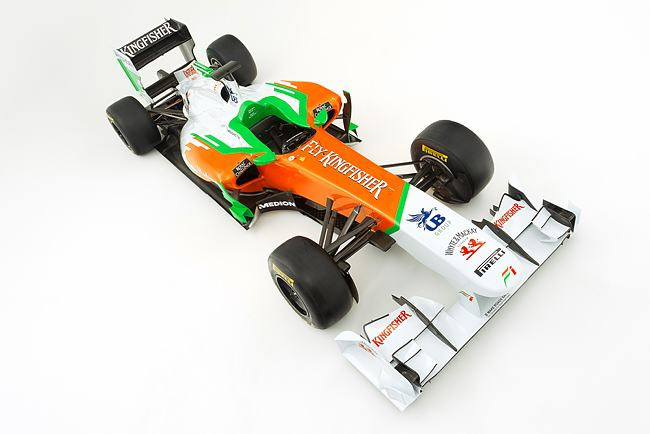
© Force India Formula 1
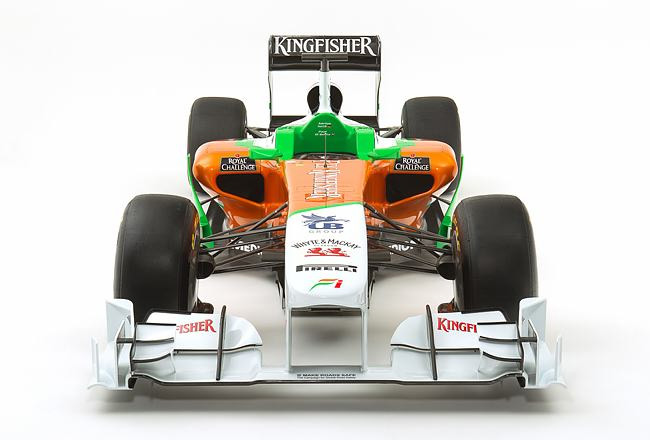
© Force India Formula 1
Drivers: (14) Adrian Sutil, (15) Paul di Resta; (Reserve) Nico Hulkenberg.
Team: (Principal) Vijay Mallya, (Technical Director / Designer) Andrew Green, (Chief Operating Officer) Otmar Szafnauer.
Engine: Mercedes-Benz FO 108Y 90° V8, limited to 18,000 RPM, naturally aspirated, mid-mounted.
Transmission: McLaren Seven-speed semi-automatic gearbox with reverse gear, Electronic shift system.
Weight (with driver, et al): 640 kg
© Hispania Racing Team
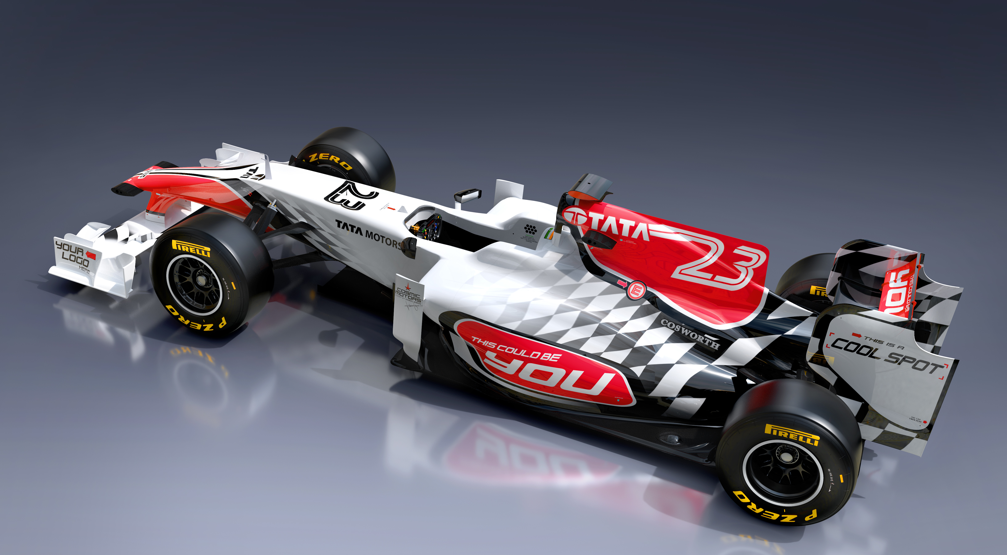
Images emerged this morning of a potential livery for Hispania Racing for their 2011 charger.
Having brought in Hollywood vehicle concept designer Daniel Simon, the team is going about building a new corporate image for the Spanish outfit. Simon has previously worked with the likes of Bugatti and Honda during previous rebranding processes and is also the author of the car design book, Cosmic Motors.
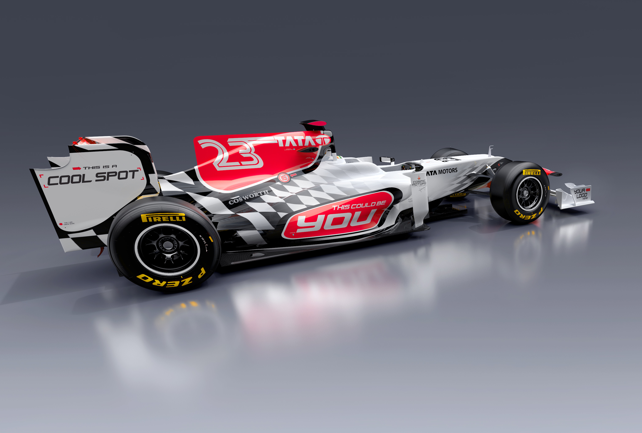
The initial livery appears to be a far cry from the battleship grey that covered last year’s machines. As this early stage, Simon has taken a peculiar step of places messages on the car advertising sale spots. Rather than leave sections of the car blank, the large open spaces have been adorned with messages, such as “this could be you”, “this is a cool spot” or more simply “your logo”.
In fact, bar some occasional small ‘Tata’ logo’s courtesy of Narain Karthikeyan’s arrival, the car appears to be completely shy of sponsors.
© Hispania Racing Team
Attracting sponsors to Formula 1 is a difficult game at the moment, especially if your previous car was regularly last of the pack, but considering there are with only five weeks left until the start of the season; signs begging for spaces to be filled are not the most attractive.
It potentially signals another tough year for Hispania – even Sauber struggled to attract spot buyers in 2010, despite their occasional points finishes.
Hispania’s 2011 machine is due to be launched at the fourth pre-season test at the Sakhir circuit in Bahrain next month. The survival of the team may very much depend on its performance.
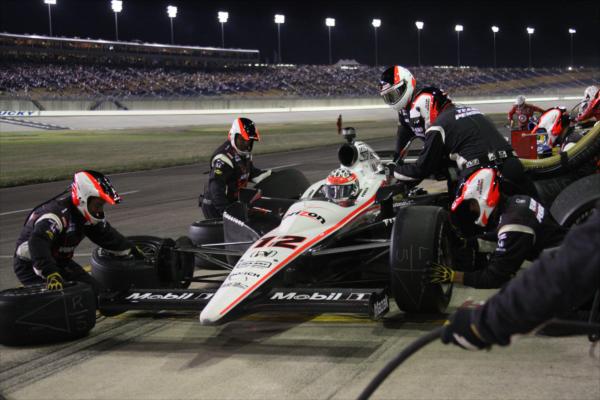
Will Power can be seen on UK screenns this year. © Dana Garrett
Following several weeks of fan uncertainty, it was announced yesterday evening that the IZOD IndyCar Series has secured a broadcast partner for the next two years.
The mainly US Championship has re-signed with Sky Sports, some six weeks prior to the first race of the year in St Petersburg.
Fronting the coverage will be former motorbike racer and presenter Keith Huewen, who will be paired in studio by long-time ALMS competitor Johnny Mowlem.
All seventeen races will be covered live and in High Definition.
Whether the IndyCar Series has a future on some of the premier Sky Sports channels remains to be seen; however for this year at least, the broadcasts will most likely remain on Sky Sports 4.
No ancillary programming is expected. Indy Lights will not have a broadcast in Europe, but can still be caught live on indycar.com. All IndyCar practices, qualifying (and the race) can also be found on the Championship’s home site.
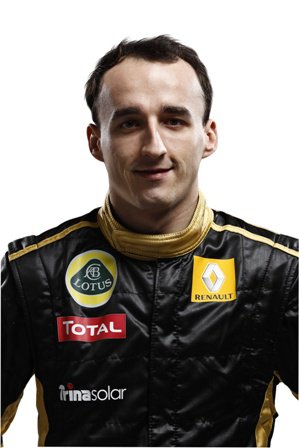
© Lotus Renault F1
Injured Formula 1 driver, Robert Kubica, showed some positive signs today when woken by doctors in the Santa Corona Hospital.
Kubica, who was placed into an induced coma yesterday evening, responded to relatives when conscious and was able to move his fingers slightly.
This is fabulous news, although it will be up to one week before more solid news can be revealed.
For further updates, keep an eye out at Renault Formula 1.
Virgin MVR-02
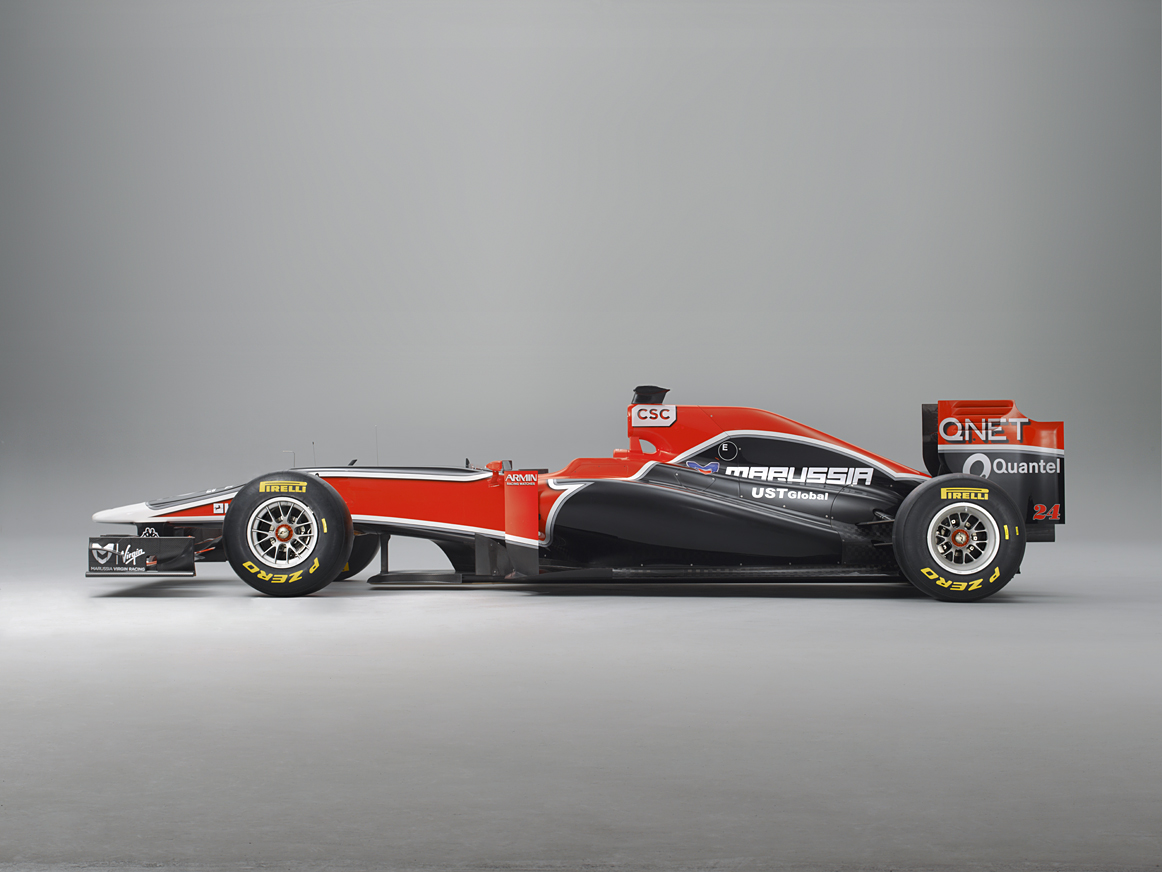
© Marussia Virgin Racing
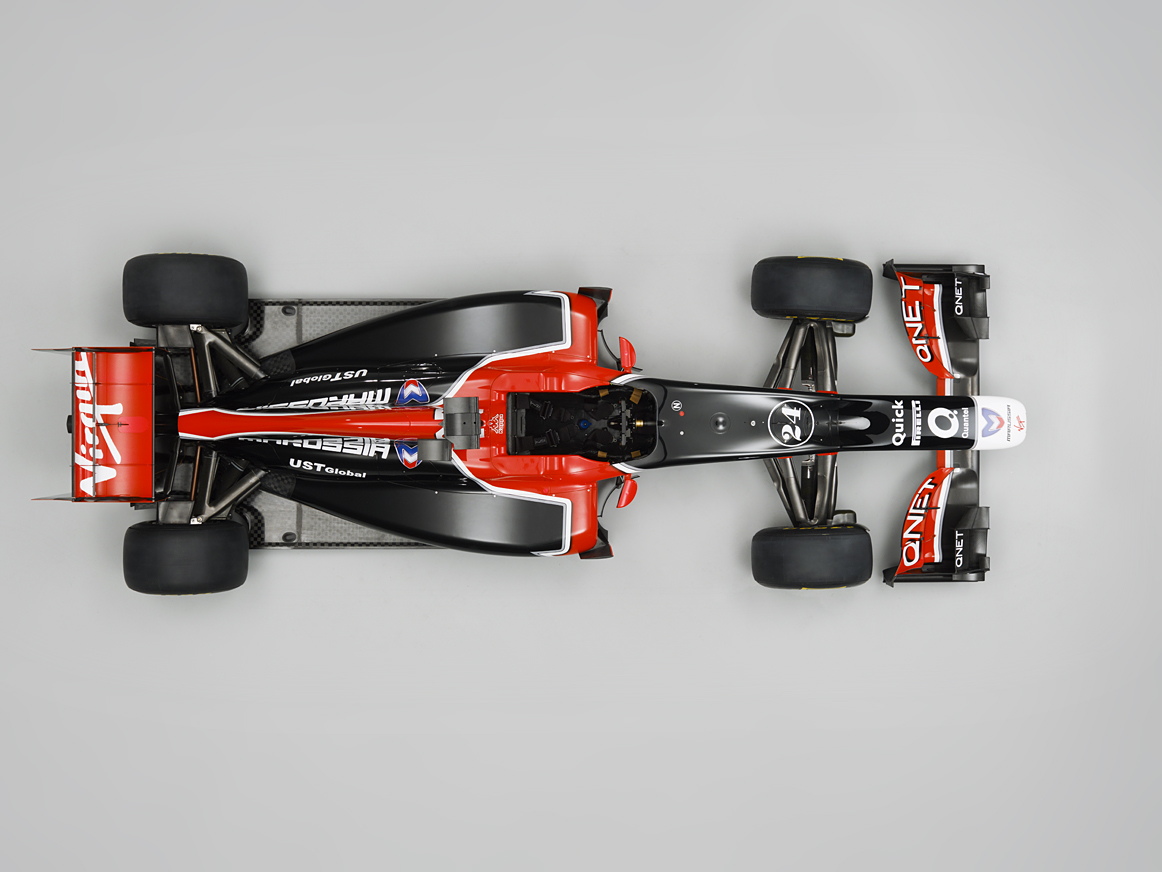
© Marussia Virgin Racing
Drivers: (24) Timo Glock, (25) Jerome d’Ambrosio; (Reserve) tba.
Team: (Principal) John Booth, (Technical Directors) Nick Wirth.
Engine: Cosworth CA2011 90° V8, limited to 18,000 RPM, naturally-aspirated, mid-mounted.
Transmission: Virgin Racing precision aluminium construction with 7-speed, longitudinally Mounted internals. Paddle operated hydraulic shift system with “seamless shift” gear selection.
Weight (with driver, et al): 640 kg
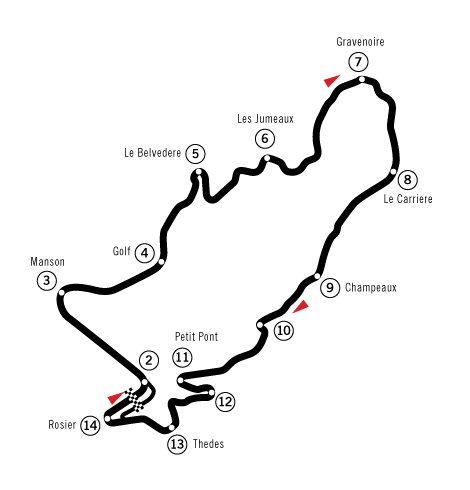
Circuit Clermont Ferrand
It was made to look so easy and in his eyes, it may well have been.
As the Formula 1 field arrived at Clermont-Ferrand for the 1965 French Grand Prix, Lotus driver Jim Clark was quietly confident. After three rounds, the legendary Scot had a three-point advantage over BRM’s Graham Hill and a further four-point lead over future star Jackie Stewart.
With reigning World Champion John Surtees 4th in the title hunt having amassed nine points, this was a stellar time for British motorsport.
Clark though, had assumed his lead over Hill despite missing the Monaco Grand Prix. Targeting victory at the Indianapolis 500, Clark gave the Monte Carlo spectacle a miss, leaving Hill to pick up the spoils.
It would be one of the few times that Clark would not be atop the middle step of the podium in 1965; however he made amends by taking the 500 mile race with style.
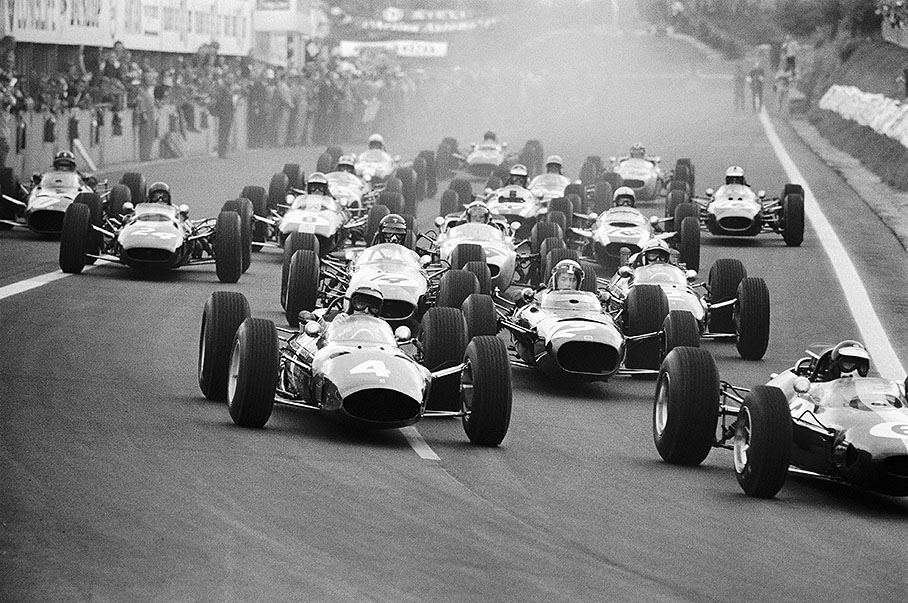
Clark (6) leads Bandini (4) off the line. © Schlegelmilch
Circling the Volcano
Seventeen entrants turned up in the centre of France for the race, flanked by a sea of fans at the 48-turn course, situated near the mountains of Auvergne. Having been built around the sides of a dormant volcano, the lavish 5-mile circuit was considered a faster and twistier version of the Nordschleife. This was Clermont-Ferrand’s first Formula 1 event and, already, it was impressing. With skill and smoothness a premium, Clark possessed an advantage that often superseded the superb engineering of his nimble Lotus 33.
For the chasing Hill, his weekend started off on the wrong foot. A stuck throttle caused a practice crash that left the 1962 World Champion with a sore neck – the king of Monaco realised early that this was a weekend of damage limitation. Clark also had his problems during practice as a broken suspension stranded the Lotus driver in the French hills.
Several drivers knew the circuit from Formula 2 competition, including Stewart and Brabham new boy, Denny Hulme. The 28 year-old Hulme had only made his Grand Prix début at Monaco four weeks earlier and acknowledging Hulme’s previous experience, team boss Jack Brabham handed his BT11 over to the Kiwi. Hulme led the practice standings come Friday evening as the future World Champion settled in with the Brabham team. Surtees and Lotus’ Mike Spence had also competed at the circuit before and it showed in the practice times.
Friday turned to Saturday and for a time, dark clouds shrouded Clermont-Ferrand. Had rain fallen, it may well have given Hulme top spot in only his second race, but the clouds dissipated early on, leaving Clark to take yet another pole ahead of Stewart and Lorenzo Bandini (Ferrari). Surtees and Dan Gurney secured the second row; however Hulme had done enough to hold onto 6th on the grid.
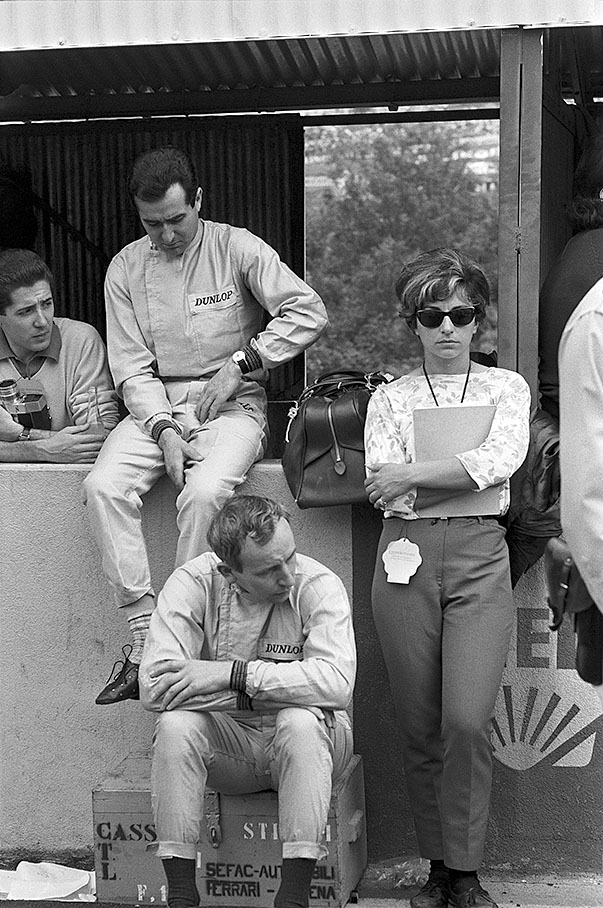
Surtees was powerless to defend his Formula 1 crown. © Schlegelmilch
Flag to Flag (again)
In the race, Clark made it look easy. The 1.5 litre V8 Climax-powered Lotus romped into an early lead and never looked back and eventually led the way for the entire 40-lap distance.
Unfortunately for Bandini, his front-row starting spot would not materialise into a race winning proposition and by the second lap, Stewart had passed the Italian. One tour later, 3rd became 5th when Surtees and Gurney got by the Ferrari man. The under pressure Bandini held off the Honda of Richie Ginther, while Spence, Bruce McLaren and Hulme sat in waiting.
Two drivers that would not be able to take advantage of the struggling Bandini were Jochen Rindt and Chris Amon – the pair collided early on and although Amon continued in his (slightly battered) Lotus-BRM, Rindt was out with a damaged front wheel. It mattered little as Amon would eventually retire from the race; the Kiwi’s fuel-system registered a failure on the 21st lap. Amon joined his teammate Innes Ireland on the sidelines; Ireland having retired three laps earlier with a strangled gearbox.
Away from all the commotion of banging wheels, position swapping and aching machinery, Clark and Stewart pulled away, but on this day Clark was simply imperious.
By the time the chequered flag dropped, Clark was a clear 26 seconds ahead of Stewart; however the 1963 World Champion had decided to lean off the power late on, as fears regarding the strength of the Coventry Climax became more apparent. Surtees held on to 3rd place, but was over 2-and-a-half minutes off of Clark; however rather than the ever dangerous Gurney, his main challenge came from the youthful charge Denny Hulme.
In fact Gurney had disappeared long ago – as the American reached the one-third distance, his Brabham began to cough unsympathetically and finally gave up on the 16th lap. Gurney’s Brabham teammates – Jo Bonnier and Bob Anderson – would also drop out of the race due to electrical problems and with six laps remaining, Brabham’s five car assault had become a paltry duo of just Hulme and Siffert. For his worth Hulme persevered when in the pack behind Bandini and picked up position after position, while others fell by the wayside.
It had become a poor day for the Honda team. Both of their entries – Ginther and Ronnie Bucknum – had also retired with sick machines before the race had reached puberty. McLaren also hit trouble as the handling on his Cooper-Climax fell away. Spence, meanwhile, simply ran out of pace once Hulme had forced his way passed him. Hulme entertained thoughts off challenging Surtees for the final podium spot, but with the end of the race looming, the Brabham’s oil pressure dropped alarmingly and Kiwi decided on taking 4th place instead rather than risk it all.
By now, it was clear that Bandini was suffering at the hands of a failing Ferrari and continued to drop down the order and as the race aged – even Hill and Siffert had reeled the Ferrari driver in, until Bandini spun off on lap 36.
All of this gave Hill 5th place ahead of the Swiss Siffert – although it was damage limitation for Hill, even he would have wished for better than that. Spence – his momentum shattered – was never in contention once Hulme had passed him and could only bring his Lotus home 7th and last of the finishers.
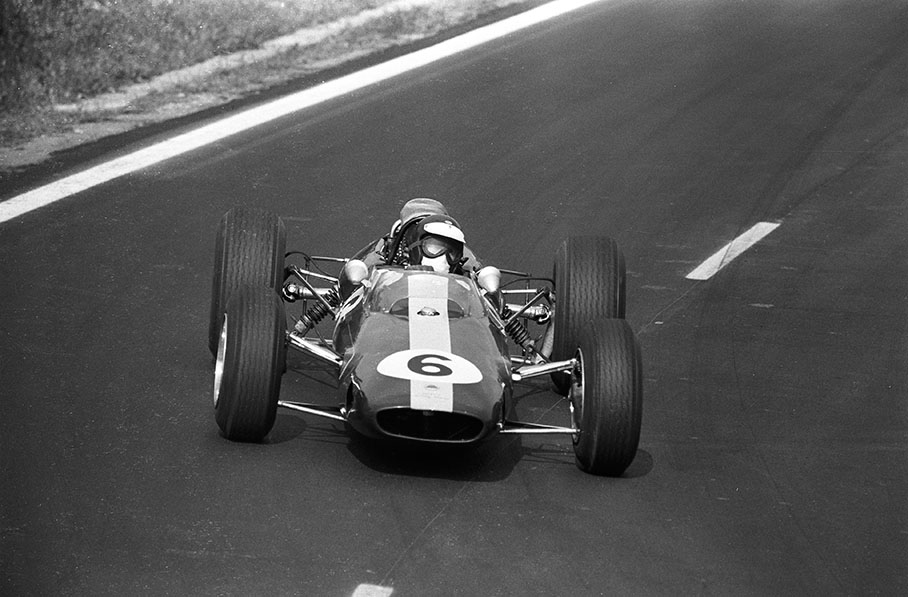
Clark was the dominant force in 1965. © Schlegelmilch
A Crushing Title
Though the season was still relatively young, Clark was on a roll. The Scot was now a full ten points clear of Clark and Stewart in the driver’s Championship, while the Lotus had shot to the top of the Constructor’s standings.
Visits to Silverstone, Zandvoort and the Nordschleife all delivered Clark victories giving him a run of seven straights wins (if one includes his Indianapolis entry as opposed to Monaco). There were also victories in non-Championship events at Syracuse and Goodwood – this truly was the year of Clark.
Following the German Grand Prix, Clark was in line to win at Monza until a fuel pump failure gave the race to Stewart. Engine failures at Watkins Glen and Mexico City saw Hill and Ginther claim those Grand Prix., but it was nowhere near enough to catch Clark.
These races give the impression of the World Championship being closer than it actually was, when in reality Clark could well have won every single race. During the mid-60’s, only the six best results counted and as such Clark had scored the maximum amount of points available – in the end, the Scot had 54 points, to Hill’s 40 and Stewart’s 33. The Championship was always going to be his.
As for Clermont-Ferrand, the circuit would hold three more World Championship races (1969, 1970 and 1970) while it swapped with Reims, the Bugatti track at Le Mans and the then-new Circuit Paul Ricard. Sadly, during the final Grand Prix at the circuit, a stone thrown by Emerson Fittipaldi’s Lotus punctured the helmet of BRM’s Helmut Marko causing the Austrian driver to lose an eye.
It instantly ended the career of a promising driver and also ended Clermont-Ferrand’s relationship with Formula 1. As loved as the circuit was, it was simply too daunting for the machinery of the 1970’s – a lesson that the Nordschleife would have to accept several years later.
Yet for many, Clermont-Ferrand will always be synonymous with a dominant Jim Clark – a great driver and fabulous car at one and on top of the game and that alone is a wonderful thought.
1965 French Grand Prix (Round 4; Qualifying)
Pos    Driver          Team           Time
 1  6  Jim Clark       Lotus/Climax   3'18.3
 2 12  Jackie Stewart  BRM            3'18.8
 3  4  Lorenzo Bandini Ferrari        3'19.1
 4  2  John Surtees    Ferrari        3'19.1
 5 14  Dan Gurney      Brabham/Climax 3'19.8
 6 16  Denny Hulme     Brabham/Climax 3'20.5
 7 26  Richie Ginther  Honda          3'21.4
 8 24  Chris Amon      Lotus/BRM      3'23.0
 9 18  Bruce McLaren   Cooper/Climax  3'23.2
10  8  Mike Spence     Lotus/Climax   3'23.4
11 34  Jo Bonnier      Brabham/Climax 3'23.4
12 20  Jochen Rindt    Cooper/Climax  3'23.6
13 10  Graham Hill     BRM            3'23.7
14 36  Jo Siffert      Brabham/BRM    3'25.2
15 30  Bob Anderson    Brabham/Climax 3'26.0
16 28  Ronnie Bucknum  Honda          3'26.3
17 22  Innes Ireland   Lotus/BRM      3'30.5
1965 French Grand Prix (Round 4; 40 laps)
Pos Driver              Team               Time / Gap
 1  Jim Clark           Lotus-Climax        2:14:38.4s
 2  Jackie Stewart      BRM                     +26.3s
 3  John Surtees        Ferrari               +2:33.5s
 4  Denny Hulme         Brabham-Climax          +1 lap
 5  Graham Hill         BRM                     +1 lap
 6  Jo Siffert          Brabham-BRM             +1 lap
 7  Mike Spence         Lotus-Climax            +1 lap
 8  Lorenzo Bandini     Ferrari                +3 laps (Spun off)
Retirements:
    Bob Anderson        Brabham-Climax         +5 laps (Electrical)
    Bruce McLaren       Cooper-Climax         +17 laps (Suspension)
    Jo Bonnier          Brabham-Climax        +19 laps (Electrical)
    Chris Amon          Lotus-BRM             +20 laps (Fuel system)
    Innes Ireland       Lotus-BRM             +22 laps (Gearbox)
    Dan Gurney          Brabham-Climax        +24 laps (Engine)
    Richie Ginther      Honda                 +31 laps (Ignition)
    Ronnie Bucknum      Honda                 +36 laps (Engine)
    Jochen Rindt        Cooper-Climax         +37 laps (Accident)
1965 World Drivers' Championship (Rd 4)
Pos Driver      Points
 1. Jim Clark       27
 2. Graham Hill     17
 3. Jackie Stewart  17
 4. John Surtees    13
 5. Bruce McLaren    8

1965 World Constructors' Championship (Rd 4)
Pos Team        Points
 1. Lotus           27
 2. BRM             25
 3. Ferrari         16
 4. Cooper           8
 5. Brabham          8
Although it still very, very early, it is still far too soon to have any definite say as to when (and if) Kubica will recover fully. For now, Professor Rossello is predicting that it may take up to one year before Kubica’s injuries are fully healed; such are the complexities the damage.
Once again, I wish him all the best.
© Renault F1
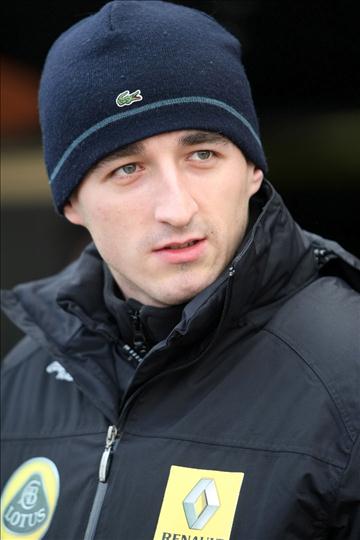
Renault Formula 1 driver Robert Kubica will now surely miss the start of the new season following a mammoth crash at the Ronde di Andora Rally today.
The Pole wiped out the front of his Super 2000 Skoda Fabia and a crash barrier in a high-speed accident on the opening 4.6 km stage, causing multiple fractures in his right arm, leg and hand in the process. Kubica has since been airlifted to hospital to undergo surgery.
Footage of the wreckage showed much of the front of the car torn away, which has led to thoughts that the barrier may have penetrated the machine.
A press conference to reveal more details of Kubica’s condition is to be held later this evening – until then, all reports about the exact nature of his injuries are pure speculation.
Kubica is certainly not the first driver to get injured while partaking in events outside of Formula 1 – in November 2008, Mark Webber was hit by a 4×4 while competing in his Tasmanian Challenge cycling tour.
Trying out other formulae, sports and events was the norm until the late 70’s and it was a option that was essentially disregarded following the death of rising German Formula 1 star Stefan Bellof in a sportscar race at Spa-Francorchamps in 1985.
In the short term, Renault’s main reserve driver is former-Hispania driver Bruno Senna, although it is not beyond the realms of possibility that Renault may opt for a more experienced hand to lead the team.
© McLaren F1
© McLaren F1
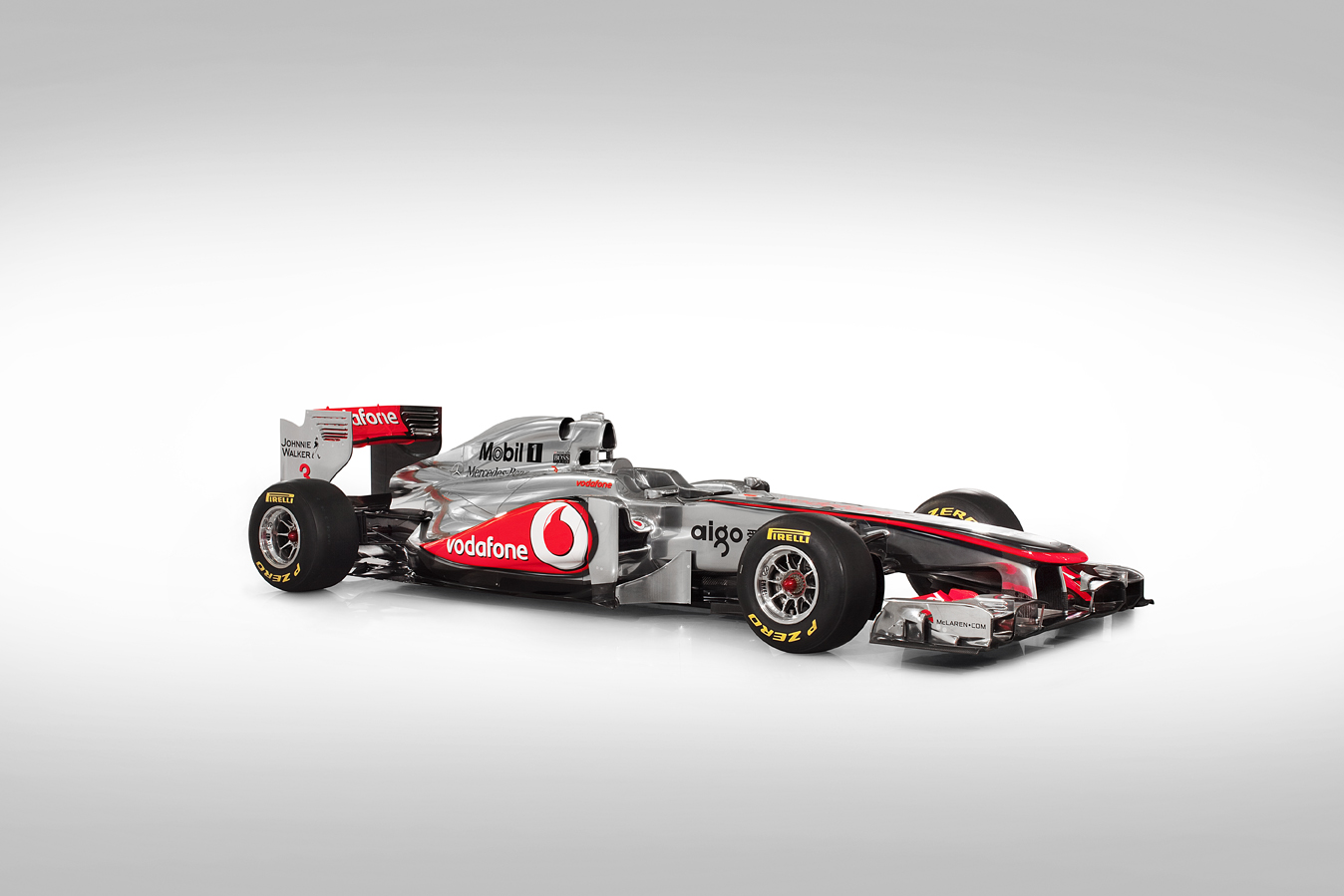
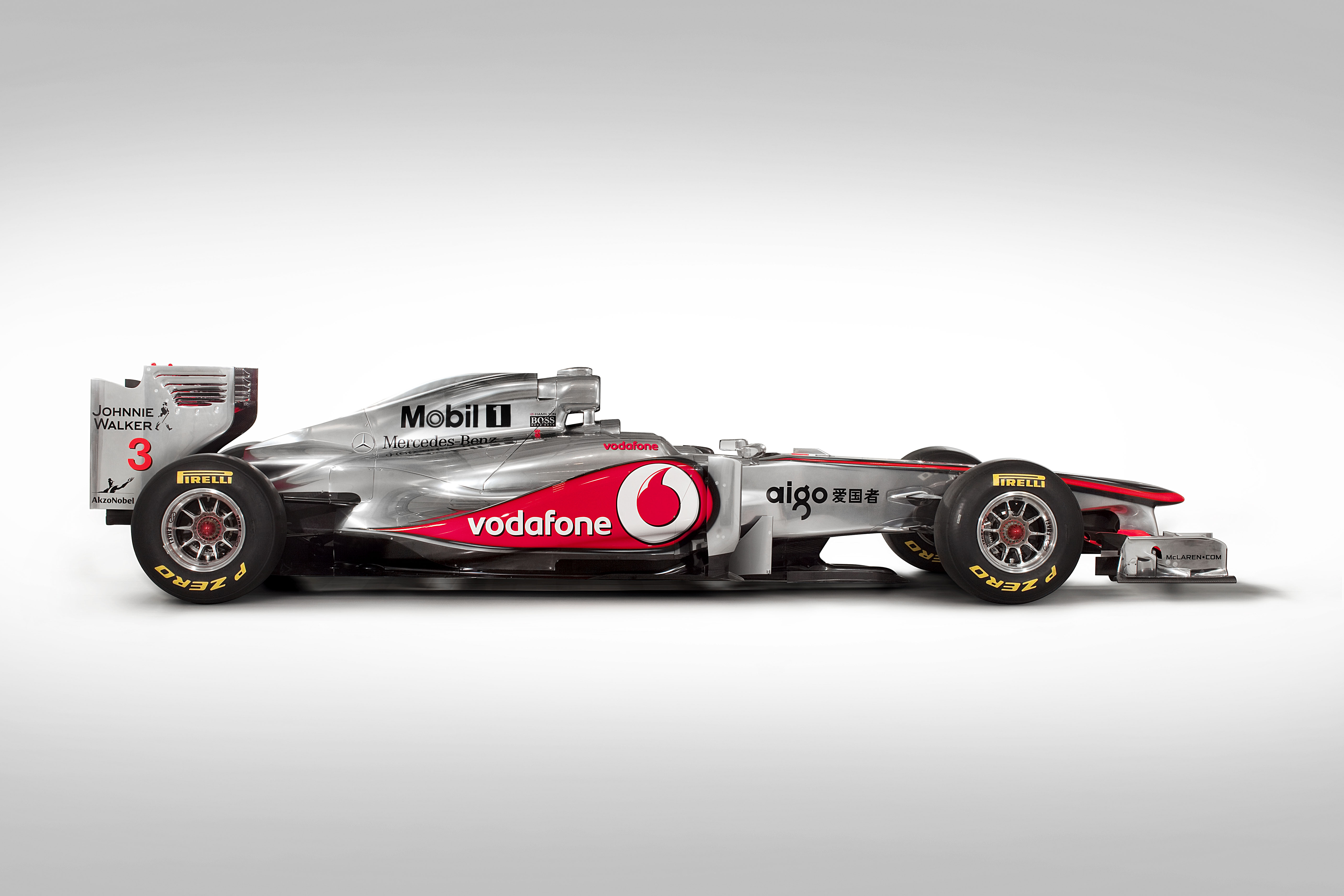
Drivers: (3) Lewis Hamilton, (4) Jenson Button; (Reserve) Gary Paffett.
Team: (Principal) Martin Whitmarsh, (Technical Directors) Paddy Lowe, Neil Oatley.
Engine: Mercedes-Benz FO 108Y 2.4 L V8 (90°). Naturally-aspirated, 18,000 RPM limited with KERS.
Transmission: McLaren Seven-speed semi-automatic gearbox with reverse gear hand-operated, seamless shift.
Weight (with driver, et al): 640 kg

 TheMotorsportArchive.com