
The tight battle between Lewis Hamilton and Max Verstappen for the 2021 Formula One World Championship is growing in intensity and with it, the heat builds among rivals.
But the animosity between the fanbase overshadows even the rivalry.
There is little doubt that the promoters of Formula One, Liberty Media, are rubbing their hands with glee.
Two of motorsport’s hardest chargers pushing the competitive envelope and it is glorious to take in.
Given seven years of near dominance by Mercedes – and mostly Lewis Hamilton – Red Bull’s long-awaited return to the top of the standings this year with Max Verstappen at the wheel is raising attention – and temperatures. Never more so than online.
It is refreshing to see that neither driver gives an inch, although at both Silverstone and Monza, one could argue that may be inches should have been offered. Alas physics taught us long along that two-into-one doesn’t go, although Verstappen and Hamilton’s attempts to coagulate have been noble.
For the most part though, the action on track between the pair has been tough, but respectful – which makes it such a shame the sparring’s between the pair’s online fanbase often veers into distasteful name calling and harrowed petulance. Some would call it childish, but that would be an insult to children everywhere.
After the clashes at Silverstone and Monza, it was difficult to not smile a little at the posts online declaring that each driver should be arrested for attempting to murder the other.
All too often, the tone casts itself downward into a vile pit of abuse. Much of the bile is bellowed by from the screaming few, demanding to heard, regardless of the crap they belch online.
But then there is the really quite horrific noise that permeates through the fanbase, twisted by racist rhetoric or anti-British, Dutch or European dialogue that serves only to cut, to wound, to injure, to incite.
These razor-sharp words that pretend to be untouchable and reside in the deepest recesses of hearts and minds. It is often said that anonymity online offers avenues for people to “get away” with the worst excesses, but it is an argument that doesn’t quite stand up, because anonymity is not in play as often as is accepted.
There are times when I wonder if we are just an angry species and that the cloak of civility merely shrouds people’s ugly truths and heinous beliefs. The violent words that emerge online and the thoughts that underpin them spend much of life sitting below the surface, residing under one’s breath, waiting to come out for some air. In the end, I just put my laptop away and drink a glass of water. Anything to wash the putrid nonsense away.
Perhaps, we should accept some blame for doing just that, or maybe it is just so unnecessary to counter such fetid attitudes online. But this should not mean we cannot talk to and advise our children, our families, our friends, our colleagues. A thoughtful and understanding word in one’s ear can do so much more than combative capital letters spewed across your favourite platform.
And no. At this juncture, neither Verstappen nor Hamilton have attempted to kill each other, despite what the pained keyboard warriors and their battered fingertips think.
On track, meanwhile, the fight continues and while emotions become heightened inside their respective machines, such feelings generally never boil over outside of the cockpit. There is a quiet joy that can be taken from watching two drivers in the best two cars with the best two teams delivering a thoroughly entertaining titanic battle.
Yet, one cannot escape the fact that Verstappen is 24 years of age, while Hamilton is 12 years his senior and that simple fact means that this fight may not last as long as we would wish.
Whereas Verstappen has suffered four significant blips during his 2021 season, the races where he has uninterrupted runs has seen him either take the win or finish in the runner-up spot. Hamilton has endured fewer lowlights than Verstappen, but the highlights have not been as frequent and yet despite everything that has happened in the previous seventeen Grands Prix, the gap with five races to go is just twelve points.
In years to come, we may talk about stellar this championship has been, for the next years, the technical regulations change and with it, so may the order.
Embrace this while you can and leave the anger to one side. It really isn’t necessary.
The global focus and expansion of motorsport and the pressures that it brings are leading competitors to talk more about mental health in the sport.
And yet, it is still seen as a taboo in many areas. In an excerpt of a conclusion from a study soon to appear in World in Motorsport, Leigh O’Gorman briefly examines pressures within motor sport and how they can be counteracted by building an efficient support network and ‘mental toolkit’.
There is little doubt that sport psychology is a topic that is beginning to gain very real traction, but it is still not one that has truly become part of open conversation in racing paddocks.
Some of this may be due to lingering ‘old school’ attitudes of masculinity that still permeate through the annals of motor sport; however, a lack of knowledge regarding the complexities of psychology and mental health has also slowed progress.
It is important to acknowledge that while athletes can be hugely famous stars, they are still people and can endure the same mental ill health and frailties that affect the general population – a distinction often forgotten when stars fall under the microscope. Athletes, too, possess strengths and weaknesses and work hard to caress the spell of belief, while grappling with the various stresses of their occupations.
And like ‘real people’, athletes experience stressed emotions that can affect their ability to delivery in their work and by that same measure, can also embrace joyful feelings and positive moments that can bolster performance.
Yet the concept of decompartmentalisation divides many. There are reasonable arguments on all sides to debate the degree of which one is affected by circumstances outside of the sporting arena and whether or not one can separate their ability to perform from significant personal stress points. Sport psychology is not something that should be examined in isolation and such an approach does not come easily – engaging in such a heightened level of state management requires effort, commitment and a healthy dose of self-awareness.
We must acknowledge too that sport psychology and mental health preparation should not start when one becomes a professional, paid racer, but the push for youth at the top-level means competitors are starting at very young ages. Generally, young racers are supported by parents, but there are those adopted into manufacturer-backed driver development programmes. Such levels of pressure heaped onto the shoulders of youth can do much to rob them of the fun that can be derived from such youthful passion.
These pressures tend to exaggerate tensions and push the concept of winning in every category, with focus on junior drivers diverting from development, education and maturity to that of victory above all. While winning is important, it is debateable as to whether one can grow in a healthy manner without development, education and maturity, as victory for victory’s sake alone is hollow when state management is not cared for.
Young racers require the right support and management if they are to develop into well-rounded people as well as successful athletes. That will not always come from parents or manufacturers with financial interests, but from sport psychologists and mental health coaches that can open the door to the kind of preparation needed to allow young drivers to grow and mature in a healthy way.
Part of this development also requires learning about outside influences and how they can prejudice emotions. Media influences, such as tradition news sources and social media, can be viewed distractions; however, the context in which they operate differ greatly from each other and therefore, the effect upon athletes also vary.
Add to this a growing lists of commitments, which include expansive and expanding sporting calendars, extensive PR duties and commercial partner activities and it is not difficult to conjure an image of an athlete being pulled into multiple directions simultaneously. Managing all these outside influences is critical to obtaining the balance between a healthy life and career, but it requires the correct support.
Given the ultra-competitive nature of motor racing, relationships within teams must also be managed if one is to operate in a healthy manner; however, it can be very difficult to exert control over the atmosphere within a team, particularly when that atmosphere turns toxic. If one is to acknowledge that an athlete has limited ability to change the behaviour of others, then developing coping mechanisms and employing techniques that can reduce the effect of that toxicity can go some way to alleviating the pressures on mental health. Ultimately though, such a relationship cannot last.
Even for the best, a final day must come eventually. Although unfashionable, athletes need to prepare for life after competition, or face acute shock when the series they were affiliated with leaves them behind. Numerous racers move to other categories, but others find work in driver management or coaching, media, while others leave the sport altogether. Having a post-motor racing plan is critical and finding opportunities that provides a similar spark – albeit at a slower pace – can provide not just long-term financial security. Alongside that, the correct advice can also help an athlete discover the correlation between the spark that ignited a love for competition and the spark in transition that ignites after the gantry lights have gone out.
Out of all of this, the optimum way to achieve a healthy balance may be to create and utilise a mental health toolkit, allowing one to meet challenges head-on and tackle them in a manner that yields positive results in both a personal and profession context. Ensuring that one’s psychological health is maintained or even bolstered, despite the significant pressures of competition and its ancillary factors, will go some way to achieving a robust mental balance before, during and after their career has concluded.
Life is complicated and emotions can be too, but the right support and preparation can alleviate many of the complexities that come with highly pressurised competition.
It only takes one minor slip to end it all, after which silence caresses and thoughtful mourning begins. Again and again and again.
One of the common tropes that always crops up when those in racing are killed or suffer injury is the same old mantra of “motor racing is dangerous, it says so on the ticket”.
But it is such bullshit.
It is a get out clause for those willing to shrug their shoulders, but unwilling to do anything about motor sport’s grand frailties. And then what..? The incidents happen again, the handwringing is pronounced and the defensive armies of old emerge, speak their piece and the cycle continues.
“Motor racing is dangerous,” they say again, as if pointed it out a second time makes it more valid. “It says so on the ticket.” As if that means a damn thing. Tell me this: how much was your ticket?
So let’s do nothing and nothing again. “What would Sterling Moss or John Surtees say,” they clamber, ignoring the irony of how Moss was almost killed at a then outdated Goodwood in 1962 and how Surtees’ son Henry was killed by stray wheel at Brands Hatch in 2009.
Should we be surprised though? Days like these, history weeps more than people do.
And then thoughts move to memories of ‘the good old days’, tethered by nostalgia and peppered with just enough gaps to make them seem kindly and plausible.
“He died doing what he loved,” they add sombrely, before taking a sip to soften the blunt force blow. Excuse me while I remove myself from such a pithy river of drivel.
Perhaps while you’re at it, the platitudes can be relayed to loved ones. I’m sure they will appreciate it.
But like before, it only takes one minor slip to end it all, after which silence caresses and thoughtful mourning begins. Again and again and again.
Dean Berta Vinales was 15 years old. Read that again. Say that out loud – to yourself and to others – and then read it again and tell me that it is worth it and I will tell you of a lie painted in gold.
No.
Next.
(But if it had to, I would argue that karting should lead the way. Anyway…)
Next.
There is a living in hell in press conferences. It is probably that a great many people don’t really want to be in them at all.
It is the pointlessly repetitive nature of it all. The empty lame duck questions that question nothing and answer even less.
The open-ended queries that are so vague, so directionless as to leave the interviewee floundering for any useless banalities that will serve as useful entries on paper and screen.
Then there are those who ask questions that are only a few words shy of dissertations. Questions that are so long and so descriptive that the best an interview can do is say “yes”, “no”, or dabble in peerless waffle in order to feel like they have said something. Such questions that, rather than be an inquiry, are an interviewer’s version of “Don’t you know who I am..?!”
For a journalist and a researcher, this is quite a statement to make, but it comes with good reason. I fucking hate generic press conferences. They are often dreary expositions looking for a point and a purpose, but never looking in the right place. Often, I wonder how many other writers feel the same way.
The generic press conferences – the one’s that fell foul to Naomi Osaka – may be contractually obligatory for competitors, but they are not so for journalists; however, the fact that they are obligatory for competitors ensure that they are obligatory for journalists. No one wants to be the poor fool who missed out on a cheap headline, because something far more interesting was happening somewhere else.
Not all press conferences are bad of course. My ire and – by my understanding – that of Osaka’s is aimed toward the pre-ordained, pre-determined ones where lots of words are said and nothing of use is learned and sometimes answers are dragged out through clenched teeth.
In the motor racing world, post-race press conferences occasionally come with nuggets of useful information, but rarely anything that will make one rethink what has just been witnessed on screen in the media centre. In any event, interesting information can be gleamed shortly thereafter in the various roundtables that take place. In saying that, I cannot confirm whether the tennis world has such sessions as well.
Truth be told, the set press conferences are soundbite sessions presented for the eyes of round-the-clock news broadcasts and social media channels. Press conferences are rarely the place for intricate or detailed questions that require thoughtful answers – generally, I leave those to group interviews or one-on-one sessions.
Facing the media is not the easiest task for any competitor, particularly those who are deeply shy and struggle with direct attention, let alone the crying glare of cameras and lights. It can be difficult to translate what has happened on court, in the car or on the pitch to journalists who may or may not (mostly the former) reached any level of competency in any given sport.
But that is what we attempt to do – translate. We just don’t always do it very well. And yet, one can’t help but wonder if the constant pressing is really all that necessary, and is it possible to justify the profane incessancy of it all?
Recently on a day off, I watched coverage of a Formula One Grand Prix on Sky Sports F1. The race had been won by Lewis Hamilton (either Portugal or Spain, I really don’t remember which) and almost immediately from getting out of the car, Hamilton and his fellow podium finishers were subjected to an immediate interview by *ex-driver who happened to be hanging around* to capture the all-important “instant reaction” for the international television feed.
Shortly thereafter, the top three head to the press conference that generally lasts about 30 minutes, mainly for additional television media, but also for the written press for stories that are about to go or have already gone live and are waiting for updates. This generally won’t make the Sky feed, unless a driver says something newsworthy that wasn’t captured in the post-race driver chat.
From there, the leading three – along with every driver in the race – moves to TV pen, where they conduct more interviews for international broadcasters, only this time drivers are passed from TV crew to TV crew one after the other where they answer the same question on repeat for a period. Sky will show this. That is generally followed by another chat with the race winner on the makeshift stage that goes live not long before wrap-up. There have been several times where Sky have interviewed/had interview clips of the race winner four times in the post-race show.
In more regular times, there often longer press debriefs with drivers and teams in the team’s various hospitality units after the TV crews final complete for the day. It goes without saying, that is a whole lot of coverage – and that’s only English language. For those dual-language competitors, the days can be very long.
The Osaka scenario that developed around the Australian Open and at Roland Garros was handled this very, very badly by Grand Slam Tennis/ITF. The moment mental health was brought into the equation, a complete rethink of how the media-competitor relationship should be handled should have been considered – and not just for the individual. Instead, Grand Slam dug their heels in, issued fines and a possible expulsion, only to revise their bullish attitude when Osaka pulled the plug on her participation.
On the other hand, sometimes competitors need to consider difficult questions and one cannot shy away from that. Finding the balance is, as always, the difficult job.
There is a bigger story than Osaka versus the media and Grand Slam Tennis. One must ask, how much of the issue is a problem that the media need to address or is this story is a symptom, or a representation of how skewered and twisted the relationship between competitors, the viewing public, the media, governing bodies, and corporate entities has become?
Last month, Sky, the BBC, BT and Amazon agreed to a three-year extension to their deal to broadcast England’s football Premier League, with a total value to be worth approximately GBP £5.1 billion {note 1}. Billion. In addition, Sky Sports’ current deal with Formula One, which runs from 2019-to-2024, is valued at approximately GBP £600 million for six years {note 2}.
The broadcasters want their money’s worth and that often includes the “instant reaction” and time sensitive press conferences as mentioned above. Broadcasters often partner with corporate entities to soften the financial blow and the partners want value, access and a piece of the action in return.
There is a drive behind the concept of instant gratification news and much of it is driven by the manner of which news and event coverage is changing. Instant reaction press conferences or interviews are the sporting equivalent of “being first.”
Whether one considers it evolution or de-evolution is entirely down to the individual, but soundbites are the clips upon which constant rolling news is pinned, particularly when deep analysis takes a backseat to drivel posing as news, or even worse… content.
Soundbites require little thought or consideration and have just barely enough meat on them to generate headlines that are quickly digested and even more quickly forgotten. As consumers, diets have changed and now we live for soundbites and the shots of instant gratification and fast reaction that backers demand. Or at least, that’s what people think other people want.
Acting as a foundation is a belief that short attention spans dominate the savage, youthful mind, but there is precious little evidence – quantitative or qualitative – to back this up, despite what Ross Brawn may believe {note 3}.
Much of the argument regarding short attention spans can be found in the spread of anecdotal evidence, wherein emotionally conceived testimony, delivered by amateurs or novices in-a-given field, passes for truth and when that anecdotal evidence spreads, it embeds itself as fact – rarely challenged and never proven.
Younger audiences are often challenged and viewed unfairly by other generations. Their attention spans are not long enough; they don’t work hard enough; their schooling and exams are too easy; their music isn’t good enough. It is the same patronising dialogue that passes from generation-to-generation. Always told, never proved.
But these unproven facts are changing the way media is produced and consumed. There is a media going forward with generic press conferences on behalf of broadcasters and partners whose understanding of the audience is at odds with any proven evidence. It is what the audience expects and what the media prepares believing it is what the audience expects, and it is what the audience receives.
The cycle of life, media, economy are often at odds. Nothing changes, until everything changes, and it all needs to happen at once, or it will never change at all.
{note 1}
“Premier League extends £5.1bn TV broadcast rights deal to 2025”
https://news.sky.com/story/premier-league-extends-tv-broadcast-rights-deal-to-2025-12305022
Accessed June 5th
Story May 13th
{note 2}
“Television deal is pie in the Sky, says F1 boss”
https://www.belfasttelegraph.co.uk/sport/motor-sport/formula1/television-deal-is-pie-in-the-sky-says-f1-boss-38146412.html
Accessed June 5th
Story May 25th 2019
{note 3}
“Brawn: Young people don’t want to watch two hour races”
https://racingnews365.com/brawn-young-people-dont-want-to-watch-two-hour-races
Accessed June 5th
Story May 14th
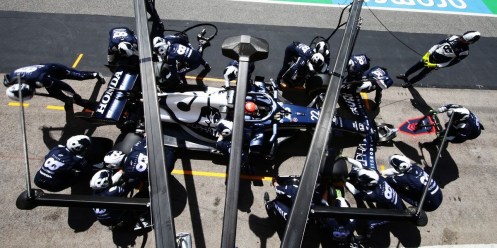
Tsunoda is AlphaTauri’s new charge. © Red Bull Media House
Yuki Tsunoda’s post-qualifying outburst during this weekend’s Spanish Grand Prix earned him no favours with his AlphaTauri team.
If the Japanese rookie is to lift himself out of his current dip, he may need to call on elements he does not have in his personnel possession – particularly calm and experience. This is where his team needs to come in.
The Bahrain Grand Prix probably seems like a long time ago for debutante Yuki Tsunoda. Even though he was only half-satisfied with his race, from 13th on the grid, the AlphaTauri racer pulled off a mature race to come home 9th in a Grand Prix that included overtakes on former world champions Sebastian Vettel and Fernando Alonso.
However, the three races since then have brutally exposed a lack of experience, maturity and relative calm for the 20-year-old. A crash during qualifying at the following event at Imola left Tsunoda starting last before a spin in the race itself left him a distant 12th. Thereafter Tsunoda endured a somewhat anonymous event in Portugal that saw him 15th and lapped, while another Q1 exit in Spain was the precursor to a brief Grand Prix in which he retired after six laps due to an electrical failure.
Beyond the season opener, Tsunoda’s more experienced teammate Pierre Gasly has picked up three points finishes so far and despite a Q2 exit in Spain, has been a regular feature in qualifying. While that may not sound like an overly convincing haul of success, given AlphaTauri’s position, it is a relatively solid score for a small Italian team who are regularly outgunned by the leading half of the field.
Occasionally though, such limitations promote frustration with drivers who are keen to push forward, but how one manages such frustrations is often key to unlocking performance, for agitation and spiral thinking behind the wheel only creates problems for a driver.
It is no secret that fans and media tend to eat up overly excitable driver comments over the team radio and in post-session media appearances, Tsunoda’s outbursts will not make friends within AlphaTauri.
Suggesting that the team are effectively producing a different car for Gasly would have raised some ire with team boss Franz Tost. For his credit, Tost will be well aware that these are the psychological machinations of a rookie driver who sees a possible seat with the sister Red Bull team in the lingering background.
Tsunoda is, in a sense, letting events get ahead of him. Not everything comes quickly and easily – it is why Formula One is so often cited as the toughest category in global motorsport and Tsunoda needs to understand this.
Calm and patience is needed, but with a hot-headed rookie, calm and patience often get shoved out of the way in favour of red mist and expletives and this is where AlphaTauri need to work with Tsunoda. Yes, the Japanese rookie appears to be struggling somewhat with the front end washing out, but that is something that can dialled out with constructive feedback between the driver and team, but that matters little if the driver’s headspace is not clear and focussed and that may what is missing.
Formula One may be a punishing sport in many ways, but the people at AlphaTauri are not stupid and the team surrounding Tsunoda should be working with the young man and a sports psychologist or mental coach in an effort to turn negative emotions into actions designed to deliver positive results.
Working with a driver to ensure that they are in tune with the direction of the team and car at their disposal, while also overturning negativity will only help to deliver confidence and, in theory, better results. Both the driver and team still require time to gel, as personalities mix, and relationships are fused.
There is no doubt that Tsunoda is a quick racer, but he will need help from those around him to lift him out of his current dip, but AlphaTauri also need to be patient with him. However, if he continues with the kinds of outburst as heard over recent Grands Prix, he will only make life impossible for himself.
Few drivers have courted as much controversy on their promotion to Formula One as Nikita Mazepin.
The Haas racer debuted in F1 with a desperately poor personal reputation, but does this correlate with his on-track analysis? The answer is rather complicated.
Even beyond that, questions are raised, such as, “When is any driver good enough for Formula One and how does one truly make that assessment?”
It is important to maintain a distinction between those in Formula One who are ‘racing drivers’ {note 1} and those who are merely ‘drivers of an F1 car’.
Those who fall in the former category are obvious: Lewis Hamilton, Michael Schumacher, Alain Prost, Ayrton Senna and Jim Clark for example (and a whole host of others).
The latter are a far more interesting bunch. These are the drivers who are reasonably capable of competently piloting a Formula One car and – maybe – on occasion will achieve respectable results. However, their level of talent is so unmemorable, so unremarkable, that their appearances in F1 would quickly become an almost impossible tiebreaker in a regional pub quiz.
The drivers are often the Diniz’s, the Modena’s, the Latifi’s, the Ericsson’s, the van der Garde’s, the Bernoldi’s of this world – all drivers in this bracket are solid competitors, but all are limited to some degree. They are perfect examples of the Peter Principle in its fullest effect, where they have also reached their level of incompetence, but they are not so incompetent that they are an embarrassment to themselves or their team, nor are they a danger to others.
Generally, they were decent enough to occasionally pick up podiums and maybe wins along the route to F1, but would do so without ever truly distinguishing themselves.
Underpinning the level of performance is the ability to spend, probably moreso today than in previous years given the sums involved. Several years ago, I asked the boss of one of Britain’s most successful junior team’s just how much a season in one of his Formula 3 cars would cost and he bluntly replied, “How fast do you want to go?”
Alas, some have more money than others; others have more money than everyone and those with the most disposable income often use it to easily dispose of the obstacles others fight hard against.
Whether the amount spent extends to influencing the personnel that work with drivers is another question entirely, but many teams will have first engineers, second engineers, third engineers (and so on) and these structures flow through various aspects of each company.
Anyone who tells you that a championship is even and fair because all the cars are the same is either a liar, a fool or a salesperson.
It’s often forgotten that the superlicence points system, introduced in 2015, was developed to stop future Max Verstappen’s jumping from karting to Formula One within the space of sixteen months.
Deliberately or not, it has had to effect of killing off championships that were seen as rivals to FIA sanctioned categories. It has also driven up the price of competing on the ladder, particularly with the best teams, as key seats in key championships become ever more valuable.
When one has the highest income, those best seats become swiftly available, sometimes with the option of shareholding if one sees opportunities to go from the lowest rung to Formula 2 with the same company. Of course, those with the deepest pockets can also make special efforts to buy teams outright or even create new ones, while recruiting the best staff in the process.
We may never truly know how much these practices skewer the outcome of races, championships and, ultimately, the application of superlicence points, but to ignore the effect how money is spent would ignore one of the greatest flaws in junior motorsport.
In recent years, many of these rejigged categories have been sold as cost effective compared to what went before, but I fear this is a case of the truth being overtaken by the sales pitch.
Some of the numbers quoted to me by drivers looking at Formula 2 and Formula 3 are frankly eye-watering, but these flaws could probably be fixed if anyone wanted to fix them. There just needs to be a desire.
Of course, all things connected to the superlicence points system is made irrelevant by the very fact that depth of talent within every championship changes constantly, as drivers either progress move to other forms of motorsport or leave racing altogether.
Far more important than the points awarded for winning a title is this question, “Who did you beat?”
Several years ago, I remember congratulating Jordan King upon winning the British F3 Championship. He simply shrugged his shoulders and said, “Who cares,” acknowledging that it was valuable seat time, but given the perceived low level of competition, the title did not amount to much. Sometimes the fight is tough, sometimes less so, but it always fluctuates, and this alone should render the superlicence points system as pointless.
There are those who will argue that the superlicence points system does much to stop under-qualified drivers from getting to Formula One, but I am not convinced that this enters into the conversation today.
For one, the kind of desperate day-to-day debt that eventually killed off the likes of Forti, Arrows, Pacific, HRT is not currently present in F1. There is debt in F1 and plenty of it, but the days where bringing in a stop gap driver with £500,000 for three Grand Prix in order to keep the lights on are long gone.
Realistically, when a team was doing those kinds of deals with drivers, permanent closure was not far away. For now, we will not be seeing Deletraz’s, Yamamoto’s, Lavaggi’s, et al in Formula One.
When teams in Formula One talk of debt nowadays, the numbers are often in the multi-millions and no amount of short-term cash flow is going to fix that. Indeed, £500,000 in 2021 wouldn’t even get you a t-short and headphones at the back of the garage.
The teams in F1 that are currently struggling are in straits so dire that they need far more than a weekend warrior with an inflated wallet; they need significant investment, and this is where the likes of Mazepin come into play.
An argument was put to me recently that it makes no sense for teams in financial strife to bring in heavily under-qualified drivers in exchange for cash, for the lack of performance they would deliver could actually do harm the potential for significant investment or may even reduce the asking price for a team wishing to sell in totality.
Returning the original question, “Would Mazepin be in F1 with or without the superlicence points system?” The answer is probably ‘yes’. Haas need the money; Mazepin wanted a drive; all that’s left is to print the receipt.
Mazepin is relatively competent driver, but the chance of seeing him ascend the order are incredibly slim. He has spent much of his career showing wildly erratic form; he has won some races, taken some podiums and also has crashed out. He has displayed some very poor judgement on-and-off track too.
So, “When is any driver good enough for Formula One and how does one truly make that assessment?” A lot of this comes down to the relationship between the driver and engineers, for often they are the ones who will truly be able to offer a close assessment. They can tell you where their driver’s strengths are, but also – more importantly – where their weaknesses are, and what their plan for improvement is.
Looking at results on a Wikipedia page will tell you absolutely nothing about a driver and will tell you even less about the quality of a championship.
Mazepin could eventually become a solid-to-middling runner, or he could spin his way into infinity, as he did for much of his opening Grand Prix weekend.
Only now will we see if he has the ability to learn and develop, although his personality traits suggest that expansion of thought may be beyond him.
{note 1}
By ‘racing drivers’, I am using the distinction that these are drivers who have reached an exceptional level of quality and it is not a reference as to their perception as a ‘racer’ or otherwise.
Reigning Formula One world champions Lewis Hamilton and Mercedes have agreed to expand their joint commitment to improving the representation of minority ethnic groups in UK motorsport.
This expanded commitment is due to take the form of a joint charitable foundation, which is designed to support wider diversity in motorsport and nurture talent that would otherwise be overlooked.
Last June, in partnership with Royal Academy of Engineering, Hamilton, with Mercedes, launched The Hamilton Commission – a standalone piece of research designed to identify and improve the representation and progression of black and other minority groups in UK motorsport, while also providing actionable recommendations to overcome barriers to entry in the STEM sector.
Speaking of the expanding partnership, Hamilton commented, “I’m equally determined to continue the journey we started to make motorsport more diverse for future generations and I am grateful that Mercedes has been extremely supportive of my call to address this issue. I’m proud to say we are taking that effort further this year by launching a foundation dedicated to diversity and inclusion in the sport. I am inspired by all that we can build together and can’t wait to get back on the track in March.”
Toto Wolff, CEO and Team Principal of the Mercedes F1 team, chimed in, noting that this was the right time to “begin a longer-term project to take the next step in our shared commitment to greater diversity within our sport.”
Mercedes’ Non-Executive Chairman, Markus Schäfer, added that, “Lewis is a warm-hearted personality who cares deeply about the world around him and wants to make an impact. As a company, Mercedes-Benz shares this sense of responsibility and is proud to commit to a new, joint foundation to improve diversity in motorsport. Opening the sport to under-represented groups will be important for its development in the future and we’re determined to make a positive impact.”
As as aside, it was also revealed that Hamilton has signed a one-year extension with Mercedes, as he looks to claim an eighth Formula One title – an achievement that would take him beyond the seven won by Michael Schumacher between 1994 and 2004.
January is both an interesting and infuriating time to be a motorsport writer. On one hand, the lack of action and the continued slow drip feed on news means there is often precious little to report or discuss.
It goes some way to understanding why so many publications publish retrospective copy, list-articles, predictive pieces and “what if” speculative drivel. It is what it is, and eyeballs are needed, so why the hell not?
Truth be told, unless you bathe in the sea of rallying and ultra-hardcore endurance racing, January represents a month where there is precious little news to get too terribly excited about. For most championships, teams at this time are busy building the stories and timelines that are soon to come, particularly for the livery launches.
That’s not to say there is nothing to report, but rather the morsels of news that do appear are often not very interesting. In essence, January announcements are the kind of things that could often be covered in single paragraphs. It’s easy: headline – breif opening paragraph – a four-line story. Ta-dah!
I jest of course. Slightly.
Of course, the cleverer sources will occasionally drop a positive major story in this period of relative quiet, as one may be guaranteed plenty of extended coverage. The announcement of Davide Brivio’s move from the Suzuki MotoGP team to become Racing director of the recently renamed Alpine F1 squad to replace Cyril Abiteboul raised some eyebrows.
And yet, Abiteboul’s move to become Head of Car Performance with the Alpine brand – alongside his role as his Team Principal position – sent signals that maybe his long-term path lay in the grander corporate machinations of Alpine. What really surprised was the news of Abiteboul leaving the manufacturer altogether, with Laurent Rossi slotting into what was due to be Abiteboul’s position.
This was a story that got the column inches it deserved.
Naturally, January is also the month where you really don’t want negative headlines to emerge for precisely the same reason as above; with no other stories to detract, bad tales linger like bad smells.
But not every bad story is a negative one. The postponement of the Australian and Chinese Grands Prix were unfortunate, but given the sprawling COVID-19 pandemic, these postponements can be forgiven with relative ease. After all, in days like these, it is better to tiptoe with caution than it is to stumble haphazardly over a cliff.
If one wants an example of a negative story, one only needs to look to the embarrassing tales emerging from the Australian Open tennis tournament, as players and their partners openly lament the nature of their lockdown on social media channels.
It showed a relatively small percentage of players and entourage behaving and complaining like spoilt brats from the verandas of a five-star hotel. Whether one agrees with the players or not, it was a bad look and utterly misjudged the tone of the situation in the State of Victoria.
Had I been the Head of Communications of the Australian Open, it is likely that my hair would have been ripped out in frustration, although it entirely plausible that I may have become Malcolm Tucker to their Ben Swain or Nicola Murray.
The tournament has not yet begun, and the news is all negative. This could have been the time where the ATP and WTA delivered a feast of enjoyment and hope; where positivity could have been matched by charitable tokens at a time when people are living through an incredibly difficult and tragic time. Instead, the tournament has only dumped self-entitled faeces on the mat. Well done. People tend not to like that.
Thankfully Formula One has not yet dropped a giant news turd, but there is always time. Trust me, there is always time.
Conor Daly has spent much of his Indycar career securing temporary drives and moving from team-to-team where needs met.
World in Motorsport spoke with Daly during a fast-paced season that saw him switch back-and-forth between two squads, secure his first Indycar pole and several top ten’s in his first full season in the sport since 2017.
Inconsistent. If there was one word to describe the nature of Conor Daly’s career up until now, it might probably be inconsistent.
That’s not a criticism of his performances, but rather an acknowledgement of the path his racing career has taken so far.
“It’s crazy man, crazy. It’s tough, because I’ve never had the luxury of controlling my own destiny,” admits Daly. It is not a subject that the 28-year-old shies away from, but where the younger Daly may have allowed frustrated to overcome him, the current, more mature man is rather phlegmatic and is better for it. “Some drivers, when they have sponsorship support, they can control their own destinies and they know what they have got and where they can go with that. I haven’t really had that luxury ever.”
Making his Indycar series debut back in 2013, while simultaneously competing in the GP3 Series, Daly has never truly enjoyed the stable environment necessary to allow his career to flourish.
He stayed in Europe the following year, but a disastrous campaign with the woefully underfunded and underprepared Venezuela GP Lazarus team finally ended his Formula One ambition and Daly returned to the US in 2015. In that time, he has driven for seven teams, including two separate stints with AJ Foyt Racing, Dale Coyne Racing and Schmidt Peterson Motorsport respectively.
Such is the epileptic nature of Daly’s Indycar career, the Indianapolis native has only twice enjoyed full-season agreements (2016 with Dale Coyne and 2017 with Foyt). “It’s definitely tough to make sure you are absolutely performing at your highest level in times where you might know two days before you get into a car that you are going to race it, but that’s sort of what I ended up getting used to and that’s how I’ve lived my life over the last few years.”
He has also taken in stints at Harding Racing, Andretti Autosport and latterly Carlin Motorsport and Ed Carpenter Racing, with confirmation of some of the drives have come at very short notice; however, he does take some positives from his experience so far. “It feels like it’s helped me get up to speed quicker. I’ll be able to use some of what I’ve learned over the past couple of years and hopefully be full-time for a long time to come.”
Daly’s part-time relationship with Carlin began in 2019, when the team’s eponymous owner asked the American to fill in for Max Chilton when it came to the series’ oval races, with the latter having stepped away, but Daly is keen to emphasise that a large dose of luck played into his hands. “Last year only having the Indy 500 on my schedule, Trevor Carlin had made me aware, even before the Indy 500, that Max Chilton might not be interested in competing on the ovals anymore.” A free agent, Daly stepped into Chilton’s vacant seat, securing a best finish of 6th at Gateway.
There is a previous relationship between driver and team, with Daly having raced for Carlin in GP3 in 2011. The respect between them is clear cut, with Daly praising the Englishman and his team. “I really like Trevor, he is a great team owner, they’ve got a great team there.”
Despite the uncertainty that has followed his path, Daly has latterly found consistency on the sponsorship side of his career, particularly with US Airforce – a partnership which is now in its third season. “Every year, it’s been a bigger investment into the series, the sport and myself, so the numbers they’re getting out of it when it comes to return [on investment] is good.” Although this partnership is proving fruitful for all parties, growing it beyond its present is a difficult task given the current economic climate at a time when motorsport is far from being a primary sport in the United States.
Daly concedes that the biggest challenge is to get people who don’t know enough about racing to really take it seriously. “[Its about getting] around that first wall of, ‘Well, this racing, it’s good, but we’ve got an NBA team, or NFL team, we’re fine.’” Although confirming that the series still lacks mainstream awareness and appeal, Daly sounds confident, telling World in Motorsport that the key is about, “trying to figure out what [partners] want and what they need.”
There is little doubt that the reunification of the Indycar Series in 2008 has helped the cause for drivers and teams a great deal. With a sense of balance and certainty, confidence has returned to the series, although audience attention for Indycar is a long way from its peak during the CART days of the early-90s. “The best part about Indycar right now is the product is not the problem. We know that we put on a great show. We need to make sure that more people are aware that Indycar is happening and that it is a great product. The series has done a great job formatting the rules, formatting the aerodynamic rules and how the cars work to make that a great product,” enthuses Daly.
Indycar is still far from the peak it enjoyed in the early-90s, and although Daly had some sponsorship to play with over the 2019/2020 winter, he knew he was still somewhat short on backing to fulfil a full season schedule.
Following discussions with Carpenter Racing, the 28-year-old signed with Indiana-based team to compete on the series’ road and street courses, while the team boss took the seat for the six oval events. “Ed [Carpenter] had an idea of what he wanted to do and what he needed and the US Air Force fitted in perfectly with his number 20 car for the road and street courses and a third car for the Indy 500, so I found myself saying, ‘Alright, you know what, this is going to be great. This is going to be the majority of the season – it’s not the full season, but it’s going to be with a great team.”
However, as the beginning of the season drew in, Daly once again received a request from Carlin to fill in on the ovals, bringing a potentially awkward situation to the fore. Thankfully, it was a situation solved with relative ease. “I talked to Ed about it and said, ‘Hey look, this is an awkward conversation to have. I know driving for two teams in one season is not ideal’, but Ed was cool with it. Ed knows that I want to compete for Indycar championships, I want to compete every weekend, every day on track, I want to be there, and it just worked out perfectly. I’ve got to thank Trevor and Ed for letting me do that and the teams have been really nice.” While some would consider it a distraction, Daly does consider it an advantage to work with two teams simultaneously, learning from each entity with every event.
For Daly right now, he is clearly enjoying his current Indycar stint in the series. “I really enjoy what Indycar is doing and I hope as we continue here and get out of this pandemic, we will continue to expand the schedule and continue to get to new tracks and new places and hopefully some new countries as well and see what happens as we keep going.”
The work for 2021 started long ago, and Daly will be hoping to build on his 2020 season with another full campaign – whether that will be with one team or two remains to be seen.
For the full version of this discussion with Romain Grosjean, as well as conversations with Rubens Barrichello, Conor Daly and WRC’s Richard Millener, Yves Matton, Andrea Adamo and Colin Clark, check back for the next issue of World in Motorsport – coming soon.
George Russell may not have won the Sakhir Grand Prix on Sunday, but his efforts in replacing Lewis Hamilton at Mercedes may have formerly confirmed his potential.
It may have also gone a great distance to settling his driver from 2022 onward.
“Very quick, very tidy. Great potential.” As the 2015 European Formula 3 season got underway, that was my quick assessment of a then 17-year-old George Russell – before taking a race win in his first weekend in the category.
Admittedly, it was something of a false dawn {note 1}, but the potential was clear and following stints in GP3 and Formula 2, there was no surprise to see the Mercedes junior promoted to a Williams F1 seat last year.
So far in his F1 career, Russell has had two comparatively weak teammates in Robert Kubica and Nicholas Latifi, but his performances in the difficult FW42 and FW43 cars have been startling, but as with all great talents, a single turn was needed to genuinely propel Russell to the top.
It is genuinely unfortunate that Mercedes team leader Lewis Hamilton fell afoul of Coronavirus, but with the champion sidelined, the German squad offered Russell a significant opportunity that only a fool or the meek conservative would have turned down.
He displayed some potential during Friday’s free practice sessions, before Max Verstappen’s Red Bull briefly assumed the top spot at the close of FP3 and while Valtteri Bottas may have secured pole position in the second Mercedes, Russell’s charge to the lead at the race start not only signalled his intent for the Grand Prix, but also for 2022. That he brilliantly repeated that feat during a late race restart merely cemented his intentions.
What an incredible shame it was that a late race puncture stole the race victory from his grasp. Come the end of 87 laps, a recovery to 9th place would secure Russell’s first ever points in Formula One, but it was not the 25 he so dearly desired.
But tongues are now wagging. Mercedes are looking at a future beyond Hamilton and that future is not Bottas. For all his worth, Bottas’ reputation in recent seasons has been downgraded and where once it was believed he may push Hamilton very hard – and at times he has – Hamilton has merely extended himself further still, ensuring Bottas’ inter-team successes are rare.
As needs must, Russell must wait. Bottas signed on for 2021 several months back and while negotiations with Hamilton are still ongoing, the seven-time champion isn’t going anywhere anytime soon.
So – unless there is some additional drama in the next few days – Russell will return to Williams and to the less stable FW43 machine and he will once again beat Latifi into submission.
Russell’s stock has raised significantly now and should another year with Williams be the price to pay for a top Mercedes seat in 2022, then it is critical that those around him work hard to keep his head in check and cap any frustrations that may inevitably come to the fore. From here on in, Russell’s biggest battle may be with himself.
{note 1}
Russell finished 6th in the standings in 2015 but did not manage to win again that season.
Some of TheMotorsportArchive.com’s more eagle-eyed readers may have noticed a couple of new buttons at the top of the site’s drop-down options, including “cart”, “checkout”, “my account” and “shop”.
These have been included to take into account the release of World in Motorsport: Volume 2, which is looking like going on sale next month.
Following on from 2018’s WRC Special Edition, World in Motorsport: Volume 2 looks at the complexities behind psychology in motorsport and whether it is still considered a secretive taboo in what is still a world full of machismo and testosterone.
Coming in at just under 100 pages, readers can pick up World in Motorsport: Volume 2 as a glossy and delicate hardcopy magazine for £8 (UK postage £1; ROW £1.50), while digital pdf copies will retail at £4.
In this examination, World in Motorsport speaks first with Haas Formula One driver Romain Grosjean about his efforts to improve his racecraft through mind management, while Dr Faye Didymus (Sport and Exercise Scientist (BASES accredited), Leeds Beckett University), Dr Victor Thompson (Clinical Sports Psychologist, BScPsy, DipSpPsy, PGDipCBT, DClinPsy, CEBHyp) and Greg McColl (DHP Acc. Hyp, M.H.S, CNHC, NLP Master Practitioner & Master Practitioner Coach, Mental Health First Aid – Armed Forces) discuss the concept of sports psychology and its changing perception in modern sport.
Also former Ferrari race winner Rubens Barrichello talks about life after Formula One and how he is embracing time with his sons, while Red Bull’s Alexander Albon reveals his secrets about race preparation.
Finally, Indycar driver Conor Daly tells World in Motorsport about the trials and tribulations of sponsorship and consistency in difficult economies, and a specialist panel of Yves Matton (FIA), Andrea Adamo (Hyundai), Rich Millener (M-Sport) and Colin Clark (DirtFish) contemplate a post-COVID-19 life for the World Rally Championship.
All this and some other neat little features in World in Motorsport: Volume 2, available exclusively from WorldinMotorsport.com and TheMotorsportArchive.com next month.
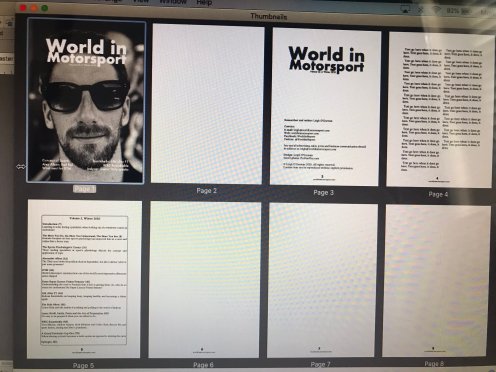
World in Motorsport: Volume 1 sample

Of the drivers competing at this weekend’s Portuguese Grand Prix, Lance Stroll, Antonio Giovinazzi, Charles Leclerc, George Russell and Alex Albon all raced there in F3 in early September 2015.
Yet despite the nods to it in various record books and websites, none of the above group managed to race on the Grand Prix layout that weekend in what proved an embarrassing solution to a solvable problem.
Nothing quite raises eyebrows like a mid-week announcement following the first day of a Formula 3 test session, mainly because there generally shouldn’t be one at all.
Indeed, the idea of any news at all emerging from testing is a novel one. Those reports are primarily reserved for the unusual or severe or in the case of Formula One, the need to rummage 500 words together from the pit of nothing.
This was slightly different. In 2015, a round of the European F3 Championship had to rescheduled and a new date was offered to the Algarve Circuit in Portimão.
A wonderful flowing track on the southern tip of Portugal, Portimão is something of a modern wonder – a 21st Century circuit layout that is interesting, challenging and often delivers some wonderful action.
As the track was a late addition to the calendar, the field was gifted an extra two test days in the week leading up to the event to enable drivers to gain further mileage prior to the beginning of the meeting.
However, the circuit provided a challenge that the assembled drivers failed to meet – the field could not keep to the track limits, particularly in the short chute that extends between the double right-handers from the exit of turn one at Primeira and the nameless turn two.
By not even coming close to properly using or respecting the track, the drivers achieved some extra speed into the flick that is turn three (Lagos).
So, rather than drive home the serious nature of managing track limits, the Clerk of the Course decided to utilise an alternative layout for just F3 that weekend. Instead of longer run into turn one, the first turn was introduced a couple of hundred metres earlier, leading to a double chicane in the form of a quick right-left-right, before drivers came to turn three.
Alas, the pro-am GT field from the (then) Blancpain Sprint Series managed the original layout perfectly well, so they decided to keep using it. However, that required the first corner to be altered between every session, as corner boards were moved and later moved back, plastic bollards were placed to remind the F3 competitors of an upcoming corner, before marshals settled at their new post {note 1}.
One wonders if it made any difference in the end. Following the 2nd race of the weekend, Prema Powerteam’s Jake Dennis informed me that following the layout change, track limits were then not going to be monitored on the exit of the new T1/2/3 Primeira chicane, thereby rendering the process an utterly pointless exercise.
The allowance offered some of the same additional pace that the original track cutting allowed, giving drivers an easier exit from Lagos toward the Torre Vip hairpin, before the switchback on the curved back straight.
Apart from the fact that F3 was/is a learning category, the changing of the layout to accommodate the competitors was an absolute cop-out and the only low during an eventful weekend. This was a solvable problem, but changing the layout to accommodate troubled young drivers set a very poor precedent.
{note 1}
It reached a special ridiculousness during the final race of the weekend when, following a botched overtaking move on Alessio Lorandi, Sam MacLeod decided upon an adventurous detour.
Going side-by-side into the new turn one, MacLeod – on the outside of corner entry – banged wheels with MacLeod, then decided to take the original turn one, but got that wrong and ran into several plastic bollards, dislodging a front wing suspension column in the process. Despite this, MacLeod kept his foot down through the original layout, overtook Lorandi on the now-disused section of circuit and decided to keep the position.
The moment prompted some criticism from me while on commentary duties, noting that MacLeod had got the corner utterly wrong, but had not even attempted to correct the error. It was a criticism that got me benched from commentating for the next race.
My thoughts and notes on the 3rd round of the 2020 Super Formula season from SUGO. Also some spiel about returning and departing drivers ahead of next month’s 4th round at Autopolis.
Just over twenty years ago, I attended my first Grand Prix as a fan with my Dad and some family friends. Although a long-time home viewer, to actually go to a Grand Prix was, until then, a luxury beyond me.
A rare precious trip and at the age of 18 and a first break abroad, the sheer size of the event grabbed my attention with both hands.
The first thing I discovered about flying abroad is that Ryanair’s flights to Brussels do not quite go to Brussels – they fly to Charleroi, some 60km south of the Belgian capital.
In the same way, one who flies to London does not necessarily have Luton in mind, Charleroi is not Brussels. The distance is not significant by any stretch, but it does still dampen the immediate feelings upon arrival.
Thinking back, Charleroi Airport in those days – I have not returned deliberately – shared much of the charm held by Frankfurt Hahn Airport, in that neither destination has any.
There is tarmac, there is grass, there is a shabby arrival’s building and a border control guard on their lunchbreak sucking the life out of a cigarette, which is in turn sucking the life out of them.
As can be expected with Ryanair, divine luxury was not an option on an airline whose planes contain seats manufactured with recycled spinal trauma and whose headrests enjoy the supple, soft feel of broken milk bottles.
In later years as a travelling journalist, it became customary to spend a little bit more cash on different airlines, if only to preserve one’s bodily integrity. One hopes soon to one be in a position where travelling to races is an option once again, but alas…
Following a pleasant drive from Charleroi Airport heading east toward deep sectors of trees and hills, the clouds above began to pull together, drawing heavy pockets of rain in their wake.
As the pockets emptied, a distinct lack of forethought made itself known given the absence of a packed coat – the Irish person’s inability to properly prepare for rain – despite or because of our wealth of experience of the stuff – can surely only be based on the guts of unfounded optimism.
We were Irish and hardy boys though – nowadays still the former, less the latter. The 2000 European Grand Prix, hosted then at the Nürburgring, was a mostly wet affair and seeking some protection, I speedily made my way to the first stall available and planted 20DM on the counter.
There was no need for translation – the rain had long since rippled through my hair and was staining my clothes, while the cold turned my rounded dimples into sharpened wrinkles. For the right price, the trader pulled out a light rain jacket from the rear of his stall.
At the time, the Schumacher and Ferrari train was gathering pace and within five months, the German maestro would have claimed the first of five titles with the Scuderia. For now, he was “merely” a multiple race winner, albeit one looking more and more likely to break the Mika Hakkinen/McLaren machine.
Such was Schumacher’s growing popularity with race-going fans, the cheap red Ferrari jackets had already been cleared from their hangers, but at this point, I was caring less and less about the colours of the thread.
With a whisp, the market man produced a yellow rain jacket and gladly took my money. Initially thinking that it might be Jordan Grand Prix, the packaging was ripped off and binned to reveal a bright luminous yellow Ferrari jacket. The zip of the jacket broke soon after, but other than that, it did the job.
Positioned at the exit of the hairpin, our seats were in an uncovered stand – always brutal at the Nürburgring – and as we made our way to our positions from the top of the stand, we passed a number of delicately groomed moustaches and windswept bleached mullets, all of which had survived the Cold War.
It took another moment to realise that the hairpin stand was red. Deeply red. And I was wearing luminous yellow. So bright was my jacket that if I wanted, I could probably be found in the dark. If I were to re-watch the race now, it would not be a surprise if my yellow frame could be found on screen.
With each pace upon the greyed dirty concrete steps, many red heads turned to gaze, and many mouths bluntly grunted stunted words. To each head, I busily flashed the Ferrari insignia on the breast of the jacket, and the grunt turned to nods of approval complete with hat tips of alcohol. This continued for three days.
As the competition turned, David Coulthard claimed pole position, but was taken by Hakkinen off the line. When a dry start turned to a downpour early on, Schumacher took charge in the inclement conditions to pass Hakkinen and go on to claim a very popular victory.
Despite the conditions, there was something oddly processional about the event. Punctured by a delicate charm, wet races can be exciting and entertaining events, particularly if ever changing conditions present themselves, but from the point the rain arrived on Sunday, the positions settled as competitors fought hard just to get to the chequered flag.
Throughout the weekend, we stayed in a village called Bitburg, situated about an hour’s drive from the circuit – even on race day. It was pretty close to nowhere, but it did have a tiny train station at a junction called Bitburg-Erdorf and while there was not much in the way of restaurants or other eateries in Bitburg, one could easily catch the hourly train to Trier.
Alas, Bitburg did have several small, comfortable bars, owned and run by men who wore only blue and/or red chequered shirts with faded jeans and exclusively served the beer Bitburger.
To get food required a train; to get beer required a short walk.
Throughout his career, Romain Grosjean has proved an enigmatic racer, whose profile has been dominated incidents intertwined with undoubted speed.
Recently World in Motorsport spoke to the Haas driver about the moments that have defined his career and how mind management has allowed him to keep his feet on the ground.
It has not been the easiest of season’s for Romain Grosjean. At the time of talking – just prior to the Russian Grand Prix – the Haas racer had yet to score a point – a statistic finally rectified at this weekend’s Eifel Grand Prix.
And yet, Grosjean is phlegmatic about his situation. Initially he appears at ease with himself and yet, one can identify a level of frustration simmers below the surface.
It is a frustration that has on occasion boiled over on team radio during race weekends, but over the course of the past eight years, Grosjean has worked hard to counter these frustrations, with the help of sport psychologists.
However, unlike many in motor racing’s top tier, the Frenchman is open to discussing the topic of sports psychology, seeing it not as a weakness, but as a method of self-improvement – from both a personal and sporting aspect. “So many examples out there and you see it from outside where some need help and there are some who are having help, but they don’t talk about it. It’s still a bit of a taboo, but for some people, they don’t want to talk about it, but if I have a fitness coach to get stronger, why wouldn’t I have a psychologist to get my head better? To me, it’s a simple as that.
“I think it helps you to become a better person. In life, we go through challenges and having kids is one of the most incredible experiences on Earth, but also one of the most challenging. Seeing a psychologist when I had my first, my second and my third kids always helped me as a man and also, in a way, as a sportsman.”
Given the full-on nature of Formula One, Grosjean admits that sometimes it can be difficult to separate his personal and professional lives and says that working with a psychologist has given him the focus and ability to find balance. “If things are going wrong at home when you come to a racetrack, it is very difficult to completely separate that. You need to make sure that one of the two lives, if you want, goes well.
“It’s not easy, but as I say, the more you do, the more you understand, the more you see the situation, the more you can position yourself, the more easy it is to reflect on a session. When you say, ‘Look guys, I haven’t done a good job – don’t worry about the car, it’s going to be fine, it’s just me, I didn’t drive well, because of this and that.’”
In the background, rumours regarding Grosjean’s future with the American team continue to swirl; rumours which have only accelerated as the discontent between the two parties has turned public. “For the third race in a row, [Grosjean was asked in a press conference] ‘What’s your future like?’ There aren’t many places left in Formula One and Haas wants to take their time… It’s always repetitive pressure and if you do Formula One, that’s your life.
“It puts you into a frustrating place and then you know you’re frustrated, so you just act a little bit differently and I understand what’s causes your brain to work and how to be in the right place.”
As with all sport the world over, the ongoing Coronavirus pandemic has played havoc with Formula One’s schedules and has also necessitated racing in front of bare or even empty grandstands. Stating that without the fans, the atmosphere at races has been very different, the 34-year-old acknowledges that “something is missing,” particularly given the normally charged events that Grand Prix are.
Despite this, Grosjean is finding some calm amidst the surrounding storms, aided by an emptier Grand Prix paddock. “It’s different. There’s less media, less marketing to be done, less sponsors, so there’s more [time],” Grosjean says. “You get to the track, you do the engineers meeting, you do the driving, you debrief, you get some time to yourself to think about what you can do in the next sessions, rather than being thrown around, going to the Paddock Club with those guys, go to an autograph session, go see the media, come say ‘Hi’ to the guests and next thing you know, you’re off, you need to go driving now.
“In that aspect for drivers, I think it’s been quite positive that we actually have a little bit more time for ourselves.”
Having made his Formula One debut in 2009, when he replaced the fired Nelson Piquet Jr at Renault, Grosjean quickly found himself back on the sidelines, with his stint lasting only seven races. Come season end, the Frenchman was cast adrift, but understands now he was missing the maturity and help necessary to fully grasp what was developing around him. “I wish I would know in 2009 everything I know now,” he recalls. “I wasn’t ready to come to Formula One in 2009 and I was missing key people around me, which is really very important for young drivers to step in and have people that can help them.”
Thereafter, Grosjean competed in the FIA GT1 World Championship and the Le Mans 24 Hours with Matech competition, while simultaneously winning the Auto GP Series – despite only taking part in two-thirds of the races. In 2011, he won both the GP2 Series and GP2 Asia Series, before returning to Formula One a year later with Lotus.
Despite it being a controversial year for Grosjean, filled with accidents and incidents – one of which earned him a race ban for the that year’s Italian Grand Prix, Grosjean still looks upon the season with some positivity. “Since 2012 – everyone talks about those incidents, but [apart from that], it was a pretty good season. There aren’t many rookies that have come and scored podiums, p2 finishes, led Grands Prix, had a fastest lap in their first year.”
With it looking likely that both he and Magnussen may be replaced at Haas for 2021 – possibly with younger talent from the junior formulae – Grosjean has a message for those looking to jump into Formula One before they are truly ready. “I wish I had matured earlier. Even though you think you have won Formula 2… no, no, no, no, no, no… you’re not ready,” he ponders.
“It’s a big switch that you need to be ready to accept and probably I wasn’t so… let’s forget the first experience in Formula One,” states Grosjean firmly.
“I don’t think you know what’s coming.”
For the full version of this discussion with Romain Grosjean, as well as conversations with Rubens Barrichello, Conor Daly and WRC’s Richard Millener, Yves Matton, Andrea Adamo and Colin Clark, check back for the next issue of World in Motorsport – coming soon.
With the 2nd round of the 2020 Super Formula Championship from Okayama completed, I recorded some thoughts about events surrounding the race.
Also, I looked over the rule changes introduced at this round, included mandated tyre stops and also took a moment to consider the future of Red Bull junior driver Juri Vips.
https://www.youtube.com/watch?v=5_f0mIT5hFMhttps://www.youtube.com/watch?v=1Iy2P-6AGjM
The set-up is not the most technical, but does still require some consideration of precision.
There are a number of elements of course – a reasonably speedy laptop helps, as does a good quality sound card with microphone and headset, while a clip-on webcam completes the connection.
All of this is, of course, relatively straightforward.
Tying it all together is this mobile lighting system, which – on the surface – puzzles me somewhat.
Switched on upon its stand, dials are adjusted, configured and reconfigured until someone on the other end of a Skype line gives me the thumbs up.
Remote coverage of live motor racing is far from ideal, but these are not ideal times, by any stretch.
Whether it actually looks good or not is, frankly, beyond me. Thereafter, it’s just the words from my head pouring out of my mouth, puncturing the images on screen.
And on this given Sunday, there were many words.
Many words.

Super Formula veteran Koudai Tsukakoshi is to replace Tatiana Calderón at Drago Racing for this weekend’s Super Formula round at Okayama.
With only four days until drivers are required to sign-on at Okayama, Calderón will not have time to sufficiently quarantine in order to take part in the event, allowing Tsukakoshi to claim his 82nd start in the series.
In a successful run at Le Mans for her inaugural 24-Hour Race, Calderón secured 9th in the LMP2 class (13th overall) in the Gibson-powered Richard Mille Racing entry, alongside Sophia Flörsch and Beitske Visser.
Calderón made her Super Formula debut at Motegi last month and enjoyed a respectable race, finishing 12th after keeping double-champion Naoki Yamamoto at bay in the final laps. It is expected that Calderón will return for the 3rd round at Sportland SUGO in mid-October.
Tsukakoshi, meanwhile, is a race winner in Super Formula, having taken victory at Autopolis in 2012 on his way to finishing runner-up in the standings to Kazuki Nakajima; however, the 33-year-old has spent much of his time in the series collecting points semi-regularly in the lower end of the top ten.
Alongside teammate Bertrand Baguette, Tsukakoshi currently leads the Super GT Series, having taken two wins from the first four races.
Following a tepid season opener at Motegi just over two weeks ago, it has been revealed that Super Formula are altering the race format for round 2 at Okayama.
Like the Motegi round, the Okayama event will enjoy two practice sessions through Saturday (Sept 26th), with qualifying and the race both continuing on Sunday (Sept 27th).
However, the race length has been extended from 168km to just under 189km (a maximum run time of 75 minutes in a two-hour window), with the race taking in 51 laps and falling some 60km short of a full-length Super Formula race.
Refuelling is still banned for the time being; however, the additional 20km could make life interesting for the drivers should they push hard.
Tyres could also be an issue. The opening round saw a mixture of two strategies, despite the shortened race distance. With all competitors now using the soft-compound Yokohama tyres by regulation, much of the field utilised a softly-softly approach to tyre usage at Motegi, punctuated by occasional quick stints.
It was a strategy that worked well for those at the front of the pack, but those in the midfield were clearly struggling toward the end of the race, particularly given how they spent significant portions of the race in traffic scrubbing grip away.
This harmed Yuhi Sekiguchi most of all, as the 25-year-old wore his right front significantly while defending against Nirei Fukuzumi (et al), before spinning out due to a puncture picked up while defending his 5th place.
On the other hand, Ukyo Sasahara and Tatiana Calderon both pitted for fresh tyres while running outside of the points. On a non-stop strategy, neither would have scored points, but pitting for fresh rubber allowed Sasahara to get within one second of 10th, while Calderon drove a steady race to 12th, before holding the charging Naoki Yamamoto at bay in the later laps.
A slightly longer event could see more drivers opt for a mid-race tyre stop if the pace advantage is there, although they will also be mindful of losing between 20-23 seconds in the pitlane against those who non-stop.
Given that for a time Sasahara was easily running 2-3 seconds per lap quicker than those ahead of him following his stop at Motegi, then drivers may be more inclined to investigate the option at Okayama.
But… this race is being held on September 27th and as such, the temperature will be quite a bit lower at Okayama than it was at Motegi at the end of August, where track temperatures of over 46C and an air temperature of 40C made conditions tough for tyre life. Temperatures for Okayama are expected to be approximately 12-15C lower, potentially resulting in a far less aggressive tyre fall off.
Meanwhile, Sasahara will continue to sit in for Jüri Vips at Team Mugen, until the latter can join the series at a later date, while Mitsunori Takaboshi will make his Super Formula debut with B-Max by Mototpark in place of Sergio Sette Camara.
Super Formula regulars Kamui Kobayashi, Kazuki Nakajima, Kenta Yamashita will be competing at Le Mans this weekend. The trio received special dispensation to only serve a 7-day quarantine prior to Motegi and the same looks to apply post-Le Mans.
B-Max by Motopark’s other full-time racer, Charles Milesi, will also be competing at Le Mans in the Graff LMP2 Oreca-Gibson; however he will not be in a position to travel to Japan following the great race.
Thanks to Nicolas Dura for the heads up.
.


