
The final list for the 2010 Formula 1 World Championship was announced yesterday evening and unsurprisingly both USF1 and Stefan GP were omitted from the final form. In recent week, there have been a number of voices in the sport questioning whether Stefan GP would pick up USF1’s place on the grid should the American outfit not make it with some suggesting that anything less than a full field would be a failure… but why? Formula 1 has operated with either 10 or 11 teams since the 1996 season, so there is little reason to see why it is suddenly so necessary for the series to possess a full field – surely the series would be stronger with eleven solid teams rather than add one or two struggling squads for the sake of it.
Stefan GP did apply for an entry to Formula 1 last summer, but failed to make the grade then, so one wonders what could have possibly changed now? Apparently the team has sourced further backing from the Serbian government and has acquired cars from the now defunct Toyota F1 team; however the team has yet to show if they will be able to make it to the beginning of next season, let alone be competitive for this one.
For a sport that is supposed to be the elite, there cannot be no-hoper’s wandering around the back of the pack more than six seconds off the pace. Virgin and Lotus – with testing – already look very far behind the field and Formula 1 would surely lose a touch of prestige should an even weaker team grace the sport. The sport should not revert to the days of the late 1980’s or early ’90’s when dreadful teams would routinely try to pre-qualify with cars that were often over 10 seconds per lap slower than the leaders and if that means leaving the last slot free for potential teams to take in 2011, then so be it.
Would the addition of Stefan GP have been beneficial for Formula 1? I don’t think so and for those that don’t remember, one should just search on YouTube for Forti Ford, Pacific or Larousse to garner an indication of embarrassingly bad some of those teams were.
Does Formula 1 need to add more teams to the list of failed runners? Probably not. Eight days to first practice in Bahrain.
 Last year, 20-year-old racing driver, Daniel Ricciardo won the British Formula 3 Championship with Carlin Motorsport in convincing style with two races to spare at the marvellous Portimao circuit in Portugal.
It wasn’t the only high point of the year for the young Australian, as 2009 also saw Ricciardo make his début in the Formula Renault 3.5 Series and take part in the Formula 1 rookie tests at the beginning of December in Jerez. From the outside, it seemed to be a year where things really came together for the Red Bull backed driver, but I think that maybe it’s best that he explains it himself.
As well as the aforementioned F3 title, the Formula Renault 3.5 start and the F1 test, you also took part in the famous Macau Grand Prix in November and were announced as the joint reserve driver for the Red Bull Racing Team (with Brendon Hartley). Would you consider 2009 to have been a bit of a good year..?
2009 was a great year for me! A lot more happened than I expected and it was all positive so it was a year I will remember.For 2010, you will be competing in the Formula Renault 3.5 Championship for Tech 1 Racing – how much of a step up from F3 is the Renault Series and was something like GP2 ever on the radar for the year?
World Series by Renault (WSR) is another level up in terms of car size, power, experience levels, competition, pit stops, etc. In terms of driving style there isn’t a huge difference from F3. The car is a little slower to react in the low speed corners due to its weight and size so the technique can be a little different here, otherwise the rest is very similar. As far as I know GP2 wasn’t on the radar for me. It wasn’t discussed.The first Formula Renault 3.5 race does not take place until mid-April. With so little going on during the winter months, how do you keep yourself occupied?
Lots of training and preparation including fitness camps in the Alps, F1 simulator at Red Bull, mountain biking and some Guitar Hero!The Alps and Guitar Hero!! Sounds like sheer hell… In November, you were very quick at the prestigious Macau Grand Prix, but unfortunately had a bit of a tough time in the two races themselves (finishing 6th in race 1 and a suffering a DNF in race 2) – is there a feeling of unfinished business there or are you tempted to just move on to whatever project comes next?
Macau is an unbelievable event and I would love to return there this year. It was a little disappointing to end my weekend the way it did, considering it started very well. But this is Macau and I would say that it was my experience in the street circuit environment which let me down in the end. I have moved on and learnt from this, but would love another chance.Now that you are the Red Bull Racing Team’s joint third driver, what are your roles at the team and will you find yourself having to attend more of the race weekends?
Yep, I will be going to quite a few of the races this season. I will attend the driver briefings, sit in with the engineer and driver after sessions and try to get involved and learn as much as possible without being a pain in the ass.
[laughs]
Your rookie test in Jerez in December appeared to go well – in fact you clocked up the overall fastest time over the course of the three days, but that seems to be a very short amount of testing for any young driver. How much can a driver really learn and absorb in such a short time?
Jerez was great. I surprised myself that’s for sure. I guess when you have good people surrounding you with Red Bull and Roger Cleary (team mate Mark Webber’s physio) this helps a lot and made the test more easy and comfortable for me. It is a lot to take in and absorb in only three days but I am young and was able to soak up most of the information that the team was giving me.There are some pretty big differences between an F3 and an F1 car – how do you prepare for that both physically and mentally?
As my training program was pretty good during my F3 season, I didn’t want to alter this too much before the F1 test as it would of perhaps been a shock to my body. So I kept the base of my training the same, but increased the intensities bit by bit leading up to the test [and] focused a bit more on my neck as well. Then mentally there is not much you can do but enjoy the experience and not get your head wondering about too many things. Once I was in the car with the helmet on, driving was all I was focused on.With the majority of rookies at the Jerez test coming from the European fold, was there competition between all the drivers to get the fastest lap or was it all about learning the new car and team?
I think the majority of us were just thrilled to be a part of it so the times weren’t the first thing on our mind. It was a big learning curve for all of us and a huge experience so there was plenty of stuff to be focused on rather than the times, but I’m not saying that ending the test P1 wasn’t a good thing. That was the icing on the cake.It is a long way from Perth where you grew up to Red Bull’s Milton Keynes base – how did you go from winning State and National Karting championships to the Red Bull Junior Squad?
It still spins me out thinking it wasn’t so long ago I was there in Perth racing at my local track. I raced karts till I was 16, then I did some Formula Ford to learn about open wheel driving and then competed in Formula BMW Asia in 2006 as my first season in cars. This was a great year to learn at an overseas level and prepared me well for Europe which is where I went in 2007 doing Italian Formula Renault. At the end of the 2007 season I received an email from Red Bull (Austria) saying they would like me to be part of there junior driver test in Estoril and potentially be on there junior driver program for the 2008 season. The test went very well, I was the fastest and this was the start of my career with Red Bull.According to your profile from your website, Mark Webber is listed as one of your favourite drivers – what is it like to find yourself in the team with someone that you have looked up to for some time?
Its pretty cool I can tell you. Mark is a great guy and its quite surreal that I will be working in the same atmosphere as him. I will try to learn what I can from Mark as he is very knowledgeable and has been in F1 for nearly ten years so I will for sure learn a lot being around him.
Do you have any advice for young drivers that are trying to come through the ranks of motor racing?
You have to be 100% sure that this is what you want to do. You need full commitment as there are so many other young kids out there who want to be in your place. Work hard and if someone is getting an advantage on you, then you must be willing to work harder. You have to make some sacrifices and block out some things you enjoy, but keep looking at the big picture and the light at the end of the tunnel.How difficult it is to raise the necessary finances at the junior level to be competitive?
It is very difficult. Motor racing is the most expensive sport in the world and I can tell you now that my dad would have preferred tennis or something! Coming from Australia its not the biggest motorsport country in the world and its hard to get some solid backing to help out the old man, but I am grateful for the ones we have found along the way and there support is a huge help. Unless you have good sponsors behind you it is very hard to be competitive or even compete at a European level.What are your goals for 2010 both inside and outside of racing?
In terms of racing this year I want to be in the title hunt for WSR and be consistently fighting for podiums. For Formula 1 I want to learn everything possible in order to be prepared for any opportunity that may arise in the near future. Outside of racing I want to keep increasing my fitness and get to the next level with that. Other than this I just want to enjoy life and hopefully see more of my family and friends.


Thanks again to Red Bull Racing junior driver, Daniel Ricciardo.
Words can no longer describe the utter mess involving these three squads, so here’s an episode of Fawlty Tower’s instead…
Over the years, we have started to see drivers get more savvy with sponsorship deals and how they sell themselves and many have utilised new social media devices to drive such endeavours. The ridebuyers as they existed in years gone past for the most part no longer exist as they days of Giovanni Lavaggi, Jean-Denis Deletraz and others have thankfully faded into the background. A number of so-called ridebuyers now, often bring a modicum of talent to the table too.
While it is disappointing that Rahal is not yet in a confirmed seat for 2010, it must not be forgotten that he was offered the Dale Coyne drive for the season – while certainly not the glamour or success of Ganassi or Penske, it would certainly keep him in view of the teams; whereas he risks the possibility of obscurity should he sit rideless this season.
With this in mind, the issue with so few North American drivers in the IRL raises a pretty big question – are the likes of Tracy, Rahal, Rice, et al unwilling to go for and activate sponsorship due to an in-built sense of entitlement? If one were to talk about ridebuyers in a literal sense, then the likes of Patrick and also Sarah Fisher would also come under that bracket; with Patrick’s seat is heavily backed by GoDaddy and Fisher’s own team receiving much funding from Dollar General.
However, the thing that separates Fisher and Patrick from the likes of Milka Duno and Marty Roth is that the former duo are actually good drivers, but as well as that, they are good drivers that gone some distance to finance their drives. It is an attitude that Rahal could learn an awful lot from.
The issue of ride buying has certainly come to a head in recent days with a number of frustrated tweets and comments from former CART Champion Paul Tracy. On the basis of what has been emerging from the Tracy twitter camp in the last couple of days, if I were a sponsor, I would probably be walking very far away at this time. Company’s tend not to want to be linked to controversies of any nature and some of Tracy’s stinging Twitter comments have been vitriolic at the least. Examples such as:
“4 drivers from this continent at the first test . i think there is 3 wins for all of them put together . as guys like rahal , rice and me get to stay home and watch . if thats what you fans want … enjoy”
“If you want a shit sandwich , don’t expect it to not taste shitty .. If u want good racing tell them u want the good drivers !!“
And followers than rallied the IRL driver to calm down were met with:
“i have 1 win at indy follower, and 32 wins in cart 25 poles a championship . how many u got from the couch”
Much of Tracy’s comments in recent days seem to have to do with the hiring of ex-Formula 1 driver Takuma Sato and IndyLights graduates Ana Beatriz and Mario Romancini by IRL teams. It may just be my racing head talking here, but if I had to choose two drivers from Tracy, Sato, Beatriz and Romancini, the favoured team would instantly be Sato and Romancini. While I think Beatriz is a very capable driver, she needs a little more time following a difficult 2009 season; however she may surprise everyone at the first race in Brazil in two-and-a-half weeks time. Sato and Romancini on the other hand have more than shown themselves to be very good, exciting drivers that are deserving of an opportunity.
One thing is for certain – Paul Tracy’s Twitter account exists on a public plain and while many can understand the Canadian driver’s frustration, he must also take responsibility for what he commits to a public domain or find that it is his irresponsibility that finishes his racing career earlier than he may like.
On the other hand at the age of 41, maybe team owners and sponsors are simply more interested in looking at younger blood. The massage to Tracy should not be what can the IRL do for him, but is he going to help himself?
When it comes to behind the wheel skill, I resolutely believe that the drivers of the World Rally Championship are the absolute best drivers in competition on the planet. Contesting a championship that runs on snow, ice, gravel, asphalt, cliff-side, mud, through thick forests, villages and towns and a number of other hazards (such as roadside fans) – the WRC challenges driving skill in ways that no other series dares.
While many of the WRC drivers may lack some of the technical finesse and all-round prowess of the Formula 1 circuit and the super-high speed nature of the Indy Racing League, the WRC drivers do make up for the deficit with sheer balls to wall skill.
Enjoy as Ford Focus driver and twice WRC Champion, Marcus Gronholm takes to the SS10 during last week’s Rally of Sweden in the opening round of the 2010 Season. The next rally – in Mexico – takes place in two weeks from the 5th to the 7th of March.
A few laps from the Formula 1 Grand Prix game on the SNES way back when. Notice how tight chicanes are taken at 260 kph…
Nearly half-a-century before Formula 1 had been conceived, the first ever official Grand Prix took place around the city and estates of Le Mans in 1906, near the Sarthe River.
Although there had been some races and minor events prior to this, the 1906 French Grand Prix signified the first time the spirit of high speed competition was sanctioned by an Automobile club – namely the l’Automobile Club de France.
The race beginning on June 25th and finishing a day later started a tradition that is still going over a century later, but now in the form of a famous annual 24 hour Sportscar event on a much shorter 8.5 mile course.
The 1906 event became a testing ground for names that are still highly recognisable in motor sports as the event saw competition between the great rivals of FIAT, Mercedes and Renault – a competition that still takes place in 2010, as those three famous marquee am to do battle in the Formula 1 World Championship.
It seems strange that even way back at the very beginnings of the 20th Century, the cars were able to just touch the 100 mile-per-hour mark as they traversed the 64 mile course. The Grand Prix taking place over the course of two days, consisted of 12 laps with two stints of six laps on either day, giving the first great race a total distance of just over 769 miles.
Hungarian amateur driver, Ferenc Szisz won the race in his Renault AK from Felice Nazzaro’s FIAT by 32 minutes with Albert Clement coming home third in his Clement-Bayard machine a further 3 minutes behind the second place man. Only two of the three Mercedes entrants finished the event, albeit 4 hours behind the victorious Szisz, while the third retired nearing the end of the first day.
The victory by Szisz has led to a rather sparse list of racing drivers from Hungary since his victory, with many potential drivers either killed in the wars that took place in Europe thereafter or bound by the communist régime during the second half of the twentieth Century. In 1987, that run seemed as if it might end as Csaba Kesjar tested for the German Formula 1 team, Zakspeed; but unfortunately Kesjar was killed less than a year later in a Formula 3 race at the Norisring circuit in Germany when his brakes failed, pitching his car hard into a tyre wall. The 26-year-old died instantly.
Thereafter the drought continued until 2003, when Zsolt Baumgartner replaced the injured Ralph Firman in the Jordan following a very serious accident – ironically enough, this occurred during the practice for the Hungarian Grand Prix. Baumgartner competed in the following race as well at Monza, but was replaced by Firman when he was fit enough to return. However the Hungarian was not yet finished with Formula 1 and during the winter he signed a full season deal with the struggling Minardi team for 2004.
As expected, Minardi struggled for results during a hard season as the team lived on the verge of collapse, but despite all the troubles with reliability, money and a general lack of pace, Zsolt Baumgartner scored his and Minardi’s only point of the season when he brought the car home in 8th place at the US Grand Prix; having only just missed out on a point at both Canada and Monaco.
Unfortunately at the end of the 2004 season, Minardi dropped the young Hungarian driver – his Formula 1 career seemingly over at the tender age of 23. Admittedly, it was unlikely that Minardi were going to hold on to Baumgartner on the basis of his talents and despite all his best intentions, the money and sponsorship that he brought to the team ran out and Baumgartner was on the sidelines once more. At this stage, the Minardi team were in their death roes and only remained in Formula 1 for one more season, before finally being bought out by Red Bull Racing and renamed Scuderia Toro Rosso.
Baumgartner’s career has floundered since and he was named as a test driver for Paul Stoddart’s Minardi Team USA team in the Champ Car Series for 2007; however he never took part in any tests and parted with the team soon thereafter. Following the reunification between Champ Car and the Indy Racing League in 2008, Keith Wiggins bought out the remaining shares in Minardi and the team became HVM Racing.
The 28-year-old’s website does not look like it has been updated since 2005 (it’s hard to tell as it is in Hungarian), so it is conceivable that he is out of motor racing altogether now and with few drivers from that territory coming through the lower ranks of junior racing, it appears that it may be a long time before we see a Hungarian national on the Formula 1 grid again.
1906 French Grand Prix
| Pos | No | Driver | Car | Laps | Time/Retired |
|---|---|---|---|---|---|
| 1 | 3A | Ferenc Szisz | Renault AK | 12 | 12:14:07.4 |
| 2 | 2B | Felice Nazzaro | FIAT 130 hp | +32:19.4 | |
| 3 | 13A | Albert Clément | Clément-Bayard 100 hp |
+35:39.2 | |
| 4 | 5B | Jules Barillier | Brasier 105 hp | +1:38:53.0 | |
| 5 | 2A | Vincenzo Lancia | FIAT 130 hp | +2:08:04.0 | |
| 6 | 10A | George Heath | Panhard 130 | +2:33:38.4 | |
| 7 | 5A | Paul Baras | Brasier 105 hp | +3:01:43.0 | |
| 8 | 1C | Arthur Duray | Lorraine-Dietrich | +3:11:54.6 | |
| 9 | 5C | “Pierry” | Brasier 105 hp | +4:01:00.6 | |
| 10 | 6A | Camille Jenatzy J. T. Alexander Burton |
Mercedes 120 | +4:04:35.8 | |
| 11 | 6B | “Mariaux” | Mercedes 120 | +4:34:44.4 | |
| NC | 1B | Henri Rougier | Lorraine-Dietrich | 11 | +1 Lap |
| Ret | 3C | Claude Richez | Renault AK | 8 | Accident |
| Ret | 12C | Elliot Shepard | Hotchkiss HH | 7 | Wheel |
| Ret | 7A | Louis Rigolly | Gobron-Brillié 110 hp | 7 | Radiator |
| Ret | 4A | Victor Hemery | Darracq 120 hp | 7 | Engine |
| Ret | 10C | Georges Teste | Panhard 130 | 7 | Engine |
| Ret | 2C | Aldo Weilschott | FIAT 130 hp | 5 | Accident |
| Ret | 6C | Vincenzo Florio | Mercedes 120 | 5 | Wheels |
| Ret | 3B | J. Edmond | Renault AK | 5 | Driver injury |
| Ret | 13B | A. Villemain | Clément-Bayard 100 hp | 5 | Wheels |
| Ret | 10B | Henri Tart | Panhard 130 | 4 | Unknown status |
| Ret | 12A | Hubert le Blon | Hotchkiss HH | 4 | Wheel |
| Ret | 13C | “De la Touloubre” | Clément-Bayard 100 hp | 3 | Gearbox |
| Ret | 12B | Jacques Salleron | Hotchkiss HH | 2 | Accident damage |
| Ret | 4B | Louis Wagner | Darracq 120 hp | 2 | Engine |
| Ret | 8A | Alessandro Cagno | Itala 120 hp | 2 | Radiator |
| Ret | 8C | Pierre de Caters | Itala 120 hp | 1 | Wheel |
| Ret | 1A | Fernand Gabriel | Lorraine-Dietrich | 0 | Radius rod |
| Ret | 8B | Maurice Fabry | Itala 120 hp | 0 | Accident damage |
| Ret | 9B | Xavier Civelli De Bosch | Gregoire 70 hp | 0 | Radiator |
| Ret | 4C | Rene Hanriot | Darracq 120 hp | 0 | Engine |
| DNS | 11A | Marius Barriaux | Vulpes | Car overweight |
 For the last couple of days, whispers of USF1’s imminent demise have become full blown chatter as stories of rumours of the team’s primary backer, Chad Hurley (of You Tube), has walked away from the project. Also thought to have left is USF1’s Business and Development Executive, Brian Bonner.
After so much speculation in recent weeks, this may indeed be the final nail in the coffin for the fledgling team – and shocking that they may not even make their shakedown test, let alone their first Grand Prix. It really is a situation only comparable to the dreadful Mastercard Lola effort of 1997, that left Formula 1 after only one qualifying session.
This may go down in the history of motorsport as one of the most horribly mismanaged teams to ever think of getting into the sport, because it sure as hell looks as if they may not compete and may have added even greater damage to Formula 1’s profile in the United States.
Swift did not delve too much into the economics of their car theory; although they did state that it would be much cheaper than the current Dallara that is in use, which right now is vitally important to the salvation of the series – it can be somewhat difficult to have a Championship if no one is around to take part. One of the great distractions about the Swift theory is that it would have fluid images on the car that would display car position, sponsors and throttle/brake usage on the sidepod and airbox. Quite frankly these options are irrelevant and add very little to the car (besides, will you be busy checking it out as it passes by you at 230 miles-per-hour?) Reiterating what I pointed out last week, it should be about:
- Safety,
- Good Racing and;
- Economy.
Flashy elements often distract, but mostly deliver little. How about we focus on how the car races, shall we – that is surely the most important point. Swift’s PDF about their 2012 concept can be downloaded from here; it is definitely worth at least a look.
 I rushed home last week to (just) miss the launch of the Delta Wing Project and I must admit that I didn’t think I was going to looking at pictures of an updated Batmobile and Homer Simpson’s Supercar. Well maybe that’s a little harsh, but while I believe the aesthetics of the machinery involved is largely unimportant, there also needs to be some semblance of beauty with these cars, otherwise they become difficult to watch.
Of course, overtime people would get used to the Delta Wing concept, but it also seemed like a step too far too soon; however I would love to see this idea re-emerge a few years down the line with more thoughts towards its appearance.
As for the mechanics of the concept itself, the Delta Wing is an interesting prospect. A design premise with interchangeable parts is an intriguing idea and definitely a first and is something that I would love to see explored. From my limited knowledge, the downforce looks as if it may generated by the compressed air inside the sidepods and the undertray. Although the car may appear to have a tiny turn-in capability, it could potentially lean in slightly like a motorbike, but it just looks as if it could struggle around the low speed corners; but until a finished unit is out testing, we may not know for sure. One thing is known though – the chassis is to be decided in May and the Delta Wing concept may not be ready for track testing until July or August leaving a potential quandary there.
The Delta Wing wins in terms of economics and environment concerns though. With all aerodynamic grip coming from the sidepods and undertray, the Delta Wing will not need as powerful an engine as drag will have been heavily eliminated. The designer, Ben Bowlby, informed the audience that the weight of the machine is less than half of the current car and talks of an engine with an output of 300BHP at 6,500RPM to achieve around 225-235 miles-per-hour. If his theory is correct, that would be a fantastic achievement that could revolutionise single seater motor racing across the globe; however there are many doubters about his power/weight ratio and speeds claim. Should his claim be correct though, it would also highly reduce fuel consumption as much of what is needed now would simply be unnecessary.
Last of the four to be released was Lola, which revealed itself to the world earlier on this week. In one sense, they same criticism that was levelled at Dallara can be aimed at Lola in that some pictures have been released that show a lot, but say very little. There are however minor bits of detail and their release did include a computer graphic showing airflow around and under the car, but no information as to what this does or doesn’t do – that simply isn’t good enough.
On the plus side, Lola’s concept also introduced the idea of partially sharing chassis designs the IRL’s junior series, the IndyLights; whereby the IndyLights and IRL would different in several sections of the car. Other than that, i cannot think of anything else to say about the machine.
There is bound to be an awful lot of discussion about these concepts and even more so when a decision is announced in May just prior to the Indy 500. I await with baited breath to see what will be chosen.
Dear Randy,
I hope this finds you well.
Although the Indycar Series is primarily based in the United States, I felt that it might be in someway beneficial to garner the thoughts of a racing fan not based in the US – currently I am based in London, United Kingdom.As a fan of motor racing, I appreciate good, clean, but hard racing. My jaw drops whenever cars are racing side-by-side at less than one foot apart at 230 miles per hour on an oval or when the drivers are to-ing and fro-ing on a road or street circuit. How the drivers handle the speed of an oval, the sweeps of a road course and the tight funnel-like features of street racing is the appeal and I am often in awe when they don’t crash those fast and heavy machines, because that is where the skill lies. In fact, if anything, there is an awful lot of grace to how these cars are handled.
My biggest gripe about the series is that every car out there is the same in every way and often my mind drifts back to the extra competitive nature that numerous engine manufacturers brought in years gone by. It brought an extra dimension to the series and was another battle to be fought.
Just like fans have favourite drivers and favourite teams, fans also had favourite engine company’s to support – whether they be a Honda guy, a Ford fan or a Toyota follower, we all had our favourites. The sounds of those different machines were often as exciting as the soundbites from drivers and teams and could even tell a story or two.
I have been to oval races before when the old CART series visited the UK some years ago. I was captivated by the speed, but was also astounded that the drivers themselves were approachable and fan-friendly. They had a wonderful attitude and sold the series to fans, not through marketing, but by being genuine.
Unfortunately being based where I am, there is little chance of me going to a race at the moment, but I never miss them on TV. It is an exciting series and I am glad to be a fan; however the series should not be complacent. It has made great strides in the last couple of years following the merge with Champ Car, but it need to keep on building and keep on moving forward. I find it difficult to believe that there is such a small fanbase for a series like this in the US, especially one with such a vibrant history.Lastly, I would like to welcome you and congratulate you on your new position as CEO of the IZOD Indycar Series. Here’s wishing both you and the IRL a bright and successful future.
All the best,
Leigh O’Gorman
The Formula 1 and Motorsports Archive Centre
1) Be polite. Pretend you are talking to Randy in person, and he knows your name. Not only is this good manners, it’s the only way to have even a remote chance that he will take you seriously.
2) Looking for ideas on what to say? Here ya go. Choose a few of these:
- What do you like/dislike most about IndyCar racing?
- What advantages does IndyCar have on NASCAR and vice-versa?
- What makes or prevents you from going to races?
- Why do you watch on TV or what prevents you from watching?
- What’s the biggest competitor (in all forms, not just racing) for the time and attention you give IndyCar?
- When friends ask why they should watch an IndyCar race, what’s your answer?
- If you were CEO, you’re first two moves would be …?
- Biggest opportunities and threats to the league.
3) Keep it as short as possible. Randy has things going on. He can’t plow through 1000 five-pagers.
4) Please, please, please don’t flash back to 1994. Let’s not re-fight The Split, OK? Life is too short.
5) Anonymous letters are for cowards.If you can’t sign your real name to it, don’t send it.
Randy Bernard
CEO, Izod IndyCar Series
4790 W 16th Street
Indianapolis, IN 46222
The second test got under way on Wednesday and saw the first runs for the Force India and Virgin F1 teams, the latter of which should raise an eyebrow for a few reasons. Firstly, the new Virgin machine is the first F1 car to run that was developed by Nick Wirth using just Computational Fluid Dynamics (CFD – i.e., the car was designed purely on computer) and are also the first of the new teams to hit the track in any sort of competitive manner, with Lotus not joining until the Barcelona test next week. Campos Meta-1 and USF1 will be skipping all tests and will (hopefully) be joining the rest of the grid in Bahrain in three-and-a-half weeks. Lastly, the Virgin team will be giving an F1 début to Brazilian Lucas Di Grassi, who has spent quite a time in GP2 and other racing formulae and has finally made the jump to the top level just when it looked like he had lost out on Formula 1 for good.
Unfortunately for this test, the weather forecast was not optimistic and come Wednesday, a wet and miserable outlook descended upon the Jerez circuit. With rain over most of the four days (and especially heavy on Friday), very little dry running was done and little in the way of mileage was clocked up. Of all the teams to lose out, it was Virgin who suffered the most as Timo Glock suffered a front wing failure early on Wednesday morning and spare parts did not arrive until the following afternoon, by which time the circuit was a wash out. Most of the Friday running was also hampered by heavy rain, with only today’s running being relatively dry for any amount of time.
Glock’s front wing collapse eerily brought back memories of the failure that would end up causing Roland Ratzenberger’s fatal accident at Imola 1994 – another Wirth designed car. Alas when the team finally did get some good running in on Saturday, the times posted appeared to be relatively good. However, we should all know by now that testing times mean nothing… right??
Jerez, February 10th
1 ROSBERG Mercedes 1m20.927s (57)
2 BUEMI Toro Rosso 1m21.031s (84)
3 HULKENBERG Williams 1m22.243s (118)
4 ALONSO Ferrari 1m22.895s (88)
5 KOBAYASHI Sauber 1m23.287s (55)
6 BUTTON McLaren 1m24.947s (68)
7 LIUZZI Force India 1m24.968s (71)
8 PETROV Renault 1m25.440s (27)
9 WEBBER Red Bull 1m26.502s (50)
10 GLOCK Virgin 1m38.734s (5)
Jerez, February 11th
1 KOBAYASHI Sauber 1m19.950s (103)
2 BUEMI Toro Rosso 1m20.026s (121)
Jerez, February 12th
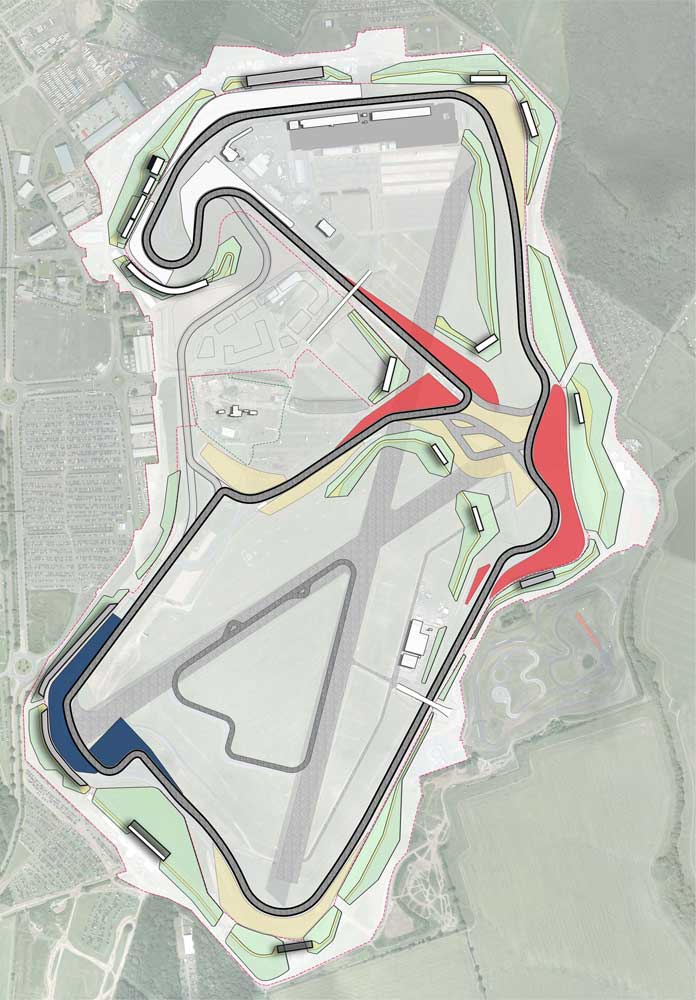 It was confirmed earlier that this year’s Formula 1 British Grand Prix will take place on the revised MotoGP circuit.
Admittedly at first glance, it does not look like the most endearing of changes and it is heartbreaking that the Grand Prix will lose Bridge corner – surely one of the finest corners in Formula 1; however something that will be gained is an extra vantage point at Becketts.
The grandstand on the inside of the complex will now be able to get a clear view of the new sections too, making that area a potentially excellent viewing spot. How the new section in terms of racing, we will have to wait until July to find out.
 Last year, the Indy Racing League set a new time period for the next IRL chassis design. The current chassis designed by Dallara in 2000 has, bar some minor tweaks, remained largely unchanged over the years. Originally it was assumed that Dallara may deliver an evolution of the current car, but in the time since a group of team owners announced a concept chassis called the Delta Wing – a concept that is to be officially unveiled tomorrow at a Chicago car show.
One thing that does seem to have been overlooked by many commentators is that although the new car will launch in 2012, it should not be designed with 2012 in mind. If this car is to run for a possible five or six seasons, it needs to be designed with 2015 to 2018 in mind. Like the new engine proposals (which may be unveiled later this year) it will need to be configured so that it will fall in line with environmental and power considerations of the future for the simple reason that this is what engine manufacturers and the likes are looking at. No one wants to build a car for 2012, because by the following January it could be considered to be conceptually outdated and its relevance may begin to sink quickly thereafter.
In the wake of all this talk about new cars, I could not help but notice that a proportion of writers have suddenly become experts on the designs of these cars with many happy to state that they have preferences for certain concepts because “…they look nice and fast…” or alternatively “…they look like an Indy car…” and it is train of thought that I simply cannot fathom.
Unless a whole host of bloggers, journalists and other commentators have become aerodynamacists overnight and can decipher the aerodynamic numbers and mechanical grip elements of cars that have yet to be built – let alone raced – then surely what a chassis looks like is quite irrelevant. Pretty cars do not always make for good racing and for all we know the ugly third concept design by Dallara as revealed last week could be the best racer of the lot and this is before any of the concepts have even been formally examined with regards to any sort of safety implementations.
This is crazy and it brings me to my biggest quip.
There seems to be a few in the racing community that appear to be more concerned about where sponsors are placed as opposed to how the cars race and ultimately that is completely the wrong way to approach any potential chassis design. If anything, this should be about:
- Safety
- Good racing
- Economy / Sponsorship
I will repeat this one last time – safety must come first; not only for the drivers, but more importantly the fans and the marshals. If the chosen chassis is slick, but inherently dangerous, then the League is just asking for bouts of litigation and bankruptcy should fatal accidents occur – this is not the 1970’s anymore and fatalities and serious injuries, while still a risk, must not be option open to possibility.
On the other hand, if they bring out a car that cannot race well and produces boring events, then regardless of how much sponsorship space a car has, the sidepods will be hard to sell, because fewer people may end up watching. However, if a chassis is chosen that allows exiting and competitive racing where drivers can get close without the risk of losing their lives, their feet or the front end in an aerodynamic wake, then people may be more aroused about the product and may be more inclined to buy in. More eyeballs may make marketing the series and obtaining sponsorship a little easier regardless of how cars look.
Taking all of that into consideration for moment, I must admit that the Italian company have been rather clever here. By revealing three concept drawings, Dallara have got an increasingly desperate fanbase talking about the cars, the IRL and most importantly their place in the series – but it’s only three drawings. No details have been released, there are no numbers, no thoughts, no ideas, just drawings of pretty cars. If I were to draw a machine that looks vaguely like an Indycar and submit it to the series bosses, do I then tout my squiggle as a potential 2012 chassis??
Like any other company in their position, Dallara were clever enough to throw out three seemingly random car concepts to position themselves one week ahead on the unveiling of the Delta Wing – thing is, when Dallara let their drawings “slip” not many were considering potential offerings from Swift Technologies or Lola cars. I wonder if Lola will unveil their 2010 Formula 1 car that was turned down? Of course, I could never really be that cynical, but the timing is certainly rather odd.
While it is wonderful that lots of people are talking about this issue, the reality is that apart from the light nuggets of information given to us by Swift Technologies, we – as fans – simply don’t know what we are talking about in terms of Indycar design. We are not aerodynamacists, so why are we even thinking about which concept car will work best? Unfortunately absolutely none of us know for sure which company may win out in the end; thus for now, the chatter is mainly about which is the prettiest drawing, but for now they are only drawings.
On a lighter note though, for the first time in a long time and despite some recent wobbles, the Indy Racing League feels as if it is moving along as opposed to bumbling around in the dark. Let’s hope progress can be maintained and that the series will be let to grow and breathe. In the meantime, the Delta Wing will be unveiled tomorrow at an auto show in Chicago and I – as with many other IRL fans – wait with baited breath to see what the Delta Wing can produce. In the absence of Formula 1 in the United States, whatever the league bosses choose will dictate the future of single seater racing in the US for years to come.
Recently, though, much attention has been heaped on Danica Patrick’s upcoming début in stock cars, as she took part in an ARCA race yesterday at Daytona Speedway – with many already suggesting that she will move from the Indy Racing League to NASCAR permanently within the next two or three years and while Patrick is a very good driver, she has never quite showcased herself as a champion (yet).
 A short one here – the 2009/10 GP2 Asia series following a three month break between Rounds 1 and 2.
Indeed, while there may be a small number of stand-out drivers that will make it to the main series, the GP2 Asia grid appears to be made up of some rather below par talent – although that could be overly harsh on my part.
Anyway, they are back in Abu Dhabi (again) this weekend, before the series splits to Bahrain for races on February 26/27 and March 13/14. Charles Pic is on pole for tomorrow’s Feature Race, while Valsecchi starts 3rd and Vietoris is in 10th position. iSport International driver, Oliver Turvey splits Pic and Valsecchi with a time that puts him in 2nd.
You can tune into Eurosport to pick up footage (although I’m sure it will be streamed somewhere on the net), but seeing as how the race is at the Yas Marina circuit, you may need to prepare one self for a rather processional race indeed.
 The 2010 IZOD Indy Racing League kicks off in Sao Paulo on Sunday March 14th with series’ first visit to Brazil. In a way, it’s a surprise that it has taken this long, especially considering that sheer amount of drivers and sponsors in the series that originate from the South American country.
Although not the widest of venues (street circuits rarely are), it is encouraging to see the two fairly lengthy straights to aid overtaking, as well as some technical features. After watching the video (below) of the track layout, it was also interesting to note how much it reminded me of the Toronto street circuit that the IRL will visit during the summer. Obviously, comparison’s can only truly be made when the Brazilian race weekend gets under way, but it should be interesting to see exactly how this works.
Alas, we shall only find out for sure how good (or bad) the circuit is when the cars run on it. Until then, forward March (as it were).

 TheMotorsportArchive.com