
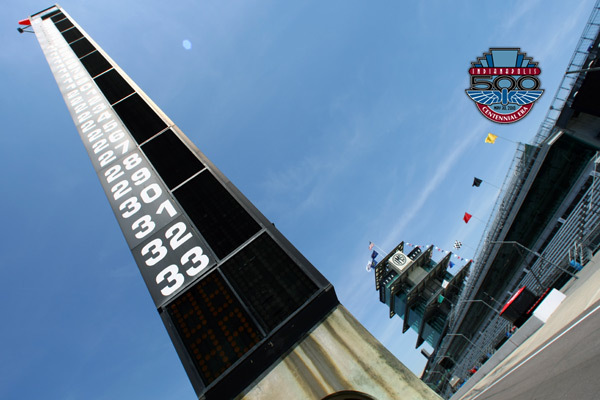
The score-tower at Indianapolis - like the Speedway itself, is an imposing presence.
Today sees the first of two qualifying days for the 2010 Indianapolis 500 – better known as Pole Day. The qualifying schedule has for this year, been greatly reduced by the Indianapolis Motor Speedway from four sessions in order to reduce the costs for both venue and the teams participating; however it is has had the additional effect of reshaping the process of qualification for the teams. As noted in the first part of “Time” (published here last August), this is all part of the long road to rebuilding the fractured IndyCar series in the US and while some of the changes that are being made will rub against the grain of the traditionalists, the IndyCar Series must be seen to progress – if it does not, the result for single seater racing in America could be potentially catastrophic.
This year’s Indy 500 will also see the first participation for former-F1 pilot, Takuma Sato, who will be driving the joint KV Racing / Lotus Racing effort. Formula 1 drivers have rarely fared well at Indianapolis over the last few decade – Nigel Mansell apart, so many eyes will be on the ex-Super Aguri driver. Sato scored his sole Formula 1 podium at Indianapolis at the US Grand Prix in 2004 while driving for BAR Honda and it is a feat the Japanese driver will wish to repeat; however he may find himself against many obstacles, primarily his inexperience on oval circuits. Another familiar name competing will be former Minardi and Jaguar F1 man, Justin Wilson. The Englishman has been driving in the IRL since it swallowed up Champ Car in 2008 and was a driver in the now defunct series prior to that.
Slow Changes
Prior to this season, qualifying at Indy for the 500-mile race was held over two weekends, with the top twenty-two positions decided over the second Saturday and Sunday of the month and the final eleven starting places decided the following weekend, including the often thrilling Bump Day taking place on the final qualifying Sunday. Only 33 drivers can start the event and with an average of 35 or 36 attempting to qualify; there were always going to those that went home disappointed. While that notion still exists in 2010, there has been an understanding that in the past few years those that did not make it were more often than not, simply lacking in the necessary skills to compete at any sort of heightened level; however a slowly strengthening series has raised the bar somewhat and for the first time in many seasons, those watching the tense qualifying show may see an unexpected early exit. This is partially due to the restructured qualifying set-up, but there is also a feeling that the overall quality of entrants this year is the highest it has been in many years as the unified category attracts a higher standard of racer.
Without wishing to cause offence to the likes of former backmarkers Marty Roth, Stanton Barrett or Jimmy Kite, it is highly questionable as to whether they could compete at a standard set by the likes of Alex Tagliani, EJ Viso or even the canny veteran, John Andretti. By the 2007 Indianapolis 500, the standard of many of the driver’s near the rear of the field was so poor that it was quite reminiscent of cast-offs of pre-qualifying in Formula 1 in the late 1980’s and early ’90’s. At that event Phil Giebler lined up in 33rd spot with an average speed of 219.6 miles per hour – a speed that may not get a driver even remotely close to the field three years on – that Giebler qualified his Honda-powered Playa Del Racing machine nearly a full 5mph faster than the bumped Kite was an example of the quality drop-off outside the running 33. It did not go unnoticed that some of the speeds for 33rd spot that were set during this week’s practice sessions, would have got a driver qualified on the edges of the top 20 during the previous decade; but what has changed in the time since and what makes this year so different?
For one, a realigned IndyCar series now has a slightly more focused driver path and line-up, and secondly the rearranged qualifying sessions has sharpened the tensions within the Indy 500 show somewhat. Although backmarkers such as Milka Duno still attach themselves to end of the field, the quality of driver that permeates through is much higher this time around and for the first time in many years, the first bumped driver (34th place) may well be in the 220 mph zone – a speed normally considered safe enough to qualify.
A New Qualifying Format
So how will the new sessions work? Many elements of previous years remain; for example, a qualifying run is the average speed of a four-lap run and a driver has three attempts per day, yet if a driver that has put in a run but wishes to go again, (s)he must withdraw the original time, and qualify again. Any competitor that does this knows there is a very real risk that they could end up with a slower time than what was originally posted. Also, motor racing still cannot run in wet conditions due to the constantly high speeds and ever present dangers – in addition to that, only one driver being allowed on track at any one time, getting the timing right for a driver’s run could be essential to their eventual participation in the race. It is therefore vital that both the team judge the conditions and their potential rivals correctly, otherwise they may find themselves in a perilous position come 6pm and the end of running. Rather than confirming the top eleven (and pole) on the first day, the reconfigured first day will now see the top 24 positions confirm their spots for the race, but the changes do not end there. From this year, Pole Day will now be split into two separate sessions, with positions 10 through 24 being solidified prior to 4pm and then a “pole position shoot-out” to place the top 9 places commencing thirty minutes afterward.
For the 90 minute session from 9.30pm (GMT +1) onward, the fastest nine drivers from the opening stint will have their previous times erased and must set at least one run for pole position with an option to run for a second time. As with the rest of qualifying, should any driver wish to go out again, their initial time will be withdrawn; therefore a second run will either have the risk of dropping a driver lower in the order or the potential of placing them on the top of the pile. In previous years, pole position at Indianapolis – like all the other races on the calendar garnered one bonus point for the Championship race; this year a points reward has been extended throughout the field with the front row drivers picking up 15, 13 and 12 points respectively. The bonus points will flow through the field with even the last qualifier picking up three points and as well as that, the cash bonus for qualifying on pole has also been raised from $100,000 to $175,000 and there are also prize money expansions for some of the lower spots.
The Battle Just to be in the Field of 33
As enticing as the shoot-out may be, the first session may be just as tense if not more so as the fight not to dragged into Bump Day could be rather fierce. Make no mistake that up to thirty cars could be fighting for the top 24 spots on day one and those that do not make could find themselves shedding beads of sweat – once left to competing on the second day, the possibility of not making the race at all is a very real one and it could spell disaster for any squad that doesn’t quite have enough in terms of both finances and reputation.
The fight for thirty-third position for the last six Indy 500’s has been close (baring 2007) and is often one of the most tense battles of the entire season and the speed markers for these entries have respectively been:
- 2004 – Robbie McGehee (211.231 mph)
- 2005 – Felipe Giaffone (217.645 mph)
- 2006 – Thiago Medeiros (215.729 mph)
- 2007 – Phil Giebler (219.637 mph)
- 2008 – Marty Roth (218.965 mph)
- 2009 – Ryan Hunter-Reay (220.957 mph)
In previous years, the fight for last place has created some shocks including in 1995 when neither Penske of Al Unser Jr or Emerson Fittipaldi were able to make the cut and in 2002 a stunned Johnny Herbert proved far too slow to make it into the event proper. With top speeds well in excess of 226 mph during the week (and 227 mph on Wednesday), these could be sessions which will potentially see the pressure reach mammoth levels – even the final practice session saw 1st to 30th place covered by less than 0.5 of a second over the course of a lap – a tiny gap and with the bump spot possibly at around 222 mph, it may make for a remarkably close field.
Realistically, the battle for pole will more than likely be between the Target Chip Ganassi cars driven by Scott Dixon and Dario Franchitti and Ganassi’s chief rival Penske motorsport. This year, Penske have three full-time entries for the first since they were all dominant in 1994 with their cars been driven by Will Power, Ryan Briscoe and three-time Indy 500 winner, Helio Castroneves.
Qualifying begins at 4pm (GMT +1) and can be found broadcast live on indycar.com with commentary from the Indianapolis Radio Network. For more in depth reports, analysis and commentary, there are three websites to check out – Pressdog, My Name is IRL and Oil Pressure, not forgetting the wondering Q&A sessions held by Curt Cavin of the Indianapolis Star which can be found at Ask the Expert.
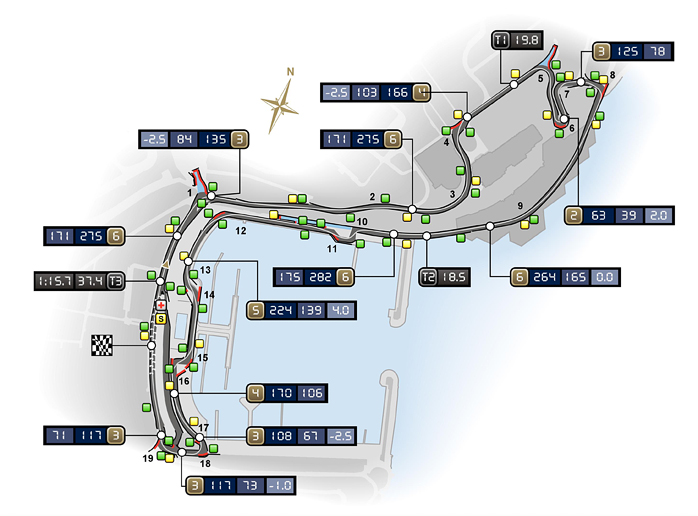
©FIA. Monaco Track Map
With the track being the shortest of the year, the gap from first to last is also reduced, although the HRT’s of Bruno Senna and Karun Chandhok continue to bring up the rear of the field. The next few races could indeed be crucial for the Spanish squad as news begins to creep out that they are in dire financial straits and for now FOM boss, Bernie Ecclestone has extended a helping hand to the team. It’s a catch-22 situation for a team mired at the back of the field; with no money coming in for updates, that situation seems set to continue and did so after the conclusion of first practice on Thursday morning – both Hispania cars set times more than one second slower than the nearest competitor and more embarrassingly, slower than a number of GP2 cars from their first session. Admittedly Chandhok did himself no favours with a spin through Massanet and while the Indian only glanced the barrier it was enough to finish his session early. Kamui Kobayashi has a more severe accident at the end of the ninety-minute session – as the Sauber driver threw his car through the Swimming Pool section, he hopped over the newly heightened kerbs and ploughed into the awaiting barrier. The collision making sure that a new front wing and left rear suspension would be required for second practice.
Early on the top of the timesheets were dominated by the Toro Rosso machines, but as the session wore on, the frontrunners began to claim the faster times – first Jenson Button, then Felipe Massa and Lewis Hamilton exchanged the top spot, before Fernando Alonso lay the final claim to the fastest time. Mercedes decided to revert to their shorter wheelbase car to make cornering much easier and while Michael Schumacher was able to lay claim to 6th place at the end of the session, Nico Rosberg mostly stayed in the garage – a suspension problem curtailing any longer runs for the German.
The early part of session two is also led by red bull liveried cars, but this time it’s the first team that head the sheets as first Sebastian Vettel goes fastest, before the German is quickly pipped by his team mate Mark Webber. For a time, Hamilton joins the battle to be fastest, but eventually the 2008 World Champion and his Australian rival tumble slowly down the timesheets as both Ferrari’s return to the top of the pile, joined this time by the Renault of Robert Kubica. Come the end of the 90 minutes, even the Pole could not hold on to the supreme pace set by the fastest cars and the session ended with Alonso claiming top spot and his Ferrari team mate notching up fourth fastest. In between the Maranello pair, were the Mercedes of Rosberg and Vettel in his Red Bull. This was a vital session for Rosberg after he lost so much ground earlier in the day and the German capitalised by not only being quick, but also garnering a large number of laps in the session – with only 60 minutes of practice left on Saturday morning, it could be vital. There were a number of brief offs during the afternoon for Massa and Timo Glock (twice) at Saint Devote, while Jaime Alguersuari, Vitantonio Liuzzi and Schumacher needed to take shortcuts across the Nouvelle Chicane; thankfully no damage was inflicted, but that says nothing for a driver’s embarrassment.
Both Renault’s are the first on track at the beginning of Saturday Free Practice, led by Kubica and it is the Pole that registers the fastest time of the session and while a Ferrari takes up the second spot and the Red Bull in third spot; however it is Massa placed behind Kubica rather Alonso. The double World Champion has looked very racey all weekend, twenty minutes into the session there is disaster for the Spaniard as he lets his F10 machine drift wide through Massanet, severely damaging his right front and ripping his right rear wheel clean off. Upon inspection, it’s revealed that the cracked chassis was cracked on impact, ending not only the practice session for Alonso, but also taking him out of qualifying. At the race where grid position is absolutely vital, the Ferrari will start from the pitlane. Alonso is not the only driver having difficulties on the Monaco streets. A slide for Adrian Sutil through the Casino Square sees his Force India fall backwards towards the guardrail and the ensuing contact damages his rear wing; however at least Sutil’s damage is repairable. Others to have offs include Schumacher and Petrov, both of whom took to the escape road at Mirabeau rather than clout a barrier. Kobayashi also has an impressive spin at La Rascasse – losing his Sauber upon entry, he keeps his car spinning full circle and exits the section the right way around; fantastic control from the young driver. Glock’s problematic weekend continued throughout the session as another hydraulic failure sees the Virgin machine pull off early in the session – he sets no time; however the Virgin team had at least sent both their cars out with properly aligned steering columns, unlike HRT. With the day still young, Chandhok is allowed on track by the Spanish squad with an out of kilter steering section – it’s a poor error by the new team and something that should never happen at this level. Both Senna and Chandhok finish third practice five seconds slower than Kubica and with every passing day, pressure continues to weigh on the shoulders of the team.
There were plenty of drivers worried about being blocked in the first qualifying session and while some did have troubles during the twenty minute run, all those that were expected to get through did; however the Lotus of Heikki Kovalainen ran Alguersuari, Nico Hulkenberg and Kobayashi close; however spins for the Finn at both Loews and Mirabeau did not help his cause or his tyres. With Alonso not running in qualifying, the six additional reject spots were eventually taken up by the three new teams. There was some relief at the HRT camp as Senna qualified his machine less than four seconds slower than the fastest lap by Massa, although a differential problem for his teammate rendered his fastest lap the slowest of the session. While one Renault pushed hard and fast, the second trailed some way behind and although the French squad are quite openly geared towards Kubica, it must surely hurt Petrov’s confidence to line up only 15th for the race. It certainly did not help that he sent his car careering into the barriers at Sainte Devote with only two minutes remaining on the clock. The Russian has some supreme races so far this year; however with passing next to impossible, it may be difficult for the rookie to repeat any Grand Prix heroics on the famed streets. Petrov was joined on the Qualifying 2 sidelines by both Toro Rosso’s, both Sauber’s and Sutil. Hulkenberg’s improvement as a driver continues as the reigning GP2 Champion only just misses the final session by mere two-tenths of a second behind the reigning World Champion.
It almost seemed inevitable in a way – a Red Bull took pole position again and Mark Webber accumulated his second top spot in succession. That makes six consecutive poles in six Grand Prix weekends so far this season; a remarkable record. Rosberg may have been fastest in qualifying second session with Massa topping the opening twenty minute run, but it was Webber on top when it counted the most. Kubica actually led most of the final session until he was pipped by the Australian; however the Renault man stayed ahead of the other Red Bull piloted by Vettel. Massa placed his Ferrari on the second, reclaiming some pride for the Italian squad. The Brazilian was tailed by four Mercedes powered cars with Hamilton in 5th and Button 8th in their McLaren’s, while Rosberg led Schumacher in the British sandwich. Both the Mercedes drivers complained that they were held up in the last session, with Schumacher the most irritated – he was blocked by his younger teammate. Rubens Barrichello and Liuzzi claimed good 5th row starting positions for their respective teams, although they may find it harder to progress higher up from there; however 78 laps is a long distance and anything can happen at Monte Carlo.
After the flyaway races finished three weeks ago, Webber was 8th in the title race – a long way behind by the Chinese Grand Prix winner, Jenson Button and seemingly under the thumb of his teammate. However by the end of the sixth race at Monte Carlo, both Red Bull drivers were co-leading the championship ahead the of Alonso’s Ferrari, while Button had dropped to fourth place. On a circuit where overtaking is near to impossible, the Australian converted to his brilliant pole position into a race win, but it was not an easy victory. Four safety car periods constantly punctured Webber’s lead, but in the clear running he was simply much faster than the rest of the field and it all started when he got clear away from the starting grid in the lead; however there were changes aplenty behind him as Vettel slotted ahead of Kubica for 2nd place, Rosberg fell to 8th and Barrichello sliced his way up to 6th place – indeed Barrichello had a far better opening lap than his team mate Hulkenberg. As field guided their way around on the opening tour, the young German driver slid off line in the tunnel and crunch the wall hard, leaving shards of debris all over the tunnel exit – safety car number 1. As the Williams team pondered upon thoughts of a mortally wounded car, the Ferrari team reconsidered race strategy – with Alonso starting from the pits, the Italian squad brought the former World Champion in for a change to hard tyres; a risky strategy would necessitate a full 76 lap run on one set, but with a weak hand, it was the only gamble left to play. Alonso’s position in the field remained the same – last, but the Spaniard probably shed a smile when at the start of the third lap, a silver car parked to one side with plumes of smoke pouring out of it’s rear end. Button was out early of the race he won twelve months earlier.
The safety car lasted approximately five laps and once it vacated the circuit, Webber pulled away from his team mate; first by 1 second, then 2 and by the thirteenth lap, the Australian was four seconds ahead of Vettel and while the main pack remained static, Alonso began to pluck off the backmarkers. It took him some time to force way passed di Grassi, but he eventually nailed the Virgin (so to speak) out of the tunnel – soon he had Glock, Kovalainen and Trulli; Alonso was 17th and catching the back of the mid-pack – the strategy was clearly working and was worrying the cars from 4th place onwards. The Ferrari driver’s odd strategy meaning the possibility was there to leapfrog much of the field – including his teammate, Felipe Massa.
While the Renault powered front three fought or their respective positions, fourth place Massa was constantly under threat from behind from Hamilton, but the Englishman relieved that pressure with his one and only stop on the 18th lap. It was a canny bit of manoeuvring from McLaren as Hamilton fed back out on track just ahead of Alonso; for now, race position was secured, but with more stops coming, the former Champion was certain to climb back up the standings. Soon twenty laps are in the books and now the pitlane comes fully to life as Massa, Schumacher, Barrichello and Liuzzi all pit in – tyres are changed and strategies are played out and it is Alonso that wins out as beats all but Massa to the first corner. It was a double whammy for Barrichello though; the Williams crew are slower to get their man out and he is beaten to the pit out line by his former teammate Schumacher. The veteran has been less than positive about his time as Schumacher’s Ferrari partner and the German is the last driver he wanted ahead of him. Keen to make up from a poor start, Schumacher’s Mercedes associate, Nico Rosberg picks up the pace now that the traffic has been removed from his front wing and the former Williams pilot registers fastest lap after fastest lap and as both Renault’s pit and Vettel pit, he jumps up to second place. As good as Rosberg’s times are, their not good enough to get him ahead of Webber when the Australian pits – the Red Bull squad making their tyre changes seem ultra smooth and polished and fast enough to halt the progress of the Mercedes. Pedro de la Rosa also ducks in for a stop at this time; however his Sauber remains permanently stationary – his hydraulics system collapses, finishing his race early and within five laps, a miserable day is capped off for the Swiss squad when Kobayashi pulls off the circuit citing a dead gearbox. In amongst this, both Virgin’s pull out of the race with Glock’s car possessing an extremely bent steering arm; contact with the barrier is not thought advisable in Monte Carlo and it seems Glock needed to be certain. The race is two-passed the two-third distance mark when Rosberg, tired of following Webber, pits his Mercedes and emerges behind both Ferrari’s, Hamilton and Schumacher – despite his fast laps up front, Rosberg managed to lose a spot to his teammate. Rosberg can count himself lucky that he pitted when he did as coming around Massanet bend, a left rear suspension failure pitching Barrichello hard into the guardrail’s bringing out the safety car once again – poor luck for Barrichello, who was on for a solid points finish.
It takes four laps to clear the mess and upon the green flag, Webber in his Red Bull pulls away again; the 35-year-old seemingly unstoppable and heading to his first Monaco victory, while behind him a conga line of various Renault, Mercedes and Ferrari powered cars fall behind in his wake – even the Mercedes powered Force India duo join the points race with Sutil heading Liuzzi for 9th and 10t. Although the Force India squad continue to gather strength, they had yet to score a double-points finish up until this stage – where better to do it than Monaco? For nine laps, the race ran without issues, until the safety car emerged again on lap 44 although on this occasion, the reason was less obvious. A marshal flagged that a drainage cover may have been lifted out of its slot during Barrichello’s accident, thereby presenting a real danger to both drivers and corner workers – the inspection took up two laps and the race allowed to continue, but once again Webber’s lead was gone… and once again he pulled away from the pack upon restart. As he was in Barcelona seven days previously, Webber’s pace was relentless and while those behind registered laps in the 1 minute 16 second range, the race leader felt content enough to run 75-second laps – he was not going to give this up any time soon regardless of what was thrown at him.
While the battle up front was being played out for points, there was a fight for pride at the rear of the field between Lotus and Hispania Racing; however while Jarno Trulli was busy looking large in Chandhok’s mirror’s for 16th place, both Senna and Kovalainen pulled into the pits to retire the same time – Senna with more hydraulic issues and Kovalainen with bent steering. With both Chandhok and Trulli instantly promoted two more places, Trulli began to look more an more feisty and on lap 75 attempted a move into La Rascasse corner; it was clumsy and ill-advised and sent the Lotus careering over the top of Chandhok and took both cars out of the race in one foul swoop and it brought out the safety car for the final time.
Webber led the field around, but with so little time remaining, the race was destined to end under yellow., but while the 2010 Monaco Grand Prix had set itself up for an anti-climactic finish, controversy reigned in the pack. The safety car peeled in at the end of the final lap and while in normal circumstances racing can resume from the final corner, this does not apply on at race completion – unfortunately no one had relayed this information to the Mercedes team. Under the belief that passing is allowed once the safety car pulled, Schumacher dived inside a sideways Alonso at Antony Noghes corner and temporarily gained 6th place across the line. After much argument, a twenty second time penalty was applied to Schumacher, which dropped the German from 6th position to 12th place and firmly out of the points – but none of this should take away any column inches away from Mark Webber. The Australian dominated this race and seemed content ahead of Vettel and third placed Kubica; the Polish drove a quiet but solid race for another podium finish. Behind the leading trio, the Massa-led Ferrari duo took 4th and 6th as the sandwiched Hamilton, with Rosberg, Sutil, Liuzzi and Buemi taking the final points spots. Nothing can take this wonderful win away from Webber who was absolutely flawless when it mattered most and he now heads the title hunt jointly with Vettel, leading by virtue of more victories – another 1-2 finish for Red Bull who are looking more and more bulletproof. Alonso moves up to third in the Championship, with Button dropping down to fourth, but it is still very close as only eight points separate Webber and Button.
Monaco may not always deliver in terms of excitement and today it existed only in brief spells and like Barcelona last week, the event started well before tapering off in the second half. Although not something normally commented on here, it could not be ignored just how many grandstands were partially empty this year. If Formula 1’s main event cannot pack out the stands, then the sport may need to look very hard at what it is doing to attract fans – especially with news that Istanbul organisers are slashing ticket prices in order to get anyone to go.
Rating: 3 out of 5
——–
Barcelona, Monaco Grand Prix (Round 6, May 16th)
1 WEBBER Red Bull 78 laps
2 VETTEL Red Bull +0.4s
3 KUBICA Renault +1.6s
4 MASSA Ferrari +2.6s
5 HAMILTON McLaren +4.3s
6 ALONSO Ferrari +6.3s
7 ROSBERG Mercedes +6.6s
8 SUTIL Force India +6.9s
9 LIUZZI Force India +7.3s
10 BUEMI Toro Rosso +8.1s
11 ALGUERSUARI Toro Rosso +9.1s
12 SCHUMACHER Mercedes +25.7s (*20 second penalty applied)
R PETROV Renault +5 laps
R CHANDHOK HRT +8 laps
R TRULLI Lotus +8 laps
R KOVALAINEN Lotus +20 laps
R SENNA HRT +20 laps
R BARRICHELLO Williams +48 laps
R KOBAYASHI Sauber +52 laps
R DI GRASSI Virgin +53 laps
R GLOCK Virgin +56 laps
R DE LA ROSA Sauber +57 laps
R BUTTON McLaren +76 laps
R HULKENBERG Williams +78 laps
Monaco, Qualifying (May 15th)
3rd Session
1 WEBBER Red Bull 1m13.826s
2 KUBICA Renault 1m14.120s
3 VETTEL Red Bull 1m14.227s
4 MASSA Ferrari 1m14.283s
5 HAMILTON McLaren 1m14.432s
6 ROSBERG Mercedes 1m14.544s
7 SCHUMACHER Mercedes 1m14.590s
8 BUTTON McLaren 1m14.637s
9 BARRICHELLO Williams 1m14.901s
10 LIUZZI Force India 1m15.170s
2nd Session
11 HULKENBERG Williams 1m15.317s
12 SUTIL Force India 1m15.318s
13 BUEMI Toro Rosso 1m15.413s
14 PETROV Renault 1m15.576s
15 DE LA ROSA Sauber 1m15.692s
16 KOBAYASHI Sauber 1m15.992s
17 ALGUERSUARI Toro Rosso 1m16.176s
1st Session
18 KOVALAINEN Lotus 1m17.094s
19 TRULLI Lotus 1m17.134s
20 GLOCK Virgin 1m17.377s
21 DI GRASSI Virgin 1m17.864s
22 SENNA HRT 1m18.509s
23 CHANDHOK HRT 1m19.559s
24 ALONSO Ferrari no time
Monaco, 3rd Free Practice (May 15th)
1 KUBICA Renault 1m14.806s
2 MASSA Ferrari 1m14.852s
3 WEBBER Red Bull 1m14.945s
4 HAMILTON McLaren 1m15.038s
5 VETTEL Red Bull 1m15.046s
6 SCHUMACHER Mercedes 1m15.236s
7 ROSBERG Mercedes 1m15.252s
8 BUEMI Toro Rosso 1m15.537s
9 SUTIL Force India 1m15.659s
10 BUTTON McLaren 1m15.682s
11 LIUZZI Force India 1m15.691s
12 ALGUERSUARI Toro Rosso 1m15.769s
13 HULKENBERG Williams 1m16.164s
14 BARRICHELLO Williams 1m16.232s
15 PETROV Renault 1m16.240s
16 ALONSO Ferrari 1m16.266s
17 KOBAYASHI Sauber 1m16.644s
18 DE LA ROSA Sauber 1m16.696s
19 KOVALAINEN Lotus 1m17.782s
20 TRULLI Lotus 1m17.865s
21 DI GRASSI Virgin 1m18.063s
22 SENNA HRT 1m19.720s
23 CHANDHOK HRT 1m19.781s
24 GLOCK Virgin no time
Monaco, 2nd Free Practice (May 13th)
1 ALONSO Ferrari 1m14.904s
2 ROSBERG Mercedes 1m15.013s
3 VETTEL Red Bull 1m15.099s
4 MASSA Ferrari 1m15.120s
5 SCHUMACHER Mercedes 1m15.143s
6 KUBICA Renault 1m15.192s
7 HAMILTON McLaren 1m15.249s
8 SUTIL Force India 1m15.460s
9 BUTTON McLaren 1m15.619s
10 WEBBER Red Bull 1m15.620s
11 PETROV Renault 1m15.746s
12 BUEMI Toro Rosso 1m16.276s
13 HULKENBERG Williams 1m16.348s
14 BARRICHELLO Williams 1m16.522s
15 LIUZZI Force India 1m16.528s
16 DE LA ROSA Sauber 1m16.599s
17 KOBAYASHI Sauber 1m16.818s
18 ALGUERSUARI Toro Rosso 1m17.023s
19 KOVALAINEN Lotus 1m18.184s
20 DI GRASSI Virgin 1m18.478s
21 TRULLI Lotus 1m18.667s
22 GLOCK Virgin 1m18.721s
23 CHANDHOK HRT 1m20.313s
24 SENNA HRT 1m22.148s
Monaco, 1st Free Practice (May 13th)
1 ALONSO Ferrari 1m15.927s
2 VETTEL Red Bull 1m16.000s
3 KUBICA Renault 1m16.016s
4 WEBBER Red Bull 1m16.382s
5 MASSA Ferrari 1m16.517s
6 SCHUMACHER Mercedes 1m16.589s
7 HAMILTON McLaren 1m16.647s
8 BUTTON McLaren 1m16.692s
9 SUTIL Force India 1m16.805s
10 BUEMI Toro Rosso 1m16.857s
11 ROSBERG Mercedes 1m17.149s
12 BARRICHELLO Williams 1m17.331s
13 LIUZZI Force India 1m17.704s
14 PETROV Renault 1m17.718s
15 ALGUERSUARI Toro Rosso 1m17.991s
16 HULKENBERG Williams 1m18.397s
17 DE LA ROSA Sauber 1m18.434s
18 KOBAYASHI Sauber 1m18.547s
19 GLOCK Virgin 1m19.527s
20 KOVALAINEN Lotus 1m19.606s
21 TRULLI Lotus 1m19.902s
22 DI GRASSI Virgin 1m20.566s
23 SENNA HRT 1m21.688s
24 CHANDHOK HRT 1m21.853s
| Driver | Team | Points |
|---|---|---|
| 1. Mark Webber | Red Bull Racing | 78 |
| 2. Sebastian Vettel | Red Bull Racing | 78 |
| 3. Fernando Alonso | Ferrari | 75 |
| 4. Jenson Button | McLaren | 70 |
| 5. Felipe Massa | Ferrari | 61 |
| 6. Lewis Hamilton | McLaren | 59 |
| 7. Robert Kubica | Renault | 59 |
| 8. Nico Rosberg | Mercedes GP | 56 |
| 9. Michael Schumacher | Mercedes GP | 22 |
| 10. Adrian Sutil | Force India | 20 |
| 11. Vitantonio Liuzzi | Force India | 10 |
| 12. Rubens Barrichello | Williams | 7 |
| 13. Vitaly Petrov | Renault | 6 |
| 14. Jaime Alguersuari | Scuderia Toro Rosso | 3 |
| 15. Sebastien Buemi | Scuderia Toro Rosso | 1 |
| 16. Nico Hulkenberg | Williams | 1 |
| Constructor Team | Points |
|---|---|
| 1. Red Bull Racing | 156 |
| 2. Ferrari | 136 |
| 3. McLaren | 129 |
| 4. Mercedes GP | 78 |
| 5. Renault | 65 |
| 6. Force India | 30 |
| 7. Williams | 8 |
| 8. Scuderia Toro Rosso | 4 |
(Originally posted on SidePodCast.com on May 12th, 2010)
——
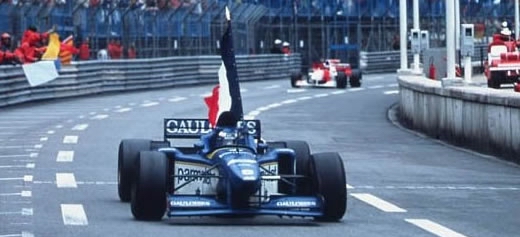
Olivier Panis parading the French flag after his Monaco triumph
One of the key aspects in motorsports, both physically and mentally, is momentum. It is often the unspoken element that gives a competitor the extra drive to make his machine work; it can breed confidence within one’s psyche and also in a driver’s surroundings.
Up until 1996, Olivier Panis had something of a patchy time at the sport’s top level – a couple of lucky 2nd places in retirement riddled events for Ligier was not the kind of form that had tongues wagging in the paddock; however keen observers had noticed some slight improvement from the Frenchman throughout the 1995 season, but he had still been generally out performed by Martin Brundle for the half-season that the Englishman drove. Panis was about to enter his third season at the top level and he needed to deliver. The season started in a difficult manner – the Ligier was not as competitive as expected and also quite unreliable, but in terms of driving, Panis had made that step and it was a progression that would eventually come to fruition at the 1996 Monaco Grand Prix.
For many spectator’s, the 1996 Formula 1 season was always going to be a Williams whitewash. Adrian Newey had produced another fast, if occasionally fragile machine, that was being driven on one hand a super-competitive ageing star (Damon Hill) and by a somewhat younger, wide-eyed hotshot in the other (Jacques Villeneuve). Meanwhile the then two-time World Champion Michael Schumacher was quietly struggling with a new team that were determined to make their way back to the top.
By the time Monaco had come around, Hill had a commanding Championship lead and was desperate to emulate his father Graham at the famed race, but the advantage lay with Schumacher who had claimed a controversial pole having blocked the Austrian of Gerhart Berger during Qualifying. Behind the enigmatic German, Jean Alesi was starting from third, just behind Hill and in front of the furious Berger – Panis, meanwhile, had to settle for a disappointing 14th place; the Mugen-Honda powered Ligier encountering problems on the city streets. Thus, this was the setting for what was – in my opinion – one of the greatest races and greatest drives of all time.
By now, Ferrari had not won at Monte Carlo since Gilles Villeneuve triumphed at the principality in 1981 and on race day when the skies opened and the rain fell, one could almost feel the race fall into Schumacher’s lap before the lights had even gone out. It would have been a hasty prediction – only half way through the opening lap, Schumacher had negotiated his way out of the tricky Loews corner, before sliding sideways and into the welcoming arms of the Armco barrier approaching Portiere – out. With the main threat gone, Hill in his Williams and Alesi in his Benetton pulled away into the distance, but behind them and in the pack, Panis began to pluck of competitor one by one – that momentum, that drive… on a track where passing is impossible, the Frenchman picked off Brundle, Hakkinen, Herbert and a number of others – and made it look easy, while the rookies and backmarkers behind them spun and crashed their way to an early bath and an angry team boss. By the 30th lap, only 11 cars remained once Martin Brundle spun his way out of the race.
As the track dried, the field began to feed into the pits and one of the early changers was Panis; at this stage running a confident 4th place. Although the circuit was far from dry, the Frenchman found a comfort zone that put him several levels above all the other competitors and on slicks, he reeled in the Ferrari Eddie Irvine at an astonishing three seconds per lap – Panis was even two seconds per lap faster than race leader Damon Hill at this point; but Hill was far in the distance, Irvine was close and getting closer.
On lap 33, Panis approached the rear wing of the Ferrari and his electrifying pace ebbed away – the momentum was being lost, floundering in the face of an Italian gearbox. Panis absolutely had to pass. The following tour around, the Ligier driver parked himself under the rear wing of the Ferrari – stalking rather than attacking; ascending Sainte Devote and Beau Rivage, sweeping through Massanet and Casino Square, before pressing into Mirabeau.
As the duo approached Loews hairpin, I saw one of the greatest overtaking manoeuvres that I have ever witnessed. There was no grace, no beauty and no finesse; however when Olivier Panis forced and elbowed Eddie Irvine out of the way in the middle of the 30 mph corner, my heart leapt. Everything about the pass screamed “get the hell out of my way, I’m coming through and you’re not going to stop me!” …and it was fantastic. It was forceful and direct and they never touched.
Panis ran off with third place, but less than ten laps later, Hills Renault engine gave out its last breath and not long after that Alesi’s race finished with suspension damage – Panis now led the Monaco Grand Prix, but it was not over yet. As the race drew to a close, the rain teemed down once again and soon David Coulthard had found his way onto the tail of the Ligier. The red and white Mercedes powered car clearly had more stability in the newly dampened conditions and although he punched a whole in Panis’ lead, he could not get by once he was under the Frenchman’s rear wing. Momentum lost.
There’s a wonderful still shot of Panis as he runs through La Rascasse corner for the last time before taking the chequered flag. As the Ligier runs through, one of the corner workers – a broad smile on his face – gives the blue and yellow machine an emphatic thumbs up. It summed up not only the race, but also a truly stunning drive by the Frenchman – regardless of what people may say about the retirement rate on the day, it was a near perfect drive and the right result.
Following Monaco, normal service resumed for the rest of the season. The Ligier went back to being an unreliable hulk and Hill took the title in his Williams; however that marked performance stayed with Panis through to 1997. Many forget that when Panis broke his legs in Canada just twelve months after his triumph, he was sitting third in the World Championship – bettered only by Villeneuve and Schumacher – and had come remarkably close to repeating his Monaco victory in Spain, were it not for a stubborn Minardi in the shape of Shinji Nakano. On that day in Barcelona, Panis was pulling in race leader Jacques Villeneuve at nearly 2-seconds-per-lap on a circuit not known for passing – again, but when Panis rolled up to the back of Nakano, he could not get by. Momentum lost.
Although, there were flashes of brilliance thereafter, Panis never quite recovered from his accident. Apart from a year off in 2000 when he tested for McLaren, the Frenchman often found himself in either horribly uncompetitive machinery or with perennial midfield teams in the midst of power struggles. Once again the momentum was lost. Panis retired from Formula 1 at the end of the 2004 season following ten full seasons in the sport and while he may never have had the necessary quality to be a World Champion, the ability to pick up more race victories in the right equipment was definitely there. Sometimes though……..
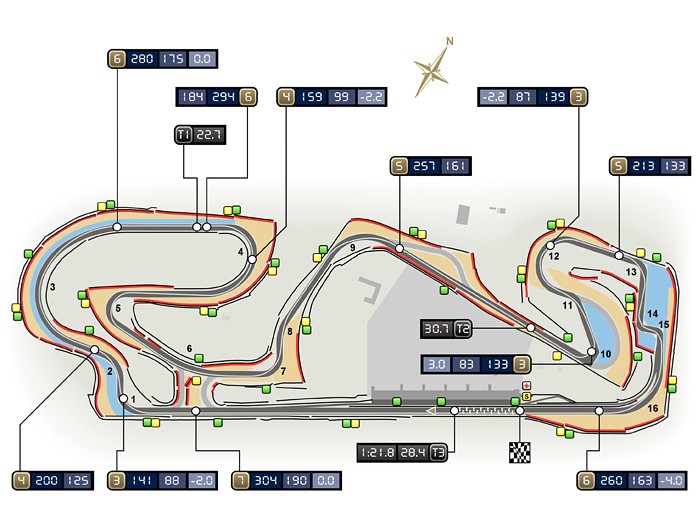
©FIA, The Circuit de Catalunya
With four races of the nineteen completed, reigning World Champion Jenson Button leads the Drivers Championship, some ten points ahead of Nico Rosberg who in turn is only just ahead of Fernando Alonso and Lewis Hamilton. Red Bull had a difficult time in China and will be looking to stamp their authority back in Europe, but with teams bringing a large number of car updates, we may see a change in order of things for the foreseeable future. As with the previous events, some of the smaller teams have introduced a third driver to run the first Friday morning session, as Force India and Lotus have done already this season and at Barcelona, HRT joined that list. Rather than Sakon Yamamoto, it was the team’s fourth signing of the year, Christian Klien that took Karun Chandhok for the opening 90 minute run – the need for experience outweighing youthful vigour as the Spanish squad seek to understand their Dallara chassis a little better. As per usual Paul di Resta sat in at Force India; this time the young Scot replaced Adrian Sutil.
Sutil and Chandhok get back into their respective seats come the start of the second session and immediately hit the track. They were not the only ones though; with greying clouds drawing in, a number of other drivers ventured out on circuit to get in banker miles. Not much time has elapsed when Sutil spun halfway through turn 8 and Chandhok found himself having to take the exit road at turn 10; however neither driver suffered any damage through their various offs. Unfortunately the same could not be said for Nico Hulkenberg – the young Williams driver ran wide exiting the fast turn 9 and pitched his car head on into the tyre barrier at the top of the back straight. Red flag. With some very significant damage done to the front end of his FW32 machine, Hulkenberg’s session is done early. It takes 10 minutes for the session to restart and as the field poured out once again and in slightly cooler conditions, the times began to tumble. Eventually the Red Bull, piloted by Vettel, topped the session; the German being only driver to complete a lap under 80 seconds, although his Australian team mate, Webber runs him close. Schumacher maintained the progress started in first practice by setting the third best time of the afternoon; however as the clock ticked down, the temperatures go up slightly and the faster times stall. It didn’t mean that drivers stop pushing though, as shown by Chandhok (again), Bruno Senna and Vitaly Petrov – while Petrov may have gone wide trying to go faster, it appears as though the poor balance with the HRT is catching out both its drivers under braking. The session ends with the Toro Rosso of Jaime Alguersuari pulling off in turn 6 – small plumes of blue smoke rising ominously from the rear of the machine.
Saturday
Heavy overnight rain had made the Catalunya circuit quite green for the start of Saturday morning practice and with precious few venturing out for laps early, the track took some time to properly rubber in. Although with the sun out and temperatures rising slowly, there was little in the way of dampness on the circuit surface, the same could not be said for the kerbs on the entry into turn 4. Situated under a pedestrian passover, a couple of inches of overnight water collected in the grooves between the red and white concrete stripes and caught out both Kobayashi in his Sauber and the Renault of Petrov. Kobayashi, the first at the scene, spun harmlessly into the gravel trap, but his fellow rookie over-corrected his sliding car and slammed backwards into the tyre barrier, shedding the Renault of its rear wing and connecting assembly. For the second time over the course of the weekend, the red flag was out.
A five minute stoppage ensued and a quaint silence shrouded the circuit – a silence eventually shattered by the roar of the Cosworth at the back of Bruno Senna’s HRT car as he made his way back on track; the green light shining brightly at the top of the pitlane. Nearly as quickly as Senna had left the pits, the young Brazilian returned – a leak from the rear of the car curtailing his session. Sutil joined Senna on the sidelines when his Force India suddenly lost drive halfway around the circuit and ground to a halt – the German driver will be hoping this is not representative of the rest of his weekend. The frontrunners emerged from their hideaways to begin qualifying simulation runs – the times begin to peel away as fast time is bettered by fast time. An air of resignation drifts amongst the team when it quickly becomes apparent that they may be chasing the Red Bull’s in qualifying rather than competing with them – Sebastian Vettel registering a time nearly one second faster than the nearest non-Red Bull; the young German even has a large gap over his experienced team mate of 0.7 seconds.
Saturday was turning into a dire day for HRT – with Senna’s reliability issues, the team’s second driver Karun Chandhok was handed a five-place grid penalty in qualifying for having a change of gearbox before the morning session got under way. There were also penalties for the Virgin team too – an error saw them not issuing their gear ratios to the stewards in time and both drivers picked up five place grid penalties as well; however considering all three penalised drivers reside at the rear end of the field, there may be little change of regular form come the end of qualifying itself. One potential grid alteration could come from Vitaly Petrov – his morning accident necessitated a gearbox change and the five place penalty that goes with it. With multiple penalties being applied to the newer teams, there were no real surprises at the far end at Qualifying 1; however the regular bottom six find themselves joined by Barrichello – the veteran claiming traffic cost him a good lap. Despite the updates that his Williams has for this weekend, Barrichello’s young team mate, Hulkenberg, set a time 0.3 of a second quicker in the old car – a very disappointing result for the Brazilian – starting from so far down, Sunday may be a very long day. Liuzzi went out early to get in a Qualifying 2 banker, but the Force India driver struggled to set a competitive time and the Italian had to settle for 17th position. The second Force India car with Adrian Sutil planted his machine firmly in 11th and was joined by Hulkenberg, Petrov, de la Rosa and both Toro Rosso’s as the second session rejects.
In the third qualifying session, the Red Bulls hit the track and were instantly 1 second up on the 3rd and 4th place McLaren’s – headed by Hamilton on the first run; at this stage pole position seems so certain for the Austrian squad. The drivers all pit in to take new tyres and fuel for their final runs – this is battle for pole between Vettel and Webber regardless of what anyone else does. It was during is final run that Vettel drove what looked like a near perfect lap and went fastest, but Webber runs close behind and goes even faster – in fact the Australian was the only driver in qualifying to get into the 1 minute 19 second bracket and finished nearly one second ahead of Hamilton, in a distant third place. Button put the second McLaren in 5th place sandwiching the Ferrari of Alonso who qualifies on the outside of the second row. For the first time this season, Schumacher in 6th out-qualifies Rosberg, with Kubica a solid 7th between both Mercedes. Massa and Kobayashi put their cars 9th and 10th on the grid respectively; however the real story lies with the blue and red duo at the front of the grid.
The driver with the pole position had yet to win in 2010 – by 2.40pm UK time, Mark Webber had altered that fact with a drive so utterly dominant, it left the rest of the field scratching their heads in his wake. Occasionally one wonders if this tactic of total control may indeed be hurting Red Bull; in terms of television advertising, his car was hardly seen all day long – all the interesting battles were happening behind him, far behind him. Over the course of the 66 lap distance, the Australian never lost the lead – even during the pitstops. Judging from the pre-race interviews, there was an air of confidence about him that had been missing all season long; all he had to do was get into the first corner ahead of the pack and the race would be his. When the red lights did go out, it happened – Webber got away well and secured the lead heading into turn one and with that the race was as good as his. Thankfully for both TV viewers and the fans, Webber’s Red Bull teammate had a rather more interesting race – Vettel got off the line well and battled hard with Hamilton and Alonso through the first turns and emerged out ahead of the trio – by the end of the first lap it was Red Bull, Red Bull, McLaren and Ferrari leading the way; however it would be some time before this fight began to heat up.
Both Heikki Kovalainen and Bruno Senna must be wishing that they could have a battle along those lines – even if it were further back. Sadly for the Finn, he did not even make it onto the grid as a failed hydraulic system meant his Lotus would take no part. Senna for his part did get off the grid, but the Brazilian only lasted three corners, before being punted off circuit and into the tyre barriers – the contact with the rubber wall was not heavy, but it was enough to end his race. Unfortunately Senna was not the only driver to face difficulties through the long right-hander. A hard charging Kobayashi ran side-by-side on the outside of turn three with Petrov’s Renault in the corner, but went too far wide and lost momentum – in a flash, the Japanese rookie dropped from 10th down to 16th, but this was the beginning’s of another poor day for the Sauber team. Starting from 12th on the grid, Pedro de la Rosa was tapped from behind by the Toro Rosso of Sebastien Buemi, shredding de la Rosa’s left rear tyre and breaking Buemi’s front wing. The veteran Spaniard went back on track; however it was clear that his car had further damage and by the 18th lap, de la Rosa pulled into the garage citing his car to be undrivable – a great shame for the former-McLaren tester, left visibly upset at his home race. If one Toro Rosso had a bad start, the other had a wonderful one – Jaime Alguersuari started 15th and sliced down the middle of the pack approaching turn one; by the 5th tour, he was already up to 9th place chasing Adrian Sutil and being chased by Robert Kubica. This battle became quite frustrating for Kubica – as much as the Pole tried, there was simply no way past the younger driver as the curse of the Barcelona circuit became more and more apparent. For the first time this season, Kubica looked well and truly stuck. A recovering Buemi gave the impression that there were passing opportunities aplenty, but on closer inspection his moves past the two Virgin’s of Timo Glock and Lucas di Grassi, Jarno Trulli (Lotus) and Karun Chandhok (HRT) simply showcased the gulf in speed between the current midfielders and the new teams.
Thirteen laps was all it took to get the first pitstops under way; Vitantonio Liuzzi making the early move, but the Italian came close to a nasty incident upon pit exit. As Liuzzi rejoined the track, Buemi came into view attempted a move around the outside of turn 1 – it failed and the Toro Rosso driver took to the escape road and back onto the circuit after turn 2; a move that would earn the Swiss driver a penalty shortly afterward. Over the course of the next six laps, the rest of the field take their turns to get new tyres; however not all are as clean as they would have liked. The slow starting Nico Rosberg lost four places on the opening lap and this was compounded by an even slower stop. The German had all four tyres changed, or so he thought; his right front wheel was not properly attached and despite his best efforts to get away, the car was pulled back to box to have it properly secured – all the while both time and more importantly other cars pass him by.
Unlike Massa, Webber didn’t have to find extra speed – he already had it and spent most of the second half of the race pulling away from his followers. By two-thirds distance, it was 11 seconds, but with every tour of the course, the gap got larger until it was up to 18 seconds; it would surely take a failure on the Red Bull to give this away and as the laps ticked by a Red Bull was indeed shackled with failing brakes; alas it was not Webber, but his team mate Vettel. A trip through the gravel trap in the turn 7/8 section was the first sign and the ominous message from the pit wall confirmed – Vettel won in Malaysia, but was denied victories in Bahrain in Australia and now he was under pressure to guide the Red Bull home in Spain. Come the end of the lap, Vettel pitted for new tyres and a new front wing, replacing the battle scarred aero piece – it was a relatively quick stop, but it was enough to let Alonso through into 3rd place. The Spanish fans went wild with this – Alonso had spent the race putting in some relative quick laps, yet was generally having an uneventful race and while still fast, he was not close enough nor fast enough to threaten Hamilton; it would take a failure to elevate the home favourite into second place and on the 65th lap of 66, that is exactly what he got. Lewis Hamilton in his McLaren had run a very solid race behind Webber, when a wheel rim let go on his left front tyre – his Bridgestone tyre delaminated and pitched the Englishman into the tyre barriers in turn 3; as with Senna at the beginning of the race, it was not overly tough contact, but definitely enough to retire him on the spot – now Alonso was up to P2 and the Spanish faithful went wild. Behind the Ferrari, Vettel receives constant messages to take it easy and the young German is able to keep within three seconds of Webber’s top pace – thankfully, the Red Bull has such a large gap over the now 4th place Schumacher, that the threat is largely minimal; however the worry on the pit wall persists.
It needn’t have though – Webber brings his Red Bull across the finish line first followed by Alonso and Vettel; his gap to Schumacher just 11 seconds by the flag. Button took fifth place with Massa, Sutil and Kubica close behind. Rubens Barrichello picked up a 9th place finish and two points in a race where he was virtually invisible; while Alguersuari salvaged 10th spot on the last lap thanks to Liuzzi’s Force India giving up the ghost on the final lap. In every way, Webber trounced the field – he was hoping for a boring race and for the most part, he got it. Indeed, there were flashes of excitement and quality racing – mainly from Button and Schumacher, but the 2010 Spanish Grand Prix will join the long list of races at Barcelona that ultimately failed to truly excite or invigorate. From here, the team will pack up fast and rush to Monaco – the jewel in the crown begins in only four days time. It’s the race that everyone wants to win and Mark Webber will take to the streets ultra confident and on a roll.
——–
Barcelona, Spanish Grand Prix (Round 5, May 9th)
1 WEBBER Red Bull 66 laps
2 ALONSO Ferrari +24.0s
3 VETTEL Red Bull +51.3s
4 SCHUMACHER Mercedes +62.1s
5 BUTTON McLaren +63.7s
6 MASSA Ferrari +65.7s
7 SUTIL Force India +72.9s
8 KUBICA Renault +73.6s
9 BARRICHELLO Williams +1 lap
10 ALGUERSUARI Toro Rosso +1 lap
11 PETROV Renault +1 lap
12 KOBAYASHI Sauber +1 lap
13 ROSBERG Mercedes +1 lap
14 HAMILTON McLaren +2 laps
15 LIUZZI Force India +2 laps
16 HULKENBERG Williams +2 laps
17 TRULLI Lotus +3 laps
18 GLOCK Virgin +3 laps
19 DI GRASSI Virgin +4 laps
R BUEMI Toro Rosso +24 laps
R CHANDHOK HRT +39 laps
R DE LA ROSA Sauber +48 laps
R SENNA HRT +66 laps
R KOVALAINEN Lotus +66 laps (DNS)
Barcelona, Qualifying (May 8th)
3rd Session
1 WEBBER Red Bull 1m19.995s
2 VETTEL Red Bull 1m20.101s
3 HAMILTON McLaren 1m20.829s
4 ALONSO Ferrari 1m20.937s
5 BUTTON McLaren 1m20.991s
6 SCHUMACHER Mercedes 1m21.294s
7 KUBICA Renault 1m21.353s
8 ROSBERG Mercedes 1m21.408s
9 MASSA Ferrari 1m21.585s
10 KOBAYASHI Sauber 1m21.984s
2nd Session
11 SUTIL Force India 1m21.985s
12 DE LA ROSA Sauber 1m22.026s
13 HULKENBERG Williams 1m22.131s
14 BUEMI Toro Rosso 1m22.191s
15 ALGUERSUARI Toro Rosso 1m22.207s
16 LIUZZI Force India 1m22.854s
1st Session
17 BARRICHELLO Williams 1m23.125s
18 TRULLI Lotus 1m24.674s
19 PETROV Renault 1m22.139s (* Penalty; originally 14th)
20 KOVALAINEN Lotus 1m24.748s
21 SENNA HRT 1m27.122s
22 GLOCK Virgin 1m25.475s (* Penalty; originally 21st)
23 DI GRASSI Virgin 1m25.556s (* Penalty; originally 22nd)
24 CHANDHOK HRT 1m26.750s (* Penalty; originally 23rd)
Barcelona, 3rd Free Practice (May 8th)
1 VETTEL Red Bull 1m20.528s
2 WEBBER Red Bull 1m21.232s
3 HAMILTON McLaren 1m21.348s
4 BUTTON McLaren 1m21.376s
5 SCHUMACHER Mercedes 1m21.583s
6 MASSA Ferrari 1m21.749s
7 ROSBERG Mercedes 1m22.013s
8 ALONSO Ferrari 1m22.091s
9 KUBICA Renault 1m22.242s
10 SUTIL Force India 1m22.377s
11 BUEMI Toro Rosso 1m22.400s
12 KOBAYASHI Sauber 1m22.412s
13 DE LA ROSA Sauber 1m22.527s
14 HULKENBERG Williams 1m22.634s
15 ALGUERSUARI Toro Rosso 1m22.926s
16 BARRICHELLO Williams 1m22.953s
17 LIUZZI Force India 1m23.597s
18 PETROV Renault 1m23.896s
19 TRULLI Lotus 1m24.610s
20 KOVALAINEN Lotus 1m24.745s
21 GLOCK Virgin 1m25.722s
22 DI GRASSI Virgin 1m25.855s
23 CHANDHOK HRT 1m26.611s
24 SENNA HRT 1m30.246s
Barcelona, 2nd Free Practice (May 7th)
1 VETTEL Red Bull 1m19.965s
2 WEBBER Red Bull 1m20.175s
3 SCHUMACHER Mercedes 1m20.757s
4 ALONSO Ferrari 1m20.819s
5 HAMILTON McLaren 1m21.191s
6 KUBICA Renault 1m21.202s
7 ROSBERG Mercedes 1m21.271s
8 MASSA Ferrari 1m21.302s
9 BUTTON McLaren 1m21.364s
10 SUTIL Force India 1m21.518s
11 DE LA ROSA Sauber 1m21.672s
12 LIUZZI Force India 1m21.904s
13 KOBAYASHI Sauber 1m21.931s
14 BUEMI Toro Rosso 1m22.184s
15 BARRICHELLO Williams 1m22.192s
16 PETROV Renault 1m22.435s
17 ALGUERSUARI Toro Rosso 1m22.449s
18 HULKENBERG Williams 1m23.765s
19 TRULLI Lotus 1m24.209s
20 KOVALAINEN Lotus 1m24.894s
21 DI GRASSI Virgin 1m25.066s
22 CHANDHOK HRT 1m25.972s
23 SENNA HRT 1m26.152s
24 GLOCK Virgin 1m26.596s
Barcelona, 1st Free Practice (May 7th)
1 HAMILTON McLaren 1m21.134s
2 BUTTON McLaren 1m21.672s
3 SCHUMACHER Mercedes 1m21.716s
4 WEBBER Red Bull 1m22.011s
5 VETTEL Red Bull 1m22.026s
6 ROSBERG Mercedes 1m22.070s
7 KUBICA Renault 1m22.202s
8 ALONSO Ferrari 1m22.258s
9 PETROV Renault 1m22.397s
10 KOBAYASHI Sauber 1m22.492s
11 BUEMI Toro Rosso 1m22.588s
12 MASSA Ferrari 1m22.975s
13 DI RESTA Force India 1m23.030s
14 ALGUERSUARI Toro Rosso 1m23.110s
15 LIUZZI Force India 1m23.284s
16 BARRICHELLO Williams 1m23.312s
17 HULKENBERG Williams 1m23.471s
18 KOVALAINEN Lotus 1m25.329s
19 TRULLI Lotus 1m26.244s
20 GLOCK Virgin 1m26.340s
21 DI GRASSI Virgin 1m26.694s
22 KLIEN HRT 1m27.250s
23 SENNA HRT 1m27.752s
24 DE LA ROSA Sauber no time
| Driver | Team | Points |
|---|---|---|
| 1. Jenson Button | McLaren | 70 |
| 2. Fernando Alonso | Ferrari | 67 |
| 3. Sebastian Vettel | Red Bull Racing | 60 |
| 4. Mark Webber | Red Bull Racing | 53 |
| 5. Nico Rosberg | Mercedes GP | 50 |
| 6. Lewis Hamilton | McLaren | 49 |
| 7. Felipe Massa | Ferrari | 49 |
| 8. Robert Kubica | Renault | 44 |
| 9. Michael Schumacher | Mercedes GP | 22 |
| 10. Adrian Sutil | Force India | 16 |
| 11. Vitantonio Liuzzi | Force India | 8 |
| 12. Rubens Barrichello | Williams | 7 |
| 13. Vitaly Petrov | Renault | 6 |
| 14. Jaime Alguersuari | Scuderia Toro Rosso | 3 |
| 15. Nico Hulkenberg | Williams | 1 |
| Constructor Team | Points |
|---|---|
| 1. McLaren | 119 |
| 2. Ferrari | 116 |
| 3. Red Bull Racing | 113 |
| 4. Mercedes GP | 72 |
| 5. Renault | 50 |
| 6. Force India | 24 |
| 7. Williams | 8 |
| 8. Scuderia Toro Rosso | 3 |
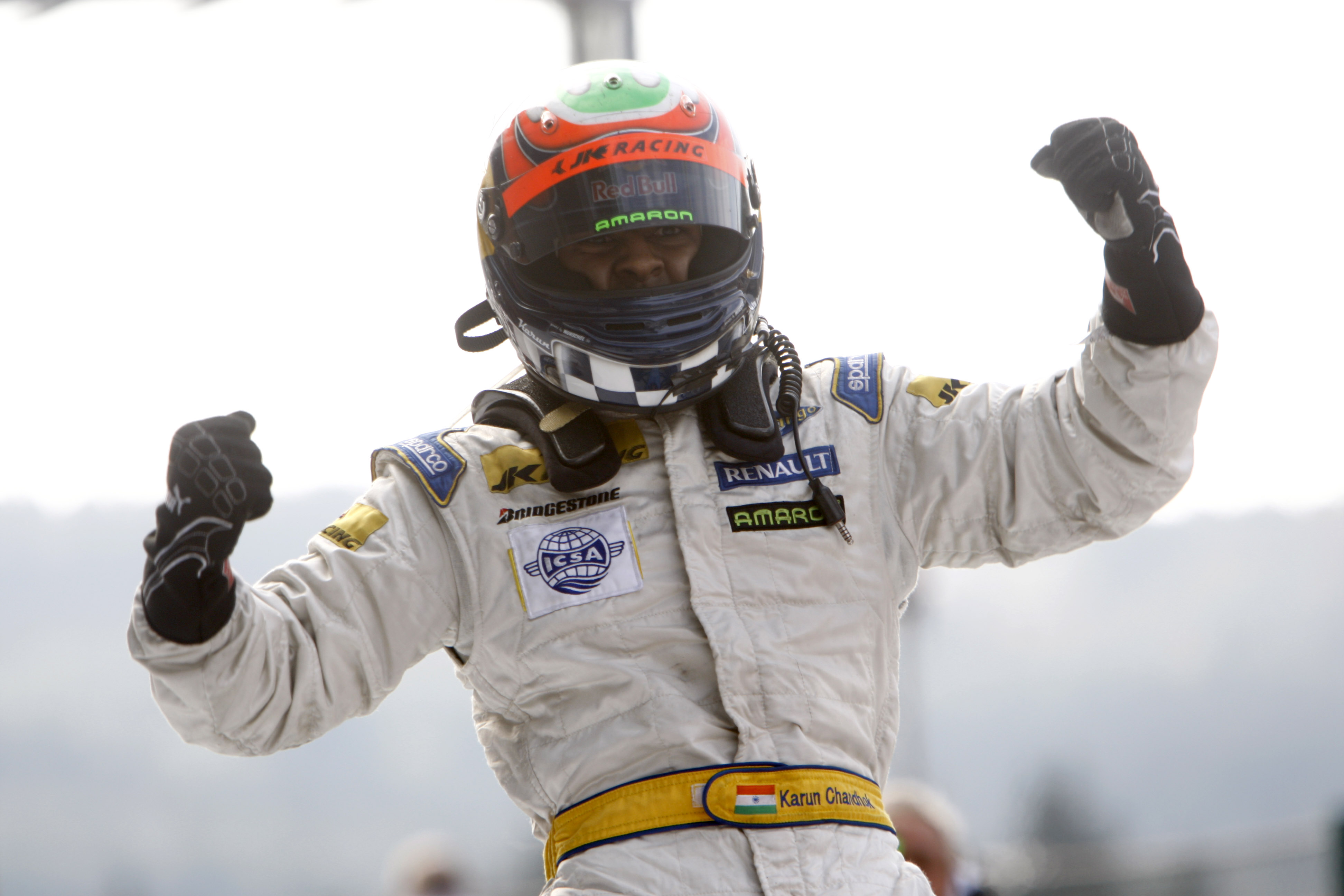
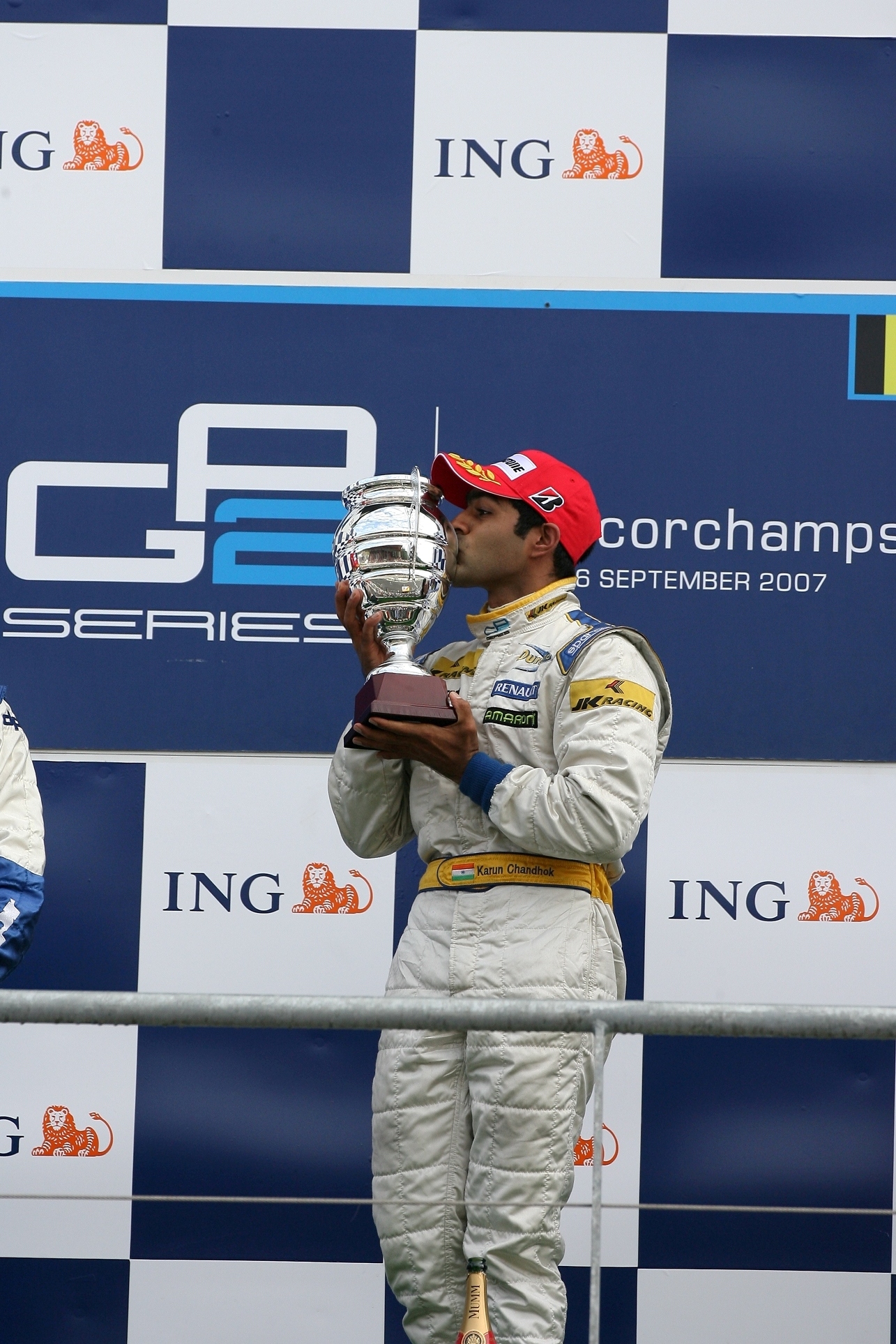
Karun Chandhok as he celebrates at Spa-Francorchamps in 2007
One of the final driver signings for the 2010 Formula 1 season was Karun Chandhok, who has been paired with GP2 team mate Bruno Senna at the newly formed Hispania Racing Team. The 26 year-old is the second Indian driver to compete in Formula 1 and although he has had a rather difficult beginning to his career with the Spanish team, his upbeat demeanour and positive attitude have made him a hit amongst Formula 1 fans across the globe.
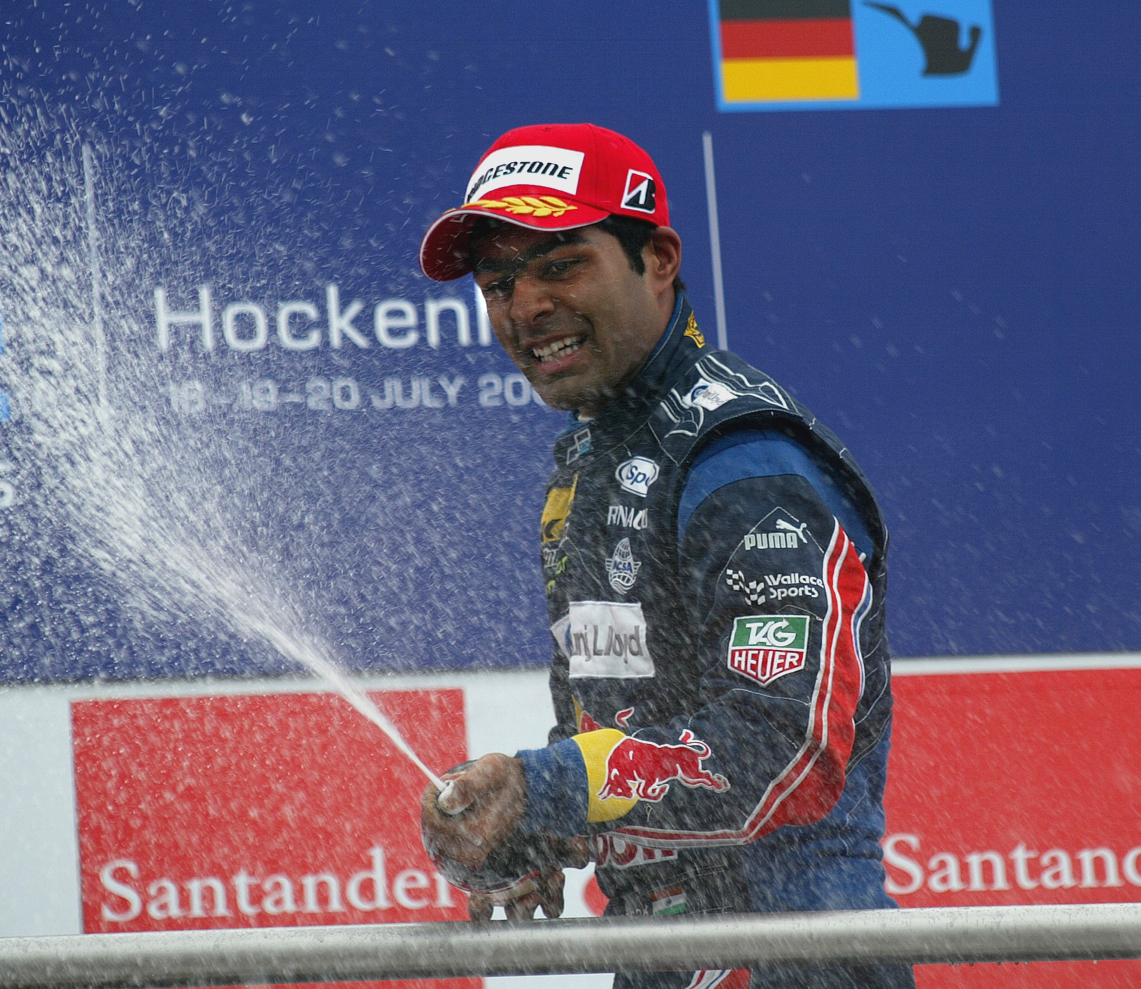
He has previously enjoyed good results on the road to F1 in both British Formula 3 and A1GP, and in 2006, Chandhok became the inaugural Formula Asia by Renault champion, winning 7 of the 12 races along the way. He later competed in Formula 1’s primary feeder-formula, GP2 with Durango, iSport and Ocean Racing Technology respectively, amassing two victories along the way at Spa-Francorchamps and the Hockenheimring. A tough 2009 campaign saw the young man from Chennai struggle to pick up points during the season, but it did not block his progress to the top tier.
Following the Chinese Grand Prix, I contacted him to find out how things are going on at the pinnacle of motorsport, about his role in pioneering social media in motor racing and what bits of road his loves most.
Since it was announced you would be driving this season, it has been a whirlwind couple of months for you. Have you had a chance to take a breath yet?
It was surreal to be quite honest with you. However I must add that when it happened, the feeling of accomplishment was the last thing on my mind as just before the start of my first race, I was told about a possible hydraulics problem. So the only thing on my mind was whether we will get the car out.
It’s pretty incredible but to be honest I hadn’t had time to think about it and let the feeling sink in until the break now. My whole life has been spent dreaming and working towards being a Formula 1 driver and I think when these big things happen in life, our brains don’t process it so quickly! Ever since I was a kid all I wanted to do was be in Formula 1 – I didn’t want to be a doctor or lawyer or anything else and the past couple of months have been the realization of that dream.
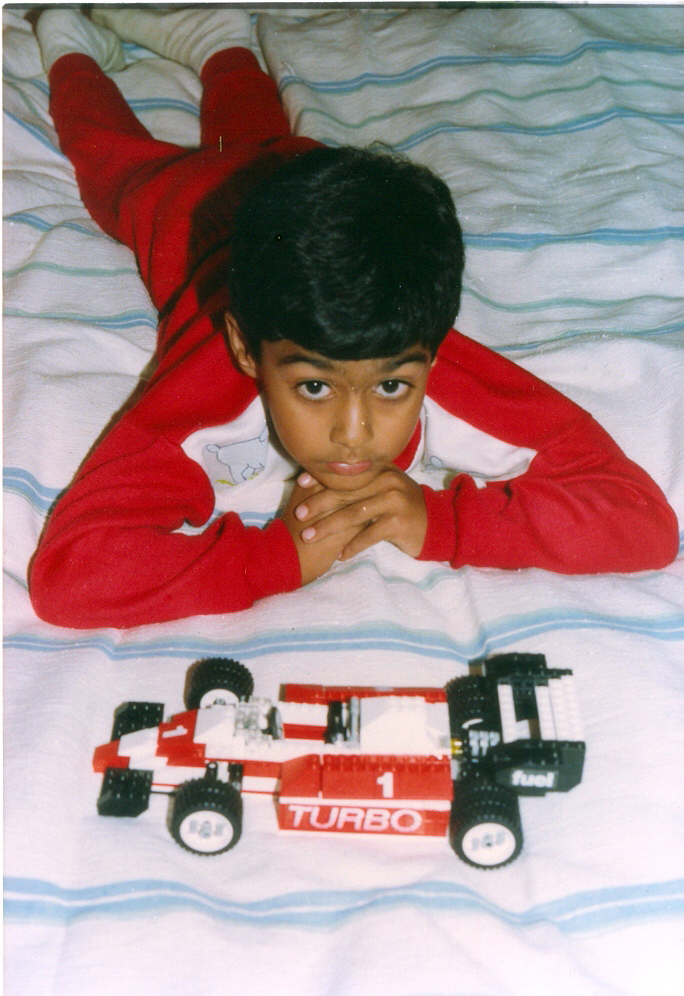
Chandhok had a passion for cars from a young age.
What was it that sparked your interest in motor racing all those years ago? Was there a driver that you really admired and influenced you during your younger years?
Racing has been my whole life since I was a kid. I’ve been obsessed with the sport and have grown up in a Motorsport environment (my grandfather raced in the 50’s and founded the Federation of Motorsports Clubs of India and my dad has been racing since 1972). It was a natural progression for me. In India family businesses are very common so I guess this is ours! Ever since I can remember I’ve wanted to be a racing driver. When my friends were reading comics I was reading Autosport!!!
Alain Prost has always been my all time favourite driver and it was an amazing feeling to finally meet and talk to him over the Bahrain GP weekend. It was a dream come true for me. Prost was one of the few drivers who believed that the focus of a race driver should not only be on speed, but on a technical level as well.
You are the second Indian driver to compete in Formula 1 following Narain Karthikeyan’s 2005 début. With Vijay Mallya’s Force India squad doing rather well at the moment and an Indian Grand Prix on the horizon, how is Formula 1 and motorsport as a whole being received in your homeland? Has there been much feedback?
The hype and response in India has been fantastic. I have had so many messages on my Twitter page and my website, that it’s been quite overwhelming. The media response has been fantastic as well and I’ve had kind words of support from some great Indians like Sachin Tendulkar, Kapil Dev and Shah Rukh Khan as well as captains of industry and political supremo’s.
There has been so much support from within India and also the Indian communities around the world, who have said that they will come to the races with Indian flags to support me which is great to see. I think with the Grand Prix scheduled for next year, I do hope that I can be in a position where we are more competitive for the rest of this season and I’m in a competitive position next year – there’s no doubt being the only Indian driver lining up for the first Indian GP will be a special feeling!
With your use of Twitter, you (with one or two other drivers) are technically leading a revolution amongst Formula 1 drivers – a group of sportsmen that famously tend not to get too close to fans. Was a closer relationship with fans something you always had in mind or was Twitter something that just fell into your lap and made it possible?
I think it’s a bit of both. I’ve always been very concious of my role as not just a racing driver but as an ambassador for the sport especially in a country like India where I have to help the sport grow in popularity. twitter provides a great medium to communicate with the public and give them insights into our world that they don’t otherwise get on the internet or from the magazines and newspapers.
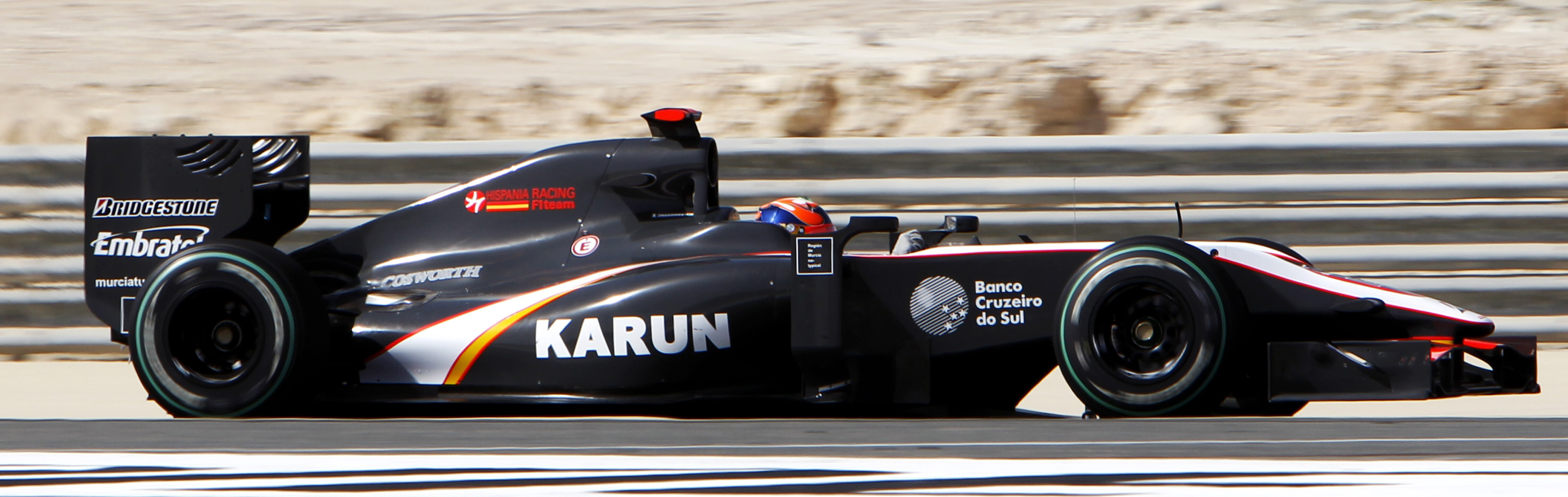
Piloting the HRT around the Sakhir circuit, Bahrain.
When my, admittedly, untrained eyes are looking at the onboard footage on television, the HRT car looks spectacularly difficult to handle through the fast turns – is that something that you actually feel when driving or are there other problems that amplify the perception of the car’s poor handling issues?
It’s no secret that we are lacking downforce and that is central to improving how the car works in all types of corners – not necessarily just the fast ones. we have a lot of work to do still with the electronics and on the suspension side but primarily the big performance gains will be aero.
Following a difficult weekend in Bahrain, you have since had three consecutive race finishes, including Malaysia and China where you and Bruno Senna brought both cars home. Are there still niggling reliability issues with the HRT cars or is focus shifting to improving the pace and balance?
We have always known that the first four race weekends for us were going to be about being respectable, being credible, and trying to just establish ourselves as respectable drivers who are ready to be in F1.
Over the next couple of races we will no doubt be in a slightly better situation because we now have more mileage under our belts, and hopefully the team can start pushing on from Barcelona onwards to chase performance.
The 26 year-old has experienced success at the Hockenheimring.
You were teammates with Bruno Senna during the 2008 GP2 Season with the iSport team. Has the fact that you are paired with a driver that you have a good relationship with helped the team knit together and if so, how?
It’s rare for team-mates to be friends but Bruno and I get along very well. I don’t see him as Bruno Senna, nephew of Ayrton – I see and respect him as Bruno, a driver in his own right. He and his family are great people and we’re both mature enough to deal with the pressures. At iSport in 2008 we had a great working relationship with the engineers so I think we can carry that on this year. We always had a similar style and similar requirements from the car which is good for the engineers to carry out parallel programs
Both yourself and Bruno are rookies in a brand new squad – has that made figuring out the car a little more difficult that it might have been with a more experienced teammate and/or team?
Not really – yes an experienced driver may have pointed a couple things out that we’ve missed but fundamentally I think that we’re both experienced enough in other categories and have both tested with good teams in f1 to know what we need from the car and the team.
After a difficult GP2 year in 2009, were you ever worried that an F1 seat might never come about and did you have any back up plans in mind in case team did fall through?
Yes, we had options to be a test driver with a couple established teams further up the field and also to do GP2 again but in the end things worked out OK for us with HRT.
Bernie Ecclestone has popped up in your corner at various times in the last few seasons – has he had much of an impact on your career?
Bernie has always been a superb pillar of support for me and my family – it’s amazing how much that man can do in a single day ! This last winter has been very hard and it’s taken us a while to get a deal sorted so there are always times when you have doubts but in the end it all worked out OK.
Victory in Belgium in 2007.
You claimed your first GP2 victory at the Sprint race at Spa-Francorchamps In 2007. For many drivers (and fans), it is a special place with a strange aura – are you looking forward to finally throwing a Formula 1 car around the famous hills and corners? Are there any other circuits this season that you are excited about driving?
Absolutely ! Spa is a great circuit in any car and I have fond memories dating back to my F3 days as well. Monaco is my favourite race of the year – it’s a great circuit and a fantastic challenge for all drivers. The street circuit has many elevation changes, tight corners as well as the high speed sections around the casino and swimming pool, which makes it one of the most demanding tracks on the Formula One calendar. With the barriers so close, there is no room for even the slightest error. I also enjoy racing at Silverstone, which remains my home race until the Indian GP in 2011. This will be my first trip to Suzuka as well, so definitely looking forward to that.
Of course, you have done laps on most of the circuits on the calendar, but how do you prepare for circuits that you have never driven before?
There’s a lot of homework involved in the sport and we generally get to the track early enough to do track walks, talk to the engineers and look at data from the past. Simulators are also used sometimes to come to grips with a new circuit although it never is quite the same, apart from which I watch on board videos of other drivers to get a closer look.
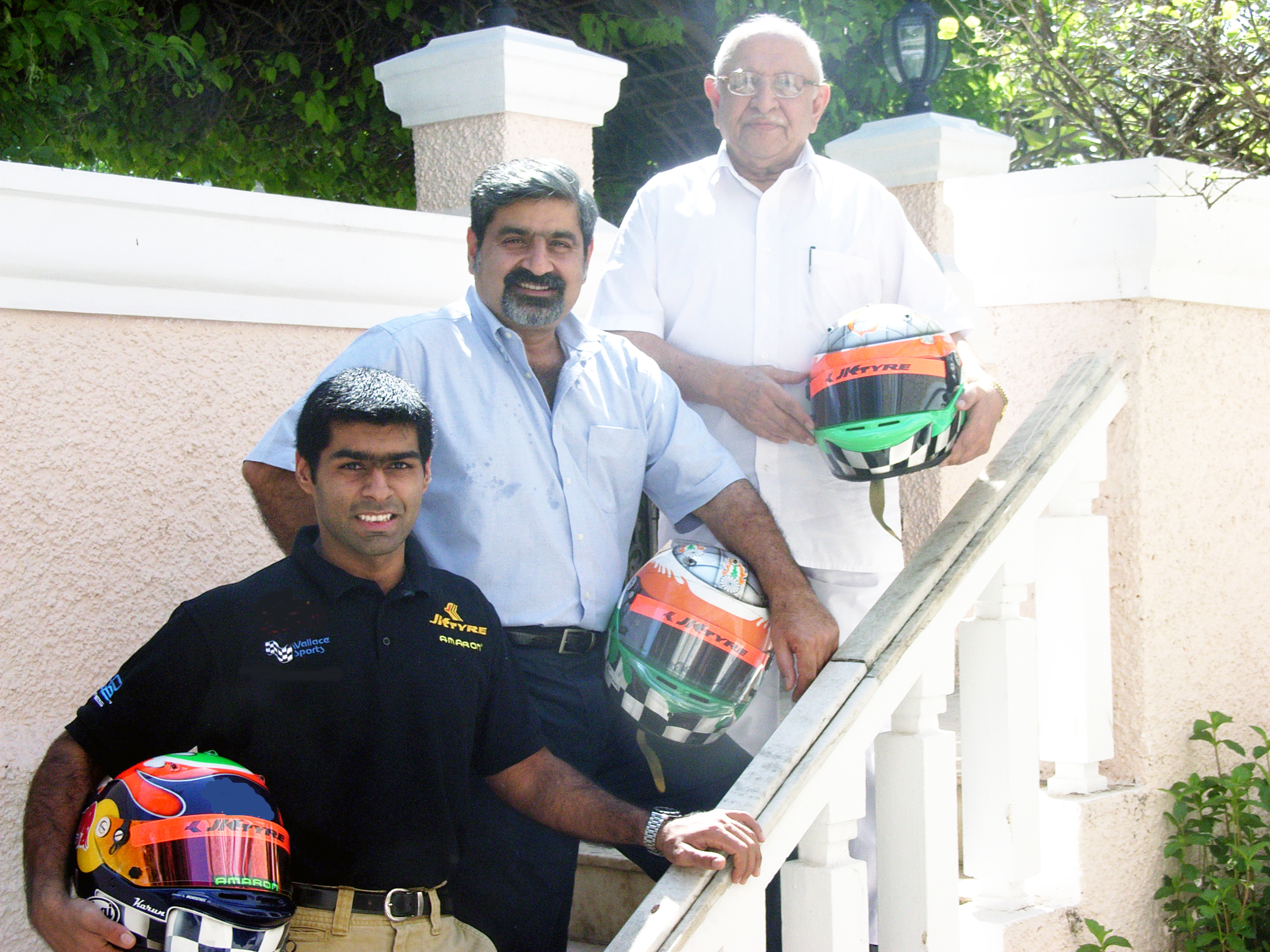
3 Generations of Chandhok's (from l to r: Karun, Vicky and Indu)
What are your aims for the rest of the 2010 season?
I think the team’s target remains becoming the best of the new teams by the end of the year. We all knew we were going to be up against the tide going in but I hope we grow in performance through the year. Personally I would like to use this year to learn and establish myself as a credible F1 driver who’s here for the long run.
Finally, do you have any one single piece of advice for young drivers that are looking to make that step forward into Formula racing?
For me, this is the greatest sport on earth. There is absolutely nothing else that combines competition, technology, finance, marketing, geography and glamour like Formula 1. It is a real dog eat dog world however – very much a case of every man for himself and you really have to be on your toes.
I think it’s important to stay grounded, focused and shut out distractions. I live in a small town called Brackley in the UK, away from the big cities and the party life that comes with it. Motivation is a huge part of it. It’s very important to motivate yourself to work to the best of your ability, both in the car and outside of it. It is a very capital intensive sport and so you have to also be marketable for the sponsors and technically strong for the engineers.
(April 2010)
Follow Karun Chandhok on Twitter at @KarunChandhok and check out his website. All photographs appear courtesy of Karun Chandhok.
My sincere thanks to both Karun and Suhail Chandhok.
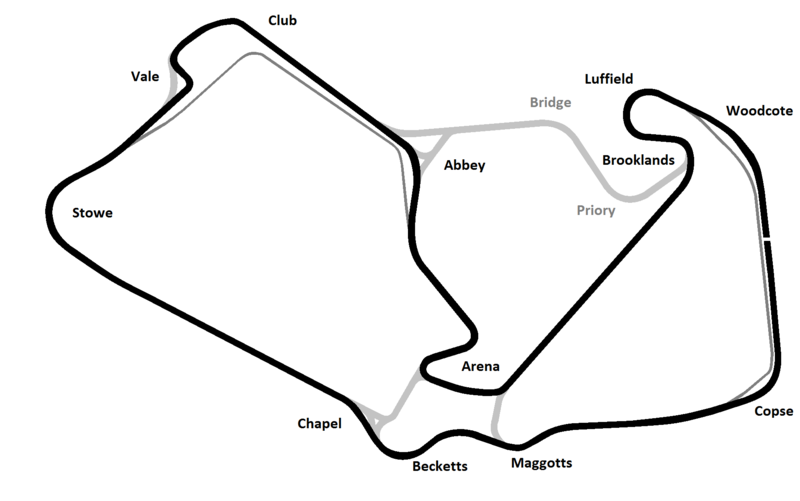
Silverstone track layout.
Race 1
The British Formula 3 series had the honour of being the first to race on the new Silverstone Grand Prix layout and it was 20-year-old James Calado that made the best of it in both qualifying and the first race.
The Worcestershire driver, whose career has thus far been furthered by the Racing Steps Foundation, got away well from fellow front row man Oli Webb off the line, holding his lead as the field powered around Copse corner.
Not all made clean starts however – Raikkonen Robertson Racing driver Felipe Nasr stalled his Dallara on the grid, only to be rammed from behind by National Class driver, Menasheh Idafar. Both retired on the spot with heavy damage.
It mattered little to Calado – while Webb applied pressure to the race leader for the duration, Calado refused to crack and crossed the line first to take the chequered flag after 14 laps.
Webb trailed the victor by only one second, but he had a somewhat similar margin over Daisuke Nakajima, whom also had a 1.2 second lead over 4th place Jean-Eric Vergne.
Carlos Huertas finished 5th ahead of guest driver Esteban Gutierrez, driving for ART Grand Prix for this one-off event. Due to his status as a guest driver, Gutierrez was ineligible for championship points; however Jazeman Jaafar, Gabriel Dias, Adriano Buzaid and Rupert Svendsen-Cook al did enough to register scores.
With Idafar out of contention following his start-line collision, James Cole took the National Class victory, some 5.6 seconds ahead of Luiz Razia.
Round 2, Race 1
1 James CALADO Carlin Dallara-Volkswagen 27m 01.234s (14 laps)
2 Oli WEBB Fortec Dallara-Mercedes +1.015s
3 Daisuke NAKAJIMA RR Dallara-Mercedes +2.143s
4 Jean-Eric VERGNE Carlin Dallara-Volkswagen +3.308s
5 Carlos HUERTAS RR Dallara-Mercedes +6.180s
6 *Esteban GUTIERREZ ART Dallara-Mercedes +6.921s
7 Jazeman JAAFAR Carlin Dallara-Volkswagen +8.613s
8 Gabriel DIAS Hitech Dallara-Volkswagen +9.448s
9 Adriano BUZAID Carlin Dallara-Volkswagen +10.852s
10 Rupert SVENDSEN-COOK Carlin Dallara-Volkswagen +16.711s
National class
1 James COLE T-Sport Dallara-Mugen Honda +44.234s
2 Luiz RAZIA West-Tec Dallara-Mugen Honda +49.808s
Invitation class
1 Gutierrez
2 Alexander SIMS ART Dallara-Mercedes +17.375s
3 Jim PLA ART Dallara-Mercedes +32.698s
Race 2
Before the cars lined-up on the grid, the skies opened up above Silverstone and in typical British fashion soaked the Northamptonshire circuit.
It meant little grip and wet tyres across the board, but where race 1 winner James Calado excelled in the dry conditions of the previous day, he would struggle from his 8th on the grid for the second run of the weekend. Calado was not helped by a mid-race fluff in the Maggots/Becketts complex, that would drop him a few spots in the order.
In fact, it was guest driver Alexander Sims that made the best of the poor conditions. Despite starting from 11th place, the F3 EuroSeries regular zoomed up to 5th place by the end of the first tour.
Just ahead of Sims into 4th was Jean-Eric Vergne, who had also had a good start the third row. Vergne battled for a short time with Daisuke Nakajima, but the Japanese driver soon dispensed with the Frenchman to begin tackling the fast starting Esteban Gutierrez.
Nakajima would take 2nd off of Gutierrez, but he would be powerless to hold off the charging Sims. By the third tour of the damp Silverstone, Sims had taken Vergne, Jazeman Jaafar and Gutierrez, before relinquishing 2nd spot from Nakajima.
Up until now, Gabriel Dias had a quiet time out front as he tiptoed around in the treacherous conditions, but even he could not hold off Sims, as the 22-year-old quickly pulled up to the back of the race leader.
At the start of the fifth lap and with no Championship points on the line, Sims tried a ballsy move around the outside of Dias in Copse Corner and pulled it off – a marvellous piece of race craft from the ART Grand Prix driver.
Yet the lead was only fleeting. As Sims entered the Maggots/Becketts complex, the young man wobbled, letting Dias through, albeit only temporarily. Once again, Sims applied pressure and before the lap was complete, he had taken the lead once again – this time he would keep it to the flag.
If there was some disappointment for the pole man to lose his lead, fellow front row starter Jaafar must have much worse. The Malaysian struggled for grip in the wet, dropping position after position in the early running. Following a short-lived battle with Vergne, Jaafar settled into 7th place, while Calado, Adriano Buzaid, Carlos Huertas, Felipe Nasr, Alex Brundle and Oli Webb fought eachother for places just behind him.
Sadly for Webb, the race would end prematurely in a pool of muddy water. The Fortec Motorsport driver found himself punted out the race on the eighth lap as he rounded Club Corner; however instead of finding gravel, the 19-year-old discovered the run-off area flooded by rain water.
Sims took the race regardless by a full 8.2 seconds, but with Sims being unable to claim Championship points, it was 2nd placed Dias that took the full score home.
Nakajima secured another podium with his 3rd spot, just ahead of the next invited driver, Gutierrez. Vergne never troubled the top-four after the early laps as he claimed 5th position, just 0.3 of-a-second ahead of Buzaid; however there was a huge gap back to 7th place onward – Jaafar won that particular battle ahead of Huertas (8th), Calado (9th) and Nasr (10th).
Menasheh Idafar took the National Class win ahead of James Cole.
Round 2, Race 2
1 *Alexander SIMS ART Dallara-Mercedes 22m 05.371s (10 laps)
2 Gabriel DIAS Hitech Dallara-Volkswagen +8.288s
3 Daisuke NAKAJIMA RR Dallara-Mercedes +9.386s
4 *Esteban GUTIERREZ ART Dallara-Mercedes +9.441s
5 Jean-Eric VERGNE Carlin Dallara-Volkswagen +12.679s
6 Adriano BUZAID Carlin Dallara-Volkswagen +12.949s
7 Jazeman JAAFAR Carlin Dallara-Volkswagen +22.506s
8 Carlos HUERTAS RR Dallara-Mercedes +23.309s
9 James CALADO Carlin Dallara-Volkswagen +26.829s
10 Felipe NASR RR Dallara-Mercedes +27.874s
National class
1 Menasheh IDAFAR T-Sport Dallara-Mugen Honda +46.798s
2 James COLE T-Sport Dallara-Mugen Honda +48.800s
3 Luiz RAZIA West-Tec Dallara-Mugen Honda +58.023s
Invitation class
1 Sims
2 Gutierrez
3 Jim PLA ART Dallara-Mercedes +29.589s
Race 3
A dry track welcomed the British Formula 3 runners for the final race of the weekend with James Calado once again lining up on pole ahead of Oli Webb. This time William Buller surprised all with a lap good enough for the second row – the 17-year-old squeezed his Hitech Racing machine ahead of Felipe Nasr.
Indeed Buller made an excellent start from his 3rd place, claiming 2nd spot ahead of Webb as the field ran through Copse. Pole man Calado remained unperturbed as he sprinted away from the chasing pack.
Sadly for Buller, the third lap would see the young man begin to slide down the order, as first Webb got by and then Daisuke Nakajima. It had been a good opening few tours for the Japanese driver – having qualified 5th, he had slotted by the slow starting Nasr off the line. By the end of the third tour, Nakajima had even moved passed Webb to claim 2nd place; however Webb would not relent, claiming his 2nd spot back soon afterward.
Within a few laps, Buller was losing positions rapidly as Nasr, Adriano Buzaid and points-leader, Jean-Eric Vergne all swooped in. Soon afterward, Buller had fallen to the fringe of the top-ten where he would remain.
Rio Haryanto was less successful with his overtakes – the Indonesian attempted a move on National Class runner Menasheh Idafar, but only managed to clatter the side of the T-Sport managed machine. It would result in a spin for Idafar and a deranged right-front wheel for Haryanto.
Come the 8th lap of the race and the first safety car of the weekend would emerge. Suffering mechanical issues, GP2 regular Luiz Razia pulled to the pitwall on the start/finish straight – with the track partially blocked, it was quickly neutralised.
The race restarted on the 11th lap, with Webb pushing Calado hard, but once the front man had settled himself, he was gone.
Guest driver Alexander Sims was feeling somewhat more feisty however – following his race 2 win, the Briton was busy cutting through the race 3 order. A move on Vergne took him into the top-six and he would soon take Buzaid too. Sims also stole 4th spot from Nakajima, but not before Nasr robbed a podium spot from the Japanese driver first with a fantastic wheel-to-wheel pass into Copse – despite a promising start for the Raikkonen Robertson Racing pilot, Nakajima was dropping back somewhat.
However, it would soon become clear that Nakajima’s car was struggling – on the final lap, the 21-year-old pulled over to the side of the circuit as his sickly Mercedes engine lost its fight for life. Race over.
It was also a premature finish for Carlos Huertas. Mired in the pack for much of the race, the Colombian attempted an ill-fated move down the inside of Alex Brundle at Vale Corner – the resulting collision destroyed Huertas’ right front suspension and caused Brundle to spin. The young Englishman would pit at the end of the lap for a new nose, leaving him dead last.
Calado had no such problems. Once he settled after the safety car, the Briton was untroubled, as was 2nd place Webb – indeed it was Webb’s fourth runner-up finish in six races as he drew slightly closer to Vergne in the title hunt. Calado’s pair of victories, brings him up to third in the Championship.
Nasr claimed the final podium place, just ahead of guest driver, Sims (4th), while Buzaid (5th) led home a pack consisting of Vergne (6th), Jaafar (7th), Dias (8th) and Esteban Gutierrez (9th). Some distance behind them, Buller took a lonely 10th position.
James Cole won the National Class, only 0.7 of-a-second ahead of Menasheh Idafar to jump into the lead of that particular title race.
Round 2, Race 3
1 James CALADO Carlin Dallara-Volkswagen 41m 03.787s (20 laps)
2 Oli WEBB Fortec Dallara-Mercedes +1.056s
3 Felipe NASR RR Dallara-Mercedes +2.893s
4 *Alexander SIMS ART Dallara-Mercedes +3.943s
5 Adriano BUZAID Carlin Dallara-Volkswagen +6.563s
6 Jean-Eric VERGNE Carlin Dallara-Volkswagen +7.250s
7 Jazeman JAAFAR Carlin Dallara-Volkswagen +8.895s
8 Gabriel DIAS Hitech Dallara-Volkswagen +9.667s
9 *Esteban GUTIERREZ ART Dallara-Mercedes +10.540s
10 William BULLER Hitech Dallara-Volkswagen +15.928s
National class
1 James COLE T-Sport Dallara-Mugen Honda +33.112s
2 Menasheh IDAFAR T-Sport Dallara-Mugen Honda +33.811s
Invitation class
1 Sims
2 Gutierrez
3 Jim PLA ART Dallara-Mercedes +18.930s
Race Rating: 3 out of 5
——–
| 2010 British F3 Championship (Round 2) | ||
|---|---|---|
| Pos | Driver | Points |
| 1 | Jean-Eric Vergne | 76 |
| 2 | Oliver Webb | 64 |
| 3 | James Calado | 51 |
| 4 | Adriano Buzaid | 49 |
| 5 | Daisuke Nakajima | 40 |
| 6 | Rupert Svendsen-Cook | 34 |
| 2010 F3 National Championship (Round 2) | ||
|---|---|---|
| Pos | Driver | Points |
| 1 | James Cole | 86 |
| 2 | Menasheh Idafar | 61 |
| 3 | Luiz Razia | 23 |
Pa'l Kiss took the long way around Blomqvist... © ITV
Hungarian teenager Tama’s Pa’l Kiss led the 2010 Formula Renault UK Championship as the series went into the third weekend of the year, this time at the famous Brands Hatch Grand Prix circuit.
However instead of two races for the junior championship, it was reduced to just one, with Round 5 being postponed due to adverse weather conditions.
And it was wet. Although the BTCC’s, the various Ginetta’s and the Porsche Super Cup races were able to go ahead, there was simply far too much standing water on the circuit for the Saturday race to run the Formula Renault machines.
As the final event running, it should have been no problems for polesitter Lewis Williamson – all that was needed was a good start, a steady pace and there should be no trouble. All that was needed was for him to stay off the wet stuff…
Indeed the first start of that plan came together – Williamson got away untroubled by trailing traffic; he simply left the gaggle to fight amongst themselves. Fellow front-run man, Tom Blomqvist appeared sluggish off the line, instantly losing 2nd spot to Will Stevens and very nearly falling behind the fast starting Nick Yelloly; behind them, an impatient Pa’l Kiss remained 5th off the line.
This was an important race for Pa’l Kiss, Stevens and Williamson – Harry Tincknell, currently 2nd in the title hunt, was starting last following a throttle failure in qualifying and this could be the opportunity to destabilise his chances.
Knowing how important this race was would give Stevens an extra charge and by the end of the opening lap, the young man had stolen 2nd place from Blomqvist. Pa’l Kiss was also on the move – on the third tour, the Hungarian had taken Yelloly for 4th and set his sites on Blomqvist. A series of fast laps later and by the sixth lap, Pa’l Kiss was on the rear wing of the Swede and attempted a brave move around the outside of Blomqvist into the first corner; however the Fortec driver held on.
…once, but not twice. Next time by, Pa’l Kiss tried the same move again, only this time initiated it earlier on the start/finish straight enabling a much faster run into Paddock Hill Bend – 3rd place.
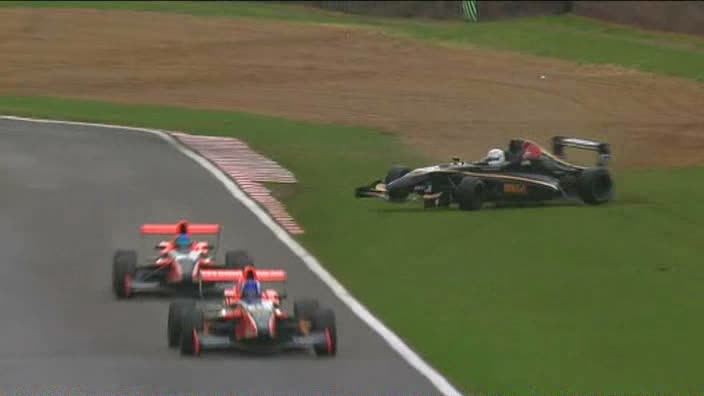
...and nearly threw it all away with a spin a few laps later. © ITV
Pa’l Kiss very nearly blew though on the tenth lap. As the Atech GP driver was busy catching Stevens in 2nd place, the championship leader went wide onto a wet patch and was flung from the track and onto the grass run-off area. For a brief moment, the car looked like it might lift as it stuttered over varying surfaces, but it kept spinning around – and back onto the circuit. Despite his trip, Pa’l Kiss’ advantage over Blomqvist was enough to see his emerge from the incident still in third.
Sadly for Williamson, he didn’t have the same fortune. Leading every lap with ease and heading to an excellent win, the Manor Competition driver let his concentration dip coming through the second-to-last corner on the final lap and speared off the circuit, handing the win to team mate Will Stevens. Williamson emerged from his adventures unscathed, but he had dropped to seventh place and with only one corner and a straight remaining, seventh is where he would remain.
Williamson’s off elevated Pa’l Kiss to an unexpected 2nd, while Blomqvist claimed his first podium with 3rd place ahead of Yelloly and David McDonald. Tincknell recovered well enough to take 6th spot, while Alex Lynn, Jessie Laine and Victor Correa rounded off the top ten.
Stevens’ victory brings the Englishman well into contention in the title hunt, as he now trails Pa’l Kiss by five points; however both Tincknell and Williamson have fallen a little behind and will need good results at the next meeting at Oulton Park.
2010 Formula Renault UK Championship (Round 6, Brands Hatch)
1. Will Stevens Manor Competition 12 laps
2. Tama’s Pa’l Kiss Atech GP +6.677
3. Tom Blomqvist Fortec Motorsport + 7.603
4. Nick Yelloly Atech GP +10.895
5. David McDonald Team Firstair +23.011
6. Harry Tincknell CRS Racing +24.395
7. Lewis Williamson Manor Competition +24.683
8. Alex Lynn (G) Fortec Motorsport +25.480
9. Jessie Laine Mark Burdett Motorsport +25.936
10. Victor Correa CRS Racing +26.275
11. Ollie Millroy Fortec Motorsport +26.536
12. Thomas Hylkema Manor Competition +35.439
13. Fabio Gamberini (G) Mark Burdett Motorsport +35.865
14. Michael Lyons CRS Racing +36.238
15. Marlon Stockinger Atech GP +36.761
16. Robert Foster-Jones CRS Racing +46.307
17. Joe Crook Scorpio Motorsport +46.548
2010 Formula Renault UK Championship (Round 6, Brands Hatch)
1. Pa’l Kiss 142 points
2. Stevens 137
3. Tincknell 130
4. Williamson 112
5. Blomqvist 101
6. Millroy 68
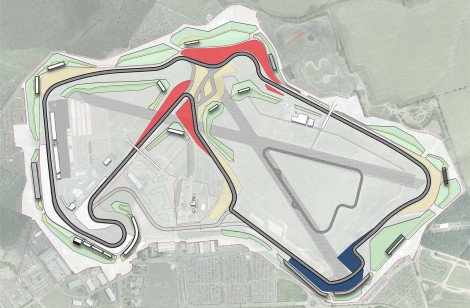
A map of the revamped Silverstone circuit
As reported here some time ago, Silverstone circuit in Northamptonshire has undergone significant modifications in the latter stages of the lap to accommodate the upcoming MotoGP race, which Silverstone is hosting for the first time this year.
Now work at the track has been completed and the new section – called the Arena – was been officially unveiled on Thursday afternoon and with Donington now not holding the Grand Prix, the updated Silverstone will also host Formula 1 for at least the next ten years.
While it is disappointing to have lost the wonderful Bridge corner, the slow and lumbering Priory and Luffield sections have been ejected and will most likely not be missed. Where previously the circuit turned left at Abbey, it now swings to the right before launching into a couple a fast sweeping turns, followed by a long back straight. Thereafter, the new section latches onto the exit of Luffield and into the double-apex at Woodcote.
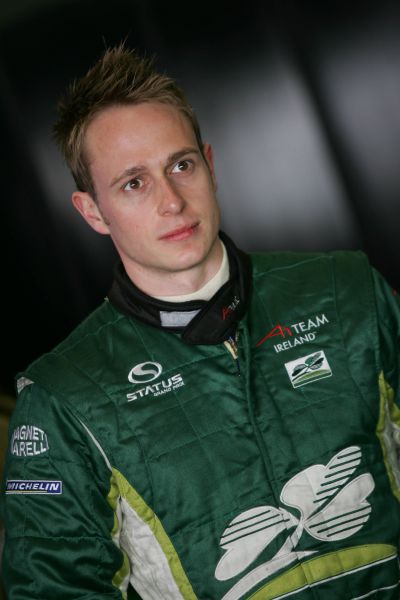
Carroll during his A1GP tenure
Following three seasons in motor racings doldrums, 27-year-old Portadown driver Adam Carroll has reportedly signed a deal with Indycar’s Andretti Autosport squad to drive a small number of races later on this season.
Carroll – who won the 2008-09 A1GP Championship for Ireland – also spent three full seasons in GP2 and also acted as a technical support for upcoming drivers in the junior series. The Irishman had also been approached by Hispania and Virgin for a drive in Formula 1 this season, but these negotiations never produced a seat.
As fast as Carroll is, he has on occasion struggled with consistency, but with a solid backing – as he had during his tenure at A1GP – he showed that he can deliver very solid results and it is that very consistency that the newly reinvigorated Andretti Autosport may be able to deliver. Carroll has won races at every level of motorsport in which he has raced and will be hoping to add Indycar to that impressive list. News of which races Carroll will compete has yet to be released.
That the time of 6 minutes 58.16 seconds was set in the Ferrari 599xx with slick tyres – a souped up inspiration for the Ferrari 590GT machine – appears to be the main point of controversy. Add to that, the 599xx’s six litre V-12 grunt and you have one incredible powerful machine, but none of these things take away from the fact that this car is a joy to watch.
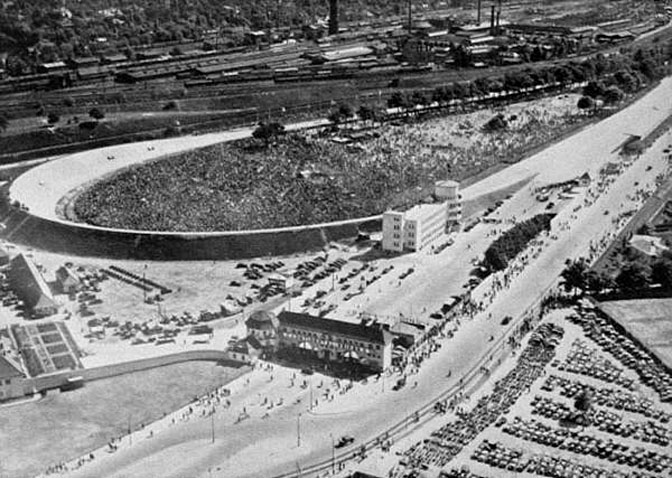
The Nordkurv banking with its steep drop. © Copyright unknown.
The Automobil-Verkehrs und Übungs-Straße circuit – otherwise known as AVUS – probably stands as one of the most striking and unusual tracks in the history of Grand Prix motor racing.
A Delayed Birth
Initially devised in 1907 as both a racing circuit and as test-base for an emerging German motor industry, it would not be until after the first World War that the facility would be built – delayed for a number of years due to mismanaged finances and, of course, the war itself.
When AVUS eventually opened in September 1921, the full extent of its odd design was finally revealed.
With its two 6-mile long adjacent straights hooked together by hairpins at either end, the pin-shaped AVUS was easily the fastest closed circuit in the world.
However, it wasn’t until 1926 that the track made its Grand Prix début when it held the first ever German Grand Prix – an event won by the great pre-Formula 1 driver Rudolf Caracciola in his Mercedes SS.
Sadly, the race was marred by the death of three time-keepers, when Adolf Rosenberger Mercedes SS machine flew off the road in treacherous conditions and crashed into a marshal’s hut.
If anything, AVUS was very similar to the Brooklands circuit which held the first British Grand Prix later that year, but the owners of the German track knew that they were under pressure to preserve the German Grand Prix from the nearby and newly built Nordschleife in Eifel mountains (now the modern Nurburgring) – something needed to change to keep AVUS relevant.
Rosemeyer led the 1937 Auto-rennen in his Auto Union. © Copyright unknown.
Competition from the Inside
When AVUS did eventually lose the premier event to the Nordscheife, the circuit owners decided to take stock and redesign aspects of the track in order to make it completely stand out from everything else.
What they came up with was a re-working of the Nurdkurv – a corner which would become notorious for its incredibly high banking and lack of any retaining barriers, leading a steep drop to the grounds below the circuit.
AVUS re-opened in 1937 and the change to the Nordkurv was truly startling – it had now been converted into a brick-layered 43-degree banked turn and was soon christened “The Wall of Death” – a name that it would all too often live up to.
The steep banking also meant that higher speeds could be maintained throughout the turn, with an extra 20-30mph going onto the start/finish straight.
In fact, it was during the 1937 Formula Libre event that race winner Hermann Lang clocked up an average race speed of 160 miles-per-hour, with the fastest lap of the event by Bernd Rosemeyer reaching a stunning 176.7 miles-per-hour – a feat that would not be beaten until the 1971 Indianapolis 500. It also still stands as the fastest Grand Prix lap of all time.
Rosemeyer died one year later whilst trying for a land speed record run on a straight section of the Autobahn Frankfurt/Darmstadt and it was the death of the popular German that made many concerned about the lack of safety on the superfast straights at tracks like AVUS.
The circuit was simply too fast for the streamlined cars that the German manufacturers were building and with overtaking being virtually non-existent on a track that was already painfully narrow, the track would face further alterations.
A lucky Hans Hermann thrown clear from his BRM at the 1959 German Grand Prix. © Copyright unknown.
The Coming of Formula 1
Following these incidents, the southern section of the circuit was demolished and joined to the Reichs-Autobahn and the reworked configuration measured just 8.3km; however following World War 2, the circuit saw very little top level racing bar four events.
In 1951, Formula 2 débuted at AVUS and ran for three years which was replaced by an F1 non-championship race in 1954; but even then the track fell silent for quite a time.
Come the end of the decade and a one-off Formula 1 World Championship race took place at the venue in 1959. Even this event courted controversy as the hugely likeable Jean Behra was killed during practice in his Porsche, thereby casting a shadow over the victory by Ferrari’s Tony Brooks.
Even prior to the 1959 race, drastic changes had to be made to the event itself – such was the level of tyre degradation during test that the Grand Prix was split into to two shortened events running at thirty laps a piece.
This race also produced one of the most stunning photographs in motor racing history – approaching south junction, the brakes on Hans Hermann’s BRM failed and the German drivers’ car pierced the make shift straw bale barrier and was thrown clean into the air.
With no seatbelts to hold him in his airborne machine, Hermann was thrown clean from his car and he was able to walk away unscathed.
Death of a Great
This was the last major event to be held at the AVUS track. Finding itself on the wrong side of safety and overshadowed by the monstrous Nordschleife, the track was reduced to holding DTM and some Formula 3 events and in 1967, even the notorious Nordkurv banking disappeared for good to become part of an intersection on Bundes-autobahn 115.
The circuit was shortened once again in 1988 reducing it to a 3-mile tour, before having further reductions in the early ’90’s – by the time AVUS was in its final formation, it measured only 1.6 miles; a brief stretch of road compared to its original layout, with a chicane being added upon entry to the Nurdkurv – the final insult to a once great circuit.
Some mammoth incidents in its later life marked AVUS out as a track still to be reckoned with, but it was the death of British driver Keith Odor in a Super Touring Car race in 1995 that spelled the end for the circuit.
A veteran’s event was held as a farewell to the track in 1999 and less than a year later, it was closed for good although symbols of its presence still remain.
The wooden grandstand parallel to the start/finish straight is now a protected historical monument and the race control tower that overlooked the north end of the circuit also remains; albeit as a restaurant and motel.
No matter what circuit is designed in the future or who designs it, it is likely that we will never see the likes of AVUS ever again and for that reason alone we must treasure this superb circuit.
Although circumstances outside of race control have dictated these results (rain, car failures, odd qualifying sessions), it still stands as an impressive record. The race conquering doubles are as follows:
- Bahrain (Round 1); Alonso / Massa (Ferrari)
- Malaysia (Round 3); Vettel / Webber (Red Bull)
- China (Round 4); Button / Hamilton (McLaren)

Formula 2 logo © FIA
This weekend sees the reinvigorated Formula 2 Championship begin its second season since its 2009 revamp. The series kicks off at Silverstone; the first of nine rounds that also takes in events at circuits such as Monza, Zolder, Portimao and Brands Hatch amongst others as a support to the World Touring Car Championship, although the Silverstone event is a stand alone race for the series. This year will also see the Formula 2 machines stepping outside of Europe for the first time as they will be racing at the Marrakech Street Circuit in Morocco in two weeks time.
As with AutoGP and the F3 EuroSeries, some questions have been raised about the true depth of talent in the F2 Championship and its future direction with several participants from the 2009 campaign having either gone down a level to GP3 or the World Series by Renault Championship or stepped sideways to GP2 in order to further their careers. The 2009 Champion, Andy Soucek, has since claimed a test and reserve role at the Virgin F1 team and will not be returning to the series. One thing is for certain – the series will most certainly not wish to see a repeat of the accident that claimed the life of 18 year-old Henry Surtees.
Formula 2 will once again be broadcast on Eurosport throughout the season, with coverage also available from the official website.
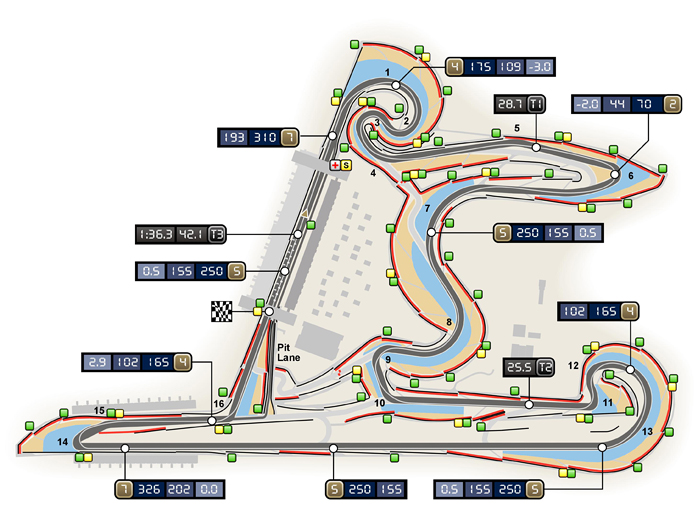
Shanghai International Circuit © FIA
Following disappointing retirements in the first two races of the season, Red Bull’s Sebastian Vettel was relieved to finally come home victorious in Sepang, but the niggling doubts about the Austrian squad’s reliability must surely have been playing on his mind throughout the Malaysian weekend. Now those doubts have been eased following a relatively easy win in Kuala Lumpur; however Red Bull must also be thinking that the Chinese Grand Prix may be one of the last races where they have a clear advantage over the field. In three weeks time, the Championship moves to Europe and the annual technical development battle will begin in earnest. Questions remain about the possibility of Red Bull’s ride height/active suspension system, but those accusations and theories remain unproven and team boss, Christian Horner was bullish about the legality of the RB6. Meanwhile, Ferrari have been trying out a variation of McLaren’s RW80 with limited success, but seem happy with some of the improvements are in the pipeline.
Something that was quite apparent about Friday practice was the incredibly low numbers in attendance at the Shanghai circuit with FOM CEO Bernie Ecclestone openly criticising the promoter of the race for not giving the Chinese event enough of a push – figures been spread about the crowds for Friday practice were around a few thousand people, which is shockingly low for any international event. There have been rumours in the past few years, that if any races are to be dropped from the calendar, then the two main candidates to be dropped are China and the mid-season race in Turkey; however Ecclestone has been keen to make clear that the race is pencilled in for future seasons. There were outside difficulties too for some of the teams and crews as rising ash from the Icelandic volcano, Eyjafjallajoekull, has stopped a large amount of air travel within Europe and caused a general chaos in the travel industry. Members from some teams and car components were left stranded in Europe, including the BBC’s own Eddie Jordan – all of whom will be seen in Barcelona when the Spanish event does eventually come around.
The first practice session started out rather cool in Shanghai, albeit rather sunny with similar conditions expected for Saturday; however early forecast predict rain for the Grand Prix itself. One driver that did not have to think about the conditions on Friday morning was Antonio Liuzzi, who sat out the session and was once again replaced by reserve pilot, Paul di Resta. Not for the first time this season, a McLaren clocks the fastest time as Button pipped Rosberg and Hamilton at the end of the session by less than a tenth-of-a-second. With their RW80 device put to good use down the 1km long back-straight, the British team were clearly fastest down the stretch – a factor that helped their cause no end. There were difficulties at Virgin as Timo Glock broke another front wing on the bumpy front straight, but problems also surfaced for Fernando Alonso, who suffered an engine blow-up after completing only six corners of the circuit – a huge worry for the Ferrari driver, now with two dead engines to his name.
Toro Rosso’s Sebastien Buemi spent most of the session in the garage with a brake leak; however nothing could have prepared him for the massive accident he suffered at the end of the back-straight. As the Swiss driver approached turn 13, his car suffered a wishbone failure on his right front suspension that ripped both front wheels clean off his car and pitched him hard into the barrier. There was an additional scare of one of his wheels flying into the general admission area near the grandstands; thankfully no one was injured. It was not a good day for the Buemi family as a whole for the young Swiss driver’s cousin, Natasha Gachnang, broke her leg in an accident at a GT1 qualifying session in Abu Dhabi.
With one destroyed Toro Rosso sitting in the garage being repaired, Buemi had no choice but to sit out the second practice session; whereas Liuzzi joined the track for the first time. It would prove to be a difficult session for the 28 year-old Italian as he struggled to find good balance and grip in his Force India. In this regard he was not alone – throughout the session the Virgin’s struggled with understeer, the Sauber’s had oversteer and the HRT’s had no balance at all. This was epitomised by off-track trips by Bruno Senna, Karun Chandhok, Lucas di Grassi and Pedro de la Rosa. Michael Schumacher, Nico Hulkenberg and Vitaly Petrov were kind enough to use the run-off areas as well; however all three of those drivers had elements of speed in their machines. An oil pressure failure ended Heikki Kovalainen’s practice run with ten minutes remaining – an irritation for the Lotus team as the Finn was on a heavy fuel run at the time. At the front, Mercedes power represented the top four slots on the timing sheets; headed – once again – by Hamilton with Rosberg, Button and Schumacher in tow. The rear end was again propped up by HRT with the Spanish squad 5.7 (Chandhok) and 6.1 seconds (Senna) slower than the fastest.
As Friday drifted into Saturday, it was announced that HRT had hired Sakon Yamamoto as their third driver. The Japanese pilot had previously competed in Formula 1 during the 2006 and 2007 seasons for Spyker and Super Aguri before falling back to the GP2 series in 2008, where Yamamoto scored a fourth place finish in Hungary – his first ever points finish in any series outside of Japan. On track Sebastien Buemi got in his first full session of the weekend with a time that put him 13th place and Rubens Barrichello got to try out the Williams version of the RW80 system, albeit with limited success. Throughout the session, the fastest times swapped between Alonso, Lewis Hamilton and the Red Bull duo, the top times were set either side of a red flag that was brought out by an accident involving Vitaly Petrov. The Russian driver stopped the session after he went wide exiting the final turn, spearing into the barrier by the pit lane entrance – it was an incident that was very nearly matched by Felipe Massa once the session got under way when he went wide at the same point. The sixty minute session finished with Webber on top; ahead of Hamilton, Vettel, Button and Alonso.
Before the qualifying session got under way, both Chandhok and Kamui Kobayashi received five place penalties due to gearbox issues; although it is unlikely to truly affect Chandhok’s grid position considering the pace of the HRT car. As expected the six new cars were dropped after Qualifying 1; however Kovalainen and Chandhok did not help their respective causes by having spins during their runs. De la Rosa also had an off but made his way through to Qualifying 2, which is something that could not be said for Liuzzi – the Italian never quite feeling comfortable with his car over the early part of the weekend and wound up 18th on the grid. During the second part of qualifying, Schumacher came very close to dropping out; the seven-time World Champion recording a time only 0.033 of a second faster than Barrichello. The Williams veteran had a much larger gap over his young team mate Nico Hulkenberg, who slotted into 16th on the grid – nearly one second slower than the Brazilian. Both Sauber’s and Toro Rosso’s also didn’t make it through to the final part of qualifying and were joined by Petrov who planted his Renault in 14th.
The morning session revealed false neutral gears during McLaren’s runs and these issues raised their head’s again during qualifying on at least three different occasions; however it did not stop Hamilton being fastest during Qualifying 1 and 2, although he could not reproduce this during the final session. A stunning lap from Sebastian Vettel ensured a fourth consecutive pole position for Red Bull, ahead of his team mate Webber, while Alonso and Rosberg were just one-tenth behind in 3rd and 4th places respectively. Button again qualified ahead of Hamilton with both McLaren’s on the third row, while Massa, Kubica, Schumacher and Sutil filling out the top 10.
The rain that had been expected on race day duly arrived not long before the race, but it remained intermittent and relatively light; however come the start of the race, the track was not yet wet enough to require intermediate rubber. A relatively poor Friday and Saturday turned to embarrassment for the Virgin squad, as they left Timo Glock up on his jacks as the field pulled away for the warm-up. He joined his team mate, Lucas di Grassi and HRT driver Chandhok in the pits for the race start. The rain continued to teem down as the red lights went out, but the field had the perfect opportunity to pit for intermediate tyres on lap 2 – as everyone wound their way through turns 5 and 6, Liuzzi lost the back end of his Force India, thereby finished his race and that of Buemi and Kobayashi with a shattering crash. The safety car emerged for three laps and everyone, bar Rosberg and Button, dashed into the pits for new tyres – a decision that would ultimately decide the race for the McLaren driver.
It transpired that much of the race action (and controversy) would indeed take place in pit lane – there were 68 stops in total during the Grand Prix; with Alguersuari and Hulkenberg venturing down the pit lane 6 times apiece. Alguersuari shed his front wing on the track and in the pit land entry; this brought out a questionable second safety car and some more stops. Fernando Alonso certainly did his bit by stopping on five occasions, although one of those was for a jump start when his Ferrari clearly got of the line before all five lights went out. It wasn’t the only time the stewards – aided by Alexander Wurz – were tested though, as Alonso barged passed Massa on the pitlane entry (no penalty given) and Hamilton was thought to have been unsafely released into Vettel’s path (Hamilton was reprimanded). A reprimand was also given to Vettel for forcing Hamilton off the driving lane prior to exiting the pits. It was a tale of a messy race versus a good run from then on as Massa, Vettel and his Red Bull team mate Mark Webber struggled in the difficult conditions thereafter. A second place start for the Australian was no guarantee of a 2nd place finish and an uncertain wet weather set-up, saw him tumble down the order to finish in 8th position. On the other hand, Alonso and Hamilton charged back up the field despite their mishaps – and in doing so provided some wonderful overtaking manoeuvres.
Indeed the best battle of the race was between the McLaren driver and the returning Mercedes pilot Michael Schumacher. It was not a race reminiscent of the seven time champion of old, as he continues to struggle in his new team, but for three laps there brief flickers of the past master as he fought wheel-to-wheel with the younger man. Alas, Schumacher dropped down the order as the race wore on and what looked like a 9th place finish became 10th when Massa shoved the German off the circuit at the beginning of the final lap and all the time, his youthful team mate Nico Rosberg is looking better and better. Rosberg himself drove a fine race, bringing the car home for a podium spot after leading early in the race; although for the most part his Chinese Grand Prix was largely uneventful, he was glad to see the chequered flag wave as the hard charging Alonso crept up on the Mercedes very quickly in the last laps – as they crossed the line, the gap was only two seconds.
Once again, both Renault drivers delivered superb drivers and were rewarded for their efforts although it’s not inconceivable that they could have had more – Kubica’s race appeared dented by the second safety car and Petrov lost 4th place during the race with a spin, although the Russian still claimed 7th place. The French/Swiss squad still faired much better than their midfield opponents though as both Williams’ drivers coming home out of the points and the sole finishing Force India and Toro Rosso cars crossing the line well down the line. For Sutil, it was even more disappointing – after running well early in the race, he fell backwards out of the top ten, while Alguersuari had an afternoon to forget. After Kobayshi’s turn 6 retirement, Pedro de la Rosa sealed another awful day for Sauber as his Ferrari engine gave up after 7 laps – one wonders if Peter Sauber will indeed find a buyer at the end of the year as his 2010 season quickly goes sour.
Of the new teams, both Lotus and HRT impressed, although they are still well down on general pace. Further hydraulic problems for Trulli didn’t dampen the Lotus mood after a 14th place finish for Kovalainen, who ran as high as 6th early on and for the second consecutive race, both Senna and Chandhok brought their HRT cars to flag. As for Virgin, the Richard Branson branded team seem to still be the fastest of the infant squads, but it hardly matters much when one finish from eight is registered – both of the red and black cars retired again in Shanghai.
In the end Button only had to stop twice and while it was not easy race by any stretch, he certainly commanded the field in hazardous conditions with aplomb. The reigning World Champion only really needed to make one overtake in the race and he did that on the 19th lap as he swiped the lead off of Rosberg. If McLaren were disappointed with their qualifying position on Saturday, they were ecstatic with their race result on Sunday – a steady drive to win and a frantic drive to claim second; the first McLaren 1-2 since the 2007 Italian Grand Prix. However, the question remains, can McLaren’s technical updates deliver this pace in the dry when the Grand Prix circus hit Spain in three weeks – doubtless Red Bull will aiming to keep their dry weather advantage with their updates… and then some.
Race Rating: 4 out of 5
——–
Shanghai, Chinese Grand Prix (Round 4, April 18th)
1 BUTTON McLaren
2 HAMILTON McLaren +1.5s
3 ROSBERG Mercedes +9.4s
4 ALONSO Ferrari +11.8s
5 KUBICA Renault +22.2s
6 VETTEL Red Bull +33.3s
7 PETROV Renault +47.6s
8 WEBBER Red Bull +52.1s
9 MASSA Ferrari +57.7s
10 SCHUMACHER Mercedes +61.7s
11 SUTIL Force India +62.8s
12 BARRICHELLO Williams +63.6s
13 ALGUERSUARI Toro Rosso +71.4s
14 KOVALAINEN Lotus +1 lap
15 HULKENBERG Williams +1 lap
16 SENNA HRT +2 laps
17 CHANDHOK HRT +4 laps
R TRULLI Lotus +30 laps
R DI GRASSI Virgin +48 laps
R DE LA ROSA Sauber +49 laps
R BUEMI Toro Rosso +56 laps
R KOBAYASHI Sauber +56 laps
R LIUZZI Force India +56 laps
R GLOCK Virgin +56 laps
Shanghai, Qualifying (April 17th)
3rd Session
1 VETTEL Red Bull 1m34.558s
2 WEBBER Red Bull 1m34.806s
3 ALONSO Ferrari 1m34.913s
4 ROSBERG Mercedes 1m34.923s
5 BUTTON McLaren 1m34.979s
6 HAMILTON McLaren 1m35.034s
7 MASSA Ferrari 1m35.180s
8 KUBICA Renault 1m35.364s
9 SCHUMACHER Mercedes 1m35.646s
10 SUTIL Force India 1m35.963s
2nd Session
11 BARRICHELLO Williams 1m35.748s
12 ALGUERSUARI Toro Rosso 1m36.047s
13 BUEMI Toro Rosso 1m36.149s
14 PETROV Renault 1m36.311s
15 KOBAYASHI Sauber 1m36.422s
16 HULKENBERG Williams 1m36.647s
17 DE LA ROSA Sauber 1m37.020s
1st Session
18 LIUZZI Force India 1m37.161s
19 GLOCK Virgin 1m39.278s
20 TRULLI Lotus 1m39.399s
21 KOVALAINEN Lotus 1m39.520s
22 DI GRASSI Virgin 1m39.783s
23 SENNA HRT 1m40.469s
24 CHANDHOK HRT 1m40.578s
Shanghai, 3rd Free Practice (April 17th)
1 WEBBER Red Bull 1m35.323s
2 HAMILTON McLaren 1m35.564s
3 VETTEL Red Bull 1m35.691s
4 BUTTON McLaren 1m35.747s
5 ALONSO Ferrari 1m35.857s
6 ROSBERG Mercedes 1m35.913s
7 SCHUMACHER Mercedes 1m36.262s
8 KUBICA Renault 1m36.343s
9 MASSA Ferrari 1m36.416s
10 KOBAYASHI Sauber 1m36.634s
11 ALGUERSUARI Toro Rosso 1m36.879s
12 LIUZZI Force India 1m37.031s
13 BUEMI Toro Rosso 1m37.192s
14 SUTIL Force India 1m37.240s
15 PETROV Renault 1m37.339s
16 BARRICHELLO Williams 1m37.585s
17 DE LA ROSA Sauber 1m37.664s
18 HULKENBERG Williams 1m37.784s
19 GLOCK Virgin 1m39.579s
20 KOVALAINEN Lotus 1m39.616s
21 DI GRASSI Virgin 1m39.749s
22 TRULLI Lotus 1m39.776s
23 SENNA HRT 1m40.316s
24 CHANDHOK HRT 1m41.141s
Shanghai, 2nd Free Practice (April 16th)
1 HAMILTON McLaren 1m35.217s
2 ROSBERG Mercedes 1m35.465s
3 BUTTON McLaren 1m35.593s
4 SCHUMACHER Mercedes 1m35.602s
5 VETTEL Red Bull 1m35.791s
6 WEBBER Red Bull 1m35.995s
7 SUTIL Force India 1m36.254s
8 ALGUERSUARI Toro Rosso 1m36.377s
9 KUBICA Renault 1m36.389s
10 ALONSO Ferrari 1m36.604s
11 MASSA Ferrari 1m36.944s
12 PETROV Renault 1m36.986s
13 DE LA ROSA Sauber 1m37.421s
14 KOBAYASHI Sauber 1m37.431s
15 BARRICHELLO Williams 1m37.657s
16 LIUZZI Force India 1m37.804s
17 HULKENBERG Williams 1m37.867s
18 TRULLI Lotus 1m39.624s
19 KOVALAINEN Lotus 1m39.947s
20 GLOCK Virgin 1m40.233s
21 CHANDHOK HRT 1m41.008s
22 DI GRASSI Virgin 1m41.107s
23 SENNA HRT 1m41.345s
24 BUEMI Toro Rosso no time
Shanghai, 1st Free Practice (April 16th)
1 BUTTON McLaren 1m36.677s
2 ROSBERG Mercedes 1m36.748s
3 HAMILTON McLaren 1m36.775s
4 SCHUMACHER Mercedes 1m37.509s
5 VETTEL Red Bull 1m37.601s
6 KUBICA Renault 1m37.716s
7 PETROV Renault 1m37.745s
8 WEBBER Red Bull 1m37.980s
9 SUTIL Force India 1m38.008s
10 MASSA Ferrari 1m38.098s
11 ALGUERSUARI Toro Rosso 1m38.161s
12 KOBAYASHI Sauber 1m38.375s
13 DE LA ROSA Sauber 1m38.421s
14 HULKENBERG Williams 1m38.569s
15 DI RESTA Force India 1m38.618s
16 BARRICHELLO Williams 1m38.678s
17 BUEMI Toro Rosso 1m39.939s
18 TRULLI Lotus 1m41.531s
19 KOVALAINEN Lotus 1m41.779s
20 GLOCK Virgin 1m41.830s
21 DI GRASSI Virgin 1m42.181s
22 SENNA HRT 1m43.875s
23 CHANDHOK HRT 1m43.949s
24 ALONSO Ferrari no time
| Driver | Team | Points |
|---|---|---|
| 1. Jenson Button | McLaren | 60 |
| 2. Nico Rosberg | Mercedes GP | 50 |
| 3. Fernando Alonso | Ferrari | 49 |
| 4. Lewis Hamilton | McLaren | 49 |
| 5. Sebastian Vettel | Red Bull Racing | 45 |
| 6. Felipe Massa | Ferrari | 41 |
| 7. Robert Kubica | Renault | 40 |
| 8. Mark Webber | Red Bull Racing | 28 |
| 9. Michael Schumacher | Mercedes GP | 10 |
| 10. Adrian Sutil | Force India | 10 |
| 11. Vitantonio Liuzzi | Force India | 8 |
| 12. Vitaly Petrov | Renault | 6 |
| 13. Rubens Barrichello | Williams | 5 |
| 14. Jaime Alguersuari | Scuderia Toro Rosso | 2 |
| 15. Nico Hulkenberg | Williams | 1 |
| Constructor Team | Points |
|---|---|
| 1. McLaren | 109 |
| 2. Ferrari | 90 |
| 3. Red Bull Racing | 73 |
| 4. Mercedes GP | 60 |
| 5. Renault | 46 |
| 6. Force India | 18 |
| 7. Williams | 6 |
| 8. Scuderia Toro Rosso | 2 |
So after three races, Felipe Massa leads Fernando Alonso in the Championship standings with Vettel, Button, Rosberg and Hamilton close behind – whatever the result on Sunday, it will leave the championship in a very close and intriguing situation when the European leg starts in May.

GP3 Logo
It was announced today that the new GP3 racing series has secured a broadcast partner with MotorsTV UK Channel.
The broadcasts will be found on Sky Channel 413 and Virgin Media 545 in the form of a highlights package, but it has yet to be announced who will present the coverage.
The new junior formula, which was conceived as a cheaper alternative to the long running Formula 3 formula, has its inaugural event at the upcoming Spanish Grand Prix in Barcelona on May 8th as a support race to Formula 1. The Championship will play a supporting role to several other European rounds of the 2010 F1 season, as well as an event taking place in Portimao as the lead-in to the GP2 stand-alone event at the Portuguese circuit.
Featuring eight weekend events, the series will conclude at Monza on September 12th and will follow an identical format to the current GP2 series – the weekend will open with a feature event based on an earlier qualifying run, with a sprint race the following morning.
The full calendar is as follows:
- May 8th – 9th; Barcelona (Spain)
- June 19th – 20th; Portimao (Portugal)
- June 26th – 27th; Valencia (Spain)
- July 10th – 11th; Silverstone (UK)
- July 24th – 25th; Hockenheimring (Germany)
- July 31st – August 1st; Budapest (Hungary)
- August 28th – 29th; Spa-Francorchamps (Belgium)
- September 11th – 12th; Monza (Italy)
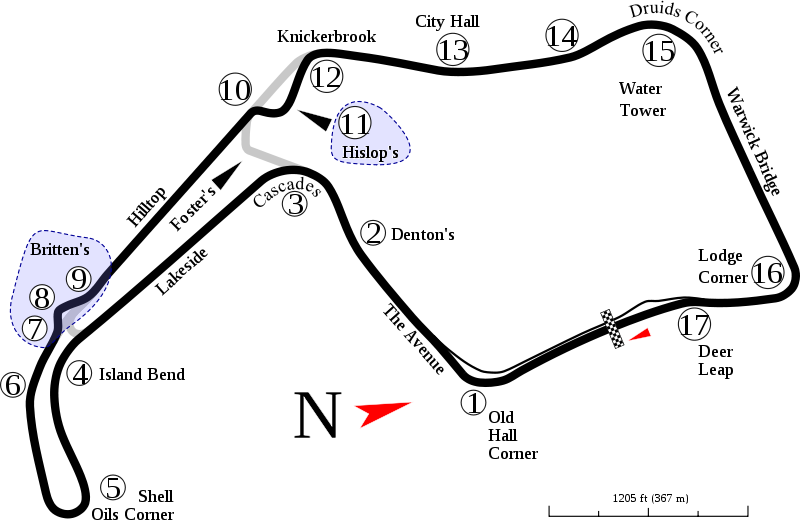
Oulton Park layout.
New Rules for 2010 Onwards
This year sees the début of a partially rearranged British Formula 3 Championship.
The series, sponsored by Copper Tyres, will be running three races instead of two – something that will give drivers more seat time during competition.
The second race will start with a partially reversed grid (the winner of race 1 picks a number out of a hat and that is his starting position, with those behind him swapping their spots as well).
There has also been a drive to increase the numbers of competitors in the series, with the number for 2010 rising slightly from the 2009 close.
Race 1
Jean-Eric Vergne started his 2010 British Formula 3 campaign in style with a lights to flag victory at Oulton Park in agreeable weather conditions. The Frenchman took the chequered flag untroubled ahead of Oliver Webb.
Adriano Buzaid started 5th on the grid, but jumped up to 3rd by the exit of the first turn, while Carlos Huertas took an uneventful 4th. The opening salvo bore rather less desirable fruit for Rupert Svendsen-Cook – having qualified in 3rd, he swapped places with Buzaid and ran home in 5th place. Daisuke Nakajima brought his Dallara home 6th.
Once the opening few corners had been survived, there was little action in the top-6, as the front group completed the 19 lap distance without changing position.
Behind the leaders, it was more of the same. In a mostly static pack, the retirements of James Calado (lap 4) and Jay Bridger (lap 17) were the only two incidents that shook the order. This misfortune for Calado and Bridger would eventually promote Gabriel Dias, Jazeman Jaafar and Daniel McKenzie to 7th, 8th and 9th respectively. Mover of the day went to William Buller – the Hitech Racing driver started a disappointing 16th, yet he managed to slice through the field to come home 10th and claim the final point.
Menasheh Idafar took the first National Class victory of the year, several seconds ahead of his sole competitor, James Cole.
| Pos. | Driver | Team | Time |
|---|---|---|---|
| 1. | Jean-Eric Vergne | Carlin Motorsport | 30:21.288 |
| 2. | Oliver Webb | Fortec Motorsport | +3.491 |
| 3. | Adriano Buzaid | Carlin Motorsport | +5.797 |
| 4. | Carlos Huertas | Raikkonen Robertson Racing | +9.698 |
| 5. | Rupert Svendsen-Cook | Carlin Motorsport | +11.164 |
| 6. | Daisuke Nakajima | Raikkonen Robertson Racing | +12.572 |
| 7. | Gabriel Dias | Hitech Racing | +15.741 |
| 8. | Jazeman Jaafar | Carlin Motorsport | +16.942 |
| 9. | Daniel McKenzie | Fortec Motorsport | +17.771 |
| 10. | William Buller | Hitech Racing | +20.105 |
| 11. | Menasheh Idafar | T-Sport | +26.259 |
| 12. | James Cole | T-Sport | +33.714 |
| 13. | Max Snegirev | Fortec Motorsport | +34.159 |
| 14. | Hywel Lloyd | C F Racing | +34.800 |
| 15. | Alex Brundle | T-Sport | +35.428 |
| 16. | Adderly Fong | Sino Vision Racing | +42.381 |
| 17. | Lucas Foresti | Carlin Motorsport | +1 Lap |
| 18. | Jay Bridger | Litespeed F3 | +2 Laps |
| Did not finish | |||
| 19. | Felipe Nasr | Raikkonen Robertson Racing | +12 Laps |
| 20. | James Calado | Carlin Motorsport | +16 Laps |
Race 2
The track was partially damp as the red lights counted down for race 2. Gabriel Dias started on pole on the partially reversed grid, but was jumped by Daisuke Nakajima off the line. Behind them Rupert Svendsen-Cook settled into 3rd spot as the leading trio ran from the following pack, led by Carlos Huertas. Adriano Buzaid got off the line well, but a momentary slip onto the grass dropped him behind race 1 victor, Jean-Eric Vergne in 6th.
Dias also found himself sliding on the grass a lap later following an unsuccessful move on Nakajima. An attempt around the outside of the Japanese driver at Old Hall Corner, saw the Brazilian hit a damp patch and slide off. Idling around at the rear, Dias would call it a day several laps later in order to preserve his car for race 3.
It would not be the last off-track excursion – Sino Vision’s Adderly Fong also took to the grass while allowing the leaders to lap him on the 4th tour. The Hong Kong native stalled on the grid, leaving him a long way behind the pack when he finally got going.
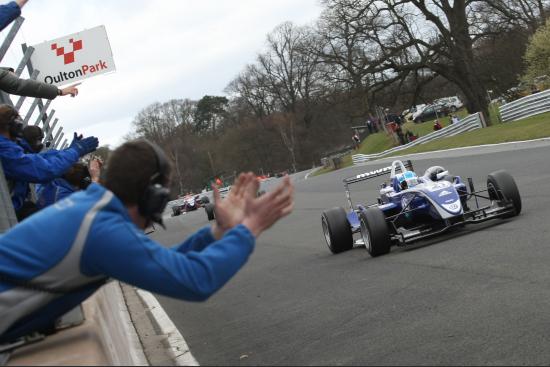
Rupert Svendsen-Cook held out to win race 2. © http://www.fota.co.uk
As Fong struggled, so did Nakajima out front. Unable to get fully comfortable, the Raikkonen-Robertson driver continued to hold off Svendsen-Cook for the lead, but it was not enough to keep the Suffolk driver at bay. Despite Nakajima weaving four times across the narrow track, Svendsen-Cook had enough momentum to zip by the inside on the approach to Cascades. Nakajima would have no answer.
With the leading two safely out front, Huertas continued to fend off the chasing pack for 3rd place for the duration. With Buzaid, Vergne, Jazeman Jaafar and Daniel McKenzie constantly pressing the Colombian, Huertas refused to give way, despite a poorly handling car. Regardless of the pressure Huertas held on to his podium spot, with no one in the pack able to make a move on anyone else.
As the chequered flag dropped, Svendsen-Cook celebrated; however Nakajima ran him close – the Carlin driver eventually took the victory by only 0.6 of-a-second.
Menasheh Idafar took his second National Class victory of the meeting following a spin and retirement by the only other runner, James Cole.
| Pos. | Driver | Team | Time |
|---|---|---|---|
| 1. | Rupert Svendsen-Cook | Carlin Motorsport | 20:08.175 |
| 2. | Daisuke Nakajima | Raikkonen Robertson Racing | +0.658 |
| 3. | Carlos Huertas | Raikkonen Robertson Racing | +3.168 |
| 4. | Adriano Buzaid | Carlin Motorsport | +3.618 |
| 5. | Jean-Eric Vergne | Carlin Motorsport | +4.500 |
| 6. | Jazeman Jaafar | Carlin Motorsport | +7.417 |
| 7. | Daniel McKenzie | Fortec Motorsport | +7.916 |
| 8. | Oliver Webb | Fortec Motorsport | +8.240 |
| 9. | William Buller | Hitech Racing | +9.378 |
| 10. | Alex Brundle | T-Sport | +10.860 |
| 11. | James Calado | Carlin Motorsport | +11.006 |
| 12. | Jay Bridger | Litespeed F3 | +12.355 |
| 13. | Menasheh Idafar | T-Sport | +20.228 |
| 14. | Felipe Nasr | Raikkonen Robertson Racing | +23.420 |
| 15. | Lucas Foresti | Carlin Motorsport | +23.975 |
| 16. | Max Snegirev | Fortec Motorsport | +27.317 |
| 17. | Adderly Fong | Sino Vision Racing | +1 Lap |
| 18. | Hywel Lloyd | C F Racing | +3 Laps |
| Did not finish | |||
| 19. | Gabriel Dias | Hitech Racing | +7 Laps |
| 20. | Jay Bridger | Litespeed F3 | +9 Laps |
Race 3
If Vergne found himself somewhat in the pack in race 2, it certainly was not the case in the weekend’s feature event. Starting on pole, the young Frenchman sailed off into an unassailable lead ahead of Oliver Webb – the pair picking up the second respective 1-2 finishes of the weekend.
Sadly for fellow front-row man Carlos Huertas, it all turned a bit sour – the Colombian stalled his Mercedes-powered Dallara on the grid, relegating himself to the rear of the field. Rupert Svendsen-Cook started on the outside of row two and slotted simply into 3rd position by the static Huertas and that is where he stayed for the distance, despite constant pressing from behind.
Both Jay Bridger and Jazeman Jaafar had awful opening laps – Bridger was slow away and fell down the order with speed, while Jaafar spun his Dallara in the opening corners, collecting Nation Class driver Menasheh Idafar in his travels. Idafar also clipped the only other National Class runner James Cole. After a check up in the pits, Cole continued onward to take the National Class win.
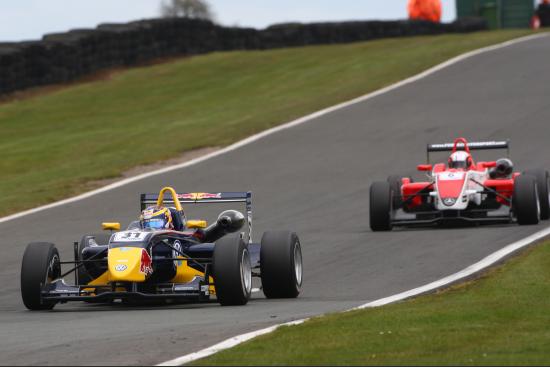
Vergne commanded the lead in races 1 & 3. © fota.co.uk
Alex Brundle started the race down in 10th spot, but a wonderful start propelled him into 7th position; however passes by James Calado and Bridger (both lap 2) would quickly drop him back to 9th, where he would finish just ahead of Daniel McKenzie.
Calado himself was 9th on the grid; however moves on Bridger and Daisuke Nakajima (as well as Brundle) were enough to take the Worcestershire driver up to 6th, where he finished.
It could have been 5th place for Calado, but for Adriano Buzaid holding him off lap after lap, despite some heavy pressure. Buzaid also found himself pressing 4th place runner Gabriel Dias without success.
In the end, Vergne made it look easy. The relatively small margin of victory (1.3 seconds) disguising the fact that Webb never looked like making a move for the win. It gives Vergne a clear title lead going into the second race weekend at Silverstone – a lead he will be looking to build on as the year progresses.
| Pos. | Driver | Team | Time |
|---|---|---|---|
| 1. | Jean-Eric Vergne | Carlin Motorsport | 39:00.158 |
| 2. | Oliver Webb | Fortec Motorsport | +1.377 |
| 3. | Rupert Svendsen-Cook | Carlin Motorsport | +25.912 |
| 4. | Gabriel Dias | Hitech Racing | +26.893 |
| 5. | Adriano Buzaid | Carlin Motorsport | +27.544 |
| 6. | James Calado | Carlin Motorsport | +28.131 |
| 7. | Daisuke Nakajima | Raikkonen Robertson Racing | +31.976 |
| 8. | Jay Bridger | Litespeed F3 | +30.341 |
| 9. | Alex Brundle | T-Sport | +40.341 |
| 10. | Daniel McKenzie | Fortec Motorsport | +42.837 |
| 11. | William Buller | Hitech Racing | +43.024 |
| 12. | Carlos Huertas | Raikkonen Robertson Racing | +46.428 |
| 13. | Jazeman Jaafar | Carlin Motorsport | +48.547 |
| 14. | Max Snegirev | Fortec Motorsport | +1:04.443 |
| 15. | Lucas Foresti | Carlin Motorsport | +1:16.562 |
| 16. | James Cole | T-Sport | +1 Lap |
| Did not finish | |||
| 17. | Felipe Nasr | Raikkonen Robertson Racing | +11 Laps |
| 18. | Menasheh Idafar | T-Sport | +26 Laps |
Race Rating: 2 out of 5
——–
| 2010 British F3 Championship (Round 1) | ||
|---|---|---|
| Pos | Driver | Points |
| 1 | Jean-Eric Vergne | 50 |
| 2 | Oliver Webb | 33 |
| 3 | Rupert Svendsen-Cook | 30 |
| 4 | Adriano Buzaid | 27 |
| 5 | Daisuke Nakajima | 19 |
| 6 | Carlos Huertas | 18 |

 TheMotorsportArchive.com