
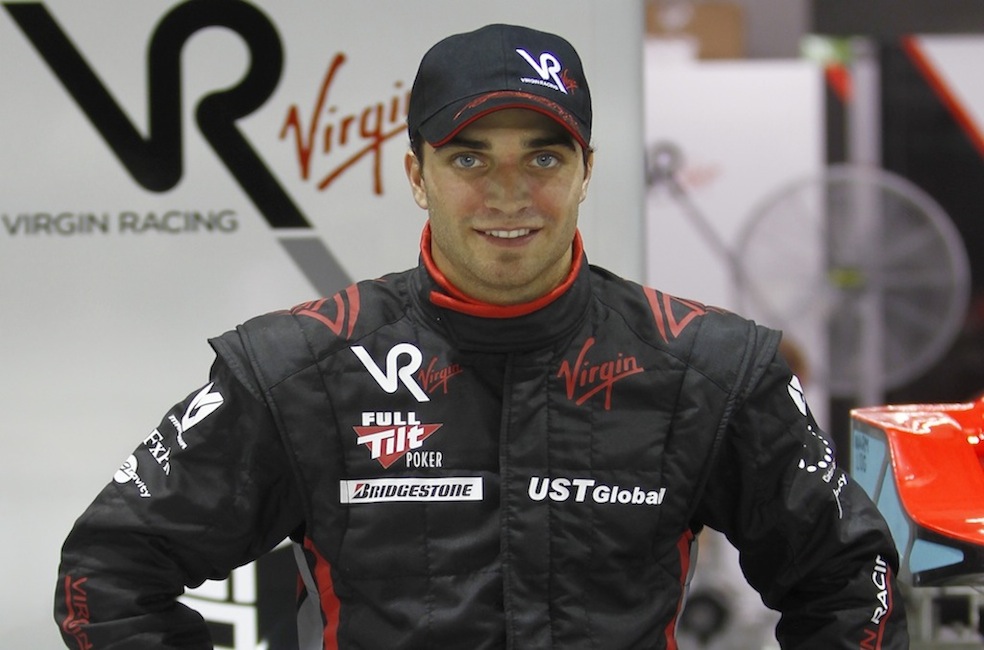
d'Ambrosio will drive for Virgin Racing in 2011. © http://www.gravitysportmanagement.com
Oh the joys of poor weather. Having given up on the air, a swift decision was made to blast across England and Wales on a train and hope for the best.
This has been a long two-and-a-bit days and it may be officially two-and-a-half by the time I get in the door.
One can assume that it has been a better day for Jerome d’Ambrosio.
The Belgian has just signed for Marussia Virgin for the 2011 season, in place of Lucas di Grassi. He will partner Timo Glock at the team.
D’Ambrosio has had some decent (if not spectacular) results on track with the only worry being that he needed a kick up the backside during this year’s GP2 season to get him to perform consistently. He was temporarily replaced by former Renault driver, Romain Grosjean, until reseated by Gravity Management.
As for di Grassi, who knows? There do not seem to be any rumours of drives on the horizon for the Brazilian and it is difficult to see where he could go at this late stage and frankly, I am far too tired to even think about it.
There has been much made that di Grassi is a fantastic development driver, but when one is regularly over 0.5 slower than one’s teammate, questions tend to be asked.
Di Grassi may find himself as a reserve driver at a team yet; a job that encompasses much simulator work and time on the sidelines. Realistically, when checking media sources, there do not seem to be many shouting his name out loud.

Although suspected some time ago, the US-based Star Mazda Championship has confirmed that it will be running at Barber Motorsports Park from April 9th-10th next year.
The junior series will be supporting the IZOD IndyCar and Indy Lights over the weekend, in what will be the second of ten race weekends.
The updated Star Mazda Championship schedule is as follows:
2011 Star Mazda Championship Schedule
March 26-27: Grand Prix of St. Petersburg with IndyCar
April 9-10: Barber Motorsports Park, Alabama with IndyCar
May 27-28: O’Reilly Raceway Park with USAC
June 18-19: The Milwaukee Mile with IndyCar
June 24-25: Iowa Speedway with IndyCar
July 22-23: Mosport with ALMS
August 6: Trois-Rivieres
August 7: Trois-Rivieres
August 26-27: Infineon Raceway with IndyCar
September 3-4: Baltimore Grand Prix with IndyCar
September 16-17: Laguna Seca with ALMS
The joys of waiting in airports... © Leigh O'Gorman
Airports can be quite monotonous places.
They are often drab and featureless, clean and lacking in personality – an emblem to modern efficiency and business.
I write this, not because I have any huge issues with airports per sé, but rather because I have been stuck in one for a few hours and am looking at further delays due to snow and extremely cold conditions.
These delays have, however, given me time to think.
The past few days has seen various droppings of news, chiefly from the IZOD IndyCar Series.
In one week, the Series has been bolstered by the signings of JR Hildebrand to Panther Racing (replacing Briton Dan Wheldon) and the formation of a second Chip Ganassi team, in order to house Graham Rahal and Charlie Kimball.
Hildebrand has shown himself to be a solid competitor, having taken the 2009 Indy Lights crown and taken part in two races this season. While the results were hardly startling, it was quite clear that the pace was there; however Hildebrand at times found himself short on luck and on the receiving end of some charmless punts from fellow competitors. He will be a good addition to the series.
Admittedly, I have poured occasional criticism on Rahal in the past year. During the 2009-10 off-season, complaints about the lack of American drivers in the IndyCar series became annoying, but thankfully the young man has worked hard behind the scenes to get sponsors on his side. Rahal, who will be 22 in January, has shown some great maturity throughout this year and it is fitting to see finally him obtain stability with Ganassi.
However, now the pressure is on and Rahal must perform and make good with his talent – there have been times when he has been asleep at the wheel, while occasionally showing flashes of brilliance. If he can turn this brilliance on more consistently, he will be an IndyCar star of the future.
Kimball is also an interesting prospect. He was diagnosed with diabetes in 2007 during his World Series by Renault campaign and after some time away from the wheel, he returned to racing. His condition is now somewhat under control and his treatment allows him to race with little worry. That his main backer is the drug company, Novo Nordisk, is also a help, as they are the suppliers for his medication.
Another announcement came earlier today in the shape of Tony Kanaan’s confirmation at de Ferran / Dragon Racing. Hewlett Packard will be backing the Brazilian, as he takes to the one-car team in place of Raphael Matos.
This will add Matos to the list of drivers looking for a seat for the coming season, as the Brazilian has yet to conform plans for the coming season.
Other drivers waiting to be confirmed somewhere include Takuma Sato, Mario Moraes and EJ Viso, although at least one of them may end up piloting the KV Lotus entry. It is also unlikely that Hideki Mutoh will be returning to the Newman-Haas fold.
Speaking of Newman-Haas, last week saw Oriol Servia and James Hinchcliffe testing for the famous squad. The pair seemed to run well together and the team are reportedly looking to secure funding for a two-car effort rather than the single-car it ran this year.
There does appear to be some good news for the Indy Lights Championship. While the car count may be lower than last year, at least one of those drivers will be the Argentine, Esteban Guerrieri.
The 25-year-old is a quick little driver, but has been plagued by next to no backing for his entire career. Having won the Formula Renault Argentina title in 2000 and the Formula Renault Eurocup in 2003, Guerrieri has suffered something of a stuttered career, with numerous partial programs, yet he has shown himself to be race winner in many different formulae.
Guerrieri came good this year with a stellar challenge for the World Series by Renault title, ending 15 points (one race win) shy of eventual champion Mikhail Aleshin, despite missing three races and being disqualified from another.
Whereas the Formula One world may have passed him by, Guerrieri will be looking to make a name for himself in the US; in the same way a young penniless Tony Kanaan did nearly 15 years previously.

Masahiro Hasemi. © Copyright unknown.
For many in decades gone, it was not uncommon for drivers to contest their local Grand Prix.
The entrants would often be poorly prepared cars, with second-hand everything that rarely reflected the pedigree of Formula 1.
In fact the early years of the World Championship would even see a mixture of formulae at races, as Formula 2 cars often shared circuit time with its big brothers.
The 1976 Japanese Grand Prix was no different in this respect. An epic showcase for Japan that just happened to be the nation’s first World Championship event – this followed several years of being a non-Championship race for sportscars and Formula 2 machinery.
When the Formula 1 teams showed up for the final race of the season and the conclusion of a titanic battle between Ferrari’s Niki Lauda and McLaren’s James Hunt, few noticed several Japanese drivers on the entry list for the main event; one of which happened to be Tokyo native Masahiro Hasemi.
The 30-year-old Hasemi was not unfamiliar with Fuji – he had won the Japanese Grand Prix at the track the previous year in a March car, but that counted for little as he stepped into his Ford-powered Kojima Engineering machine for his first Championship event.
By this stage in his career, Hasemi was quite experienced, but Grand Prix cars were not his only love – having started racing at the age of 15 in motorcross, he soon moved to Nissan Motorsports to compete in various Saloon Car efforts and GT races.
Yet should one look at Hasemi’s single Grand Prix entry, it may not seem that impressive. The Japanese driver finished the Fuji event in 11th place, some seven laps down on eventual victor Mario Andretti, yet the pace set by Hasemi throughout the weekend set several tongues wagging.
Indeed it was only an error that saw the Kojima-Ford only end up 10th on the grid – Hasemi had set the 4th quickest time in first qualifying and was actually on course for a stunning pole position at Fuji until and accident on his fast lap ruled him out of much of the session.
With Hasemi unable to make any further runs, the Japanese driver dropped to the fifth row of the grid.
This was just a momentary distraction from the battle being fought by Lauda and Hunt, but in the race Hasemi would not let up. After a very bad start in extremely difficult wet conditions, he set a quick pace, but as the circuit dried, is tyres fell away.
Dunlop had little to spare, and thus Hasemi spent much of the race on the wrong tyres, causing his rubber to wear away very quickly. As this occurred, his competitiveness also dropped. Unwilling to concede defeat in front of their home crowd, Hasemi took the chequered flag – the last of the eleven remaining runners.
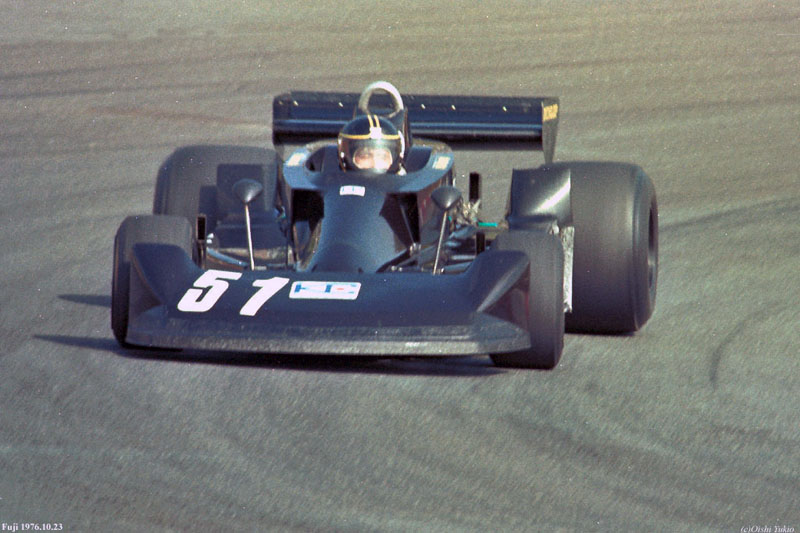
Hasemi, making waves at Fuji. © Oishi Yukio
Something that has created much confusion over the years is the status of the fastest lap of the race. According to the official record books of Formula 1, Hasemi actually set the fastest lap of the race on lap 25; however this has become something of an “official untruth.”
While Hasemi did indeed set a lap that was a good 1.7 seconds faster than the next fastest driver, the Japanese Automobile Federation (JAF) proclaimed that the Tokyo driver had cut part of the Fuji circuit comprehensively, giving him approximately three seconds in hand.
With this information, Hasemi’s fastest lap was disallowed and awarded to the next fastest driver, Jacques Laffite; however this was never taken into account by Formula 1 management and thus on paper, Masahiro Hasemi is considered to be the only driver to record a fastest lap in what was to be his only race.
Sadly, after one further Grand Prix entry (the 1977 Japanese Grand Prix), Kojima Engineering never returned to Formula 1, as the company concentrated on Japanese racing efforts, especially in Formula 2.
There were murmurs that Willi Kauhsen was interested in buying the Kojima KE007 and further developing the machine, but that never came to fruition – Kauhsen did eventually enter as a constructor in 1979, but only for two Grand Prix before shutting down operations.
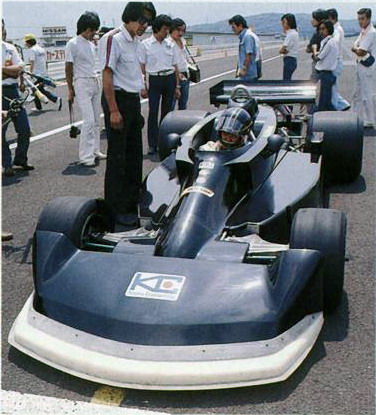
The bulky Kojima KE007 was quick runner. © Copyright unknown
Of course, Hasemi was not the first Japanese driver to enter a World Championship race. That honour went to Hiroshi Fushida when he made attempts to get on the grid for the Dutch and British Grand Prix in 1975.
However while Fushida simply did not qualify for the Silverstone event, he did get into the race in the Netherlands, only for his Ford engine to blow before the parade lap on Sunday afternoon; thereby denying Fushida a race start.
Also on the entry list at Fuji in 1976 were Masami Kuwashima in Walter Wolf prepared Williams (he was replaced following the first practice session with the rather more capable Hans Binder) and Noritake Takahara, who drove to 9th for Team Surtees. Bridgestone also made their short-lived début at Fuji, thanks to Kazuyoshi Hoshino – the Shizouka man ran very well in the early conditions, but had to pull in to retire during a pitstop, as his team had run out of wheels!
Following his Formula 1 experience, Hasemi took part in GT racing and touring cars for many years, winning three Japanese Touring Car titles and one All Japan Sports-Prototype Championship – handy additions to his JAF Formula Pacific and Japanese Formula 2 titles from 1978 and 1980 respectively.
Outside of Japan, he won the famous touring car race at Macau in 1990, before leading an all-Japanese team victory with Nissan at the 1992 Daytona 24 Hour Race, alongside Hoshino and Toshio Suzuki.
Hasemi eventually retired from racing in 200, but was later reunited with his Kojima Formula 1 machine in 2004, when he took part at the Festival of Speed.
Nowadays, the 65 year-old still resides in Japan.
While the eventual winner of the Formula 2 title – as run by Motorsport Vision – earns a test with the Williams Formula 1 team at the end of year rookie sessions, the next two drivers in the standings will now pick up tests with GP2 squads during their winter running. Indeed, both Dean Stoneman and Joylon Palmer did rather well in the respective Formula 1 and GP2 tests of late.
As much as a test with a GP2 team may indeed be a valued prize, it does seem odd that an F2 Championship that was originally touted as rival to GP2 could potentially end up feeding that very series.
An issue that the Formula 2 Championship has faced since its rebirth has been the loss of some of its competitors to either similar or lower formulae.
Following the 2009 season, Mikhail Aleshin moved to World Series by Renault, while Mirko Bortolotti, Tomas Hegewald and Robert Wickens transferred to GP3. Several drivers also left for Auto GP and Alex Brundle joined the British Formula 3 Championship, although he may be returning to Formula 2 for the 2011 run.
These moves have given the impression of a compromised reputation, but it does beg an important question.
A number of people believe they know where Formula 2 sits in the grand scheme of things, but where do Motorsport Vision believe Formula 2 stands? Does it see itself as a Formula 1 feeder or as yet another avenue to the likes of GP2, GP3 or World Series by Renault?
To be truly successful in the future, Motorsport Vision may need to position itself better in order to reflect that …or maybe it has done just that?
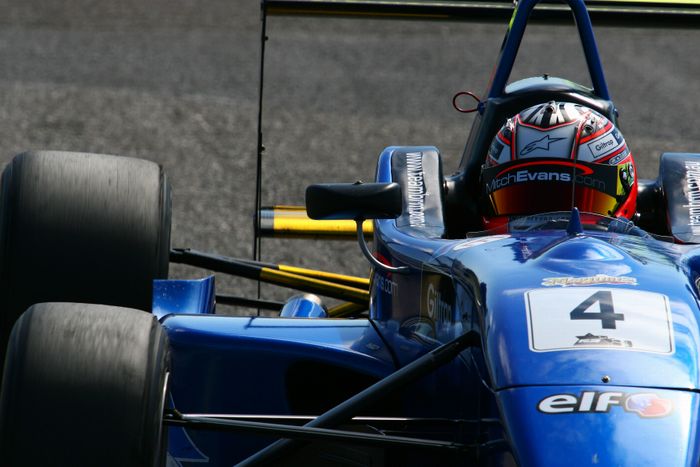
Is Mitch Evans the next Australian star? © Richard Craill / Formula3.com.au
From next year, the inaugural Australian Formula 3 SuperPrix will run at Darwin’s Hidden Valley next June, as a support to the V8 Supercars Championship.
Series regulars battling for the CAMS Gold star and the Australian Drivers Championship, will also have to face competition from international talent, as drivers from multiple Formula 3 series’ venture to the Northern Territory circuit.
Earlier this year, it was announced that Formula 3 would return to the streets of Pau, while a SuperPrix event was also booked for the Korean International Circuit, only to be postponed until next year.
The Formula 3 Grand Prix of Macau already stands as one of motorsport’s must win race’s for developing drivers and the organisers are hoping to bring similar prestige to the Australian contest. The event will run from June 17-19.
According to Australian Formula 3 Chairman, Ian Richards;
“The track is perfectly suited to our cars, with its long straight allowing for slipstreaming and plenty of overtaking opportunities. It will be a spectacular show and we are all looking forward to working with the Northern Territory Major Events team to continue to build their truly outstanding event. This will be a major ‘marquee’ race in Championship.”
In the past decade, the CAMS backed series has produced racers such as IndyCar Series runner-up Will Power, Indy Lights driver James Winslow, Superleague race winner Earl Bamber as well as future hopeful and Mark Webber prodigy, Mitch Evans.
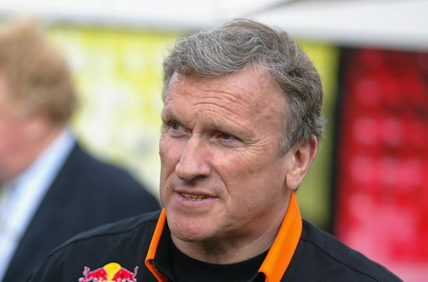
Walkinshaw in his V8 Supercar days. © http://www.drive.com.au
Former Formula 1 and Sportscar boss, Tom Walkinshaw has passed away at the age of 64. The Scot had been suffering from cancer for some time, before eventually succumbing to the disease.
Walkinshaw started out as a racer in the late-60’s, where he competed in Midget’s and Formula Ford’s, eventually winning the Scottish FF1600 Championship.
Later he contested in many different classes of racing, included Formula 2, Formula 5000 and Formula 3 – in the later class, he broke his ankle badly at the wheel of a March. In the mid-70’s, Walkinshaw took to Touring Car racing and come 1976, he established Tom Walkinshaw Racing (TWR). He would continue to race for several more years, before retiring in 1988 to concentrate on TWR.
Before hanging up his helmet, Walkinshaw won the European Touring Car title for Jaguar. Under the TWR banner, Walkinshaw oversaw Jaguar secure three Sportscar titles and two victories at the Le Mans 24 Hour Race (1988 and 1990).
Walkinshaw joined the Benetton Formula 1 team as Engineering Director in 1991 and would oversee not only the drafting of Michael Schumacher from Jordan Grand Prix, but also the German’s first two titles.
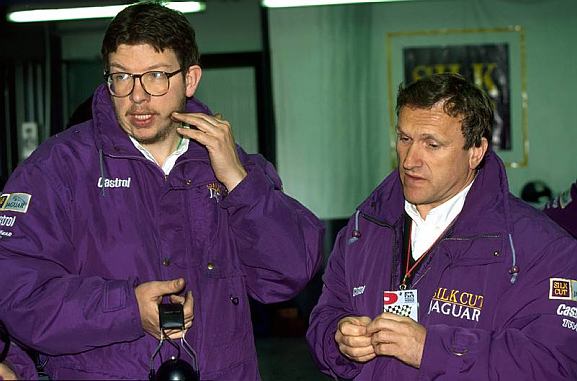
The Scot worked with some of the world's finest.
Walkinshaw bought 50% of the Ligier team with Benetton team principal, Flavio Briatore, but after falling out with the Italian, he bought the Arrows Formula 1 team, recruiting reigning Champion Damon Hill in the process.
Despite the occasional good result (including nearly winning the 1997 Hungarian Grand Prix), Arrows struggled for the next few years and eventually collapsed in 2002, with Walkinshaw leaving the sport to head to the V8 Supercar series in Australia.
Following several years running or co-owning several squads, he created Walkinshaw Racing in 2009 to run two cars in the V8 Supercup for Paul Drumbrell and David Reynolds. They returned for a second season this year with Andrew Thomson and Fabian Coulthard.
Admittedly I had never met the chap, but whenever he was interviewed, he always came across as quite a character devoid of much the modern day corporate chirping associated with motorsports.
He will be missed.
Here’s video of Tom Walkinshaw’s pole lap at the 1985 Bathurst 1000 race in his TWR Jaguar XJS.
This new ruling would see a car behind get a boost by changing the angle of a section of the rear wing plane when within one second of the driver ahead, thereby creating extra straight-line speed and an overtaking possibility.
Yet the driver ahead will not have the same measures at their disposal and it is this raises my ire somewhat. Overtaking is primary skill in motorsport and the flexible rear wing rule negates that skill to a degree. This is supposed to be the top level of motorsport and elements like the flexible rear wing rules simply cheapen the art of overtaking, potentially reducing its significance as happened with the reintroduction of refuelling in 1994.
It feels like a cheap option. When refuelling returned to help “spice up the show”, it in one foul swoop removed what little on track overtaking was left. Rather than fix the cars and circuits, a gimmick was brought into play and the flexible rear wing is just another gimmick.
Soon, the talk was of strategy and chess moves, but that is not interesting if no one can still overtake through daring and skill. The KERS units will also return from next season.
On the subject of easy overtaking, the ban on team orders has been lifted… at last. As much as it would be delightful that team orders would go away, the truth is they never did and never will. If there is not arranged passing on track, then positions are most likely to be changed in the pits.
There are other forms of team orders and favouritism too – Red Bull’s pre-qualifying actions at Silverstone this year were technically a form of team favouritism. Advising drivers to hold position is also another form of team orders – it still rules out the possibility of good racing. For the most part, team orders may not be as blatant as displayed at Hockenheimring this year, but they do exist and it would be dreadfully naïve to assume otherwise.
I still don’t understand why Ferrari didn’t swap them during the pitstops though…
Other technical rules discussed revolved around the engine regulations for the 2013 season. The engines will change from their current 2.4-litre V8 format to 1.6-litre four-cylinder turbo’s, with power output to be around 750bhp – similar to current machinery; however, it is thought to lead to 35% increase in fuel efficiency.
The power output of KERS will also increase for the 2013 season – the new power of the new units will increase from 60kw to 120kw in 2013.
So enjoy, “The Shy Champion: Phil Hill“
As part of the second VivaF1 blog swap shop, Pat Wotton of I Watch Too Much Racing has penned a fantastic post on the Formula 1’s ladder system.
I shall also be taking part in this with a post on Grab Bag Sports later in the week.
——–
“Pruning the Feeder Series”
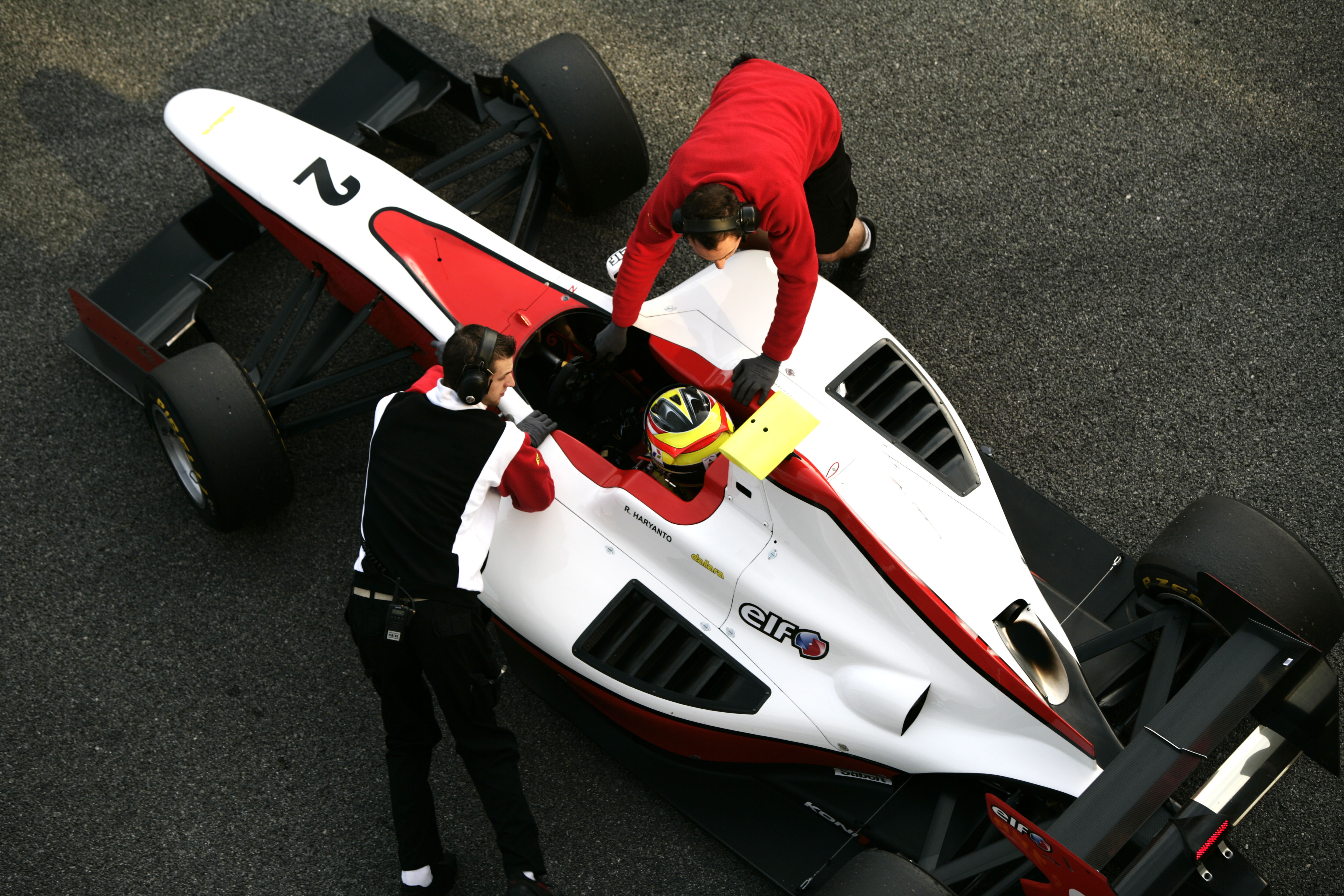
GP3 now working as GP2 and F1 feeder. © Drew Gibson/GP3 Media Service
Fractured
Apologies for a fairly long post but I know my host isn’t averse to the occasional long write-up. A theme often touched upon both by Leigh and myself in discussions around the internet is that of the junior and development series.
There are too many of them. If the Indy car debacle of 1994 was described as a split, the European junior scene could be described as shattered. While it is pretty bad elsewhere Europe has it worse and that’s where I’ll focus my attention here.
I’m going to defend several of these championships. I’m not necessarily advocating a complete return to the old days of the simple ladder progression from Formula Ford through F3 and F2/F3000 (GP2 now) and finally to F1, or whichever top level series is chosen – for simplicity for this post we’ll assume that is F1.
There are arguments for having an alternative route, when there are many good talents working their way through the ranks as well as diamonds in the rough or those with as-yet untapped potential we cannot just assume the ‘favoured’ series will always pick them all up.
Flexibility
I believe the two development series directly below the top level, namely GP2 and F.Renault 3.5, complement each other perfectly. Drivers with the requisite talent and budget can jump into GP2 directly from the tier below (whether it be F3 or whatever).
Those drivers needing a little enrichment and experience – and increasingly those unable to raise GP2 budgets – can slot themselves into FR3.5. GP2 should be for the last bit of refinement before F1, and then as an F1 rookie there should be a learning curve. FR3.5 is a good place to do a bit of learning without the pressure of GP2, particularly for those who haven’t as much experience with car set-up.
There is nothing wrong with having a net to catch those good talents who, due to budget or whatever other reason, might have been lost to motorsport or consigned to their national touring car series (nothing wrong in that either, many make good careers of touring cars, but if they are good enough for F1, Indy or Le Mans let’s try to get them there first, eh?).
FR3.5 is a small step below GP2 yet it has proven itself as a good grounding for the likes of Sebastian Vettel and Jaime Alguersuari, both of whom were considered to have been promoted too early and yet one of them is now World Champion. I’m undecided though, perhaps I would still like to see its’ graduates complete one year in GP2, perhaps instead of the usual 2 or 3.
If we take a look at what we might call ‘the third tier of racing’ traditionally that would mean the various Formula 3 championships across the continent plus those in South America (SudAm F3) and the strong Japanese series. Again, nothing too wrong with this because each would be the top level of junior development in that nation or region.
The structure was set up like a pyramid, lots of F3 series all feeding up into a smaller number of series above them. Equally the level below F3 features a far greater number of series feeding upward, and most of them are some variant of Formula Renault 2.0 (too many of those actually). This whole approach has worked well for getting on for a couple of decades. The great advantage of F3 is that it is the best school for teaching race car set-up to young drivers. Everything else out there is a spec series, F3 is more open.
Then came a new tranche of championships, intentions unknown. Money-spinners? Dissatisfaction with the current establishment? Political moves? Who knows?
Divergence
When F3000 died and relaunched as GP2 the cars were moved to Italy and run in a series based there, which seemed to pitch itself as an alternative route into GP2, it grew to become Euroseries 3000, has relaunched as AutoGP and now features the original A1GP machines. I am not sure how AutoGP sees itself. There are GP2 teams in the series, perhaps the teams see it as a feeder series to GP2, or is it a different business venture for them? I don’t see the need to have this step between F3 and GP2/FR3.5. We don’t need an alternative to any of them or a middle step.
The only way I can see AutoGP succeeding as a venture is if it distances itself entirely from the ladder series and becomes something else entirely – a Europe-based single-seater series in its own right, in the same way Superleague Formula is on the path to becoming. I’d be okay with that because you can argue with falling European F1 rounds, Europe needs a ‘domestic’ single seater series that isn’t a feeder series. What we don’t need is another feeder series.
Formula Master came and went. Few noticed. For what its worth, it was at F3-level and raced with WTCC. The only driver of note to come through that route was Jerome d’Ambrosio, current GP2 driver and F1 tester for Renault and Virgin.
Formula 2 was brought back in 2009 and had a fairly successful first year. It was the FIA’s attempt to do something about the stratospheric budgets needed by GP2 and to find another way into F1.
It has failed at that aim and now looks to be repositioning itself as a feeder into GP2. Again.. do we need another one? It has achieved the aim of digging up drivers that would’ve struggled elsewhere, the question is whether any of them were any good and whether it would have been good for them let them struggle. Maybe only a few of them were much cop.
Again it was a WTCC-support but will be going its own way in 2011, which could be the nail in the coffin for the series – does it infer a lack of confidence from the FIA under the new President?
2010 saw the start of GP3. I can perfectly see the reasons why GP3 was set up and I agree in principle with many of them. It has cars that go just about as fast and are just about the same size as F3, albeit as a spec-series GP3 is far more controlled, this means it should be cheaper to run cars. I’m sure travel costs balance that out, and perhaps it is better to gain experience on the F1 tracks rather than Snetterton or the Rockingham roval.
It also features many GP2 teams which is a great asset since that series is the next port of call. Running two levels of development series on the European F1 weekends makes perfect sense, it works extremely well for MotoGP where nearly all the successful riders of the modern era came up through the 125cc and 250cc ranks which race alongside the top class (indeed these are in the process of converting to Moto3 and Moto2 respectively), the Superbike converts seem to struggle.
It is too early to say whether GP3 will work as well as either 125cc or Formula 3. What we do know is it has basically sucked the life out of the F3 Euroseries, reducing it to just 14 cars.
As it enters Year 2 will the teams stick around or go back to F3? I really like the idea of a series a full ‘tier’ below GP2 running alongside it at the F1 meetings. I do think it could’ve been better if that series had been Formula 3.
What Can Be Done?
I was going to suggest a great deal of hard-nosed pruning and I was going to point out which series I would keep on merit, however the financial situation of the last couple of years may be making the decisions for me.
In any case, let’s recap what could be done:
F.Master was a pointless series and it has rightly died. F2 doesn’t appear to have a point, and unless they have something up their sleeve they are keeping quiet will likely to struggle greatly in 2011. The talent level in 2010 was not good. Let’s close it now. Ideally I’d have GP2 running under the Formula 2 name. Politically this probably won’t ever happen. GP3 is a good idea. I’d loosen up the technical regulations a little, perhaps offer a merger with F3 Euroseries and take that name. That way we’d have F1/F2/F3 as the series on the F1 bill. If we’re merging F3 Euroseries and GP3, the existing national F3 series in Britain, Spain, Italy and Germany can act as feeders into it or FR3.5. GP2 must persist, albeit the costs are too high for all concerned and that needs to be reviewed. Dallara and Renault can’t keep coming up with ever more expensive equipment every 3-year cycle. FR3.5 World Series should continue, deliberately positioned half a step back from whatever GP2 is doing. As AutoGP grows – as I hope it will – it should stop feeding drivers into GP2 and become a destination in its own right. Whether there is the money or the number of drivers for this is debatable. There’s a whole blog post in that for another time. Consolidate the eleven-hundred Formula Renault 2.0 championships, there really is no need for as many as there are! There’s the Euroseries, several regional series within Europe, and several national series. Keep a small number of healthier local series with the Euroseries at their head, and place drivers from the others into those. Don’t start any more development or junior series unless there is a need for them!
The feeder series should be working for the drivers and teams, not for the interests of the series. The economy is naturally contracting the number of entrants of some series, let’s go further and kill off the dying championships before they ruin careers. There are enough series in Europe not to be too sentimental about it.
And Finally
I’m out of room and time but I didn’t touch on IndyCar, Indy Lights, USF2000, Star Mazda.. and the sad fall of Atlantics. It is fantastic that IndyCar has embraced the ‘Road to Indy’ ladder and prevented them from falling out of existence, as seemed possible.
Despite what I say above about dying series, it is a real shame that the Atlantics series couldn’t have been saved whether under the IndyCar umbrella or not, it was a great development category and could’ve potentially provided a route for future American F1 stars should they not wish to take the Indy ladder.
Unlike Europe there is room in North America for it, unfortunately the economy killed it.
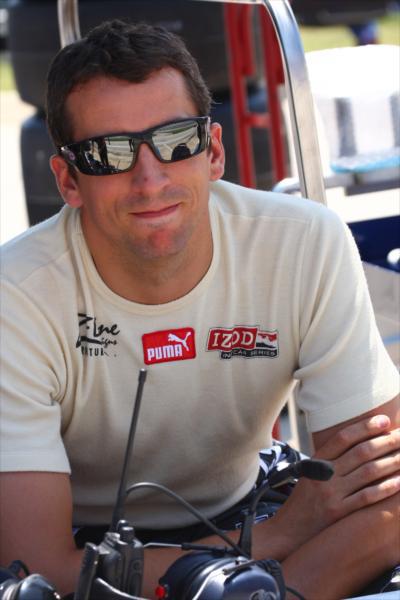
Justin Wilson. © Dan Helrigal
For many the world over, motor racing begins and ends with Formula 1.
It becomes almost ritual to take note of a driver as they enter the higher echelons of motorsport, only for their names to to slip should they step out of the light.
Truthfully, Formula 1 is just a singular peak in a mountain range – a wider view of the valley reveals drivers of equal measure competing hard in the likes of the IZOD IndyCar Series, the World Rally Championship or the NASCAR Sprint Cup Series.
Indeed, just below those peaks sit championships such as DTM, AutoGP, Superleague and multiple Touring Cars series’.
For example, after Juan-Pablo Montoya parted company with McLaren in 2006, his career did not end – in fact, the Colombian walked straight into a drive with Chip Ganassi’s NASCAR squad.
Even Ralf Schumacher and David Coulthard have found racing seats beyond Formula 1’s hardened glamour.
Thus when Sheffield’s Justin Wilson parted company with Jaguar’s beleaguered Formula 1 team at the tail end of 2003, the Briton suddenly found himself at the wheel of a Champ Car with Conquest Racing.
After one year with Eric Bachelart’s small squad, Wilson moved to RuSport where he won four races in three seasons, that saw him a title contender in two of them.
Following the realignment of the IndyCar Series at the beginning of 2008, Wilson picked a further two victories – the first for Newman/Haas/Lanigan Racing in Detroit (2008), before securing Dale Coyne’s first ever win as a team owner in dominant style at Watkins Glen (2009). Wilson joined Dreyer & Reinbold Racing for the 2010 season and recently announced that he will be staying with the squad for the upcoming year.
So with 2010 slowly grinding to a halt as Christmas approaches, I got in contact with Justin to see how he was getting on.
Formula 1 Archive: You recently re-signed for a second year with Dreyer & Reinbold Racing – how much of a benefit is that in terms of season preparation and building relationships with engineers and other team members?
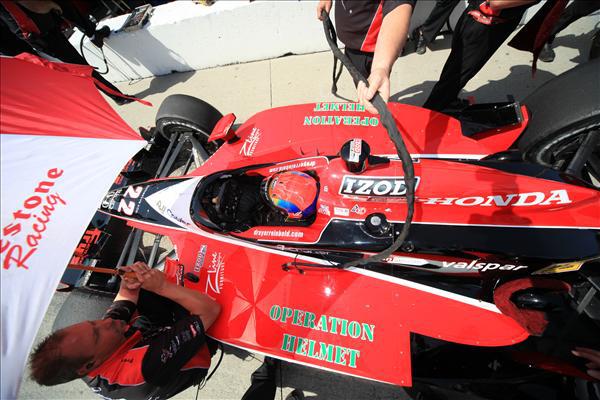
Justin Wilson: Rejoining DRR (Dreyer & Reinbold Racing)for a second season should be a huge advantage as it means we can concentrate on some of the finer details that really make a difference in the IZOD IndyCar series.
I’ve already met up with the team and we have started to focus on those areas we know we need to work on. We are analysing each race from this season and working out what to do better.
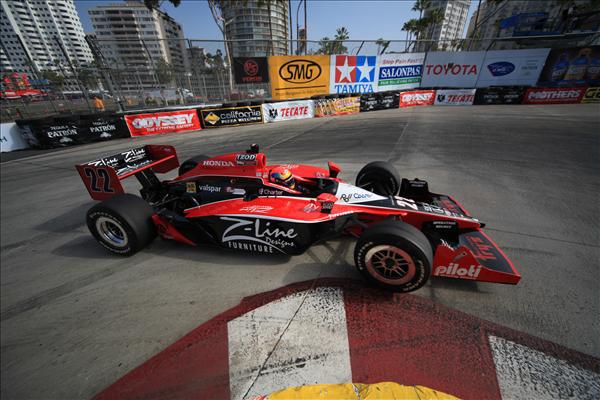
One of the things that I’ve learned with the Dallara is that the car set-ups are very track-specific. You have to develop a Toronto set-up year after year at Toronto – you can’t just bolt on a Long Beach set-up that worked well earlier that season just because it’s a similar kind of street course.
And it’s not just the road courses, the ovals are the same. Staying with the same team means we have an opportunity to start where we finished last season and find more speed at every track.© Ron McQueeney
F1A: In May, your 2010 team-mate, Mike Conway, suffered a horror crash at Indianapolis.
For the rest of the season, you had five team mates – was that ever a destabilising factor in the team?
JW: Having a rotating team mate really didn’t help our season, but that’s not something that you can control.
It’s obviously not something that was planned, or even wanted, but after Mike’s accident the team just had to do what it could to keep the 24 car on track. The main thing was that Mike was able to make a full recovery after that terrible accident.F1A: You seem to have a very good commercial partnership with Z-Line Designs – how crucial has a company like Z-Line Designs been in supporting your exploits these past couple of seasons?
Of course, there is also the Justin Wilson Investors Club – what exactly is that and how is it coming along?
JW: Z-Line have been a great supporter and I have been very fortunate to have driven their car for the last few years. DRR has a lot of other really good sponsors too, and from the commercial side it’s a really interesting team to be involved in.
The investment arrangements made through Justin Wilson PLC still have their formal AGM each year and we normally have those at Brands Hatch. It’s good fun to meet up with investors each year to talk about how things are going and if the track’s free Jonathan lets us take a spin round the Indy circuit.
In between AGM’s, Justin Wilson Investors Club is a more informal way of keeping investors up to date with how things are going. It also organises trips if people want to come out and see what IndyCar racing’s all about.F1A: Something that struck me following the final race at Homestead, is that the 2011 was nearly 5-and-a-half months away.
Do you do any racing during the off-season to keep the cobwebs off and if not, what do you do to get back into it?
JW: We have a long gap between the end of each season and the start of the next but I stay busy. I probably won’t be in the car testing until February, so from now until then the only driving I will be doing is on iRacing.com which is a very realistic online racing simulation.
You can practice on your own as well as race online against other members, and I’ve had a lot of fun since October hosting a few races at different tracks and in different cars. It definitely helps to keep you sharp.
The rest of the time I will be with my family and training for next season. I go to the gym several times a week and do a lot of road cycling and mountain biking whenever the weather’s good enough.
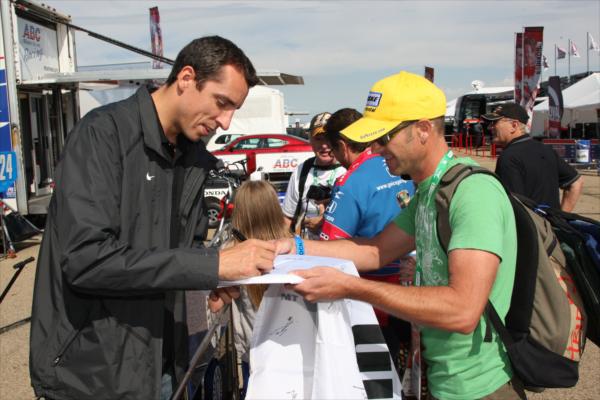
Another benefit of having my deal sorted this early is to be able to put some good foundations in with my training for next year.Wilson has proven himself to be a fan favourite. © Chris Jones
F1A: I’ve heard from many fans of their excitement of multi-aero kits and the return of engine competition in 2012.
As a driver how do you view such major changes to the formula and how does you feel as motor racing enthusiast when you see such names as Chevrolet and Lotus getting back into IndyCar?
JW: Like everyone I think that it’s great news to have Honda, Chevrolet and Lotus building engines and body kits for the new car.
It’s just another sign that the series is on the right road to recovery and it will create a lot of excitement for the fans and the teams.
This is exactly what we need t grow the sport, but I’m sure it wont be too long before we hear people complaining that they don’t have the strongest engines or the best aero kits! But that’s racing!F1A: With your time in Formula 1, Champ Car and IndyCar (and not forgetting your 2004 attempt at Le Mans), you are one of the very few drivers that has been involved several periods of top-level motorsport in a relatively short time.
Have you had to develop a special versatility as a driver to adapt to each formula or is it just about making slight adjustments in vaguely similar cars?
JW: I’m can’t think of anything I’ve consciously done to adapt, but like most drivers I just focus on trying to extract the most from any situation I’m in. I love driving different types of cars and learning what they can do.
After switching back and forth a few times you gain confidence and that allows you to adapt more quickly. It’s been great to have the opportunity to race competitively in some of the world’s biggest events from Sebring 12h, Daytona 24 Le Mans 24h as well as the Indy 500. Not forgetting Monaco of course.F1A: When you drove for Minardi in F1 during the 2003 season, I am led to believe they designed car to cater or your height. Is that a luxury that you have also had in IndyCar or is it a case of one tub fits all?
JW: I was fortunate that Minardi was able to modify the car to allow my knees to fit. That was the only time I have had to have a tub modified, Since then it’s usually been a case of moving pedals and steering columns around to squeeze me in. The 2007 Panoz was a larger car and that made me more comfortable and I’m hoping that the new Dallara will do the same thing.Tension mounting pre-race. © Ron McQueeney.
F1A: Thinking of comfort, you would be considered primarily a road or street racer. How have you found ovals since your move to the US, especially the likes of Texas Motor Speedway and its high banking?
What do you make of the pack racing that we see at Kentucky and previously, at Chicagoland?
JW: The ovals have been a challenge to find speed on when you’re flat out, but I really enjoy them.
We only had a couple of oval races each year in Champ Car, so it’s been a steep learning curve since coming over to IndyCar and the rate of progress hasn’t been helped by the change of teams each year. I’m hoping that the continuity with DRR will help us to focus more on the ovals in 2011.
The last few years the teams I’ve been with have put 90% of the effort into the road courses and spent most of their testing miles on those track. That was the right thing to do given where they were at with their road and street course development, but now that we’ve got some continuity there’s an opportunity to spend more time on our oval performance.
We had a great car in Chicago where I was able to get in the middle of some crazy pack racing action. And we had some pretty quick qualifying cars at Indy and Homestead. So I feel it’s not out of reach, we just need some tweaking.F1A: Finally, what is the difference between Justin, the 2001 Formula 3000 Champion and Justin the 2011 IndyCar driver?
JW: About 10 years! No, seriously, I feel that I’m the same now as I was then, but with a lot more experience. I have more confidence too which is always a huge factor in driving.
F1A: Thanks Justin. Best of luck in 2011.
You can follow both Justin Wilson and Dreyer and Reinbold Racing on Twitter. My thanks to Justin for his time and Rachel Middleton at Motorsport Vision for helping put this together.
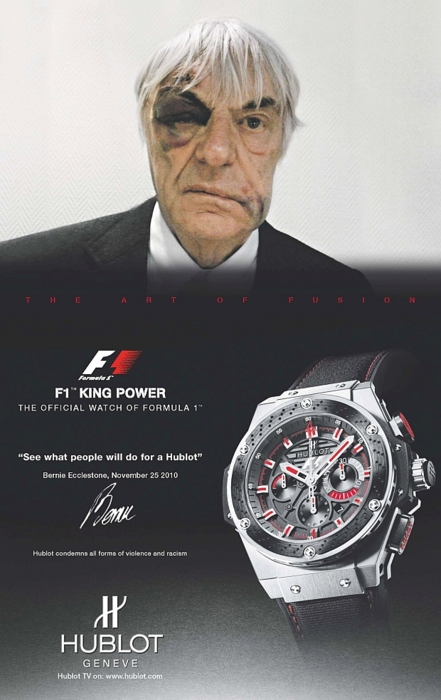
When Formula 1 supremo Bernie Ecclestone was attacked in West London on November 25th, the 80-year-old and his Brazilian mistress Fabiana Flosi became the latest victims of a crime wave in the area.
On this occasion, the group of four stole jewellery from the pair (reportedly worth around £200,000) and proceeded to punch and kick Ecclestone in the head a number of times. Ecclestone briefly fell into unconsciousness, while Flosi was left shaken by the incident.
The value of what was stolen means little – Bernie can well afford the financial damage; however it is sad that many feel the need to count the cost of the attack in terms of dollars and sterling, rather than the tissue and emotional damage.
I have come across several people make some shocking remarks about the incident and its victims in the time since – shame on them.
However in the time since, Bernie has proved himself to be made of stronger stuff than most. Despite his injuries, Ecclestone returned to work the following morning and today unveiled himself as the star of watchmaker, Hublot’s latest marketing campaign. Showing the former Brabham owner to be heavily bruised and cut, the poster proudly exclaiming “…see what people will do for a Hublot.”
The campaign is set to live this week with adverts running in the Financial Times and several other publications.
Somehow I doubt many of my age group (late 20’s) would be so willing to get back into the swing of life after such an experience. If anything, it is a brilliant two-fingers up to the lowest of society and a sign that maybe Ecclestone is made of sterner stuff than most.
Jack Clarke topped the time sheets in the first of Formula 2’s winter tests at the Portimao circuit in the Algarve, with Benjamin Lariche proving to be the quickest in the afternoon.
Clarke set the fastest lap of the morning in the final minutes of the session, as the track began to dry out following early rain; while Lariche clocked up his time late on under the emergent Portuguese sun.
Clarke finished the morning with a lap 3.5 seconds faster than 2010 Formula 3 Euroseries runner Antonio Felix da Costa and 4.7 seconds clear of Thiemo Storz; however Storz proved to be the quickest runner while the circuit was sodden. Lariche, Kevin Mirocha and Joylon Palmer also proved to be initially quick, before falling down the order as the circuit dried late on.
Such were the changeable conditions of the morning session, it is next to impossible to assess just how quick Clarke really was compared to the competition – it is highly unlikely that young Spaniard Bruno Mendez is 14.7 seconds slower than the Briton; however in terms of confidence, it could be an extra boost for Clarke.
One driver that did not enjoy a boost of confidence was British Formula 3 runner Alex Brundle. In difficult early conditions, the Briton slapped the turn 3 barriers sidelining him temporarily, before returning to the circuit late on.
Indeed Clarke kept up the pace in the afternoon, registering the 3rd quickest time, some 0.2 of-a-second shy of Lariche – da Costa once again found himself 2nd quickest, sandwiched by Clarke and Lariche in the final order.
Joylon Palmer also proved to be quick with his 4th best time – the top four found themselves some distance clear of the rest of the field as the chequered flag flew for the final time.
Day One, Morning Session:
1. Jack Clarke, 1:40.561s
2. Antonio Felix da Costa, +3.567s
3. Thiemo Storz, +4.713s
4. Benjamin Lariche, +5.429s
5. Kevin Mirocha, +6.300s
6. Jolyon Palmer, +6.319s
7. Ramón Piñeiro, +6.371s
8. Vincent Beltoise, +6.708s
9. Alex Brundle, +7.355s
10. Max Snegirev, +7.787s
11. Natalia Kowalska, +7.820s
12. Plamen Kralev, +8.035s
13. André Negrão, +8.200s
14. Bruno Mendez, +14.746s
Day One, Afternoon Session:
1. Benjamin Lariche, 1:36.200s
2. Antonio Felix da Costa, +0.244s
3. Jack Clarke, +0.248s
4. Jolyon Palmer, +0.353s
5. Thiemo Storz, +0.899s
6. Alex Brundle, +0.948s
7. Bruno Mendez, +1.210s
8. Max Snegirev, +1.237s
9. Ramón Piñeiro, +1.302s
10. Natalia Kowalska, +1.410s
11. Kevin Mirocha, +1.417s
12. André Negrão, +1.909s
13. Plamen Kralev, +2.059s
14. Vincent Beltoise, +3.506s

Dave Weston at the wheel of an MGZR in the snow. © Castle Combe Circuit, Will Belcher
Some in the UK may have noticed that we are suffering some rather poor wintry weather of late.
Rather than teeming rain pouring through sogged rain jackets and onto cold to the touch skin, many parts of Britain have been hit with a barrage of snow and sub zero temperatures – something quite unusual for this time of year.
It’s times like this that I forget to stock up on wise footwear and quality gloves, often leaving myself exposed to cold fingers, wet feet and pitiful glances.
However, in Castle Combe, they just drive – regardless of how cold and snowy it is. Thus last Saturday, a charity track day was organised at the Wiltshire circuit and despite the flurry of a flaky white menace, drivers hit the circuit in what must count as truly dire conditions. Organised by Katie and Ben Elliot, the track day raised £1999 and £2374 for Cancer Research UK and Birdham Nursery respectively.
The clip (see below) was filmed by Adam Kane, Mark Henderson, Tim F Matthews and Tom Schonfeld and was also edited by Matthews. It is a fantastic little piece and worthy of a couple of minutes of anyone’s time.
For more shots of the day – taken by Will Belcher, check out Castle Combe’s Flicker page. More information about the circuit and its events can be found at castlecombecircuit.co.uk.
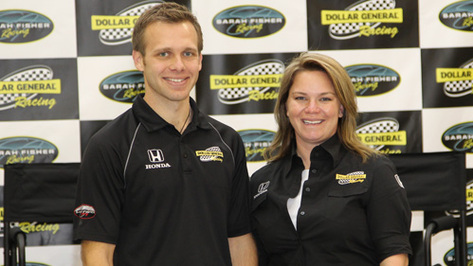
Ed Carpenter will take Sarah Fisher's seat in 2011. © indycar.com
IndyCar fan-favourite, Sarah Fisher announced her retirement as a driver today.
The 30-year-old, who started racing 25 years ago, is hanging up her helmet so that she can concentrate on running her IndyCar squad that she started with her husband Andy and father-in-law John O’Gara.
Over the years, Fisher competed in several full seasons in IndyCar’s, although her appearances have become somewhat more sporadic in recent years. 2007 represented her best overall finish in the IndyCar Series Championship.
Following a season of consistent runs, the Iowa native claimed 17th in the Series with Dreyer & Reinbold; however her best race result remains 2nd spot at Homestead in 2001 with Walker Racing.
In January 2008, Fisher brought her Sarah Fisher Racing Team to the then Indy Racing League, but in the time since has only competed in a small number of events. This season saw Sarah Fisher Racing expand to a two-car effort, with Graham Rahal running three races and Jay Howard taking part in a further four events.
Although it was thought that she may announce her retirement, it was assumed that Fisher may make one final appearance at the 2011 Indy 500, but it looks at this stage as if Fisher is to remain on the sidelines for the centennial event.
Fisher will be replaced in the driver’s seat by former Vision Racing peddler Ed Carpenter. After the collapse of Vision at the tail end of 2009, it seemed as if Carpenter’s top-flight racing career was finished; however several second-seat drivers for Panther Racing last year elevated Carpenter’s reputation as a solid, if unlucky, oval racer. Carpenter will be running at nine races in 2011.
The car’s primary sponsor, Dollar General, will also be staying on as a backer to the number 67 machine, bring their relationship into its fourth season.
Much of Sarah Fisher’s popularity comes from the down to earth nature that she puts across. Rather than the more overtly serious attitude shown by many within the racing community, Fisher has always appeared smiley and happy, with lots of time for fans. I wish her all the best in the future.
SARAH FISHER RACING PLANNED 2011 RACES
March 28 – St. Petersburg, Fla.
May 29 – Indianapolis Motor Speedway
June 11 – Texas Motor Speedway
June 25 – Iowa Speedway
August 7 – Mid-Ohio Sports Car Course
August 14 – New Hampshire Motor Speedway
September 4 – Streets of Baltimore
October 2 – Kentucky Speedway
October 16 – Las Vegas Motor Speedway (TBD)
The Romanian driver has shown flashes of speed all week long; however it remains to be seen whether he can repeat this form when he joins Coloni for the 2011 season. Initially Herck was shy of Rapax driver Fabio Leimer in the morning, the Swiss driver had his times disqualified after it was discovered the Swiss driver was underweight. Leimer would return in the afternoon to register the 2nd quickest lap.
Once again Josef Král continued to show some quick times, as he made good use of his iSport machine – indeed Král was 2nd quickest in the morning, before dropping to 3rd later in the day. Adrian Quaife-Hobbs (Coloni) and Kevin Ceccon (DPR) also ran well today, while Sauber reserve Esteban Gutierrez (ART Grand Prix) rediscovered some of the speed that deserted him during yesterday’s outing.
Arden’s Rio Haryanto suffered an off during the morning, damaging the tub in the process and prematurely ending his day early.
This was a day of lasts. As the chequered flag waved, Bridgestone dropped out of the Series as next year, Italian company Pirelli take on the role of sole tyre supplier. Today also marked the final running of the GP2/08 chassis – it is to be replaced for the 2011 season by a new car; one that will be similar to the modern Formula 1 designs.
GP2 now breaks for the winter, to reconvene at the beginning of February for two short testing periods, before embarking on a startlingly short GP2 Asia series.
Morning session:

Pos  Driver               Team                Time        Gap
 1.  Michael Herck        DPR                 1m47.909s
 2.  Josef Kral           iSport              1m47.941s  + 0.032s
 3.  Adrian Quaife-Hobbs  Coloni              1m47.961s  + 0.052s
 4.  Kevin Ceccon         DPR                 1m48.169s  + 0.260s
 5.  Esteban Gutierrez    ART                 1m48.171s  + 0.262s
 6.  Marcus Ericsson      iSport              1m48.229s  + 0.320s
 7.  Brendon Hartley      Ocean               1m48.322s  + 0.413s
 8.  Alexander Rossi      Racing Engineering  1m48.340s  + 0.431s
 9.  Luiz Razia           Addax               1m48.549s  + 0.640s
10.  Rodolfo Gonzalez     Trident             1m48.603s  + 0.694s
11.  Sam Bird             Super Nova          1m48.622s  + 0.713s
12.  Roberto Merhi        Addax               1m48.643s  + 0.734s
13.  Adrian Zaugg         Trident             1m48.764s  + 0.855s
14.  Alexander Sims       Racing Engineering  1m48.793s  + 0.884s
15.  Karun Chandhok       Coloni              1m48.903s  + 0.994s
16.  Oliver Turvey        Arden               1m49.197s  + 1.288s
17.  Charles Pic          Rapax               1m49.205s  + 1.296s
18.  Rio Haryanto         Arden               1m49.397s  + 1.488s
19.  Jolyon Palmer        ART                 1m49.491s  + 1.582s
20.  Jan Charouz          DAMS                1m49.894s  + 1.985s
21.  James Jakes          Super Nova          1m50.027s  + 2.118s
22.  Pal Varhaug          DAMS                1m50.113s  + 2.204s
23.  Armaan Ebrahim       Ocean               1m50.247s  + 2.338s
24.  Fabio Leimer         Rapax

Afternoon session:

Pos  Driver               Team                Time        Gap
 1.  Michael Herck        DPR                 1m47.138s
 2.  Fabio Leimer         Rapax               1m47.158s  + 0.020s
 3.  Josef Kral           iSport              1m47.227s  + 0.089s
 4.  Alexander Rossi      Racing Engineering  1m47.280s  + 0.142s
 5.  Rodolfo Gonzalez     Trident             1m47.425s  + 0.287s
 6.  Brendon Hartley      Ocean               1m47.456s  + 0.318s
 7.  Luiz Razia           Addax               1m47.667s  + 0.529s
 8.  Alexander Sims       Racing Engineering  1m47.744s  + 0.606s
 9.  Roberto Merhi        Addax               1m47.779s  + 0.641s
10.  Charles Pic          Rapax               1m47.797s  + 0.659s
11.  Marcus Ericsson      iSport              1m47.820s  + 0.682s
12.  Oliver Turvey        Arden               1m47.884s  + 0.746s
13.  Kevin Ceccon         DPR                 1m47.888s  + 0.750s
14.  Adrian Quaife-Hobbs  Coloni              1m47.925s  + 0.787s
15.  Pal Varhaug          DAMS                1m48.156s  + 1.018s
16.  Sam Bird             Super Nova          1m48.239s  + 1.101s
17.  Adrian Zaugg         Trident             1m48.362s  + 1.224s
18.  Karun Chandhok       Coloni              1m48.535s  + 1.397s
19.  James Jakes          Super Nova          1m48.761s  + 1.623s
20.  Jolyon Palmer        ART                 1m48.998s  + 1.860s
21.  Jan Charouz          DAMS                1m49.430s  + 2.292s
22.  Armaan Ebrahim       Ocean               1m49.537s  + 2.399s
23.  Esteban Gutierrez    ART                 1m49.978s  + 2.840s
Not content with topping the timing sheets on Wednesday, Swiss driver Fabio Leimer registered the fastest laps at today’s GP2 test as well.
Running with Rapax squad, Leimer had a trouble free day, completing 38 laps over the course of the session. He topped Josef Král in his Arden machine in the morning (by 0.026 of-a-second) and DPR’s Michael Herck in the afternoon (0.116 of-a-second ahead).
Herck’s competitive times matched his Tuesday form – the Romanian driver was only 0.049 slower than Leimer in the morning and he will be well served should he take this form into the 2011 season. However, with this being testing, it is difficult to know where Herck truly stands in terms of outright pace.
Twice Superleague Formula Champion and former GP2 driver Davide Rigon tested with Rapax today. The 24-year-old’s times fell somewhat short of Leimer’s ultimate pace, with Rigon 19th in the morning 1.62 seconds slower; however that gap shrank to 0.843 of-a-second in the afternoon as the Italian picked some little pace.
Britain’s Sam Bird also had a rewarding day. The 23-year-old was driving for iSport today – his third team this week and confidently gave them 3rd (morning) and 4th (afternoon). He will drive for Super Nova tomorrow.
Bird was partnered at iSport by Rio Haryanto – the GP3 driver was unable to match the pace of his more experienced team mate, finished bottom of the timing sheets in the morning (2.2 seconds slower than Leimer) and then 23rd in the later running (2.5 seconds adrift).
Only ART Grand Prix’ Esteban Gutierrez was slower than Haryanto in the afternoon; the Mexican was running race simulation’s, but the pace was not apparent. Gutierrez did put in a good time in the morning, registering the 8th best lap. Alexander Sims partnered Gutierrez at ART – the 22-year-old found himself near the rear of the timing screens as he struggled to understand the feel of the GP2 machine.
Unseated Formula 1 drivers Romain Grosjean and Karun Chandhok stepped back into GP2 today as part of benchmark runs. Grosjean set top ten times in both sessions while Chandhok had a more difficult day – the Indian driver spent time with Ocean Racing Technology, working on aero set ups, registering 14th (morning) and 13th (afternoon) best times in the process.
Morning Session // Day 3
1 Fabio Leimer Rapax 1:47.856 (18)
2 Josef Král Arden International 1:47.882 (22)
3 Michael Herck DPR 1:47.905 (25)
4 Sam Bird iSport International 1:48.053 (19)
5 Marcus Ericsson Barwa Addax Team 1:48.113 (29)
6 Roberto Merhi Racing Engineering 1:48.279 (31)
7 Brendon Hartley Racing Engineering 1:48.372 (28)
8 Esteban Gutierrez ART Grand Prix 1:48.517 (26)
9 Romain Grosjean Dams 1:48.552 (27)
10 Dani Clos Trident Racing 1:48.634 (20)
11 Oliver Turvey Super Nova Racing 1:48.645 (30)
12 Jolyon Palmer Barwa Addax Team 1:48.647 (29)
13 Alexander Rossi Arden International 1:48.703 (24)
14 Karun Chandhok Ocean Racing Technology 1:48.772 (23)
15 Rodolfo Gonzalez Ocean Racing Technology 1:48.819 (34)
16 Kevin Ceccon DPR 1:49.085 (23)
17 Jake Rosenzweig Super Nova Racing 1:49.439 (24)
18 Julian Leal Trident Racing 1:49.439 (22)
19 Davide Rigon Rapax 1:49.476 (18)
20 Nathanael Berthon Dams 1:49.480 (11)
21 Adrian Quaife-Hobbs Scuderia Coloni 1:49.488 (31)
22 Alexander Sims ART Grand Prix 1:49.605 (29)
23 Armaan Ebrahim Scuderia Coloni 1:49.731 (17)
24 Rio Haryanto iSport International 1:50.067 (18)
Afternoon Session // Day 3
1 Fabio Leimer Rapax 1:47.165 (20)
2 Michael Herck DPR 1:47.281 (23)
3 Sam Bird iSport International 1:47.490 (14)
4 Romain Grosjean Dams 1:47.558 (21)
5 Dani Clos Trident Racing 1:47.567 (17)
6 Marcus Ericsson Barwa Addax Team 1:47.775 (21)
7 Roberto Merhi Racing Engineering 1:47.869 (19)
8 Oliver Turvey Super Nova Racing 1:47.960 (20)
9 Davide Rigon Rapax 1:48.008 (33)
10 Jolyon Palmer Barwa Addax Team 1:48.185 (28)
11 Adrian Quaife-Hobbs Scuderia Coloni 1:48.228 (25)
12 Josef Král Arden International 1:48.303 (26)
13 Karun Chandhok Ocean Racing Technology 1:48.372 (23)
14 Alexander Rossi Arden International 1:48.425 (29)
15 Julian Leal Trident Racing 1:48.499 (21)
16 Brendon Hartley Racing Engineering 1:48.540 (23)
17 Nathanael Berthon Dams 1:48.575 (17)
18 Rodolfo Gonzalez Ocean Racing Technology 1:48.738 (28)
19 Armaan Ebrahim Scuderia Coloni 1:48.857 (30)
20 Alexander Sims ART Grand Prix 1:48.889 (27)
21 Jake Rosenzweig Super Nova Racing 1:49.139 (30)
22 Kevin Ceccon DPR 1:49.549 (7)
23 Rio Haryanto iSport International 1:49.715 (22)
24 Esteban Gutierrez ART Grand Prix 1:50.670 (36)

 TheMotorsportArchive.com