
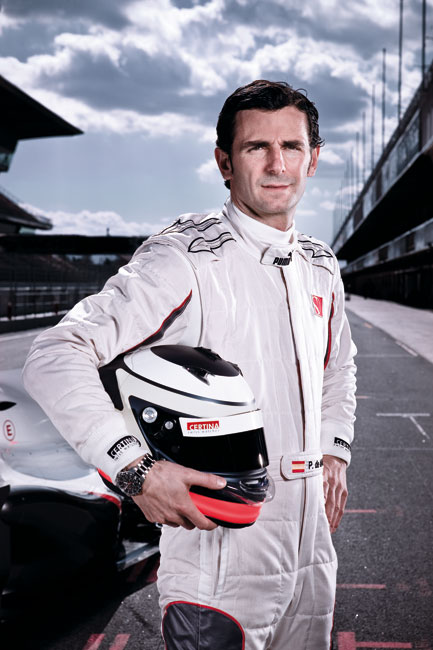
A pose from de la Rosa at the start of the year. © http://www.pedrodelarosa.com
As has been in the news since this morning, Spanish Formula 1 driver Pedro de la Rosa has been dropped from the Sauber team following Sunday’s Italian Grand Prix at Monza – he has been replaced by Nick Heidfeld. It has been a difficult year for the veteran – the 39-year-old has only had one points score in a season blighted by poor reliability and poor pace, while team mate Kamui Kobayashi has achieved several top ten finishes.
But what next for de la Rosa? At 39, he is hardly a spring chicken in terms of Formula 1 and as the 2011 season draws ever closer, seats are getting more difficult to come by. Should he obtain a drive, it may cost him a lot in sponsorship; realistically with this sudden dropping, Formula 1 may have seen the last of Pedro.
It has been a patchy road from his humble beginnings at Arrows, where he scored a hard fought point on his début at the Australian Grand Prix to Jaguar Racing – a team at which virtually every driver struggled for results. The end of the 2002 season saw both de la Rosa and Jaguar team mate Eddie Irvine without drives – with no other seats available, de la Rosa joined McLaren as a test driver and Irvine retired from the sport.
For several years, de la Rosa sat on the sidelines with the British team, conducting the occasional test; although he did replace the injured Juan-Pablo Montoya for the Bahrain Grand Prix in 2005.
De la Rosa returned to the McLaren seat one year later, when he replaced the NASCAR bound Montoya following the race at Indianapolis. During this time, the Spaniard picked up the only podium of his career, finishing 2nd to Jenson Button’s Honda at the Hungarian Grand Prix, however at the end of the year, he returned to his testing duties.
In this time, testing was banned, leaving many reserve drivers with little to do; however with less on track time, drivers have been utilising simulators on a more regular basis. De la Rosa was heavily criticised during 2007 for taking part in McLaren’s spy scandal that saw the team fined $100 million. After two further years working on simulators, de la Rosa joined Sauber.
Any potential team owners will most likely look at results and drive before they choose someone for their seat and at times, de la Rosa has come across somewhat lost and lacking enthusiasm on television.
This was certainly not the way anyone wants to lose their seat, especially if it ends their career. Let’s hope he can find success – I wish him all the best in the future.

Monza track map. © FIA
2010 Italian Grand Prix
Coming into the 2010 Italian Grand Prix, it looked as if the title battle was down to just Mark Webber and Lewis Hamilton. However, once the chequered flag dropped at Monza, the five-way battle had once again reopened as Fernando Alonso, Jenson Button and Sebastian Vettel pulled themselves back into contention with some stunning drives.
For the most part, it was a fantastic race too. The moment Button, in his silver and red McLaren carefully nudged ahead of Alonso’s all-red Ferrari into the Prima Variante chicane, the battle was on. The McLaren – running a higher downforce setting for cornering stability – had the lead, but was instantly under attack from the low downforce Ferrari, tailored for higher top speed.
Behind them, the second Ferrari got off to a decent start as Felipe Massa limply challenged Alonso into the first turn before letting the Spaniard get away. Lewis Hamilton was not quite as gentle when plying Massa with pressure – on approaching the second chicane on the opening lap, the 2008 World Champion went for a gap that didn’t exist and he clattered Massa as a result. With a broken steering arm and damaged suspension, Hamilton was out on the spot. Massa, still 3rd, carried on regardless.
Button was also on the receiving end a Ferrari-styled thump after losing part of his rear wing endplate to Alonso’s nosecone.
The other title challenges also had a poor opening lap – Webber started 4th and was 9th at the end of lap 1, while Vettel slipped from 6th to 7th in the opening three miles. With the Red Bull’s down the order, it was Nico Rosberg (Mercedes – 4th), Robert Kubica (Renault – 5th) and Nico Hulkenberg (Williams – 6th) that filled out the rest of the top six spots early on.
As Alonso continued to push Button hard, looking for any opportunity to get by the reigning Champion, Webber was finding things less difficult – the hard charging Australian made a move down the inside of Michael Schumacher into the first corner on the 6th lap and began chasing after his team mate.
Sadly things were not quite so rosy for Sauber or Force India – Kamui Kobayashi had originally qualified 13th in his Ferrari-powered Sauber, but a gearbox failure pre-race saw him retire early on. At Force India, Adrian Sutil had a decent start, but suffered an off prompting the German to change to the harder Bridgestone tyre at the end of the third lap. Sutil would soon pick off the backmarkers with Lucas di Grassi falling by the wayside first, followed by Sakon Yamamoto (lap 12), Heikki Kovalainen (lap 17) and Timo Glock (lap 18) for 17th position.
His team mate Vitantonio Liuzzi required an engine change pre-race and had a good start, jumping from 19th to 13th in the opening tour. Liuzzi would make that 12th with a pass on the second Sauber of Pedro de la Rosa ten laps later.
While the Ferrari’s and McLaren surged ahead, Hispania’s Bruno Senna must be wondering what such a car feels like, as his morbidly slow Dallara pulled off at the second Lesmo corner on the 13th lap with another hydraulic failure. The Italian Grand Prix may rank as a new low for the Spanish squad – this represented the fifth time over the weekend that Senna’s car had broken down; a shocking statistic, even for Hispania.
Thankfully, Yamamoto in the second Hispania wasn’t doing too badly. The oft-derided Japanese driver found himself in 19th in the opening stint and was running ahead of di Grassi’s Virgin. In fact, despite having a Monaco-spec rear wing, Yamamoto was actually running faster than di Grassi during the first-third of the race – a fact that the young Brazilian will not like to be reminded of.
Yamamoto may have been running fast, but Alonso, Button and Massa were faster – much faster. Alonso continued to harass Button – the gap between the pair rarely more than 1.5 seconds and often around 0.7 of-a-second as they crossed the line, with Massa stalking not far behind. In fact the leading trio busied themselves setting fastest laps each time around the famous Monza track; the gaps shrinking and growing with alarming elasticity. Yet none of the leaders could still make the decisive move.
While Alonso kept to lines and stayed on the right side of the rules, Jaime Alguersuari ignored such formalities. Having pitted on lap 16, Alguersuari found himself in a battle with the Lotus of Jarno Trulli three laps later; he cleanly jumped the first corner while attacking for 17th position – it did not take long for the stewards to react and the Toro Rosso driver found himself slapped with a drive through penalty. The Spaniard was somewhat miffed afterwards claiming that “…at the moment, I don’t really understand why I got the drive-through penalty. As far as I’m concerned (…) I did not gain an advantage…”
The stewards, however, disagreed.
Mark Webber was rather more clean with his overtaking, although the Australian had a little help. Still chasing his team mate on lap 21, Vettel suddenly slowed while exiting the Ascari chicane with what initially sounded like a sick engine – it cost the German nearly three seconds and 7th place. It was soon discovered that his brakes had stayed on lock after the corner, slowing Vettel and straining his Renault power unit as he accelerated and broke at the same time. Vettel was back on power almost as soon as the brake released itself.
Vettel’s scare was nothing compared to the panic in Hispania Racing’s pitbox. On lap 25, Sakon Yamamoto made his one and only stop, yet as the 28-year-old was signalled to leave his stall, a radio mechanic was still working on the car, slightly to the rear of the driver. The mechanic, caught unaware, was taken down by the speeding car and clouted heavily by the rear wing – within moments, an ambulance had arrived to whisk the mechanic away.
At this stage, I have heard that the mechanic suffered no serious injuries, but is being held in hospital for observation. The team would later be fined $20,000 for an unsafe release of its driver. With the ambulance present, the pitlane remained closed for a few minutes, reopening on lap 31.
One of the first to take advantage was Robert Kubica. The Renault driver had spent much of the race running in a solid 5th position between the two Nico’s (Rosberg 4th and Hulkenberg 6th). Sadly for the Pole, his stop was not as smooth as it should have been; trouble changing the front tyres resulted in him dropping back – when both Rosberg and Webber pitted two laps later, the Mercedes driver beat Kubica out, but Kubica just nudged ahead of Webber into the first turn.
Hulkenberg made for new tyres on lap 37 and also got out ahead of the Renault driver – in fact, Kubica had to get out of the throttle to avoid an accident with the Williams driver in the first chicane. It was enough to give Webber some good momentum and the Red Bull driver pushed by the Renault man at the Variante della Roggia to swipe 7th position. In the meantime, Sebastian Vettel stayed out and jumped this entire group.
Lap 37 was also hugely significant for Jenson Button. Having received the message that his stop was coming, the McLaren driver put his foot down and set some impressive times – only for the Ferrari pair to match and occasionally beat the McLaren. Even after two-thirds of the race, the top-three were only separated by three seconds, with Alonso still on Button’s tail. It was make or break for the leading trio and come 37, Button pitted first.
The reigning Champion rejoined to a clear track in 3rd, but the following tour by Fernando Alonso was simply mesmerising. Leaving nothing to spare, the Spaniard got everything just right on his in lap and with the gap less than one second, it would be game changer. The Ferrari driver pulled in one lap later and with a clean tyre change, rejoined the circuit mere feet ahead of Button’s McLaren.
The pair fiercely tackled at the opening corner wheel-to-wheel, but there was no way through for the Englishman. A further attempt at the Variante della Roggia would also yield no success – with his Bridgestone’s now up to temperature, this was Alonso’s race.
The game had still yet to finish for Felipe Massa. While the race contenders pitted, the Brazilian stepped up a gear, eventually pitting on lap 39 – sadly for Massa, despite some very quick times, the gap to Button was simply too great to make up as he emerged back into 3rd position; however the distance to the McLaren had been halved.
One could say that while Alonso’s defence of his newly found lead was “sturdy”, Nico Hulkenberg’s was simply overboard. The young Williams driver was under deep pressure from Mark Webber, with his 6th position was under threat from the Australian. Following his poor start, this was damage-limitation Mark Webber on track during the race and the urgency to get passed the German rookie was more than apparent.
So much so, that mistakes began to creep into Hulkenberg’s racecraft – the occasional locked wheel was eventually matched by the 23-year-old jumping the Rettifilo twice as he defended. For an unknown reason, Hulkenberg was not punished by the stewards for his indiscretions.
This chicane hopping gave Webber some free air behind the Williams and it allowed the Australian to set the (at the time) fastest lap of the race, as Hulkenberg surged into an ill-gotten lead. It was a pace that Webber had struggled to set all weekend long, yet on lap 46, he managed it. Several more fast laps brought the Red Bull driver back up to the tail of Hulkenberg again by the 48th tour – this time Hulkenberg made another mistake, as he again cut the second chicane and swiped across the front of Webber, nearly wiping out the nose of the Red Bull in the process.
It was yet another ridiculous move from the young German, however it still was not enough to garner a penalty. Webber was frustrated by the lack of action against Hulkenberg, deeming that “…he spent every second lap going through the chicanes. The stewards did a hard job on him… they left him alone, so that was interesting…”
With Hulkenberg getting more and more ragged in his defence, Webber was finally able to pass the Williams a lap later and grab 6th; however with only four laps remaining and Rosberg a long way up the road, it would be as good as the Australian could manage. Hulkenberg maintained his 7th spot, but spent the remaining tours under the watchful of Robert Kubica – unfortunately for the Pole, there simply was not enough time to make a difference.
Hulkenberg was not the only driver to lose a spot at this late stage, however for Jarno Trulli, his problem was somewhat more terminal. His Lotus spent much of the race struggling due to a failing gearbox and with only a short distance remaining, the Italian pulled off on the start/finish straight while in 20th place – his day done.
The Lotus team was announced a year to the day, so a great shame that the team were unable to celebrate the anniversary with a double-finish.
With the front three now settled as the race hit its final moments (Alonso leading Button by 3 seconds and Button 2 seconds ahead of Massa), Sebastian Vettel still held on to 4th place. In what may be one of the cleverest strategic moves of the year, the German was left out until the penultimate lap, finally pitting with just over three miles to go.
As others behind him pitted much earlier and battled amongst themselves thereafter, Vettel stayed out and continued to register some very good lap times, to the point where he had secured a 25-second gap over 5th place Rosberg. Vettel – changing to the obligatory soft tyres – had more than enough of space ahead of Rosberg to keep his 4th place; a wonderful result for the 23-year-old and a brilliant strategy employed by the Red Bull team, especially considering Vettel’s poor start. A series of stellar laps when in clear air helped the young German jump Rosberg, Kubica and Hulkenberg in one swift move.
As for Alonso, he played it perfectly – the only blip on his Italian Grand Prix record being a chicane hop when lapping Pedro de la Rosa with two laps remaining. The mistake cost him one second, but his gap over Button was enough for him to not worry too much – in fact, Alonso followed it up with the fastest lap of the race on the penultimate run.
Just over three miles later, the Spaniard in Italian red crossed the finish line to roars of manic approval from a fanatical Tifosi. Incredibly, this was Ferrari’s first victory at Monza since 2006 and it was a truly marvellous drive by Alonso to take that win by just 2.9 seconds. Alonso was pragmatic in his post race account, saying that “…the pitstop was superb…” – while it may have been key in getting him ahead of Button, but it would be foolish to ignore his own stellar efforts. It is a victory will have endeared the fiery Spaniard to the Italian fans for years to come.
Realistically, the soft tyres had been lasting so unbelievably well in the race that it was purely a waiting exercise for Ferrari – even if Button had waited an extra ten laps, the red-team would have still just pitted one lap later in order to try for the lead.
Runner-up Button oozed quality too after his race-long battle – the Englishman remains determined to retain his crown and although an element points collection creeped into his late race performance, he still had enough to hold station ahead Felipe Massa in 3rd. This result was enough to bring both Alonso and Button back into the title hunt, but Sebastian Vettel’s 4th place reinvigorated his title hopes as well.
Nico Rosberg’s 5th place was enough to jump Robert Kubica in the standings – Rosberg had a solid if unspectacular race, but is proving himself to be one of the best of the rest when the occasion fits. Kubica crossed the line in 8th after also having a quite race – sadly for the Pole, he could not regain ground lost in the pitlane in the second-half of the race.
Ahead of Kubica were embattled pair of Mark Webber (6th) and Nico Hulkenberg (7th). Webber was indeed disappointed after the race, as he lamented missed opportunities and potential lost points – despite retaking the lead in the Championship, there could have been much more there for the Australian had he not got stuck behind the Rosberg, Kubica and Hulkenberg following his poor start. Despite his often ragged style, it was a good race for Hulkenberg – solid points for the young man should be good to keep the young man in good stead with English team.
Michael Schumacher secured a double-points finish for Mercedes with a solid 9th and two points at Monza, although he was some 10 seconds adrift of Kubica and the battle that entailed as he faded during the race. Rubens Barrichello picked up the final point at the scene of his last win one year ago. This was the first race of the year where the veteran was truly beaten by Hulkenberg, his younger team mate; however he still has a good lead over the rookie in the points standings.
Sebastien Buemi (11th) and Vitantonio Liuzzi (12th) crossed the line less than two seconds behind Barrichello, but it was not enough to a garner points reward for the pair. Vitaly Petrov secured 13th spot after an unremarkable weekend; he will need to improve on this performance should he wish to be retained at Renault.
Pedro de la Rosa (14th), Jaime Alguersuari (15th) and Adrian Sutil (16th) all finished one lap down and rounded off somewhat indifferent days for their respective teams, while the final three finishing drivers were from the new squads as Timo Glock (17th), Heikki Kovalainen (18th) and Sakon Yamamoto (19th) all finished two laps down.
While the battle between Lotus and Virgin continues, it must be pointed out that this was easily Yamamoto’s best performance in his Formula 1 career, having spent much of the race doing battle with (and beating) the Virgin of Lucas di Grassi. The Brazilian rookie actually retired on the final lap with a suspension problem and although classified, he would join Jarno Trulli, Bruno Senna, Lewis Hamilton and Kamui Kobayashi on the non-finishers list.
There may be some that will lament the lack of overtaking during this years Italian Grand Prix, but I see this a little differently – for much of this race, we witnessed a startlingly close battle between two of the fastest drivers in the world in two of the fastest racing cars in the world.
For so long, this really was a tense battle as Jenson Button and Fernando Alonso were neck-and-neck around the famed Italian circuit – and with that, one of the most competitive seasons in the history of Formula 1 continues to get better.
Race Rating: 4 out of 5
——–
Monza, Italian Grand Prix (Round 14, September 12th)
1 ALONSO Ferrari 1h16m24.6s (53 laps)
2 BUTTON McLaren +2.9s
3 MASSA Ferrari +4.2s
4 VETTEL Red Bull +28.2s
5 ROSBERG Mercedes +29.9s
6 WEBBER Red Bull +31.3s
7 HULKENBERG Williams +32.8s
8 KUBICA Renault +34.0s
9 SCHUMACHER Mercedes +44.9s
10 BARRICHELLO Williams +64.2s
11 BUEMI Toro Rosso +65.1s
12 LIUZZI Force India +66.1s
13 PETROV Renault +78.9s
14 DE LA ROSA Sauber +1 lap
15 ALGUERSUARI Toro Rosso +1 lap
16 SUTIL Force India +1 lap
17 GLOCK Virgin +2 laps
18 KOVALAINEN Lotus +2 laps
19 YAMAMOTO HRT +2 laps
R DI GRASSI Virgin +3 laps
R TRULLI Lotus +7 laps
R SENNA HRT +42 laps
R HAMILTON McLaren +53 laps
R KOBAYASHI Sauber +53 laps
| Driver | Team | Points |
|---|---|---|
| 1. Mark Webber | Red Bull Racing | 187 |
| 2. Lewis Hamilton | McLaren | 182 |
| 3. Fernando Alonso | Ferrari | 166 |
| 4. Jenson Button | McLaren | 165 |
| 5. Sebastian Vettel | Red Bull Racing | 163 |
| 6. Felipe Massa | Ferrari | 124 |
| 7. Nico Rosberg | Mercedes GP | 112 |
| 8. Robert Kubica | Renault | 108 |
| 9. Michael Schumacher | Mercedes GP | 46 |
| 10. Adrian Sutil | Force India | 45 |
| 11. Rubens Barrichello | Williams | 31 |
| 12. Kamui Kobayashi | Sauber | 21 |
| 13. Vitaly Petrov | Renault | 19 |
| 14. Nico Hulkenberg | Williams | 16 |
| 15. Vitantonio Liuzzi | Force India | 13 |
| 16. Sebastien Buemi | Scuderia Toro Rosso | 7 |
| 17. Pedro de la Rosa | Sauber | 6 |
| 18. Jaime Alguersuari | Scuderia Toro Rosso | 3 |
| Constructor Team | Points |
|---|---|
| 1. Red Bull Racing | 350 |
| 2. McLaren | 347 |
| 3. Ferrari | 290 |
| 4. Mercedes GP | 158 |
| 5. Renault | 127 |
| 6. Force India | 58 |
| 7. Williams | 47 |
| 8. Sauber | 27 |
| 9. Scuderia Toro Rosso | 10 |
When Karl Jochen Rindt’s Lotus 72 ploughed head-on into the guardrail at Monza’s fast, sweeping Parabolica on September 5th, 1970, motor racing was robbed of one of its most outstanding talents.
At 28, the exuberant Austrian was to become Formula 1’s first – and thankfully only – posthumous world Champion.
Youthful Hedonism
Born in the city of Mainz in Germany in April 1942, both of Rindt’s parents were killed in an allied bombing raid at the tail end of the following year and the young boy was eventually raised by his grandparents in Graz, southern-Austria.
While young, he was hedonistic and passionate; abrasive and defiant. With vast amounts of determination, the youthful Rindt threw himself into what would be known today as ‘extreme sports’ and did so with a vigour rarely matched by his peers.
Imbued with a love for speed and danger, The thrill-seeker initially started out a skier, but to moped racing and later motocross when he twice broke limbs in skiing accidents. In competition, the teenager often won – or crashed trying to do so.
His grandparents would eventually send the Austrian teenager to England to pick up both the language and modicum of disciple, yet while Rindt picked up the language with some ease, discipline was somewhat harder to come by. Time at school was often broken up with several suspensions and expulsions.
Rindt was abrupt and (often) unkempt and while these may have not gone down well in his days in private schooling, to generation of motorsport fans, he would become something of a rock star.
In these early years, Rindt found a friend in future Formula 1 driver and Red Bull man Helmut Marko and together the pair would venture into the world of fast cars.
Like many racing drivers, both Rindt and Marko would at times find himself in trouble with the police as they drove like men possessed in the midst of regular road goers, many of whom had something of a slightly higher sense of self preservation.
That Rindt found himself based rather close to Goodwood racing circuit, was enough to ignite the passion for motor racing.
Outings Amongst the Wreckage
With his hero, Wolfgang von Trips leading the charge at Ferrari during the 1961 World Championship, Rindt made his initial steps into four-wheel motorsports – first in touring cars, and later in single seaters.
Just like his time in motocross, the determined Austrian was fast; winning occasionally, crashing a lot, many times waking to find himself in hospital. When von Trips was killed at a tragic accident at the 1961 Italian Grand Prix, Rindt’s resolve was only strengthened. Having finally received his inheritance at the age of 18, he splashed out on a Simca Montlhéry and began racing his new toy in various events.
Soon, he moved over to Giuliette TI and began to dominate hill climbing events. Determined to move into the world of single-seaters, he picked up an old Cooper T59 machine and quickly secured pole positions and race wins in the Italian Formula Junior Championship against more established drivers.
Heavily motivated to press on, Rindt bought a Formula 2 Brabham machine for £4,000, where the then unknown-Austrian beat Graham Hill, Denis Hulme and Jim Clark at London’s Crystal Palace in only his second outing. If victory against the stars of Formula 1 wasn’t enough to garner plaudits, the oft manic, sideways style of driving certainly earned him many fans.
This would be enough to earn Rindt the support of Ford Austria through the 1964 Formula 2 season, during which he also made a one-off entry in that year’s Austrian Grand Prix at Zeltweg Airfield, racing Rob Walker’s privately entered Brabham – he ran near the rear of the field and would retire with steering issues on the 58th lap.
Rindt signed to Cooper at the start of 1965 for three seasons, securing third place in the championship in 1966 behind the dominant Jack Brabham and series runner-up John Surtees. Yet Rindt was not happy with just Formula 1 opportunities; he was to run the 1964 Le Mans 24 Hours in a NART / Ferrari effort, but sadly the car broke early due to a burst oil pipe with David Piper at the wheel.
The Austrian triumphed a year later at the marquee event alongside the American Masten Gregory in another Ferrari 250LM entry – it was to be Ferrari’s last success at Le Mans. Although Rindt had yet to claim a Grand Prix, the Austrian had laid down his marker.
Success and Failures
In fact, the mid-1960’s was a very busy time for Rindt – on occasion, he would also compete in sportscar endurance races taking a podium at the Nurburgring 1,000 km race with Jo Bonnier, while also taking part at the 1,000 km event at Monza with Gerhard Mitter.
Aligned with his improving Formula 1 driving, Rindt was proving to be a handful in Formula 2 as well as he took win after win and eventually took the British Formula 2 title by a huge margin in 1967.
The year would also see him make his début at the Indianapolis 500 in one of Dan Gurney’s Eagle machines; however he retired with a broken valve at just over half distance. He returned to the race a year later with Brabham, but this time only lasted for five laps until a piston failure sidelined his entry.
Indianapolis was not the only venue where Rindt suffered reliability issues – in fact he left Cooper at the end of the 1967 season after it proved to be quite a disappointment; his Maserati-powered machine retired in 8 out of 10 races, although the Austrian secured two fourth place finishes (Belgium and Italy) when the car did actually finish.
It was during his last year at Cooper that Rindt finally found a touch of stability in his life when he married glamourous Finnish model, Nina Lincoln. That stability would not last in his driving career though, as he signed for Brabham for 1968.
Things improved mildly as Rindt scored 3rd position twice; however these were his only results he retired on ten different occasions in the twelve race season. The Austrian would only stay with Brabham for a single season and in 1969, Rindt was to partner Graham Hill at Team Lotus.
1969 was a key season for Colin Chapman’s team. Although Hill had taken his second title with the squad the previous year, there was still some fragility following the death of Jim Clark at Germany’s Hockenheimring early in the year.
Rindt was fully aware of the speed and competitiveness of the Chapman / Maurice Philippe Lotus 49; however concerns over the safety features of the car, made the Austrian unsure as to whether he wanted to make the jump. Eventually Rindt put his pen to paper when convinced by close friend Bernie Ecclestone that it was the car he needed to take the title.
Taking the ‘Glen
Although Jackie Stewart secured his first Championship with his Tyrrell-Matra, Rindt finally won his first Grand Prix at the US Grand Prix at Watkins Glen – a race that was marred by accident to Graham Hill that left the famous Briton severely injured. Until that point, Rindt had showed that he was quicker than his double-World Champion team mate and this showed itself with some stellar, including two further podiums at Monza and Canada’s Mosport Park.
The initial year with Lotus had not been without controversy – while leading the Spanish Grand Prix at Montjuic Park, the high rear wing collapsed pitching him into the wrecked Lotus of his already retired team mate. Hill’s Lotus had actually retired for the same reason, but unlike Rindt, Hill emerged with only a few scrapes – the Austrian, however, broke his jaw and suffered a concussion in the accident, leading him to be publicly critical of Chapman’s designs.
Due to these injuries, Rindt was forced to miss the next race at Monaco. It was because of these (and other) accidents, that the heightened wings would soon be banned from the sport.
Over the course of the year, Rindt had done enough to assume fourth in the standings, but not without much frustration – the fragility of the Lotus machine reared its head on a regular basis and it was not be until the British Grand Prix in mid-July, that Rindt finally saw the chequered flag. Throughout the year, the Austrian had taken five pole positions – it was clear the speed was there, but the results were not following through.
With Lotus, he had even made the journey Indianapolis for his third attempt at the great 500-mile race, but was withdrawn the team suffered a continuous steering problem. Out of team with Rindt, Graham Hill and Mario Andretti, only Andretti made the start (in the team’s back-up HAWK chassis) and the Italian-American went on to take his only Indy 500 win.
Wherever he went, unreliability seemed to follow.
Lost Friends
As the seventies dawned, it appeared as if Rindt was looking at a repeat of 1969. The season opened in South Africa’s Kyalami circuit at the beginning of March, but after qualifying a promising 4th in the now-ageing Lotus 49, the promising 27-year-old retired with a blown engine.
Chapman – aware that the bar had been risen – initially drew up the woeful Lotus 66 (so poor in fact, it was never used), before launching the Lotus 72. It did not have the most successful of beginnings – it’s début at Jarama for the Spanish Grand Prix saw it only lasting nine laps, before the ignition gave up.
The car had problems that needed to be looked at, but while this was being done, Rindt took back the 49 and promptly drove it a sensational victory at Monaco. The Austrian spent much of the race in 5th spot, before claiming 2nd through retirements and then busied himself reeling in Brabham – following a incredible charge, the Austrian was on the tail of the wily Brabham, who spun at the final corner while under pressure from the Lotus driver.
So fast was Rindt around the track, he managed to beat his qualifying time by over one-second in the race. An emotional Rindt had claimed a fantastic victory in the Principality and it is one that he is remembered for most.
Sadly for the Austrian, he would be emotional for very different reasons in the weeks that followed, when good friends Bruce McLaren and Pierce Courage were killed in accidents. While McLaren died in testing a CANAM car in the days leading up to the Belgian Grand Prix, Courage was killed during the Dutch Grand Prix itself – a race that Rindt would go on to claim in dominant fashion.
These deaths along with the very recent birth of his daughter Natasha had convinced the Austrian to give up motor racing at the end of the season.
Although the Lotus retired with another engine problem at Spa-Francorchamps, the Grand Prix at Zandvoort started a roll of success that would give Rindt the title. Lotus had showed up with a revised 72 in Belgium and in the four races after Spa-Francorchamps, the Austrian sailed to victory. At the end of the German Grand Prix, Rindt beat Jacky Ickx by only three-tenths of-a-second, but would later declare the 72 to be so good, that a monkey could win driving the car.
Fittingly, Rindt’s last race was in Austria, where his run of success came to an end with another blown engine. By now, he was 20 points clear of Brabham in the title hunt – only a miracle would take it away from him.
Tragedy at Monza
In the end, Rindt was not denied by a miracle, but by the Monza guardrail. During qualifying with the Ferrari’s up to 10 mph faster in the straights, he ran wingless in an attempt to garner as much speed as possible, leaving the Lotus prone to problems of instability.
As he approached the long final corner at the Italian circuit, Rindt dabbed on the brakes, only for the car to swerve violently in the opposite direction and speed toward the barriers. He was never fond of the clutch straps that came with the machinery of the day and often refused to wear them – the lack of protection he afforded himself would be his undoing.
The car hit the guardrail hard, with the Lotus digging beneath the Armco and Rindt slammed forward within the car as the front end crumpled into a horrific mess. After the car became entangled in the barrier, it was thrown back toward the circuit where it finally came to a rest. In the cockpit, the motionless Rindt had sliced his throat on his seat buckles – he would later be declared dead at a Milanese hospital.
First on the scene was Ecclestone, who would leave the scene clutching his good friend’s battered helmet and a torn shoe that was thrown from the wreckage. It would be declared that the accident was caused by a right front brakeshaft failure and the death caused by poorly installed barriers.
Come the end of the 1970 season, Rindt still led the standings by five points from the Ferrari of Ickx; despite a great end of year run, Ickx was denied by a poor start to the season, while Jack Brabham faded badly as the year wore on.
When Lotus protégé Emerson Fittipaldi won at Watkins Glen, the title was sealed for Rindt. Something that has added to Rindt’s ghostly image is the fact that he suffered his fatal accident at virtually the same spot as his hero Wolfgang von Trips nine years previously.
An edited version of this was first published last week on Grand Prix View and can be found here.
The latest issue of Grand Prix View. © vivaf1.com
The nice people over at VivaF1 recently started their very own e-magazine called Grand Prix View. The PDF covers everything from the latest news, titbits from Formula 1, technical information and feature articles – in fact the latest issue (which is actually only the second effort) features a guest piece from my very own self about the late Jochen Rindt (an extended version will appear here later on).
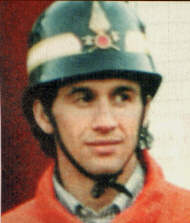
Paolo Ghislimbert. © Copyright unknown.
While many racing fans will speak of Ayrton Senna as the last fatality over a Grand Prix weekend, we must not forget those that died in accidents outside of the cockpit.
Friday September 10th signalled the tenth anniversary of the death of track marshal, Paolo Ghislimberti.
On the opening lap of the 2000 Italian Grand Prix at Monza, a mammoth crash occurred as the field approached the Variante della Roggia chicane.
As the field bunched-up, the two Jordan’s of Jarno Trulli and Heinz-Harald Frentzen collided with each other, before collecting Ruben’s Barrichello in his Ferrari and the McLaren of David Coulthard.
As that accident reached its conclusion, Pedro de la Rosa – blinded by the gravel dust – smashed into the back of Johnny Herbert (Jaguar), launching the Arrows high into the air and into a violent barrel-roll. Upon landing, de la Rosa found himself planted precariously inbetween Barrichello and Coulthard. For the drivers, it was a terrifying accident and a very, very near miss.
Sadly for Ghislimberti, the marshal was struck by Frentzen’s right rear tyre as it flew through the air at high speed. In the meantime, the safety car was brought out while Ghislimberti received trackside treatment – a move that drew much criticism after the race, with Coulthard extremely vocal that the event should have been stopped. The accident led to adoption of wheel tethers in Formula 1, which had been introduced in CART a year earlier.
Less than six months later another track marshal, Graham Beveridge, was killed by a flying wheel from Jacques Villeneuve’s BAR at the beginning of the 2001 Australian Grand Prix. Following this, the wheel tethers were strengthened further and barring some incredibly unusual accidents (Sebastien Buemi during practice at this year’s Chinese Grand Prix comes to mind), the tethers have worked extremely well.
It must be remembered that without marshal’s, motorsport cannot possibly exist. Without their help and expertise, no circuit racing could take place anywhere – regardless of whether that marshal is just there to wave flags or whether their job is to stabilise a situation until medical help arrives.
The loss of Ghislimberti, Beveridge and other marshals at this rather unglamorous end of motorsport must not be forgotten and should be remembered as keenly as lost drivers of time passed. It is their efforts that make this sport possible.
Whomever the lovely gentlemen is, we – the people – thank you.
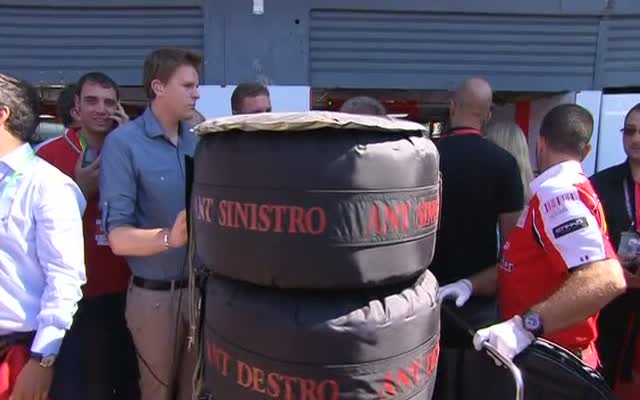
A Ferrari mechanic blotting out Eddie Jordan's latest rant. © BBC

Monza track map. © FIA
Free Practice 3
Once again, McLaren decided to split their cars with regards to downforce strategy as Jenson Button held onto the F-Duct and a high downforce set-up, while Lewis Hamilton retained his skinny rear wing set up. At the end of practice, Hamilton was the faster of the two and indeed fastest overall, with Button lagging with 5th best time and a gap of 0.2 of-a-second.
Both Red Bull’s ran well, with Sebastian Vettel setting the 2nd fastest time just ahead of Ferrari’s Fernando Alonso – something that was not anticipated at this low-downforce track. Vettel’s team mate, Mark Webber stopped at the Prima Variante chicane after 40 minutes with an airbox fire, which resulted in a cut engine – it was becoming a difficult weekend for the Australian who finished the session with the 7th best time, just slower that Nico Rosberg’s Mercedes.
Felipe Massa registered the 4th best time, but only after he had an off at the first Lesmo corner, kicking up the dust, but not causing any damage to his red machine. Jaime Alguersuari had a similar off to Massa at the second Lesmo; his Toro Rosso went wide and slid into the dusty gravel trap – the Spaniard pulled in mired down in 15th.
Following a disastrous Friday, both the Hispania machines finally got some decent running, but were still slowest of all the runners.
Qualifying
Under the glare of the Tifosi, Ferrari driver Fernando Alonso secured the 19th pole position of his career. With the fastest lap of the entire weekend (1:21.962), the Spaniard nudged Jenson Button to the top spot by just over one-tenth of-a-second.
Button – who was running the F-Duct with a high downforce wing set-up – found himself sandwiched by red cars as Felipe Massa slotted his Ferrari into 3rd. Massa will joined by the leading Red Bull of Mark Webber. Indeed this is the first time a Red Bull has not been on the front row since the 2009 Italian Grand Prix.
It was an excellent time by Webber, who has struggled all weekend with poor reliability. He’ll be hoping to stay ahead of Championship rivals Lewis Hamilton and Sebastian Vettel tomorrow as they start from 5th and 6th respectively.
The top 10 was filled out by the leading Mercedes driven by Nico Rosberg, while Nico Hulkenberg (8th) and Rubens Barrichello (10th) squeezed the Renault of Robert Kubica (9th).
The second session confirmed something of a disappointing session for the Force India’s as Adrian Sutil (11th) just lost out to Rosberg and Barrichello for the last slot into Q3. That disappointment will be nothing compared to the pressure faced by Michael Schumacher – the great German won on his last visit to Monza in 2006; however he will start the race from the sixth row, alongside Sutil.
Kamui Kobayashi was the fastest of the Sauber’s in 13th, with team mate Pedro de la Rosa in 17th. The Swiss team sandwiched both Toro Rosso’s (Sebastien Buemi (14th) and Jaime Alguersuari (15th)). Vitaly Petrov had originally qualified in 15th, but was later penalised five places for blocking Timo Glock in the first session.
Vitantonio Liuzzi was the biggest loser in Q1 – his Force India lost engine power during the run, leaving the Italian to start in 19th position. Ahead of him were both Lotus’, headed by Jarno Trulli. It was not a good qualifying session for Timo Glock – apart from the Petrov block, he later picked up a grid penalty for changing his gearbox, leaving him firmly in last place behind the Hispania duo.
Italy, Qualifying (September 11th)
1 ALONSO Ferrari 1m21.962s
2 BUTTON McLaren 1m22.084s
3 MASSA Ferrari 1m22.293s
4 WEBBER Red Bull 1m22.433s
5 HAMILTON McLaren 1m22.623s
6 VETTEL Red Bull 1m22.675s
7 ROSBERG Mercedes 1m23.027s
8 HULKENBERG Williams 1m23.037s
9 KUBICA Renault 1m23.039s
10 BARRICHELLO Williams 1m23.328s
11 SUTIL Force India 1m23.199s
12 SCHUMACHER Mercedes 1m23.388s
13 KOBAYASHI Sauber 1m23.659s
14 BUEMI Toro Rosso 1m23.681s
15 ALGUERSUARI Toro Rosso 1m23.919s
16 DE LA ROSA Sauber 1m24.044s
17 TRULLI Lotus 1m25.540s
18 KOVALAINEN Lotus 1m25.742s
19 LIUZZI Force India 1m25.774s
20 PETROV Renault 1m23.819s (* 5-place penalty for blocking Glock)
21 DI GRASSI Virgin 1m25.974s
22 SENNA HRT 1m26.847s
23 YAMAMOTO HRT 1m27.020s
24 GLOCK Virgin 1m25.934s (** 5-place penalty for a gearbox change)
Italy, 3rd Free Practice (September 11th)
1 HAMILTON McLaren 1m22.498s
2 VETTEL Red Bull 1m22.545s
3 ALONSO Ferrari 1m22.644s
4 MASSA Ferrari 1m22.648s
5 BUTTON McLaren 1m22.724s
6 ROSBERG Mercedes 1m22.946s
7 WEBBER Red Bull 1m23.082s
8 HULKENBERG Williams 1m23.129s
9 KUBICA Renault 1m23.209s
10 SUTIL Force India 1m23.303s
11 BARRICHELLO Williams 1m23.450s
12 BUEMI Toro Rosso 1m23.673s
13 SCHUMACHER Mercedes 1m23.896s
14 KOBAYASHI Sauber 1m23.908s
15 ALGUERSUARI Toro Rosso 1m23.909s
16 PETROV Renault 1m23.967s
17 DE LA ROSA Sauber 1m24.191s
18 LIUZZI Force India 1m24.439s
19 TRULLI Lotus 1m25.788s
20 KOVALAINEN Lotus 1m25.925s
21 GLOCK Virgin 1m26.434s
22 DI GRASSI Virgin 1m26.682s
23 SENNA HRT 1m27.471s
24 YAMAMOTO HRT 1m28.730s

Monza track map. © FIA
Free Practice 1
A bright and sunny morning at Monza welcomed the final European weekend of the season – it also saw the introduction of updates on several cars, specifically for the fast Italian track.
McLaren brought two rear winds; one with large Spa-Francorchamps settings connecting to their F-Duct and another rear wing with smaller elements. The British team also installed a sturdier undertray to pass new FIA tests. Renault also delivered two types of rear wing as they continue to test their new F-Duct system. Most teams are, as expected, running smaller rear wing elements for pre straight-line speed.
Rubens Barrichello wasn’t caught out by the kerbs, but was sidelined half way through first practice with an input-shaft failure, a problem that also affected the early session for both Lotus entries. A brake fluid leak had Bruno Senna’s Hispania parked for much of the opening practice – Senna eventually made it out, before pulling off circuit with yet another car-related problem.
Paul di Resta took to Adrian Sutil’s Force India during the morning session and eventually set the 12th best time in the presence of cousin and IndyCar runner, Dario Franchitti.
Michael Schumacher posted the fastest time in early part of the session, but he was later displaced by the McLaren’s – first by Lewis Hamilton and later reigning Champion Jenson Button. The McLaren’s sandwiched Sebastian Vettel in his Red Bull – the top three headed Robert Kubica (Renault), Nico Rosberg (Mercedes) and Mark Webber (Red Bull), with Schumacher eventually coming away with the 10th fastest time.
Free Practice 2
Hamilton had the F-Duct removed and is going for a low-downforce, while Button held onto the high downforce settings – following a minor tweaks, Hamilton secured the 4th best time, just ahead of team mate Jenson Button. An hour into the session, Hamilton picked up damage to his right front wing end plate as the 2008 Champion hopped over a kerb, finishing his run early on.
Michael Schumacher found himself running quick early in the session – a little too quick perhaps; the 7-times World Champion was carrying far too much speed through the Parabolica, sliding into the gravel trap. Schumacher took a disappointing 14th fastest.
Felipe Massa ran wide at the Parabolica in far more dramatic fashion during a quick run – he was heading for the crash barrier, when a marvellous save by the Brazilian kept him out of harms way. Moments later, Alonso put in his fastest lap – good enough for 2nd on the sheets, while Massa (3rd) coasted the short distance to the pitlane.
Red Bull were not expected to run right at the top, but Vettel got in the way of that expectation by setting the fastest time of the day. Fellow Red Bull man Webber (6th) didn’t have as good a day as he pulled off the track at the first Lesmo with 20 minutes remaining – a loss of water pressure ending his Friday prematurely.
In the sister team, Toro Rosso’s Jaime Alguersuari also stopped out on track with a mechanical failure at a Variante della Roggia chicane. He claimed the 18th best time.
The Williams’ had a good afternoon run after morning difficulties with Barrichello leading Nico Hulkenberg in 7th and 9th places respectively, sandwiching Robert Kubica.
Bruno Senna had further problems with fuel pressure at the very beginning of the session – his car only got to the end of the pitlane exit, before grinding to a halt. The Brazilian rookie eventually got back out during the session, however his Hispania stopped with more problems after only a couple of laps. He took the Hispania out again a short while later, but the car broke again – Senna set no time. Sakon Yamamoto in the second Hispania, had his running cut short by a gearbox problem – his was last in both sessions.
Italy, 2nd Free Practice (September 10th)
1 VETTEL Red Bull 1m22.839s
2 ALONSO Ferrari 1m22.915s
3 MASSA Ferrari 1m23.061s
4 HAMILTON McLaren 1m23.154s
5 BUTTON McLaren 1m23.210s
6 WEBBER Red Bull 1m23.415s
7 BARRICHELLO McLaren 1m23.708s
8 KUBICA Renault 1m23.709s
9 HULKENBERG Williams 1m23.852s
10 ROSBERG Mercedes 1m23.857s
11 SUTIL Force India 1m24.181s
12 LIUZZI Force India 1m24.380s
13 PETROV Renault 1m24.407s
14 SCHUMACHER Mercedes 1m24.448s
15 BUEMI Toro Rosso 1m24.517s
16 DE LA ROSA Sauber 1m24.547s
17 KOBAYASHI Sauber 1m24.785s
18 ALGUERSUARI Toro Rosso 1m25.106s
19 TRULLI Lotus 1m26.204s
20 KOVALAINEN Lotus 1m26.306s
21 DI GRASSI Virgin 1m26.631s
22 GLOCK Virgin 1m26.676s
23 YAMAMOTO HRT 1m29.498s
24 SENNA HRT no time
Italy, 1st Free Practice (September 10th)
1 BUTTON McLaren 1m23.693s
2 VETTEL Red Bull 1m23.790s
3 HAMILTON McLaren 1m23.967s
4 KUBICA Renault 1m24.120s
5 ROSBERG Mercedes 1m24.129s
6 WEBBER Red Bull 1m24.446s
7 LIUZZI Force India 1m24.512s
8 ALONSO Ferrari 1m24.543s
9 MASSA Ferrari 1m24.648s
10 SCHUMACHER Mercedes 1m24.756s
11 HULKENBERG Williams 1m24.841s
12 DI RESTA Force India 1m24.923s
13 PETROV Renault 1m25.292s
14 BUEMI Toro Rosso 1m25.318s
15 DE LA ROSA Sauber 1m25.320s
16 KOBAYASHI Sauber 1m25.334s
17 ALGUERSUARI Toro Rosso 1m25.897s
18 GLOCK Virgin 1m26.772s
19 TRULLI Lotus 1m26.898s
20 DI GRASSI Virgin 1m26.956s
21 KOVALAINEN Lotus 1m27.374s
22 SENNA HRT 1m28.256s
23 BARRICHELLO Williams 1m28.516s
24 YAMAMOTO HRT 1m29.870s
The 2011 Formula 1 calendar was launched today at the World Motor Sports Council meeting in Paris and as thought, the series is up to twenty races. While it is quite nice to have a busy schedule, perhaps Formula 1 should also worry about the potential for overkill.
What is also quite perplexing is this drive for green initiatives, all the while putting more and more races on the calendar. Like music festivals that call themselves “green” when they are clearly not taking into account the cost of pollution fans bring, this is frankly absurd.
With all this in mind, last week it was announced that the 2013 regulations may be framed around turbo-charged I4 engine units, powered to around 650BHP. There is also some consideration to reintroducing ground effect aerodynamics – suddenly 1980 all over again; there’s an ongoing recession, the calamitous Tories are back in power after Labour failures and an Aussie is challenging for the title.
Once again, Bahrain opens next season, but on the original version of the track; meanwhile Brazil will conclude it. This was also the case last year, when the calendar was changed very late on meaning Abu Dhabi picked up the end of season finish.
It is absolutely right for the season to end in Brazil (as it was for it to finish in Japan and Australia in years gone by) – the race is always packed by somewhat mental Brazilian fans and the circuit is a fan and driver favourite too.
2011 Formula 1 Championship Season
March 13 Bahrain
March 27 Australia
April 10 Malaysia
April 17 China
May 8 Turkey
May 22 Spain
May 29 Monaco
June 12 Canada
June 26 Europe (Valencia)
July 10 Great Britain
July 24 Germany
July 31 Hungary
August 28 Belgium
September 11 Italy
September 25 Singapore
October 09 Japan
October 16 Korea
October 30 India*
November 13 Abu Dhabi
November 27 Brazil
* Subject to the homologation of the circuit
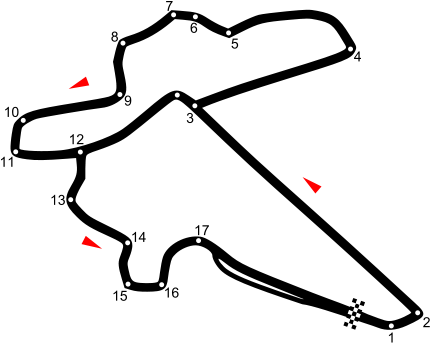
Layout of the Korean International Circuit. © Copyright unknown.
Over the weekend, sidelined Hispania Racing man, Karun Chandhok, took the Red Bull RB5 to the track at the grand opening of the new Korean Grand Prix circuit at Yeongam in South Jeolia.
There have been many worries over the web that the track may not be finished in time for the first race weekend (in six weeks), but Chandhok’s short run and pictures that he tweeted on Saturday show that the situation may not be a bad as previously feared.
While there were initial thoughts that the asphalt may degrade and break up, it appeared in fairly decent shape during the Red Bull laps; however it will only be when twenty-four Formula 1 cars hit the track in anger that the true strength of the track will be discovered.
Other than that, many of the circuit amenities seem to still need a lot of work, but when brand new tracks are constructed, it is not completely unusual for the track surroundings to be somewhat unfinished when the first events takes place – the 2008 European Grand Prix at Valencia was a very recent case.
As for the layout itself, it’s difficult to tell just how effective it will be based upon Chandhok’s run, although it does look quite intriguing. There are still too many corners though.
Yesterday, the video below of Chandhok’s laps was released.
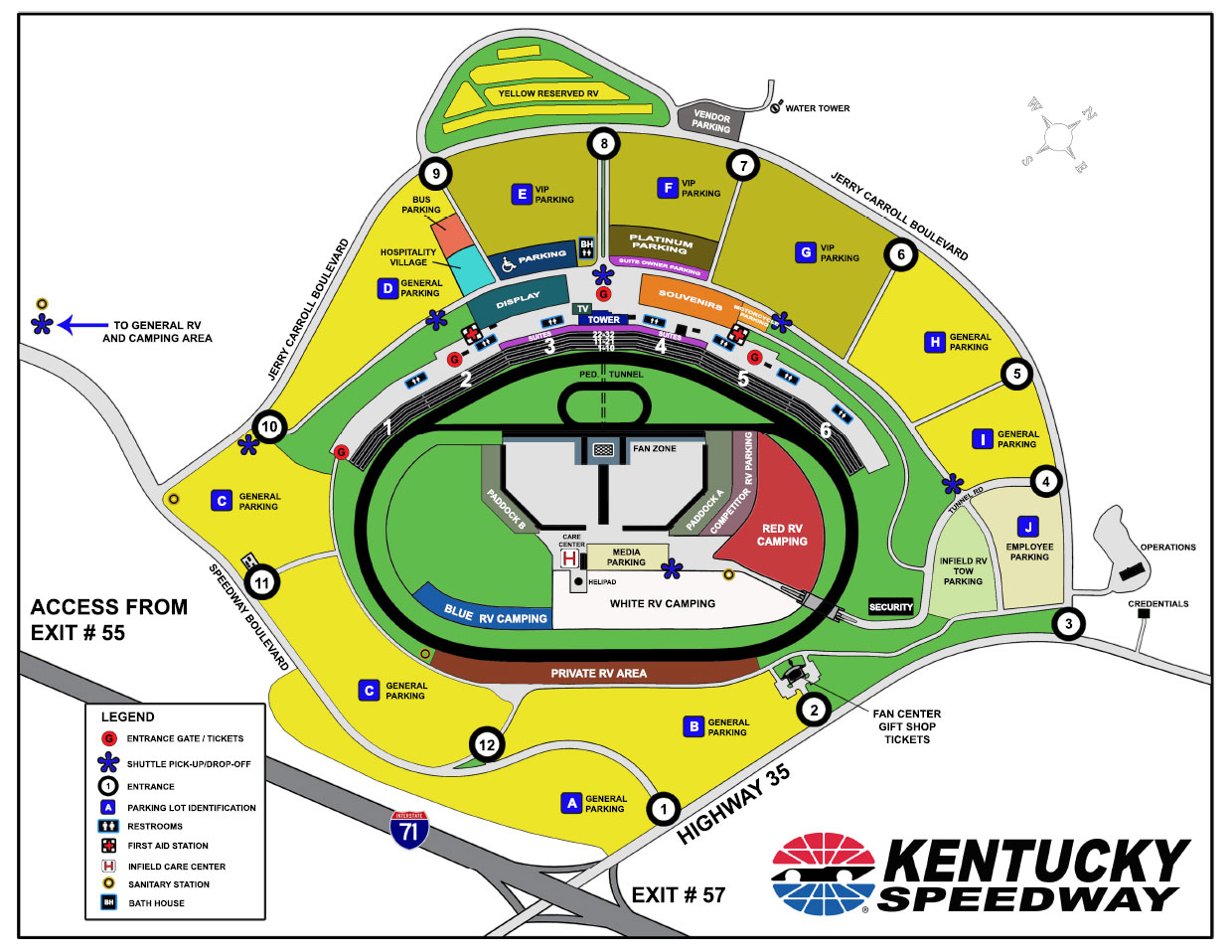
Kentucky Speedway. © kentuckyspeedway.com
Helio Castroneves secured his second victory of the 2010 IZOD IndyCar season at Kentucky Speedway. The Brazilian started from 8th spot in his Penske and spent much of the race running on the fringes of the top ten, but a clever – and risky – fuel strategy brought him an unlikely victory late on ahead of Panther Racing pair, Ed Carpenter and Dan Wheldon.
Realistically though, this should have been Wheldon’s race. The racer from Manchester spent virtually the entire race either running in the lead or in the top three and would eventually be denied by a splash-and-go stop six laps from the end. Carpenter, who claimed his first pole yesterday, also ran well during the race.
Both Tony Kanaan and Ryan Hunter-Reay had close calls too – while Hunter-Reay had his own mini-spin, Kanaan was very nearly wiped out by Sato. Kanaan carried on with no problems, but Hunter-Reay made for the pits to take on new tyres and although it left one Andretti-Autosport machine mired at the back, at least Kanaan had the pleasure of snatching ten positions off the start as he ran from 26th to 16th spot.
The green fell again on the 9th lap and stayed out this time around – Carpenter wasted no time in robbing Power of 2nd spot and within two laps had assumed the lead from his team mate. Power would soon be slotting back into 4th behind the fast starting rookie, Bertrand Baguette – the Belgian driver has had a difficult first season, but has shown of late that he is finding his rhythm. Baguette would continue to hold off the Penske for another ten laps, before Power stole 3rd spot back from the Conquest Racing driver on the 21st lap. With the Belgian vulnerable, Scott Dixon slotted into 4th position a lap later as Baguette began to fall backwards into the pack.
EJ Viso was another driver hitting difficulties; sadly for the KV Racing driver, his problem’s were terminal as the Venezuelan stopped in the pits with a brake problem – two of the KV cars out at only one-quarter distance. Viso’s retirement did little to disturb the flow of the race and both Tony Kanaan and Ryan Hunter-Reay were probably thankful – after excitement early on, both had reached the fringes of the top ten by lap 50 (Kanaan 11th, Hunter-Reay 13th) and were unwilling to have their spells broken.
The first round of pitstops began in earnest on the 54th lap – all were clean bar Carpenter, who had a slow tyre change; something that dropped him to 10th spot. In the other Panther pit stall, Wheldon’s stop went without a fuss, but it was not enough to keep Power and Dixon behind as the pair jumped to 1st and 2nd respectively. Wheldon rejoined the track 3rd, ahead of Franchitti and a fast-stopping Kanaan.
Wheldon refused to be held back and on lap 65, grabbed 2nd position back from Dixon and instantly gave chase to Power; taking lumps out of the lead as he did so. Marco Andretti started following in Wheldon’s footsteps as the young American began to surge forward. The Andretti-Autosport driver emerged from the stops in 6th position, but by lap 78 had made his way into 3rd thanks to decisive moves on Kanaan, Dario Franchitti and Dixon.
As Marco makes his move into 3rd, the leaders find themselves amongst Simona de Silvestro and Vitor Meira – neither were having a spectacular day, but it would get decidedly worse very quickly. As Power was about to put de Silvestro a lap down, the ‘Swiss Miss’ made a move for low-line on track, only to find it occupied by Meira’s Foyt Enterprises machine.
The pair tangled sending both into the wall hard, however on her way to the SAFER barrier, de Silvestro clipped the left rear of Ryan Briscoe sending him hard into the inside retaining wall. De Silvestro herself slid ominously back down track, making further contact with the infield barrier. With the track littered with debris, the safety crew made for the track and a full course caution was signalled.
The field pit to top up fuel and change tyres – all was well except for Andretti and Castroneves; a slow stop dropped the American to 6th place, while Castroneves stalled his Penske. It was a double-blow for the Penske driver, but it would ultimately change the face of the race – unsatisfied that his right-rear wheel was properly attached, Castroneves was brought back in on lap 89 to have it properly affixed. He also took on more fuel while he was there.
While not ideal, at least Marco and Helio could claim fine running cars, a pleasure not afforded to Sarah Fisher; she had a difficult day to this point, before her Dollar General machine began to lose 5th gear. She would later retire as the problem escalated.
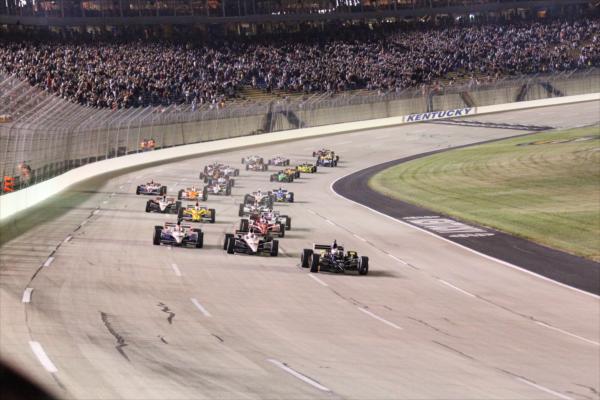
Carpenter led for a time. © indycar.com
The race restarted at the beginning of the 96th lap and in a repeat of earlier circumstances, Wheldon clung to the rear of Power and continued to press hard, but could not find a way around the Australian and stayed a constant one-tenth behind him. Ed Carpenter had less hassle when regaining ground on the leaders – passes on Tony Kanaan, Marco Andretti and Dario Franchitti amongst others, brought the part-timer back into the top 4, really allowing Carpenter to showcase his talents on the 1.5 mile oval. As Kanaan and Andretti dropped back slightly, they were joined by team mates Danica Patrick and Ryan Hunter-Reay as all four Andretti-Autosport drivers fought amongst themselves for 6th spot.
As the race moved into its second-half, Paul Tracy had made his way into the top ten, as the veteran moved through the field. The Dreyer & Reinbold driver struggled in what was his first 1.5 mile oval race in five years, qualifying a lowly 23rd on Friday evening; however as the race progressed, the feel of his Honda-powered began to fall toward him.
Up front, 3rd place Scott Dixon continued to stalk the leading pair. Although not on a stellar pace throughout the weekend, the Kiwi found himself inadvertently brought into contention on lap 131 while the leaders dealt with Milka Duno. Prior to race, chief steward Brian Barnhart instructed the slower drivers to stay to the low line while they were being lapped and while Duno did this, the Venezuelan also got off the throttle, baulking both Power and Wheldon in the process. This brought Dixon into the action with Wheldon, both Power had enough momentum to keep ahead; however as Wheldon and Dixon cleared traffic, they drafted back up to the rear of the Penske.
The next round of pitstops came on lap 143 as Power dived in first and Wheldon and Dixon arriving one lap later. The trio took new tyres and fuel in relatively short time, but on the 146th tour of Kentucky Speedway, Power made an error that many thought had been been iron out of the Australian. As the Penske man surged ahead of Wheldon, Power ran wide exiting turn 4, missing the concrete wall by mere inches – it was quite a save by the Penske driver, but the moment was not without penalty as he dropped to 6th spot once the stops had finished.
The Ganassi team must have delighted at this change in the order, but they were probably less delighted with a poor stop dropping Scott Dixon down the order to 10th as the race entered its final stage. Meanwhile the final car to pit, Castroneves, had fallen out of the top 10 altogether and out of contention, surely? Now Wheldon led, but the threat of one Ganassi car had simply been replaced with another as Dario Franchitti assumed 2nd spot ahead of Andretti (3rd) and Kanaan (4th).
Power was soon up to his feisty best, battling for a top four spot with Carpenter and Kanaan, keen not to let Franchitti gain too much ground in the title hunt. Come lap 165, Power had yet another momentary lapse of judgement and fell to 8th spot – this time the Australian would not recover from this slip up. Free of the Penske driver, Kanaan and Carpenter were set free and very quickly, both challenged Andretti for 3rd position as the laps ticked by – on lap 167 Kanaan took 3rd from Andretti, but within ten laps, Carpenter had taken both of them.
Only 25 laps remained and Wheldon led from Franchitti and Carpenter, but concerns and worry lines began to stretch ominously on the various pit walls. The last set of stops had come about too early for the main pack to get to the end – last second fuel fill-ups would be necessary if anyone wanted to finish the race.
Not like that was going to worry Ryan Hunter-Reay – with 20 laps remaining, the Andretti-Autosport driver pulled off and out of the race with mechanical problems – after a poor qualifying day, the race had been fairly promising with a top assured, but it was not to be. His retirement ended an eight-race streak of top-5 finishes.
As the field prepared for their respective stops, Castroneves was running slow – very slow in fact. With the remaining runners certain that they would need to pit with at least five laps remaining, the stayed on the throttle running in the 215-217 mph range; Castroneves meanwhile, was running at an average of 207 mph – this was fuel saving of the most absurd kind. But it was enough.
With eight laps remaining, the field began to flow into the pits – Kanaan first and then the race leaders on lap 195 with Carpenter a lap later. A good stop by Carpenter as well as a good in-lap was enough for him to jump Wheldon… just. Franchitti had a slight fumble in his pits, that would drop him to 5th behind Kanaan; however it was beginning to dawn on all that Helio Castroneves was staying out. A few laps were left when the Brazilian received a message from his chief engineer Tim Cindric that he had saved enough fuel to put his foot down – Castroneves had stolen the lead at Kentucky in a tense and dramatic style and less than two minutes after the final stop, Castroneves had also claimed the victory.
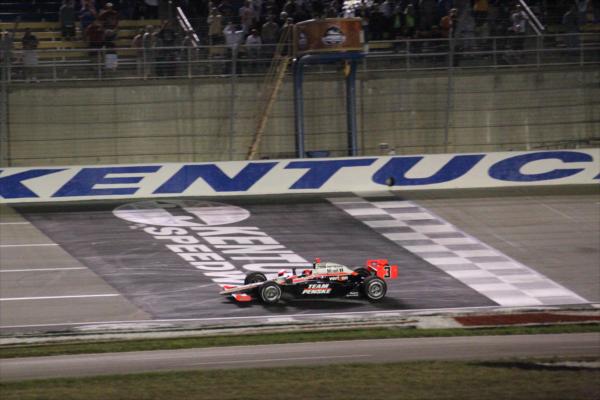
Castroneves crosses the line to win. © indycar.com
The mood on the Penske wall was ecstatic, with many still feeling Castroneves was severely hard done by earlier this year at Edmonton, where his win was taken off of him post race. Rather than flying off in a fit of rage, ‘Spiderman’ jumped from his white, black and red Dallara and made for the catch fencing, climbing up high to celebrate with the crowd.
The Penske driver was quick to give credit to his and their chief Tim Cindric, saying afterwards that “…I tried to stay steady and saving fuel. All of a sudden, Cindric says ‘Try to make this number.’ I was like, ‘That’s going to be impossible, man.’ When we pitted the last time, he just said you’ve got to make this number because we have nothing to lose, and it’s definitely going to pay off…”
This victory for Castroneves moved him ahead of team mate Ryan Briscoe in the Championship, but both are now so far behind Power and Franchitti, that any chance of a title shot is long gone.
Carpenter eventually took 2nd position ahead of team mate Dan Wheldon in 3rd spot – although disappointed with the runner-up position, it was still a fantastic performance by the American, buoyed on by a fine run in Chicagoland a week ago. He was very pragmatic about it afterwards, claiming that “…Dan and I […] had the best cars in the race. But that’s racing. The best car doesn’t always win.” Wheldon, whose IndyCar career is currently up in the air led the most laps of the evening (93); although that may be of little comfort to the Englishman: “…the ending was unfortunate. I am bummed that the race didn’t turn out different, but it will motivate us for the last two races.”
Tony Kanaan took a well deserved fourth after starting 26th with Franchitti extending his run of top 5 finishes to seven races with his 5th result. Marco Andretti (6th), Scott Dixon (7th) and Will Power (8th) filled out the top 8 – it wasn’t the ideal result for Power as the race became more about damage limitation rather than pulling away from Franchitti; the Scot took a further six points out of Power’s title lead.
Danica Patrick extended her race-finish streak to 31 races and scored a respectable 9th in the process, ahead of Belgian rookie Bertrand Baguette finishing 10th for Conquest Racing; it was his best finish of the season. Justin Wilson (11th), Paul Tracy (12th), Alex Lloyd (13th), Tomas Scheckter (14th), Alex Tagliani (15th) and Raphael Matos (16th) all had quiet runs, while Hideki Mutoh crossed the line in 17th despite a good day in qualifying. Mario Moraes, Milka Duno and Graham Rahal rounded up the top 20.
With only two races left, Dario Franchitti is now 17 points behind Will Power in the Championship and with Franchitti’s favourite oval approaching in two weeks time (Motegi), Power needs a good result to solidify his lead.
Race Rating: 3.5 out of 5
2010 IndyCar Kentucky 300 (Round 15)
Pos Car Driver Lap Time Down Elapsed Time Avg Speed Status
1 3 Castroneves, Helio 200 0.0000 01:41:50.0059 174.402 Running
2 20 Carpenter, Ed 200 13.1597 01:42:03.1656 174.028 Running
3 4 Wheldon, Dan 200 13.9214 01:42:03.9273 174.006 Running
4 11 Kanaan, Tony 200 13.9931 01:42:03.9990 174.004 Running
5 10 Franchitti, Dario 200 14.1968 01:42:04.2027 173.998 Running
6 26 Andretti, Marco 200 14.5669 01:42:04.5728 173.988 Running
7 9 Dixon, Scott 200 15.1025 01:42:05.1084 173.972 Running
8 12 Power, Will 200 15.6142 01:42:05.6201 173.958 Running
9 7 Patrick, Danica 200 15.8494 01:42:05.8553 173.951 Running
10 34 Baguette, Bertrand (R) 199 0.6982 01:41:50.7041 173.511 Running
11 22 Wilson, Justin 199 0.8728 01:41:50.8787 173.506 Running
12 24 Tracy, Paul 199 1.3729 01:41:51.3788 173.491 Running
13 19 Lloyd, Alex (R) 199 1.5131 01:41:51.5190 173.487 Running
14 36 Scheckter, Tomas 199 7.7270 01:41:57.7329 173.311 Running
15 77 Tagliani, Alex 199 15.5012 01:42:05.5071 173.091 Running
16 2 Matos, Raphael 199 22.4863 01:42:12.4922 172.894 Running
17 06 Mutoh, Hideki 199 23.1823 01:42:13.1882 172.875 Running
18 32 Moraes, Mario 198 4.9711 01:41:54.9770 172.518 Running
19 18 Duno, Milka 195 15.5458 01:42:05.5517 169.611 Running
20 66 Rahal, Graham 195 20.8991 01:42:10.9050 169.463 Running
21 37 Hunter-Reay, Ryan 174 – 01:31:09.2912 169.505 Mechanical
22 67 Fisher, Sarah 134 – 01:18:57.3883 150.706 Mechanical
23 14 Meira, Vitor 79 – 00:39:01.9765 179.725 Contact
24 6 Briscoe, Ryan 79 – 00:39:02.0028 179.723 Contact
25 78 de Silvestro, Simona (R) 78 – 00:39:01.5320 177.484 Contact
26 8 Viso, EJ 45 – 00:24:37.1918 162.308 Mechanical
27 5 Sato, Takuma (R) 0 – 00:00:01.6515 n/a Contact
2010 IZOD IndyCar Series (Round 15)
1. Will Power Team Penske 552 points
2. Dario Franchitti Chip Ganassi Racing 535
3. Scott Dixon Chip Ganassi Racing 469
4. Helio Castroneves Team Penske 448
5. Ryan Briscoe Team Penske 418
6. Ryan Hunter-Reay Andretti-Autosport 404
7. Tony Kanaan Andretti-Autosport 392
8. Marco Andretti Andretti-Autosport 347

Kentucky Speedway. © kentuckyspeedway.com
It ended up being a dream weekend for Pippa Mann. Pole position on Friday afternoon was swiftly followed up by a dominant win on Saturday – and I mean dominant. The young lady from London stormed to the chequered flag at Kentucky Motor Speedway, but it wasn’t a completely undisturbed run.
After the first green flag was waved off (the field was too stretched), however when the race did eventually start, a huge three-way accident between Philip Major, Stefan Wilson and series returnee Daniel Herrington. Exiting turn 4, Major spun by himself and was T-boned on the rebound by Wilson – Herrington was unable to avoid speeding wrecks. It was an accident that was scarily similar to the one that very nearly killed Alex Zanardi in 2001, albeit at slower speeds. While Herrington and Wilson emerged fairly quickly, Major was trapped in the car for a few moments – all were later declared to be fine.
It’s was appalling luck for Herrington. The 24-year-old stepped in at the last moment for Sebastian Saavedra at Bryan Herta Autosport and found himself innocently tangled in an accident before four laps had been completed. Meanwhile for the second consecutive race, the red flag was produced.
In the few laps of running that had taken place, Mann surged ahead of Martin Plowman, with JK Vernay and James Hinchcliffe not far behind.
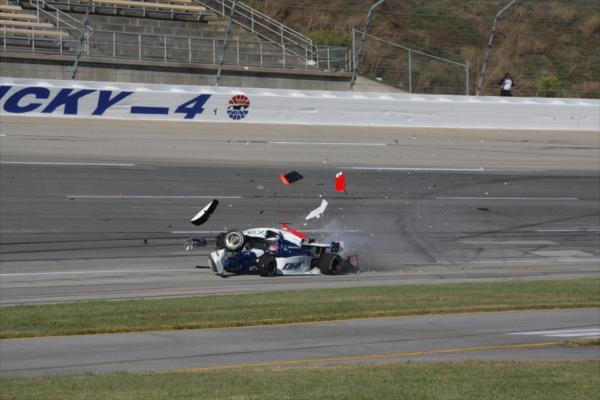
The early race smash was terrifying. © indycar.com
Following a 15 minute stoppage, the field took to speed again and Mann launched herself into an immediate and commanding lead – she would not be caught. For every lap completed, one-tenth or two-tenths were added to the gap as she pulled far away from the chasing pack.
Initially Plowman led the followers, but Hinchcliffe (having deposed Vernay of 3rd) took 2nd place from Plowman on lap 15 and gave chase, but Mann was already 2.6 seconds down the road. As the laps were ticked off, Plowman clearly did not have the speed of the front runners and the 19th tour of the circuit, Vernay had removed 3rd place from the Briton. For a time, Plowman battled hard with the Frenchman, but Vernay had the advantage and used it wisely.
Whatever about holding Plowman off, Vernay was not going to able to catch the leading pair. As the race moved into its second-third, the Championship leader was three seconds behind Hinchcliffe who was in turn a further 3.2 seconds shy of Mann.
Behind the leading trio, Adrian Campos Jr was on a charge after running 8th early on, the Spaniard took positions from Gustavo Yacaman (lap 17), Dan Clarke (lap 28), Charlie Kimball (lap 36), before finally forcing his way into the top four with decisive move of Plowman (lap 37). Kimball had himself moved up a few spots during the course of the race – overtakes on Brandon Wagner (lap 16) and Plowman saw the American run in the top five.
‘Speedy’ Dan Clarke had opposing fortunes – after a good early race in 5th spot, Clarke dropped down the order and landed in 10th place by the 40th lap. With only Barbosa behind him (by a clear lap), it would be where Clarke remained for the duration.
By the 50 lap distance, Mann now had a 4.8 second advantage over Hinchcliffe and only a dramatic error or a yellow flag could possibly stop her progress – neither would come.
While there may have been no race for the lead, there certainly was an ongoing fight for 3rd. Vernay – still holding on to that vital top 3, found himself in an increasingly tough battle with Campos Jr. For lap-after-lap, the Team Moore driver pushed Vernay, but couldn’t find an ideal spot anywhere, whether on the outside or inside line. As Mann’s lead grew to 5.8 seconds by lap 60, Vernay and Campos Jr were still only separated by 0.1 of-a-second across the line.
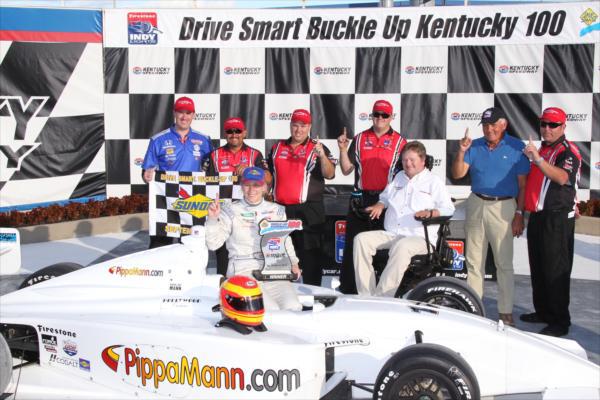
Mann and her team in victory lane. © indycar.com
One man who was not being deterred was Gustavo Yacaman – after being passed by Campos Jr earlier in the race, the Cape Motorsports driver set his sights on Charlie Kimball, robbing him of 6th on lap 61, before taking 5th from Martin Plowman two tours later. What started out as a day with potential for Plowman had turned into something much more mediocre.
For Pippa Mann, it was perfect – with the completion of lap 67, the chequered flag waved and the Londoner picked up her first Firestone Indy Lights victory. It really were a wonderfully composed drive and showcased a dominance rarely seen on an oval nowadays.
Hinchcliffe came home a lonely 2nd nearly three seconds up on Vernay as 4th place man, Adrian Campos Jr ran out of laps. Vernay only has to show up at Homestead Miami Speedway in four weeks time to claim the 2010 Firestone Indy Lights title – he is now some 48 points clear of Hinchcliffe. Gustavo Yacaman and Charlie Kimball crossed the line in 5th and 6th respectively, with Plowman eventually securing 7th spot.
Brandon Wagner (8th) and Arie Luyendyk Jr (9th) finished on the lead lap a long way ahead of the lapped Dan Clarke (10th). Rodrigo Barbosa was the last of the runners in 11th position, three laps down.
Despite Hinchcliffe only having one finish outside the top-10 this season (St Petersburg), the Canadian has been unable to take as many race wins as Vernay and it is one of a number of things that has lost him the title. However, with Hinchcliffe, Vernay and Mann talking of potentially moving up to IndyCars next year, the fight will be on to grab the attention of owners one last time – Pippa Mann certainly did her bit today.
Race Rating: 4 out of 5
2010 Indy Lights Kentucky 100 (Round 12)
Pos Car Driver Lap Down Elapsed Time Avg Speed
1 11 Mann, Pippa 67 0.0000 00:34:04.7529 174.581 Running
2 2 Hinchcliffe, James 67 6.8372 00:34:11.5901 174.000 Running
3 7 Vernay, JK (R) 67 9.7137 00:34:14.4666 173.756 Running
4 22 Campos Jr, A. (R) 67 9.7924 00:34:14.5453 173.749 Running
5 10 Yacaman, Gustavo 67 13.9245 00:34:18.6774 173.401 Running
6 26 Kimball, Charlie 67 13.9735 00:34:18.7264 173.397 Running
7 27 Plowman, Martin 67 14.4538 00:34:19.2067 173.356 Running
8 32 Wagner, Brandon 67 23.5225 00:34:28.2754 172.596 Running
9 24 Luyendyk Jr, Arie 67 24.4884 00:34:29.2413 172.515 Running
10 40 Clarke, Dan (R) 66 1.1462 00:34:05.8991 171.879 Running
11 18 Barbosa, Rodrigo 64 3.0664 00:34:07.8193 166.515 Running
12 29 Herrington, Daniel 3 00:01:05.5822 162.483 Accident
13 49 Major, Philip (R) 3 00:00:31.4419 169.455 Accident
14 28 Wilson, Stefan (R) 3 00:00:31.8427 167.322 Accident
2010 Firestone Indy Lights Championship
1 JK Vernay Sam Schmidt Motorsports 479 points
2 James Hinchcliffe Team Moore Racing 431
3 Charlie Kimball AFS / Andretti-Autosport 371
4 Martin Plowman AFS / Andretti-Autosport 364
5 Sebastian Saavedra Bryan Herta Autosport 303
6 Dan Clarke Walker Racing 291
7 Pippa Mann Sam Schmidt Motorsports 282
8 Gustavo Yacaman Cape Motorsports 279
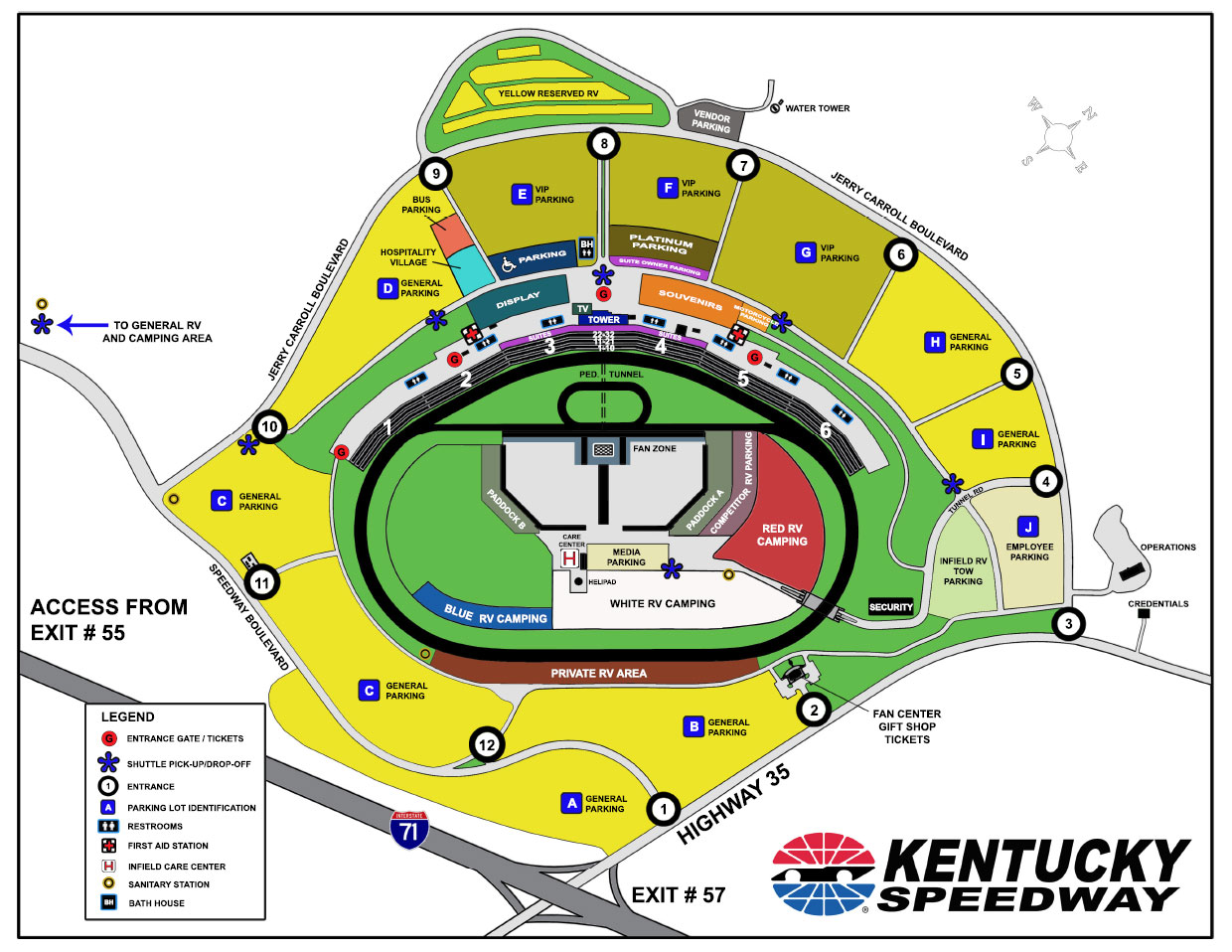
Kentucky Speedway © kentuckyspeedway.com
Ed Carpenter must be wondering what his 2010 season would have been like should he had a full run on the ovals – positive runs at this years Indianapolis 500 an last weekend’s Chicagoland 300 km had left the part-time driver confident, but his first ever IndyCar pole position for tomorrow night’s IndyCar race at Kentucky Speedway was probably not on the cards.
It’s all rather timely too as several sets are still to be decided for next year – including that of his temporary team mate, Dan Wheldon. It’s unlikely that Wheldon is too disappointed with his Kentucky run, as the Manchester-born man will be starting on the inside of row 2 just behind Carpenter.
In between the two Panther Dallara’s is championship leader, Will Power as he aims to reinstate the points gap to challenger Dario Franchitti following a late race problem with fuel last weekend. Franchitti will not be buoyed on by his qualifying performance – the Scot starts in 11th place. Franchitti’s Ganassi team mate, Scott Dixon will start on the outside of row 2, ahead of the Newman-Haas of Hideki Mutoh and Belgian rookie Bertrand Baguette.
Mario Moraes (KV Racing) heads up an all-Brazilian fourth row alongside Helio Castroneves, followed by Ryan Briscoe (9th) and part-timer Tomas Scheckter (10th). AJ Foyt Enterprises’ sole entry, Vitor Meira ran a solid qualifying run, picking up the outside of row 6 (alongside Franchitti), while the single FAZZT Racing car driven by co-owner Alex Tagliani will start from 13th.
The second KV runner, Takuma Sato goes from the outside of row 7, well ahead of his other team mate EJ Viso – the Venezuelan has had a poor season so far and it may continue as starting from 22nd spot. Marco Andretti will lead the four the Andretti-Autosport entries from 15th spot in what was an abysmal session for the team – Danica Patrick will line up from 17th and Tony Kanaan from 26th spot following a difficult run. Ryan Hunter-Reay had a crash in turn 2, meaning he did not post a time – he will start 27th and last.
Justin Wilson (16th) is sandwiched by the two leading Andretti-Autosport cars and will be tailed by fellow Briton, Alex Lloyd (18th). Simona de Silvestro and Raphael Matos make up row 10, followed by the Fisher Racing entry driven by Sarah Fisher (21st). Paul Tracy returns for both this race and the next one in Motegi, but has left himself with much to do with his 23rd starting position. Dale Coyne’s, Milka Duno qualified 24th, with Graham Rahal (25th) slotting in behind.
Coverage for the 2010 IZOD IndyCar Kentucky 300 begins on indycar.com from 1am Sunday morning and from 1.30am on Sky Sports 3.
2010 IZOD IndyCar Kentucky 300 (Round 15)
Pos Driver Team No Total Time Avg Speed (mph)
1 Ed Carpenter Panther Racing 20 00:48.8958 217.933
2 Will Power Team Penske 12 00:48.9192 217.829
3 Dan Wheldon Panther Racing 4 00:48.9480 217.700
4 Scott Dixon Target Chip Ganassi Racing 9 00:48.9857 217.533
5 Hideki Mutoh Newman/Haas Racing 06 00:49.0214 217.374
6 Bertrand Baguette Conquest Racing 34 00:49.1087 216.988
7 Mario Moraes KV Racing Technology 32 00:49.1335 216.879
8 Helio Castroneves Team Penske 3 00:49.1383 216.857
9 Ryan Briscoe Team Penske 6 00:49.1967 216.600
10 Tomas Scheckter Conquest Racing 36 00:49.1991 216.589
11 Dario Franchitti Target Chip Ganassi Racing 10 00:49.2120 216.533
12 Vitor Meira A.J. Foyt Enterprises 14 00:49.2343 216.434
13 Alex Tagliani FAZZT Race Team 77 00:49.2443 216.391
14 Takuma Sato KV Racing Technology 5 00:49.2728 216.265
15 Marco Andretti Andretti Autosport 26 00:49.2939 216.173
16 Justin Wilson Dreyer & Reinbold Racing 22 00:49.3462 215.944
17 Danica Patrick Andretti Autosport 7 00:49.3744 215.820
18 Alex Lloyd Dale Coyne Racing 19 00:49.5001 215.272
19 Simona De Silvestro Team Stargate Worlds/HVM 78 00:49.5621 215.003
20 Raphael Matos de Ferran Dragon Racing 2 00:49.5747 214.948
21 Sarah Fisher Sarah Fisher Racing 67 00:49.6059 214.813
22 E.J. Viso KV Racing Technology 8 00:49.6564 214.595
23 Paul Tracy Dreyer & Reinbold Racing 24 00:49.7317 214.270
24 Milka Duno Dale Coyne Racing 18 00:49.9478 213.343
25 Graham Rahal Sarah Fisher Racing 66 00:50.1781 212.364
26 Tony Kanaan Andretti Autosport 11 00:50.5428 210.831
27 Ryan Hunter-Reay Andretti Autosport 37 No Time
2010 IZOD IndyCar Series Championship
1. Will Power 528 points
2. Dario Franchitti 505
3. Scott Dixon 443
4. Ryan Briscoe 406
5. Helio Castroneves 398
6. Ryan Hunter-Reay 392
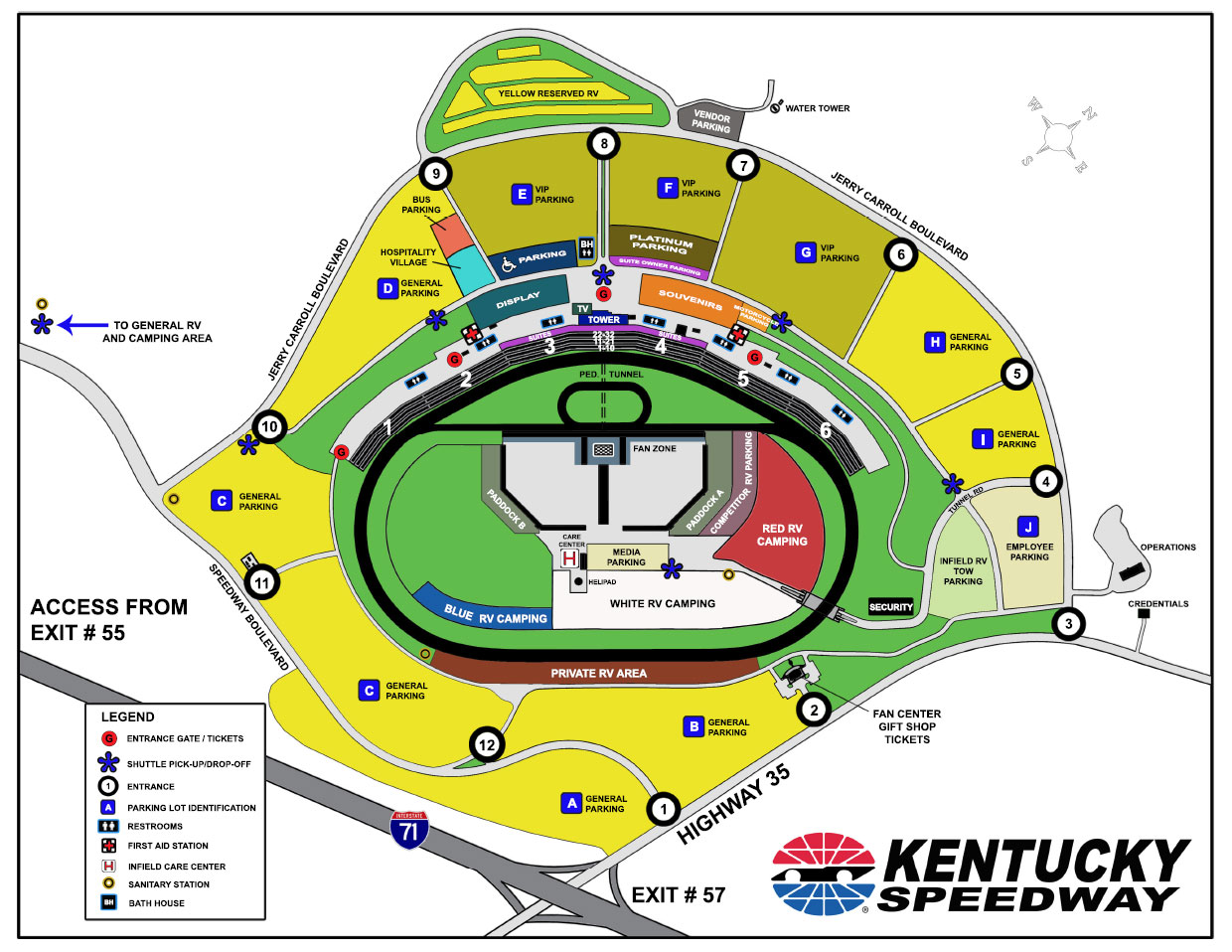
Kentucky Speedway © kentuckyspeedway.com
Pippa Mann secured her second pole position of the season for the Firestone Indy Lights Series at Kentucky Motor Speedway. The 29-year-old pipped (unavoidable, sorry) fellow Briton Martin Plowman by 0.165 mph as she registered an average speed over two laps of 190.474 mph around the 1.48-mile oval.
Plowman’s AFS / Andretti-Autosport team mate, Charlie Kimball, notched up the inside of row number two with Championship leader JK Vernay alongside. Vernay’s Championship challenger, James Hinchcliffe starts directly behind on the outside of row 3, while Lights rookie ‘Speedy’ Dan Clarke is place between the pair.
Adrian Campos Jr, Brandon Wagner, Arie Luyendyk Jr and Stefan Wilson line up from 7th – 10th respectively, with Rodrigo Barbosa taking up 11th position. Sebastian Saavedra, Philip Major and Gustavo Yacaman did not set times and will claim the final three spots as a result.
Since her return from injury a few weeks ago, Mann has delivered her finest performances since she started in Indy Lights – if she can convert this pole into a victory, it would indeed be well deserved and a popular one.
Vernay can claim the title in tomorrow’s race – he leads Hinchcliffe in the title hunt by 53 points with 105 available. However a bad day for the Frenchman could possibly bring Hinchcliffe right back into it, bringing the title down to the wire at Homestead in four weeks.
By the end of Saturday evening, we will know for certain.
Coverage for the 2010 Firestone Indy Lights Kentucky 100 will begin at 10.15pm (BST) from indycar.com.
2010 Indy Lights Kentucky 100 (Round 12, Qualifying)
Rank Car Driver Name Total Time Speed
1 11 Mann, Pippa 00:55.9447 190.474
2 27 Plowman, Martin 00:55.9932 190.309
3 26 Kimball, Charlie 00:56.0084 190.257
4 7 Vernay, JK (R) 00:56.0099 190.252
5 40 Clarke, Dan (R) 00:56.0464 190.128
6 2 Hinchcliffe, James 00:56.1096 189.914
7 22 Campos Jr, Adrian (R) 00:56.2945 189.290
8 32 Wagner, Brandon 00:56.3427 189.128
9 24 Luyendyk Jr, Arie 00:56.3669 189.047
10 28 Wilson, Stefan (R) 00:56.4069 188.913
11 18 Barbosa, Rodrigo 00:56.9392 187.147
12 29 Saavedra, Sebastian No Time
13 49 Major, Philip (R) No Time
14 10 Yacaman, Gustavo No Time
2010 Firestone Indy Lights Championship
1. JK Vernay 444 points
2. James Hinchliffe 391
3. Charlie Kimball 343
4. Martin Plowman 338
5. Sebastian Saavedra 303
6. Dan Clarke 271
Hermann Tilke's reworked wiki page. Click on it to read further.
Stick to racing Mark.
Apparently Formula 1 may be introducing two extra test session from next year onwards. Testing was originally curtailed for both economic and practical reasons – the costs had simply soared and getting cars to Spain on a regular basis proved to be a drain on many squads.
However teams would often perform mid-season tests at a track approximately ten days prior to a Grand Prix being run at a venue and that in itself resulted in many a dire race, as the teams had already sussed the track and its conditions prior to the event being run.
At the time there were many complaint from fans, especially those paying expensive numbers to a Grand Prix weekend as Friday practice sessions essentially became tumbleweed cities. The modern testing restrictions have helped that immensely as teams have been left with little choice, but to run on the opening days of race weekends.
While it is nice that at least there is “some” reintroduction of testing Formula 1 should best try to avoid returning to its former testing schedule – if only for its fans sake.
Along with the four tests in Spain in February, Bahrain may be added to the schedule in early March with an addition running potentially in Abu Dhabi following the conclusion of this season.
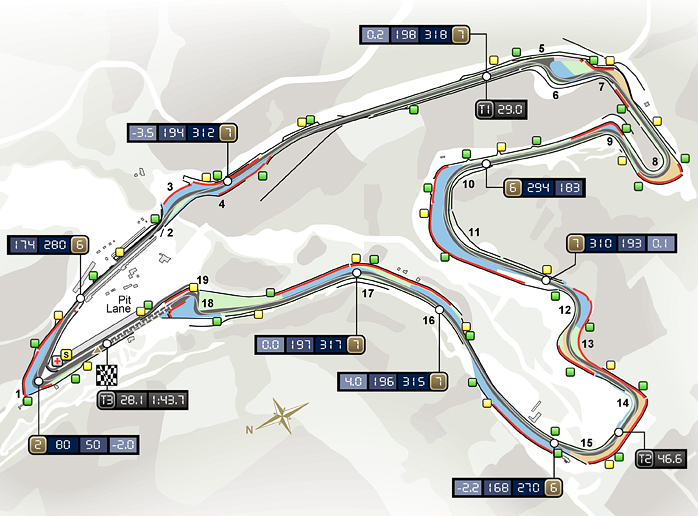
Layout for Spa-Francorchamps. © FIA
2010 Belgian Grand Prix (Round 13)
Sometimes it comes to you and other times it doesn’t. Lewis Hamilton just missed out on pole position to Championship leader Mark Webber by 0.1 of-a-second in yesterday’s qualifying session; but determination and a cool head saw the 2008 World Champion surge to a fabulous victory when it mattered most.
However, the constantly changing weather made sure the Briton would have to work hard for it – in fact the first droplets of rain were felt on the warm up lap.
In fairness a slow starting Webber gave Hamilton an easy run to the first corner – so poor was Webber off the line, that even Robert Kubica and Jenson Button were able to pass the Australian out of La Source. Webber eventually fell to 7th spot as cars rushed by his Red Bull.
The race was barely into its second lap when the safety car emerged for the first time – as the pack approached the Bus Stop chicane on lap 1, the top 5 all ran off circuit in the damp conditions.
However that was topped when Rubens Barrichello missed his braking point and slammed into the side of Fernando Alonso; somehow Alonso survived the hit and pitted for tyres and a front wing, but Barrichello was out on the spot – his 300th race over early.
Just as the race was nullified, Sebastien Vettel and Robert Kubica go wide up the famous Eau Rouge and onto the Kemmel straight, letting Button into 2nd. With the Mercedes deployed, Hamilton led Button, Kubica, Vettel and Webber.
The safety car period was short and the race recommenced come lap 4 with the field remaining static up front. Whereas Webber was poor off the line, both Vitaly Petrov and Michael Schumacher had phenomenal starts from further down the order – Petrov jumped from 23rd starting place up to 11th and Schumacher slipping up to 12 position after starting 21st as the Renault and Mercedes men enjoyed sterling starts.
Another driver out of the limelight and out of the race was Hispania racer, Bruno Senna – the Brazilian pitted twice early and damaged his Cosworth-powered car in a spin at Stavelot. Senna would pit again to retire from the race at the end of the 6th tour from last position.
Not too far ahead of the Brazilian driver, Alonso was on a charge – after a short time spent wandering down in 17th place, the Spaniard comfortable on new tyres, forced his way passed Lucas di Grassi, Pedro de la Rosa and Jarno Trulli by lap 9; however Trulli did not make it easy. Desperately trying to hold off the Ferrari, the Lotus driver stuck to a defensive line, but had no answer when Alonso ducked the inside at Campus.
Trulli was not the only driver defending hard. Mercedes driver Nico Rosberg resiliently defended his 10th place from Vitaly Petrov on the Kemmel straight, weaving across the track in a dangerous manner as they approached Le Combes. Petrov was not perturbed and brilliantly shoved Rosberg aside as he passed the Mercedes around the outside. With Rosberg destabilised, Schumacher saw an opportunity to take another position and as the silver pair exited the Le Combes chicane, the veteran cut across the track, removing Rosberg’s left front wing endplate in the process – a fantastic opportunistic move.
Sebastian Vettel would certainly have wanted to do the same to Jenson Button; as the race approached the one-third mark, the reigning champion had fallen 7.2 seconds behind his race leading team mate, but was under severe pressure from the trailing Vettel. However it was clear that his Renault power was no match for the Mercedes unit in the back of the McLaren. As good as the Red Bull was through the sweeping Spa-Francorchamps corners, Vettel had nothing on the straight.
A stalemate was forming before our eyes, that was until Vettel finally made a determined lunge on Button into the Bus Stop, lost his rear end and speared the McLaren in the side. Incredibly despite the huge hit, Vettel suffered only a damaged front wing, yet no suspension worries and while he lost many positions when pitting for new front wing, at least he was still running. A few minutes later, Vettel would have a drive through penalty added to his list of woes.
…which couldn’t be said for Button. Irritated, the Briton attempted to continue, but his car was a wreck, its radiator punctured – retirement and a huge dent in his title hopes.
Vettel should arguably have taken notes from Fernando Alonso – it took a few laps, but the Ferrari driver pushed his way passed Vitantonio Liuzzi’s Force India at the same point. No damage done. Liuzzi would soon find himself in a battle with Vettel – the Red Bull driver came out behind the Force India man and shot down the inside of La Source; however the Italian had more than enough juice to retake the young German on the approach to Le Combes. It was all irrelevant as Vettel took his penalty a lap later.
Up front, with Button and Vettel now out of the way, Kubica and Webber found that they were able to pick up the pace without obstruction. Hamilton, however, was already 11 seconds down the road by the 23rd lap, it was going to be a struggle to catch the McLaren – the only thing for was pit strategy.
First in was 5th place Sutil on lap 22, followed by Webber the next time around and the Kubica / Massa pair on lap 24 – Hamilton took to the pitlane last at the start of the 25th lap. While the fresh rubber Adrian Sutil the extra grip to pass Kamui Kobayashi and Schumacher for 5th place, Webber managed only to get closer to the 2nd placed Pole, but not close enough to make his strategy work – stalemate. Massa watching from a short distance away in 4th, had some good speed on his fresh Bridgestone’s, but not enough to close to the Red Bull.
Not all the stops was strictly for fresh rubber though. Vettel recovering from his drive through penalty pulled up to the back of Liuzzi once again, only this time the pair collided coming through the Bus Stop chicane – Liuzzi had his front wing sheared, while Vettel received a sliced left rear tyre. The Italian had enough of an angle to pull into the pitlane; however Vettel in taking the corner had no choice, but to complete the lap with only three inflated tyres – both would drop back down the order.
Just like Liuzzi, both Sauber’s were also under huge pressure as 8th place Kobayashi continued to fight off Alonso’s mighty Ferrari (successfully). Nico Hulkenberg was also trying his hand at passing Pedro de la Rosa for 12th position – also with no success; both Ferrari-powered cars were on roll, considering their poor starting places.
There was no carnage out front either – in fact, Hamilton was surging away from Kubica by the two-third’s distance. In reality, the McLaren team were worried. Just above the Spa-Francorchamps circuit, the micro-climate changed its mood once again, and dark clouds descended upon the forest lined track. The rain was coming, although no one was quite sure when
On the 33rd lap of the course, the expected droplets of rain finally began to fall – the pitlane spring into action as hordes of intermediate tyres were sprung from their blankets. Timo Glock was the first to pit as his Virgin swapped used slicks for fresh intermediates, but the rain was yet to cover the entire circuit – the back section of circuit clearly damp, while the first turn up to Eau Rouge and Le Combs remained dry, but not for too long more.
As the wet weather spread, Hamilton stayed out – as did Kubica and Webber – while the rest of the field seemingly poured into the pits. It was a decision that very nearly cost Hamilton badly – as the former Champion tiptoed around the damp condition, he lost traction at Bruxelles, ever-so-lightly glancing the barrier, before regaining his McLaren and retaking the circuit. Hamilton was lucky twice over in that no damage was done to his car and that he had enough of a lead over Kubica. The Pole was 12.4 seconds behind, but with one mistake that gap was down to 4 seconds – Hamilton could not afford another error.
The top three finally pitted for intermediate tyres at the end of the 35th lap – both Hamilton and Webber got out cleanly, but it went awry for Kubica. As he pulled his Renault into his pitbox, his car slid slowly forward as he missed his slot by a mere couple of feet. The time lost would cost Kubica his 2nd place, as Webber left the pits ahead of him.
Suddenly, the leaders had plenty of grip, but the conditions still changed lap after lap, as Fernando Alonso was to find out when he slammed his Ferrari hard into the barrier, destroying his suspension, at Bruxelles on the 38th time around. The Spaniard had made his way into the top ten, but as his red machine clutched a wet kerb at the medium speed corner, he was flung around into retirement.
For the second time, the safety car was called out as his stricken Ferrari lay perilously across the track, blocking much of the road.
And so the field closed up again and as the safety car peeled into the pits at the end of lap 40, the remaining pack of cars made a huge dash across the line – the group was led by Hamilton, followed by Webber, Kubica, Massa and Sutil, but neither could make a move on another.
The same could not be said for Nico Rosberg – the Mercedes driver restarted from 8th spot and immediately drafted his veteran team mate, Schumacher up the Kemmel straight. As Rosberg pulled up alongside the seven-time World champion, he barged Schumacher out of the way, forcing the issue and robbing Schumacher of 7th position – a marvelous move as Rosberg continues to assert his authority at Mercedes.
7th place would soon become 6th when the high running Kamui Kobayashi fell off the road at Stavelot; although the Japanese driver would still regain 8th spot as he rejoined ahead of the Vitaly Petrov’s Renault.
Jarno Trulli had a much more frantic spin at Pouhon in the closing moments – his Lotus spun wildly through the fast corner and into the middle of the track, but somehow all those behind missed the Italian; some truly fantastic reactions on display.
All of this was happening a long way behind Lewis Hamilton as despite the pressure from Webber, the Briton claimed a truly fantastic victory in a mesmeric race. Once again, Red Bull failed to convert a pole position into a win, but a sigh of relief for Webber considering his torrid start was present; however despite Webber’s podium, Hamilton has retaken the championship lead, albeit by only three points.
Today’s result was ever more crucial for the front pair considering the poor days for Button and Alonso; one wonders if their title hopes are now finally cooked. Vettel has also dropped 31 points behind Hamilton, as his tile run-in also falters. With Monza coming in two weeks time, the Vettel, Button and Alonso trio need a startling result to reinvigorate their chances.
Robert Kubica took a solid 3rd behind Webber, but he may be disappointed with the small error that cost him a possible 2nd place. The Pole had pulled away from the Massa, Sutil and Rosberg trio by the chequered flag, with Schumacher and Kobayashi several seconds behind the top 6 finishers. Vitaly Petrov picked up a superb 9th from his 23rd starting place. Jaime Alguersuari crossed the line in 10th place, but was later penalised 10 seconds for overtaking Liuzzi by jumping the Bus Stop – whereas the Toro Rosso driver was dropped to 13th, Liuzzi was promoted to 10th place, collecting a single point in the process.
Today was all about Lewis Hamilton and no one could possibly take this away from him now – and what an emphatic way to exercise the demons of 2008.
Sometimes it comes to you and other times it doesn’t. Today, it came to Lewis Hamilton.
Race Rating: 5 out of 5
——–
Spa-Francorchamps, Belgian Grand Prix (Round 13, August 29th)
1 HAMILTON McLaren 44 laps
2 WEBBER Red Bull +1.5s
3 KUBICA Renault +3.4s
4 MASSA Ferrari +8.2s
5 SUTIL Force India +9.0s
6 ROSBERG Mercedes +12.3s
7 SCHUMACHER Mercedes +15.5s
8 KOBAYASHI Sauber +16.6s
9 PETROV Renault +23.8s
10 LIUZZI Force India +34.8s
11 DE LA ROSA Sauber +36.0s
12 BUEMI Toro Rosso +39.8s
13 ALGUERSUARI Toro Rosso +49.4s*
14 HULKENBERG Williams +1 lap
15 VETTEL Red Bull +1 lap
16 KOVALAINEN Lotus +1 lap
17 DI GRASSI Virgin +1 lap
18 GLOCK Virgin +1 lap
19 TRULLI Lotus +1 lap
20 YAMAMOTO HRT +2 laps
R ALONSO Ferrari +7 laps
R BUTTON McLaren +29 laps
R SENNA HRT +39 laps
R BARRICHELLO Williams +44 laps
* 10-second time penalty for cutting chicane
| Driver | Team | Points |
|---|---|---|
| 1. Lewis Hamilton | McLaren | 182 |
| 2. Mark Webber | Red Bull Racing | 179 |
| 3. Sebastian Vettel | Red Bull Racing | 151 |
| 4. Jenson Button | McLaren | 147 |
| 5. Fernando Alonso | Ferrari | 141 |
| 6. Felipe Massa | Ferrari | 109 |
| 7. Robert Kubica | Renault | 104 |
| 8. Nico Rosberg | Mercedes GP | 102 |
| 9. Adrian Sutil | Force India | 45 |
| 10. Michael Schumacher | Mercedes GP | 44 |
| 11. Rubens Barrichello | Williams | 30 |
| 12. Kamui Kobayashi | Sauber | 21 |
| 13. Vitaly Petrov | Renault | 19 |
| 14. Vitantonio Liuzzi | Force India | 13 |
| 15. Nico Hulkenberg | Williams | 10 |
| 16. Sebastien Buemi | Scuderia Toro Rosso | 7 |
| 17. Pedro de la Rosa | Sauber | 6 |
| 18. Jaime Alguersuari | Scuderia Toro Rosso | 3 |
| Constructor Team | Points |
|---|---|
| 1. Red Bull Racing | 330 |
| 2. McLaren | 329 |
| 3. Ferrari | 250 |
| 4. Mercedes GP | 146 |
| 5. Renault | 123 |
| 6. Force India | 58 |
| 7. Williams | 40 |
| 8. Sauber | 27 |
| 9. Scuderia Toro Rosso | 10 |
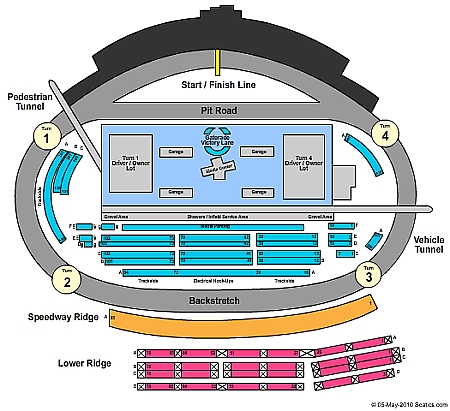
A look at Chicagoland. © Copyright unknown.
Going in the fourteenth round of the 2010 IZOD IndyCar Series Championship, it looked like Will Power had the title by the scruff of the neck. How quickly things can change…
The Australian – driving for the powerful Penske squad – went into the race with a 59 point advantage over Ganassi driver, Dario Franchitti, but left the Windy city with only a 23 point advantage. Of course it could have so different – as Franchitti surged to the lead at the tail end of the race, Power was not far behind, only to be let down by a malfunction on his fuel system during his final stop. The series leader found himself needing a “splash-and-dash” – an extra pitstop that left him far down the order.
The second Penske pilot, Helio Castroneves suffered a long stop early in race; something from which he also did not fully recover.
One could argue that this race equally belonged to Ryan Briscoe – another of the other Penske talents. Briscoe, picked up his third pole of the year on Friday night and led 130 laps, before more pit issues shuffled him down the order.
So good was Briscoe that the Australian held his own from the initial drop of the green flag; although Castroneves, Franchitti, Marco Andretti, Power and Dan Wheldon pushed him hard in the opening stint. Admittedly, the opening stint lasted only a matter of five laps as birthday boy Raphael Matos and series returnee Tomas Scheckter were collected following spins by both Alex Lloyd and Power. Matos and Scheckter were out on the spot – indeed the son of the 1979 F1 World Champion was none too pleased about the situation indicating that “…for someone to hit you from behind on one of these big tracks that early on, is uncalled for, but that’s what you get with some of these guys…”
It was also quite a moment from Power as he caught the Penske in a masterful fashion, ensuring that he could continue. Lloyd on the other hand burned his tyres badly in the spin and needed to pit under caution conditions – he was joined by de Simona de Silvestro, Alex Tagliani, Justin Wilson, Vitor Meira, Davey Hamilton, Sarah Fisher and Milka Duno.
As the green flag dropped on lap 15 Briscoe led from Andretti, Franchitti, Castroneves and Wheldon. Behind this leading pack, Ed Carpenter was making his presence felt. The American was driving only his second race of the season following the dissolution of Vision Racing last winter and was certainly proving a point to the field – starting from 11th position, Carpenter was 8th by the restart and even started mixing with top 5 for much of the race.
In the midst of this, Andretti-Autosport pair, Tony Kanaan and Ryan Hunter-Reay found themselves fighting over the tail end of the top ten with KV Racing’s, Takuma Sato – sadly for Sato, he would find himself having to pit early on lap 37, leaving him mired down the order.
Sato’s team mate Mario Moraes was also having a decent run. Both Sato and Moraes have come in for a lot of criticism this year for some unruly driving, but in the early part of the race, they had found their way up the field and were determined to climb even higher.
One driver who seemed to be going backwards was England’s Jay Howard. Driving for Sarah Fisher’s small home run team, the 2006 Indy Lights Champion has struggled this year and even missed this years Indy 500 when he was bumped out on the final qualifying day. Things were not going well at Chicagoland either – having qualified last, the Briton was running near the back of the pack when he had to pit on lap 31 for throttle issues.
It would be a further 23 laps before the rest of the field began to pit, starting with Andretti and Graham Rahal. Within five tours of Chicagoland, the remaining runners had made their run for new tyres and more fuel at least once.
At this point Wheldon and Castroneves had slow stops that dropped them down the order, but neither were met with Tagliani’s misfortune. The Canadian stayed out longer than the main field (having stopped early on); however it was a little too long – the driver of the FAZZT machine ran his fuel tank dry as he pulled into the slow lane, causing his Honda-powered Dallara to grind to a halt. Tagliani would be restarted, but would find himself well out of contention.
Lloyd would also find himself in trouble. The 25-year-old peeled off into the pits on the 69th lap from a solid 6th position with clutch issues – Lloyd would eventually go out and keep running, but never reached those heights again.
Not that any of this concerned the leaders – it was just one less challenger. In fact, Andretti’s only mission was to catch the leader. For lap after lap, the Andretti-Autosport driver would get closer, but could never seem to make a move stick. Resigned to having to try moves around the outside, the Dallara engines found themselves maxed out; although Andretti led over the line once, generally Briscoe held the advantage when it mattered.
It was constantly close though; each time around the duo were barely separated by 0.01 of-a-second – fascinating stuff, but it signposted clearly that even on a fiercely competitive oval like Chicagoland, overtaking was proving to be extremely difficult.
All of this was nullified on lap 78 when former Indy Lights runner, Ana Beatriz white-walled her Dreyer & Reinbold machine. Beatriz would pit immediately and was initially given the all-clear, but would be called in ten laps later to retire.
In the meantime, out came the full course yellows and in came the field to pit, bar Sarah Fisher. With Fisher running in the pack for much of the race, the team hoped an off kilter strategy may gain them spots when they eventually reached the chequered flag – for now, the 29-year-old from Ohio had the lead and was determined to make the most of the opportunity.
Takuma Sato is probably wishing he stayed out too. As his crew finished servicing his KV Racing car, team mate EJ Viso drove into the side of Sato as he was about to leave, spinning the Japanese driver around and destroying suspensions on both cars. It was not the first time two KV cars eliminated themselves with foolish blunders – one wonders if any of the current three drivers will in the team come next season. This time, it was all down to Viso and Sato had every reason to be frustrated: “…after the pitstop, I exit(ted) the box, unfortunately my teammate came in and hit me. (…) it’s just unnecessary.”
Their were other blunders too – Hideki Mutoh was sent out of his Newman-Haas pit with a poorly attached left front wheel. This came loose and was clear of the car before Mutoh returned to track leaving the Japanese driver to crawl back to the pits for a replacement wheel.
It wasn’t all calamity in the pitlane – having dropped back to 11th place, Franchitti was propelled back up the order with some stunning pit work. The double IndyCar Series Champion now found himself back in the top five.
Come lap 86, the green waved again, but it was almost unnecessary. Before it had a chance to flutter in the wind, the yellows returned when Tagliani found himself shoved into the awaiting walls, when Meira hit the back of Mutoh who in turn rammed Tagliani. While Meira continued with a new front wing, Mutoh had also picked up too much damage and was out of his car – an early end to a difficult day.
The green finally flew at the start of lap 90 and while Fisher led valiantly for a few laps, she would eventually be swallowed up by Briscoe, but in 2nd place Fisher held her own marvellously. For the next 15 laps, the Iowa-born lady would not be displaced from her 2nd position – for an age, Franchitti, Andretti, Moraes and Carpenter all tried to force the issue by going two and sometimes even three-wide into the turns, but Fisher would not budge. Power also sat behind, just biding his time.
It was not to last though as first Andretti and then Power stole precious positions from Fisher before she had to pit – it was a worthwhile gamble, but it simply hadn’t worked. Pitting under green flag conditions on an oval is a perilous result to an alternate strategy and one that tends to leave drivers laps adrift of the lead if it goes awry – Fisher would leave the pits in 20th place.
With Andretti and Power now in free air, they pulled right up to the leading Penske – it was blatantly clear the cars sitting in a draft were picking up 2-3 mph more that the cars in single air, making catching Briscoe easy. Unfortunately, once Power and Andretti were behind Briscoe, they too found it incredibly difficult to get by the Australian – yet another stalemate.
Up front the leading trio bogged down, Carpenter brought himself back into the mix and while none could quite match Briscoe, the on track fight between Carpenter, Power and Andretti became intense. Seemingly with each lap they swapped positions and exchanged spots in the road, whether it single, double or three-wide, they gave it their all – until lap 136. As fuel counters ran down to nought, the pits opened and the battlefield moved once again.
The timing was impeccable and the luck cruel – while others surged forward with perfect pit procedures, but for Carpenter and Moraes, good fortune abandoned them. While Moraes was self inflicted – he took his KV Racing machine over the speed limit line a little too quickly – Carpenter and his crew suffered from rustiness. Moraes would take a drive through penalty three laps later, while a very slow tyre stop dropped Carpenter down the order and out of contention.
The American would be further hindered when it transpired his fuel line had not given him the correct amount of fuel – Carpenter returned to the pits on lap 141 for another stop. If his day wasn’t over beforehand, it certainly was now.
Briscoe’s stop wasn’t up to scratch either – a poorer effort from his crew and suddenly the Australian found himself on the fringes of the top 6 with fellow Penske man, Castroneves – it would be the unraveling of Roger Penske’s day at Chicagoland. With Briscoe absent, Wheldon assumed the lead in National Guard sponsored Panther machine – Power and Hunter-Reay followed in his tracks, but could not get by the 2005 Indy 500 winner. Marco Andretti – who had also been the recipient of poor pit practice, would also join the fight for the lead, but would have to needle his way by Tony Kanaan and Scott Dixon to do it.
One driver who was not going to make any further was HVM pilot, Simona de Silvestro. The ‘Swiss Miss’ slowly crept down pit land and extracted herself from her car – day over.
With one-quarter of the race remaining, the lead was still separated by mere thousandths-of-a-second – Power, Andretti and Wheldon, all side-by-side, unwilling to give up the front as Hunter-Reay dropped back towards 5th place Dixon; Wheldon, though was beginning to run shy of precious “push-to-pass” engine boosts.
This battle, like all others, was to be nullified on 170th lap. Alex Lloyd, having an already difficult day, lost control of Dale Coyne machine on the exit of turn 4 with tyres smoking and grass bound – another full course caution, the field pit for the final time.
As the leading group left their pit boxes and fed back onto circuit, there was a very different look to the order. Dario Franchitti and his crew, still on relatively fresh tyres, decided to leave on the old rubber – the quicker stop propelled the Scot into the lead from 8th place, with championship leader Power just behind. This could be an epic finish between the two leading title contenders…
…or it might have been had Power received all his fuel. The Australian would eventually make his final stop on lap 194. Another driver to fall away was Carpenter; the American pulled into his pitstall to retire, as mechanical gremlins ended his day prematurely.
The race restarted on lap 178 and while Franchitti nursed his lead, Wheldon sneaked passed Power for 2nd place. More frantic action followed suit, as Briscoe, Andretti, Kanaan and Hunter-Reay attempt to go four-wide on the backstretch – of the four and placed on the outside, Briscoe lost out and had to get out of the throttle, dropping him to 13th position.
At the front, Wheldon and Power were not being dissuaded by Franchitti’s wide Dallara. For lap-after-lap, they tried around the outside of the Ganassi driver, but nothing would stick – every attempt resulted in a stalemate, albeit with less than one-hundreth of a second between them crossing the line each time by.
With Power out of the game with six laps remaining, Andretti pulled back into the battle for the lead and for the remaining tours, it was on between the leading, but no matter how much the Panther and Andretti-Autosport pair pushed, this was Franchitti’s day – the Scot crossing the start / finish line for the 200th time in first spot by 0.0423 of-a-second ahead of Wheldon.
It was the third win of the season for Franchitti and the boost he needed in his fight to retain the IndyCar title. His second victory at Chicagoland was also his 26th open-wheeled win, leaving level with the great Roger Ward for all time race wins.
Andretti was no slouch and ran Wheldon close and even he was not far ahead of team mates Ryan Hunter-Reay and Tony Kanaan. Both Wheldon and Andretti have had somewhat difficult seasons, but both matched their best results of 2010, although it was still a little shy of the success they desired. For Hunter-Reay, this was his best oval result of the year thus far.
Helio Castroneves and Justin Wilson took 6th and 7th respectively; however they were somewhat anonymous in the pack as they slyly picked up places on the night – it was quite an impressive feat by Wilson, especially considering he started 23rd.
Scott Dixon secured 8th place, but despite being 3rd in the series standing, any chance of a third title seem a long way off – he is now 85 points shy of Will Power and it would need monumental reversal of fortunes for the Kiwi to pull in both Power and Franchitti with only three races remaining.
Regardless of his mid-race incident with Mutoh and Tagliani, Vitor Meira picked up 9th position ahead of Graham Rahal, with Briscoe having to scrap 11th spot.
Reigning World Series by Renault driver, Bertrand Baguette finished a solid 12th – the young Belgian is really beginning to pull some very good results together. Hideki Mutoh and Danica Patrick were the last to finish on the lead lap, 13th and 14th respectively. Pitting under green eventually left Sarah Fisher a lap down and in 15th, just ahead of Power. Mario Moraes (17th), Davey Hamilton (18th) and Milka Duno (19th) were the last of the runners.
Over the years Chicagoland has made a habit of producing some of IndyCar’s most exciting races and while this year’s event was certainly no classic, it was still a good example of some very fine oval racing. Sadly, it looks like it may be IndyCar’s last hurrah at the circuit – with NASCAR taking early Autumn date from 2011 onwards, the series looks like it is being ousted from the circuit, lest a replacement date be found last minute. Even still, the low crowd at the Saturday night event was shockingly poor compared to previous runnings.
A shame.
Race Rating: 4 out of 5
2010 IZOD IndyCar Grand Prix of Chicagoland (Round 14)
FP Car Driver Team Laps Time Status
1 10 Dario Franchitti Chip Ganassi Racing 200 01:47:49.5783 Running
2 4 Dan Wheldon Panther Racing 200 01:47:49.6206 Running
3 26 Marco Andretti Andretti Autosport 200 01:47:49.6834 Running
4 37 Ryan Hunter-Reay Andretti Autosport 200 01:47:49.7414 Running
5 11 Tony Kanaan Andretti Autosport 200 01:47:49.9191 Running
6 3 Helio Castroneves Team Penske 200 01:47:50.0651 Running
7 22 Justin Wilson Dreyer & Reinbold Racing 200 01:47:50.1736 Running
8 9 Scott Dixon Target Chip Ganassi Racing 200 01:47:50.4920 Running
9 14 Vitor Meira A.J. Foyt Enterprises 200 01:47:50.5371 Running
10 02 Graham Rahal Newman/Haas Racing 200 01:47:50.5624 Running
11 6 Ryan Briscoe Team Penske 200 01:47:50.5968 Running
12 34 Bertrand Baguette Conquest Racing 200 01:47:50.6616 Running
13 06 Hideki Mutoh Newman/Haas Racing 200 01:47:50.8825 Running
14 7 Danica Patrick Andretti Autosport 200 01:47:51.1441 Running
15 67 Sarah Fisher Sarah Fisher Racing 199 01:47:51.6270 Running
16 12 Will Power Team Penske 199 01:47:58.1955 Running
17 32 Mario Moraes KV Racing Technology 199 01:48:01.2063 Running
18 21 Davey Hamilton de Ferran Dragon Racing 199 01:48:01.3746 Running
19 18 Milka Duno Dale Coyne Racing 197 01:47:51.7735 Running
20 20 Ed Carpenter Panther Racing 179 01:39:43.6087 Mechanical
21 66 Jay Howard (R) Sarah Fisher Racing 162 01:47:51.4765 Mechanical
22 19 Alex Lloyd Dale Coyne Racing 161 01:39:19.4910 Rejoined
23 78 Simona De Silvestro HVM Racing 150 01:25:03.1938 Mechanical
24 24 Ana Beatriz Dreyer & Reinbold Racing 88 01:34:52.8506 Mechanical
25 77 Alex Tagliani FAZZT Race Team 85 00:50:05.2152 Contact
26 5 Takuma Sato KV Racing Technology 80 00:44:19.7999 Contact
27 8 E.J. Viso KV Racing Technology 80 00:44:20.5096 Contact
28 36 Tomas Scheckter Conquest Racing 4 00:01:45.1407 Contact
29 2 Raphael Matos de Ferran Dragon Racing 4 00:01:45.4504 Contact
2010 IZOD IndyCar Series (Round 14)
1. Will Power Penske 528 points
2. Dario Franchitti Ganassi 505
3. Scott Dixon Ganassi 443
4. Ryan Briscoe Penske 406
5. Helio Castroneves Penske 398
6. Ryan Hunter-Reay Andretti-Autosport 392

 TheMotorsportArchive.com