
(I was meant to post this last weekend, but… forgot).
The IRL has had a couple of title sponsors over the years, but neither of those were successful ventures and, to be honest, were half-arsed from the outset.
However, the series has just signed a new title sponsor in the shape of IZOD with a 6 year-plus deal that, rather than just keep the series alive, but even push it towards sustainable heights once more. I’ve stuck the press conference below – most will think it’s boring, but for me it was a genuinely exciting announcement. As well as that, I am also amazed at the how the models in background don’t move a fucking inch for 21 minutes solid…
IZOD IndyCar Series Media Event
Discussing the Announcement
Driver Reaction
Of course it is naturally disappointing when a team decides to leave Formula 1 – especially one as big as Toyota. The Japanese manufacturer are just another in an ever growing list of Asian companies to have decided to jump from developmental motorsports in the last 18 months; that list includes Bridgestone and Honda (F1), Subaru and Suzuki (WRC) and Kawasaki (Moto GP) – there may be others that I have not heard about yet.
Whether Formula 1 will truly miss Toyota or not is a different matter, but the initial feeling from fans and viewers is that while it is bad news that another team has left the sport, no one is surprised that Toyota have split – it is news that had been rumbling for over a year. There were strong rumours at the start of this season that they had to win at least one race during the 2009 season, otherwise a serious rethink would be necessary.
Considering that they had some of the highest funding in Formula 1 history, the best the team managed was 4th place in the Constructor’s Championship in 2005 (which was achieved under speculation of cheating) and a number of 2nd place finishes. However, 13 podiums in 8 years for a team that reportedly spent over $1 billion is simply not good enough – the likes of Ferrari, McLaren and Renault have won World Championships by spending less money.
Stories of political infighting and difference of opinion regarding future direction seemed to plague the team following team boss Ove Andersson’s departure from the squad in 2003; too much influence wielded by people from outside of the team itself also seemed to be a constant complaint – there appeared to be many instances of the team itself not working as a productive unit and Toyota are not be the first (or the last) to fall into that trap.
The truth be told, Toyota are not a racing team; they’re a car manufacturer – one of the biggest in the world, if not the biggest. For a company such as this, motorsports is a side-issue and like Jaguar and BMW, they seem to lack the appreciation for motorsports to understand its finer nuances.
Many large constructor’s see F1 as a massive marketing tool, but I have never met a single person who bought a Toyota, Honda, BMW, Ferrari, Mercedes, Renault or Ford because they happened to be competing in Formula 1 – it is not a theory that enters the public consciousness.
Toyota failed, sadly, because they didn’t know how to race.
There is one remaining question for Toyota: “was Timo Glock actually injured?” Whenever this subject came up over the last couple of races, there was a feeling of “Timo’s still injured (nudge, nudge, wink, wink)“, but we happen to have this Japanese who can jump in the car at a moments notice.
Admittedly Kamui Kobayashi did a very good job in the two races he drove for the team in Brazil and Abu Dhabi (if maybe a little ragged at times), but rolling out the national driver when the boardroom are considering pulling the plug was a little crass. Meanwhile, Glock himself appeared to be wandering around the paddock with seemingly little actually wrong with him.
In a sense Toyota had very little to lose in fielding the Japanese driver – they were mathematically too far ahead of the teams behind them and were never realistically going to catch the McLaren or Ferrari teams for 3rd or 4th place, so what ever result that Trulli and Kobayashi got in Brazil and Abu Dhabi would have little potential baring on the eventual outcome. So, did Glock deliberately crash in qualifying and thus, was he injured at all?
What now for Trulli, Glock and Kobayashi? Well, the rumour mill says that Trulli will be at Lotus and will be back with former Toyota and Jordan designer Mike Gascoyne at the new Lotus team and that Kobayashi is to battle it out with Takuma Sato for the second seat at the returning squad, while Timo Glock is nearly certainly signed by Renault, but it has yet to be officially announced.
How ironic that the last fuel stop in modern Formula 1 was done by a Toyota..? Well, not at all actually – that was just a coincidence…
*the 5-10 year test:
If a country has such an international event, then rather than scoff it immediately, a certain amount of time is given in which a grassroots level of drivers may develop – if there is not even a blip on the radar after 10 years, then the project may be deemed a failure. There are obvious exceptions to this rule (i.e. – Spain) but they are very rare indeed.
 It is 6:22am and the sun is slowly brightening the sky on this cool November Monday morning and only one day after the 2009 Formula 1 season finishes, I rise to the news that Bridgestone are quitting Formula 1 cold from the end of next season. After what will be fourteen seasons (seven of which will have been contested without opposition), they are to concentrate purely on their “development of innovation technologies”.
Interesting times ahead indeed.
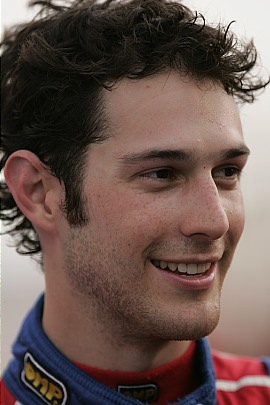
Bruno Senna in his GP2 days.
Bruno Senna has signed a deal with Formula 1 new boys, Campos-Meta, for the 2010 season. Bruno, who is the nephew of three-time Formula 1 World Champion Ayrton Senna, has had success in a number of junior categories; despite having not run in the many Karting Championships that his peers competed in.
Although he had began to race Karts at a young age, his family forbade the youngster from racing when Ayrton was killed at Imola in 1994; however having driven his uncle’s 1986 Lotus charger some years ago, Bruno decided to take up motor-racing once more and jumped straight into the Formula BMW series in the UK.
Seasons in Formula 3 and GP2 followed and although the young Senna did not score any Championship victories, he did many to win races on a number of occasions – finishing 3rd in the 2006 British Formula 3 series and 2nd in the 2008 GP2 Championship.
Following his second season in the junior series, there were rumours that the young Senna was to replace Rubens Barrichello at Honda for the 2009 Formula 1 season; however those plans were scuppered when the Japanese manufacturer pulled out of the series last December.
When Bruno lines up on the grid at Bahrain in March, he will join the list of famous (and not so famous) drivers that have had sons or nephews race in F1; such as Hill, Villeneuve, Fittipaldi, Andretti, Nakajima and Rosberg. Whether he will success as Damon Hill, Jacques Villeneuve and Nico Rosberg have or whether he disappear like Christian Fittipaldi and Michael Andretti (and like Kazuki Nakajima soon will) is entirely up to him, but one thing is for certain – the name Senna will create a pressure that may be difficult to live up to.
One of the drawbacks of motor-racing is its dangers. Even at the very pinnacle, accidents can happen – whether they be through driver error or mechanical fault.
Some crashes are large, some are minor; but thanks to many developments in car and circuit safety over the years, drivers generally walk away fairly unscathed.
The days of at least one or more fatalities or serious injuries are (for the most part) long gone – ironically enough, this year would seem to be the exception to that rule (see Henry Surtees and Felipe Massa).
However, every so often, there is an accident that is so devastatingly huge that it can leave a chill down your spine. Examples that stand out would be Alex Zanardi (CART, Lausitzring, 2001), Roland Ratzenberger and Ayrton Senna (F1, Imola, 1994) and Jeff Krosnoff (CART, Toronto, 1996)
However, no accident has turned my stomach quite like the one suffered by Canadian CART driver Greg Moore at Fontana Motor Speedway on October 31st, 1999.
It seems so difficult to believe that it is ten years since Moore’s death. There had been an exciting lead-up to the race as it was the Championship decider between Juan-Pablo Montoya and Dario Franchitti.
Earlier that day, Mika Hakkinen had just won his second Formula 1 World Championship and I was desperately excited to see the climax of what had been a great year of racing. The US500 would be the final top-tier race of the year and what better setting than California?
For those that have seen Moore’s accident, it can be rather difficult to explain (and not nice to visualise). To put it simply, Moore over-steered off of turn 2 and fell into a fast slide; his car was flipped up into the air by high level grass and the top of the machine smashed against the inner concrete barriers.
Following several sickening barrel-rolls there was nothing left of the car and no life in the cockpit.
As is well documented, Moore had suffered a separate accident the previous day – only this one was in the paddock on a motor-scooter. Although he had broken a finger, he was administered with painkillers and cleared to race the following day.
Whatever one says about his crash, it is difficult to describe the exact feeling when you witness something so horrific and brutal.
I vaguely recall a deep emptiness at the bottom of my stomach and a feeling that I really wanted to be sick. From the severity of the incident, it was fairly clear that no good was going to come of this.
Moore had something of a meteoric rise through the junior ranks of USAC and IndyLights and eventually reached the CART World Series with the Forsythe Racing team at the tender age of 20 and it was not long before he was making his mark on the series by picking up a number of podiums during his début year.
He didn’t have to wait too long for his first victory though as Moore triumphed at the Milwaukee Mile in 1997 just ahead of Michael Andretti and followed that up with – admittedly – a lucky win at Detroit a week later when the PacWest duo of Mauricio Gugelmin and Mark Blundell ran out of fuel on the final lap.
Wins didn’t come easily though for the Forsythe team over the next couple of yeas as Moore only picked up three more wins during the 1998 and ’99 seasons, but his speed and enthusiasm could not be questioned and it was these factors that brought him to the attention of US Racing giant, Roger Penske.
Just prior to his fatal accident, Moore had announced that he had signed to Penske Racing from 2000 onwards – a move that would surely have made him as a top-level driver. Penske has had a habit of taking fast, but inconsistent drivers and turning them into very quick, consistent runners; the kind of stability that Moore lacked on occasion.
He was also just one of an exciting generation of drivers that burst through to CART in the mid to late-90’s that are still successful in the IRL series today – namely Dario Franchitti, Helio Castroneves and Tony Kanaan; others from that group that are not active right now include Paul Tracy, Alex Tagliani, Orial Servia and Patrick Carpentier.
One of things that I always admired about Greg Moore was his demeanour. He projected a character that was calm, charming and genuinely likeable and lacked the arrogance and aloofness that is often associated with top-level athletes.
Often I have thought it pointless and silly to predict the outcome past events had circumstances been different; however I am one of many that feel Moore had the potential to be Indy 500 winner as well as CART / IRL Champion at some stage.
Moore was only 24-years-old at the time of his death and is still sorely missed by all – he surely would now still be at the top of his game and could well have been one of the greats.
(Greg Moore, 1975 – 1999)
 *I was actually meant to post this on Monday, but things have been busy, busy, busy…
It has a number of years since I last followed the World Rally Championship properly – it is around the turn of the decade that I lost touch with the series. This had nothing to do with not liking the events and series, but more to do with the local network losing coverage; rallying simply fell off the radar. The same happened for CART and MotoGP too – once I left home, it became impossible to follow and eventually interest naturally waned.
To a degree, the WRC is always something that was going on in the background. It was impossible to have at least not heard of the exploits Colin McRae, Richard Burns, Marcus Gronholm and Petter Solberg, but I never followed it too closely until this season.
There are a large number of people that claim the Michael Schumacher/Ferrari era of dominance in Formula 1 was one of the worst in the sport’s history due to the sheer scale of his dominance over the field, but I have never agreed with that stance – if anything, there was a feeling of excitement as sheer excellence triumphed at the pinnacle of motorsports.
For this reason, I am somewhat saddened to have missed out on the last few years of the WRC, because Sebastien Loeb has been busy “doing a Schumacher” and destroying everything in his wake and on Sunday just gone, Loeb with his co-driver Daniel Elena, claimed his 54th Rally victory (from 125 starts) at the Rally of Britain and his sixth consecutive WRC title. One must also bare in mind that the Citroen driver could have made that seven straight titles, but lost out to Petter Solberg in 2003 by a single point.
Although made have had it easier in years gone by (2004 is a good example), this season he was really pushed by Finnish driver Mikko Hirvonen. Although the Ford driver first entered the WRC in 2002, it is only since the 2007 season that he has strung together consistently good performances and victories – 12 in all now – but this was the first year where Hirvonen looked really close to Loeb.
The Finn led the championship coming into the final Rally in Britain, but lost out to a superb drive by his rival, giving the title to the Frenchman. One thing is for certain though; Hirvonen’s time will come – at only 27, he’s still young, but he will be eager to claim at least one WRC before Loeb retires and with the Citroen man now on the wrong side of 35, that may only be a couple of seasons away.
If one were to look at the season as a whole, Loeb probably deserved it with his seven Rally victories to Hirvonen’s four; however it was Mikko’s consistency that really stood out this year. When he wasn’t winning, he was often in 2nd place and a drop-off in form mid-season by Loeb let Hirvonen back into the title.
Confusing matters though was an awful lot of talk of Loeb switching to Formula 1 to drive for Toro Rosso – in fact it was only four days before the Rally of Britain that he was denied his superlicence. Many in the Rally paddock spoke of the Citroen man suddenly becoming distracted from matters at hand and not quite focusing on the job, thereby letting Hirvonen creep up in the points standings.
We may now never know how competitive Loeb would have been in an F1 car; he has since conceeded that the Toro Rosso opportunity was his last chance and now signed on again for the French manufacturer for another season. One thing is for certain though, Loeb may well be in for a fight next yet; not only with Hirvonen, but it would seem his young team-mate, Dani Sordo, has finally found his feet and may fancy a challenge.

News emerged last month that the famous Spa-Francorchamps race circuit in Belgium is to have its licence revoked due to noise complaints from recently arrived residents.
The track, which was originally built in 1920 and apart from a few gaps, has been holding Grand Prix as the host to the Belgian Grand Prix – occasionally swapping with Zolder Race Circuit – and is a known favourite amongst both drivers and spectators. So much so, that many of the Formula 1 drivers claim it to be the finest track in the world, with only Le Mans and Suzuka coming close to a similar accolade.
It’s not just the circuit as a whole that is famous, but also some of its terrifyingly fast corners such Eau Rouge , Pouhon and Blanchimont.
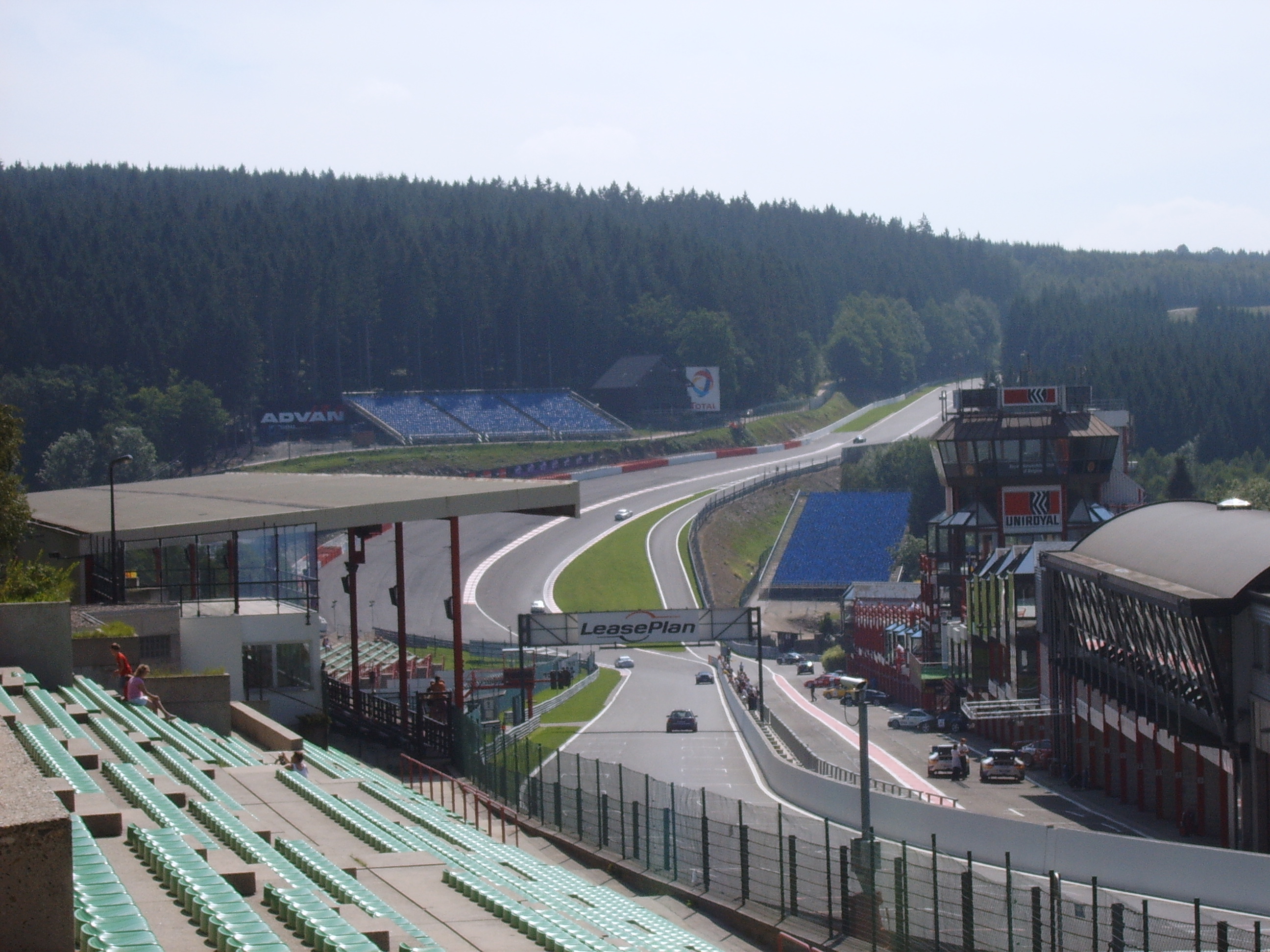
Overlooking Eau Rouge
As of September 23rd, it appears that the historic circuit’s future is in serious doubt. Noise issues arising in 2007 have led the facility to have its license removed until 2026 by the local Council of State; however opposing locals have decided to raise their voices in defence of the track, claiming that the track is:
“…the most beautiful circuit in the world is a real economic tool, which gives work to a significant amount of people and a lot of publicity and a dynamic and qualitative image of Belgium all around the world…”
They also go on to say that:
“…they are for the continuity of the circuit… and we will fight to preserve it. We are sorry for the people that don’t agree to be integrated into local life.
If like us, you like the circuit of Spa-Francorchamps;
If like us, you are conscious of the historical and touristic heritage of our country;
If like us, you are proud of your area;
If like us, you want to fight the crisis and react to the criticisms;
If like us, you like the track and want it to survive;
Then please sign the petition”
The petition to help save the wonderful Spa-Francorchamps circuit can be found here – petition. Meanwhile, a lap from Fernando Alonso…

The banking at Monza reached incredible heights
One of the current themes of not just Formula 1, but motor racing in general, is one of cost-cutting and material conservation.
Mention those two elements in the same sentence as F1 fifteen years ago and you would have been laughed out of every room, but times have changed.
In a greater push to bring costs down, the FIA has introduced a raft of new regulations over the last decade or so, to try to limit amount of waste associated with the sport.
However to assume that this is a recent concept may be something of an error – in fact, the theory of material conservation was originally planted in the early 1950’s, although it is doubtful that economy was the main driving force behind it.
When designers Antonio Beri and Aldo di Renzo set about redesigning and rebuilding the old oval section at Monza, they had a couple of primary motives;
- in accordance with the thoughts of today, it was considered that rebuilding the oval from the 1920’s would give both brakes and transmissions time to “breathe” following a lap of Monza’s hard braking, hard-shifting circuit, therefore making them last a full race distance with fewer issues; and also
- it would create a performance track with a very high average speed.
In addition to these points, a very high banking – approximately 38.69 degrees at its highest (the equivalent of a gradient 80%) – would also benefit the steering column and arm section, as the machine would naturally curve around the high banked walls as opposed to the cars having to steer into them.
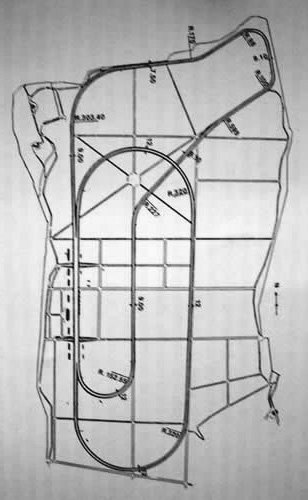
The map of Monza, with banking.
Beri and di Renzo’s great plan was to have the Autodromo di Monza ready for the 1955 Italian Grand Prix, but they very nearly didn’t make it in time.
Construction began in March of that year as the remaining sections of the old oval from track built in 1922 were demolished and replaced, but severe delays and continuous circuit development problems meant that the track was completed only two weeks prior to the Grand Prix.
Meanwhile difficulties refused to go away. When the new circuit opened, it measured in at 9.8km making the 1955 Italian just under 500 kilometres in length, yet there were still concerns about the bumpiness on the banking’s and quality of surface over many sections.
The first race at the “new” Monza was scheduled to take place less than three months after the great Le Mans disaster that claimed the lives of 84 people – as a result of the Le Mans incident, there were fears that the Grand Prix may be cancelled due to worries about excessive speeds on the banking.
With the tragedy still raw in the minds of many, all the British teams (except for Vanwall) boycotted the race, essentially leaving a field with just Mercedes, Ferrari and Maserati cars. Eventually the Grand Prix was given the go ahead and was taken by the Mercedes of the great Juan-Manual Fangio in a time just shy of 2-and-a-half hours.
The following year, the British teams entered the race following a test to ensure that the cars could survive the high speeds on the outer sections. Sterling Moss took the victory ahead of Fangio in front of a very interested party – American race manager, Duane Carter.
The Autodromo’s chairman, Giuseppe Bacciagaluppi, had often dreamed of a contest whereby the best talent from Europe could take on the might of the US – a proposition made to Carter following the 1956 race.
At the time, the Indianapolis 500 was still part of the Formula 1 World Championship and Bacciagaluppi was determined to bring USAC drivers to Monza to compete in a 500 mile race on the oval section – the first event (called the Monzanapolis 500 or the Race of Two Worlds) took place in June 1957.
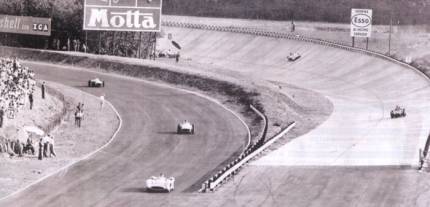
Both the regular track and oval woud be used at the same time
Prior to the race, American driver Pat O’Connor conducted a tyre test on the oval and clocked over 225 miles with a top speed of 170mph – the competition had yet to start and the speeds were already 30mph faster than at Indianapolis.
However, apart from a small number of sports car drivers, the first event was shunned by the Formula 1 community and Jimmy Brian won the first Two Worlds Trophy with a combined average speed of 160mph. Unlike the Indianapolis 500, the Monza event was split into three separate 63-lap heats with an hour in between the sprints.
The following year Jim Rathmann took the prize with a minor Formula 1 field present and with Fangio and Maurice Trigtinant in USAC machines while a young rookie called AJ Foyt would replace Trigtinant to make his European début in the second heat.
Nightmares of what might happen should a driver get it wrong or suffer a failure on the steep section were very nearly realised in the final heat as the steering column of Moss’ Maserati failed 20 laps from the end.
Unlike at most circuits where circuits were lined with barriers, tree, hay or ditches, Monza’s steep banking had a small wooden barrier – if a driver broke through it, the only way was down to the forests and track below.
On this occasion, Moss got lucky. He was able to scrub off enough speed before riding the barrier itself; eventually he slowed down enough to safely ride down to the inside lane.
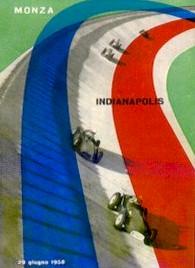
The cover of the 1958 Monzanapolis race
And that was it… Unfortunately the Race of Two Worlds was considered a financial failure, despite being a favourite with drivers and the few fans that did attend.
Grand Prix at Monza over the next couple of seasons took part on the regular circuit and the oval section did not come back into use until the 1960 Italian Grand Prix, but even this reprieve would be short lived.
With Formula 1 machinery becoming faster and faster, it became apparent that at some point soon, they would be too fast and dangerous for the full track.
Sadly, that day would come in September 1961, when an accident involving Ferrari’s Wolfgang von Trips and Lotus’ Jim Clark would claim the lives of fourteen spectators and Von-Trips himself, at the entrance to the oval section – with this carnage so public, the banks of Monza remained closed to the higher echelon’s of motor sport for good.
Although the oval was used for intermittent sports car races from 1961 onwards, it eventually fell into disrepair and the final competitive race on the banks took place in 1969 as more and more events moved to the road circuit for safety reasons.
Since the late-1990’s the banking has escaped demolition on a number of occasion’s and there are petitions and campaigns to get the oval section recognised as a monument of historical significance.
As for now, trees grow around and the concrete is slowly cracking and breaking apart; however there are rumours that it may be saved with the addition of a national park as the centre piece. One can only hope it is true.
1957 Race of Two Worlds
Footage from the 1966 motion picture, Grand Prix
 Without wishing to question the talent of Sebastien Bourdais, something has always struck me as troubling; but let it be known first, that these particular troubles are irrelevant!!
With many of CART’s star names gone (to other racing formula’s such as NASCAR, IRL, variations of Sportscar’s or even retirement) its big teams swiftly vacating the series, CART was a shadow of its former self. At their lowest ebb, teams began to refocus their efforts and resorted to hiring “pay” or “sponsorship” drivers in order to pay the bills – many still cite 2002 as the last season that CART had a large array of talent still active. By the following March, with the series’ financial and political woes becoming more public, even CART’s staunchest supporters were jumping ship.
2003 saw Paul Tracy finally win his first (and so far only) Open Wheel Racing title, but by then years of mismanagement finally saw the CART series bankrupt, eventually to be taken over by Open Wheel Racing Series and renamed Champ Car. With the series “re-started” and featuring the likes of (an aging) Roberto Moreno, Alex Yoong, Mario Dominguez and Tiago Monteiro amongst others, it became difficult to take Champ Car as seriously as CART was in its 1990’s heyday. Latterly Gaston Mazzacane and Tarso Marques would join its ranks and the reputation of the series would dip further still.
…and then in 2004, even I stopped caring.
The depth of talent that had existed in years previous had disappeared – Alex Zanardi had lost his legs, while Greg Moore had lost his life and names such as Andretti, De Ferran, Vasser, (Bobby) Rahal, Unser Jr and Fittipaldi had now vacated the series long since and suddenly Champ Car had no stars to turn to and no public face with which to show the public.
While he was Rookie of the Year in 2003 and had taken three victories as well as pole position in his first race, it was here that Bourdais’ run of success began and in 2004 he notched up the first of his four titles. From here on in the field began to shrink and the number of events each season grew smaller, before the series finally merged with the Indy Racing League in February of last year. There is no doubt that Bourdais is a talented racing driver; however there must be serious questions as to whether he would have taken four titles, 31 race wins and 27 poles in a stronger field. When it comes to “raw” racing, then Bourdais is incredibly talented, but when he made the move to Formula 1 he was badly caught out by the speed of technical development – earlier this year, one Toro Rosso mechanic noted to F1 journalist James Allen that Bourdais was fast, but he spent his entire time chasing the car.
This week, the 30-year-old Frenchman secured a seat with Formula Superleague team Seville AFC – it’s a series that may suit his style, with spec chassis and engine units designed by Panoz and Menard respectively; however one quick look at the entry list and thoughts of Champ Car era poor drivers rapidly return – Bourdais should win easily…
 There was a running joke at last weekend’s European Grand Prix regarding Ferrari substitute driver, Luca Badoer – on the television coverage, Badoer’s name is abbreviated to “Bad”. However, I doubt even Ferrari in their wildest dreams (or nightmares) could have though that Badoer could be that slow. The Italian driver was regularly 2 seconds slower than Raikkonen during practice and qualifying and 1.5 seconds per lap slower than the Finn throughout the race.
To be fair to the chap, to be “with it” 10 years after his last competitive drive was never going to be easy and Badoer was never the fastest driver when he was in Formula 1 first time around – however, it is clear that he is simply one of the best test drivers in motor sport; arguably along with Alexander Wurz and Brian Herta.
A very major problem for Badoer is that the current in-season testing ban has left him completely out of the car without any other drives at all; whereas Ferrari’s fourth driver, Marc Gene, has taken up sportscar racing to keep himself race-fit. Badoer has one more race to acquit himself – this weekend’s Belgian Grand Prix – but I can’t see him do anything other than drive around at the back.
 Obviously the big story during the summer break was the possible return of Michael Schumacher, something that was eventually ruled out a neck injury. It was such a shame that the great Schuey could not make it back, but those that criticised the German for bottling it seriously need to be hit with a giant stick to store some sense.
The number of armchair experts claiming that he “only had motorbike accident” and that 10 minutes in the car would be fine, quite simply know nothing of the sport and its physical pressures. Schumacher, who as early as 2005, was complaining of a bad back of muscle strain had simply done too much damage when he crashed in February with reported ligament finally nailing any chance of a come back.
There has always been a lingering feeling that Schumacher left the sport too early and his immediate desire to jump straight into the car made those feelings even more pronounced. The 7-time World Champion may have “retired”, but realistically Ferrari had Massa in place for 2007 and signed Kimi Raikkonen from McLaren (to make way for Lewis Hamilton). Unless Schumacher fancied rounding up his career at a mid-field squad, his only other option was to leave…
But what now for Schuey? He is now approaching three years out of the sport and is 41 years old next January. Should he recover from his neck injury, he could be well into his 42nd year before he gets an opportunity to return and it is conceivable that at that stage it may really be too late for him to get back into a Formula 1 race seat. As for the IRL, he has stated on many occasions that he will not oval race for safety reasons and he drove sportscars nearly twenty years ago, so why would he return to that?
A couple of weeks ago, I noted that Ferrari boss Luca Di Montezemelo might be interested in putting out a third car if the rules could be amended, which is an interesting idea. Technically, the previous set of rules regarding this regulation stated that two cars could score Constructor’s points, yet a third vehicle could not; however all three drivers’ point’s would be eligible for the Driver’s Championship, but with Fernando Alonso nearly certainly heading to Maranello in the next year or two, would Ferrari bother?
This situation with Luca Badoer and Michael Schumacher was also the realisation of another very real problem for Ferrari – they have no genuine replacement drivers and no youth system in place with their teams. Whereas Renault, McLaren, Red Bull and Toyota have young, race-fit drivers going back to GP2 and Formula 3 (and in Red Bull’s case, all the way back to go-karting) ready to jump in if necessary, Ferrari have no-one lined up – especially when you consider that Ferrari have spent most of their existence plucking drivers from other teams to compete for them. Even Williams have a young driver (Nico Hulkenberg) ready to step in needs be, although there are strong rumours to suggest that he will have a full time seat next season though. The theory used to be “why should we? Let drivers come to us.” Once again the Scuderia have been found wanting…
In the meantime, i have a busy weekend ahead of me. I will try to get a couple of reviews in, but I shall be standing at a gig tomorrow as well as catching up on the Formula 1 practices, qualifying, the race as well the IRL 300 from Chicagoland and the GP2 and IndyLights races. It is going to be a long weekend staring at an awful lot of things.
Just a short note here folks; I want to send my best wishes and “get well soon’s” to both Will Power and Nelson Philippe who were involved in pretty big smash in free practice from the IRL GP of Sonoma earlier this morning (a clip of the crash is below). Essentially, Philippe spun coming through corner 3A and was first clipped by EJ Viso, before being t-boned by Power.
As far as we know at this stage, Philippe has a fractured left foot, while Power has suffered two compression fractures to his lower back. Both drivers also sustained concussions. If you are squeamish, look away…
 It’s been a strange year for the IRL thus far in 2009 – a poor global economy, Tony George ousted at the Indianapolis Speedway, some surprisingly processional oval races and virtual dominance from two teams has brought the series in for a lot of criticism from all sides.
However, I have no intentions to dilly-dally about – I suppose you could call this a view on the IRL from the eyes of a European citizen and Formula 1 fan, so let’s get going…
Schedules and Overreactions
Something that disappointed me was not necessarily next year’s schedule, but indeed the reaction to it and while I understand that many fans of the series are disappointed that road/street circuits outnumber ovals for the first time in the series’ history, I believe that fans should also embrace the fact that the IRL has one of the most diverse circuit line-ups in motor racing right now. Rather than criticise it, I think it should be applauded; however like everyone else, I do have some concerns.
First thing’s first – I am not a fan of either Edmonton or Sonoma racetracks. For the life of me, I just don’t see how Edmonton City Centre Airport qualifies as a circuit – rarely ever is enough speed built up on the straights to generate enough of a tow to bring cars past; while the corners themselves are too fast to encourage out-braking manoeuvres and too slow to power past on the exits onto the straights due to the dirty air from a car in front.
Sonoma – something of a dust bowl – suffers from general twistiness and a lack of long straights thereby removing much opportunity to be fast enough to draft by an opponent; while regular season opener, St Petersberg on the other hand often leaves me cold and a little bored – I just hope the IRL does not go down the Champ Car route of a parade in the car park’s of Denver.
If it were possible, I would like to see them replaced with a super-speedway along the lines of Fontana and at least one other tri/1.5 mile oval. Of course, it goes without saying that Milwaukee should be on the schedule and although the new promoter’s are in talks with the IRL to place the race in its usual spot just after the Indianapolis 500, I have often wondered if it was this very fact that has potentially harmed numbers at the circuit over the years. Should the worst happen and it not be on 2010 schedule, then I hope that they can claw back enough finances for it to follow the 2011 Indy 500 – which of course would celebrate the 100th anniversary of the first 500-mile event – a fitting tribute for a venue which has a long history of its own.
 With regards to the new Brazilian race in Rio, it is such a shame that most of the Jacarepaguá circuit (right, 1987 Brazilian GP) is now gone – the old Formula 1 track there was very fast and leant itself to some fantastic overtaking, while the inbuilt tri-oval circuit there was also very good when CART visited the circuit from 1996 to 2000.
However when I learned that there plans being put in place for a street circuit, my head dropped somewhat. Street circuits can be interesting if they are done right – Monaco did it right, Long Beach did it right, Montreal did it right and Toronto did it right (I may also add to that list Macau; but for its supreme driving challenge as opposed to great racing). All of the above tracks also have a great deal of history – a story if you will – and that is something that you cannot manufacture from concrete and gravel.
Unfortunately many modern circuits do seem to possess a very basic flaw, with overtaking areas being manufactured into the layout and design; as opposed to tracks that flow with the gradient of the land as it naturally is. While this is not a point against a designer like Herman Tilke (current Formula 1 track designer) per se, it is not awfully inspiring to see land completely flattened, so that straight line/tight corner combination’s with a certain percentage of twisty bits can be applied – driver’s constantly refer to these as technical circuits. The moment anyone mentions those faithful words, I know it’s going to be a dull race, regardless of the Formula that is in action.
That the series in 2010 is being opened in Brazil is a mistake as I think it could do better if slotted with Motegi later on in the season (what a shame Surfer’s Paradise is not on the schedule, as a three-tier flyaway scheme could have worked very well); the IRL is, after all, at heart an American racing series and having a US race to open the season should be a bit of a no-brainer. However, without knowing of any timing, TV or contractual issues, I can’t help but feel that Long Beach would be more of a “grande” opening to the year.
Dissent and Formula 1
Regarding the dissent concerning the 2010 schedule, I was surprised by some of the responses I came across on the web – while many were disappoint, there were many comments that were more than just anti-F1 insults, but folk were taking digs at people from certain countries and bringing old innuendo’s and stereotypes to the fore. This simply is not on at any level.
The problem with being on the inside looking out is that you often have a mistaken idea of what the outside actually represents. Many Formula 1 fans catch the following years schedule and often think “that race track is horrible, this particular country obviously does not dig F1, why are we going there..?” Etc, etc…
It was something that was drilled home by the incredibly low attendance figures at the Malaysian, Chinese, Bahrain and Turkish Grand Prix this season. The Valencia Grand Prix reported extremely low ticket sales until the return of Michael Schumacher was announced and rumoured numbers for the upcoming Singapore Grand Prix do not look impressive. Crowd numbers for Friday morning practice at this year’s British Grand Prix (at approximately 10am) were around four times higher than the attendance for the actual Bahrain Grand Prix. Remember IRL fans, if you dislike the IRL schedule, you should only look in despair at the places Formula 1 goes to…
Physical Regulations
Simply put, not all road courses are going to work, but a lot of what does work depends on the regulations that a series runs at any particular time; something that became apparent on some of the ovals this season. It also fits in that while the cars may be powerful and fast machines on ovals, when it comes to the road courses, they simply are not fast enough. At 650bhp, they seem to tumble around many corners in awkward manor that at some sites is not pretty at all and makes the cars appear like lumbering JVC’s.
It would be interesting if Honda (or whichever engine manufacturer is in the sport in 2012) could build a budget engine that runs at 750bhp, but is detuned or HP limited on ovals so that speeds can be kept in check – there are obviously no need for some of the insane speeds that CART was achieving in 2000.
TV Rating
As for the TV ratings, it has been reported on Pressdog and My Name is IRL on a number of occasions that the numbers of Versus are somewhat low, however Versus, like the IRL itself, is still very young and although numbers are low now, it will be beneficial to both parties to stick together and grow in tandem and while it may never recover the viewing figures of years gone by, the series may attain a healthy following that will allow it flourish and expand.
It struck me during the Kentucky 300, that every-so-often in the corner of the screen, Versus was advertising live Cage-fighting, so it is safe to say, that this is not mainstream television that I am writing about here.
Drivers
Again there seems to be a lot of criticism from fans of the series regarding the domination of Penske and Target Chip Ganassi Racing, however I think there is more to the domination of the almighty red cars than meets the eye.
I stated earlier in the blog that the IRL should be applauded for a circuit schedule that is diverse and representative of multiple forms of racing – may I add to that, that I believe in Scott Dixon, Helio Castroneves, Dario Franchitti and Ryan Briscoe, the two leading teams have also cornered the best drivers on the grid – the only possible exceptions being Tony Kanaan, Danica Patrick and Will Power (who happens to drive Penske’s occasional third car).
While a number of drivers have shown supreme capability on a certain tracks (i.e. – Wilson on road circuits and Carpenter on ovals), the above drivers are potentially the only drivers that are showing heightened skills on multiple circuit layouts. Admittedly Kanaan’s and Patrick’s performances have been overshadowed by the fact that AGR are having a dreadful season, but the glimpses are evident.
This is key to the success and a clue to the organisation of Penske and TCG – that they can identify drivers because of their multiple skills and then nurture those skills later is why TCG has been at the top since the mid-90’s and why Penske has been successful in open-wheeled-racing for over forty years. Their success did not come overnight and it is up to the other teams to get their act together in order to challenge the status quo – something that Dale Coyne took big steps to achieving this year, however even they have a long way to go.
With this, I must congratulate Dale Coyne Racing once again; to go from a back of the grid squad to earning a first win and a second place is excellent and let’s not forget, Wilson (I believe anyway) had also bagged 2nd place at Mid-Ohio until his pitstop.
At the other end of the scale, there is Dreyer and Reinbold Racing. I really feel for them, for I would really hate to see them go under, as it really is Milka Duno’s sponsorship cash that is getting the team by, because it sure as hell isn’t prize money from results – however, this week Mid Ohio race was the limit. Mike Conway is fast – very fast in fact, but he is erratic and for every fast lap he puts in, he is destined to crash next time around; this was apparent in Formula 3 and in GP2 and it is sad to see, but the chap has not learned any lessons over the years.
Duno though, is just truly awful. I mean awful in Jean-Denis Deletraz kind of way (look him up). It was pretty obvious that she was just far too slow and could not hold any of her racing lines – it is absurd to think that on a track that Briscoe qualified in 66 seconds that she is somehow eight seconds per lap slower. To be lapped twice before lap 20 is a joke and considering the ever growing and outspoken complaints about her driving, I can’t see her being awarded a license for next season.
To add to that, that such bad drivers happen to be in the field has the consequence of lowering the overall perception of quality of the grid and opens the series to ridicule – in the same way that F1 was ridiculed in the mid-90’s for having the likes of Deletraz an Giovanni Lavaggi driving around hopelessly laps behind everyone else. Surely there has to be at least one driver out there with sponsorship that is better than Duno – at least one!!
One thing is certain though – as soon as F1 had its commercial aspects rise in the 90’s and the economy’s around the world improved, it’s field quality drastically heightened – ironically it was the time pay drivers began to disappear and racers that appeared on the grid were there on merit.
Time
So what’s the point for all this malarkey then?? The common theme for me is time. There has been an awful lot of negative press regarding the Indy Racing League’s movement towards road/street circuits at the expense of ovals, the poor TV ratings and constant driver switches; but there are factors outside the IRL’s control at play here.
Currently, one of the major problems (everywhere) is the economy. Fans are struggling, teams are struggling and circuits are struggling – US-based sponsors are not now in a position to throw money at sports, especially motor-racing. Circuits are seeing lower attendances (also in NASCAR and in F1) and teams have no choice, but to take on pay drivers to survive.
During economic boom times, it is easy to note that the quality of driver in any racing series is higher, due to the fact the sponsors are a little easier to come by, therefore negating the need to sell rides. As time goes by and the series progresses and (hopefully) the economy improves, this may also come to pass.
On the other hand, there is an overriding impression that when the IRL and Champ Car merged in February 2008, that things would pick up and repair open-wheel racing fairly quickly – unfortunately that is simply not the case. Once again this is about time – the split lasted 14 years and it may take just as long for the rift to fully heal.
One of the consistent thoughts pervading through F1 this year was the feeling that if F1 and FOTA did split, it would do similar damage to single seater racing in Europe, kill it completely in the middle-east and parts of Asia and cremate it forever in North America.
Now it looks like F1 is going back to Canada and we’ve just seen some well attended races at both Kentucky and Mid-Ohio, while numbers at Indy were also on the up this season. The series needs an awful lot of work, but it also needs people who can look long term as well as appealing to fans that demand fixes in the here and now. For a true gauge of how the IRL is doing, we may need to wait until at least 2012 before we can look in depth at the series’ condition again, but let’s just keep an eye on it for the minute, shall we..?
The IRL Kentucky 300 – now that was a race!! Insert multiple smiley’s…… here!

This has been a very tough weekend for motorsports. Firstly, earlier on today, the Rally of Bulgaria was cancelled when navigator Flavio Gugelmini was killed and his driver Brian Lavio injured in an accident on Special Stage 7.
That was followed by an accident at Brands Hatch this afternoon that claimed the life of 18 year-old Henry Surtees – son of Formula 1 World Champion and Motorcycling World Champion John.
It would appear that an errant wheel from Jack Clarke’s crashed car struck Surtees’ on the head leaving him unconscious. From that point on, an unconscious Surtees pressed down on the throttle and eventually hit a barrier at the following turn head on. He never regained consciousness.
Surtees has come through the ranks of Formula BMW and Formula Renault after many years competing in Karting championships to find himself in the reformed Formula 2 series that his father helped to set up and this incident comes just one day after his first ever F2 podium finish. From all accounts thus far, it would appear that this is just a horribly unfortunate accident with the worst possible outcome.
Henry Surtees (1991 – 2009)
 The FIA and FOTA have not agreed on the issues facing Formula 1, with the result being the FOTA teams leaving F1 to start their own rival series. FOTA – which consists of Ferrari, McLaren, Brawn GP, Toyota, Renault, BMW, Red Bull and Toro Rosso – have decided after ongoing talks broke down (again) that their dealings with FIA are now concluded in dramatic fashion.
I have not written or commented on this recently as the press releases and news flowing in each direction with supreme regularity left me feeling nauseous and confused.
So now it’s on. The great irony is Formula 1 had in recent years dropped many of the fans’ popular circuits, so it’s quite conceivable that the likes of Silverstone, Imola, Montreal and Indianapolis may find their onto the FOTA Grand Prix calendar as they’re still easily up to FIA safety specs. There won’t be word of a potential car design or rules for a while yet, so that’ll be interesting when it comes about. I am also rather intrigued to see who will pick this up commercially too.
While sitting in watching Round 6 of the current IRL season from Texas Motor Speedway something quite irritating popped into my head (apart from the incessant ad-breaks).
Ryan Briscoe – once again driving an impeccable racing for Penske – was leading by around 11 seconds (just under half-a-lap) and had lapped everyone up until Tony Kanaan in 8th place.
No problem there; I remember sitting through the Schumacher years of Formula 1 when he pulverised everyone repeatedly, but then on lap 150 the stewards through a full-course yellow… for debris on track, thereby closing the entire field up. Now I must agree with Pressdog on this occasion by calling bullshit – this was a crude trick taken directly from NASCAR’s big book of cheap thrills. In NASCAR, they don’t bullshit though; they call them “competition caution” – an open and deliberate ploy to close the field up if someone is too far ahead; in the IRL, they call the “debris cautions”… hmmm.
In the long run, Briscoe got passed by his team-mate Helio Castroneves for the win in the pits and Briscoe came a close second, but this came about purely because the “debris caution”. I doubt there was any call to make sure Castroneves won, but that they wanted to bring the field together for a “close finish”.
There are many folks calling the IRL’s bluff on this – there’s a lot of unhappy folks that felt a race win had been stolen from Ryan Briscoe. Let’s hope this get nipped in the bud, as we don’t need NASCAR type rules in open wheel racing.
*edit:
Grumble… grumble… grumble…
As a follow up to this post, IRL official, Dave Lewandowski has released a statement to counter the many complaints raised following the phantom debris on lap 150. According to the release, there were loosened bolts and marbles on track on the outside of turn 2 that had been spotted by the trackside safety crew and the stewards acted upon those notifications – which is sensible considering the deaths of drivers Tony Renna and Paul Dana are still fairly fresh in the series’ history.
However, I still would like to debate why it took longer to tidy up stray tyre marbles than clear a three car pile-up at the start of the race. Commercial breaks, pit-stops followed by more commercial breaks anyone?

 TheMotorsportArchive.com